
Mid-market companies don’t stay on spreadsheets because they’re careless. They stay because Excel is already installed, everyone knows it, and enterprise procurement suites were built for a much bigger company. The cost of staying is real, but it’s scattered: a few hours here, an overrun there, a supplier nobody re-checked. So it rarely shows up on one line of a budget.
We’ve just published Replacing Excel: A Playbook for Mid-Market Procurement Teams, a free 48-page guide. It covers the research, the business case and an 8-week plan to move purchasing out of spreadsheets and inboxes.


Why does mid-market procurement still run on Excel?
Because spreadsheets made sense at the start, and the process grew while the tool stayed the same.
When a company has five buyers and twenty purchases a month, a shared sheet is fast, free and flexible. Then a second site opens, then a subsidiary, then a new region. Purchase requests climb from 50 a month to 500. Each step seems small, so nobody redesigns the system. The sheet just gets more tabs.
Mid-market teams are also stuck in what the playbook calls “the messy middle”:
- Below them, spreadsheets, form builders and expense apps are cheap and easy, but they can’t enforce a purchasing policy.
- Above them, enterprise suites are powerful, but they were designed for global corporations with large IT teams and long implementation budgets.
Caught in between, many companies keep patching Excel with macros, locked cells, approval columns and colour codes. Each patch adds a little control and a lot of maintenance.
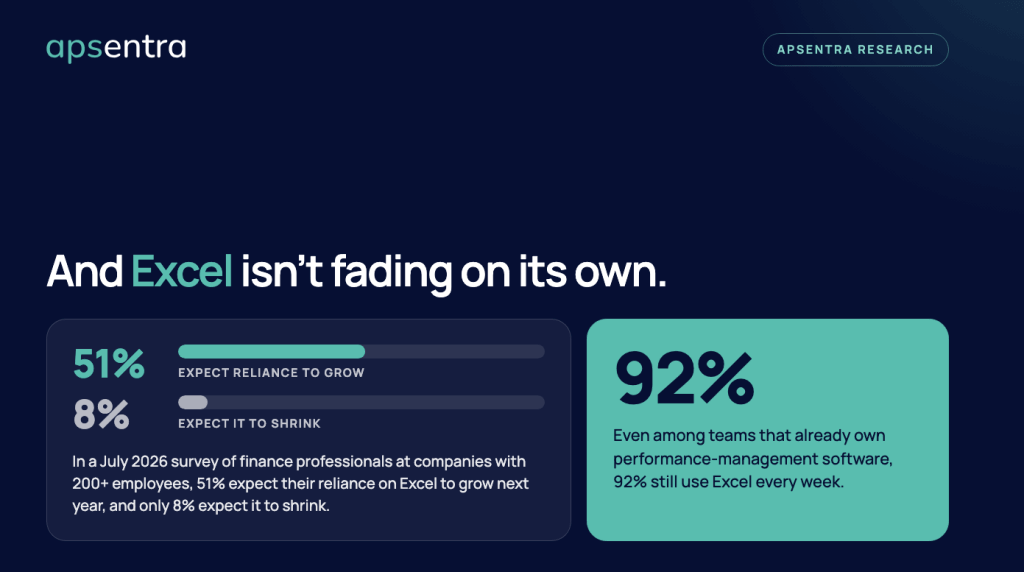
And Excel isn’t fading on its own.
In a July 2026 survey of finance professionals at companies with 200+ employees, 51% expect their reliance on Excel to grow next year, and only 8% expect it to shrink.
Even among teams that already own performance-management software, 92% still use Excel every week.
What does the 2026 research say it costs?
The playbook pulls together 30+ data points from 2025–2026 research.
Here are five of them:
- 29% of enterprise spend is still outside procurement’s control (Ardent Partners, 2025)
- 6-12% savings on each dollar brought under management (Ardent Partners, 2025)
- $9.40 vs. $2.78: the cost to process one invoice, average vs. best-in-class (Ardent Partners, 2025)
- 9.8% vs. 1.0%: procurement workload growth vs. headcount growth (The Hackett Group, 2025)
- 72 hours: the approval wait after which people buy around the process (Procurify, 2026)
The workload figure is the one most teams feel first. With workloads up 9.8% a year and headcount up just 1.0%, there’s an 8.9% efficiency gap that hiring can’t close. Digitally mature procurement teams run at 19% lower cost as a share of spend, with 31% fewer people and 58% shorter requisition-to-PO cycles (The Hackett Group, 2025).
Then there’s risk. Organizations lose an estimated 5% of revenue to occupational fraud each year, and the typical scheme runs 12 months before anyone notices (ACFE, 2026). Spreadsheets don’t cause fraud, but they make it easier to hide and slower to find.
The playbook includes the full research table with every source cited, free to quote in your own internal business case.
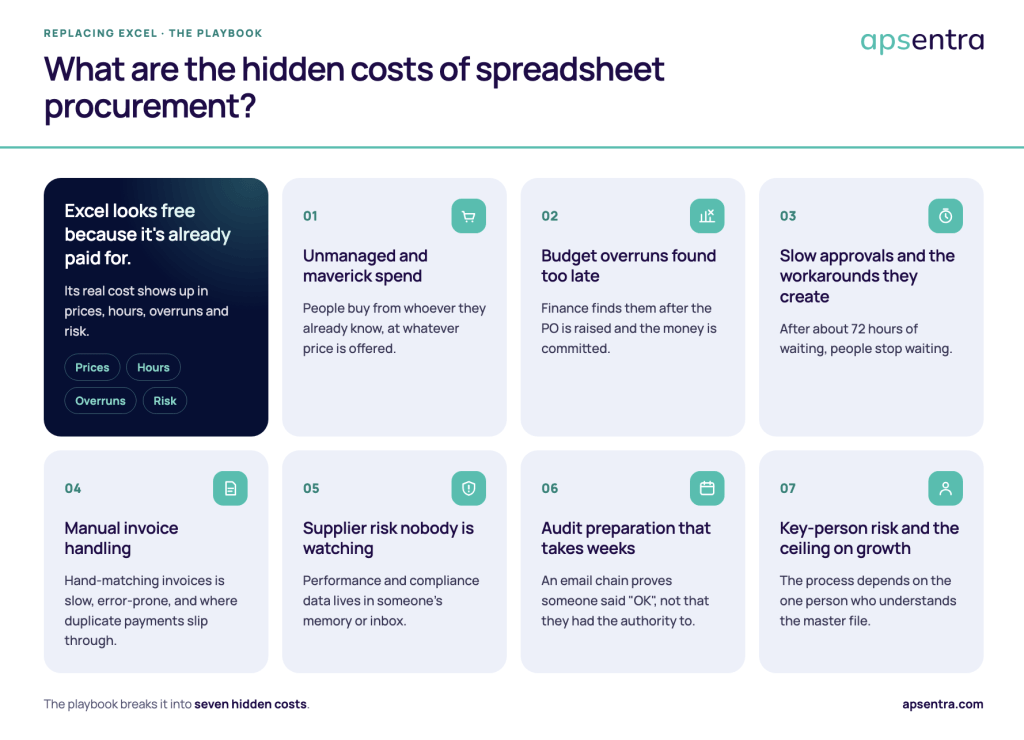
The playbook includes a worksheet that turns these lines into an estimate for your company. It’s deliberately conservative: it counts only what you can measure today.
How do you know it’s time to move off Excel?
There’s rarely one dramatic moment. The signals build up.
The playbook’s Spreadsheet Breaking-Point Scorecard turns them into a number you can take to leadership. It has 15 statements, scored 0–2, and takes about ten minutes.
Here’s a quick taste. How many of these are true for your team?
- Purchase requests arrive by email, chat, phone and in person, and someone re-types them into a sheet.
- Approvals are given by replying to an email or a chat message.
- Budget overruns are discovered after the PO is raised or the invoice arrives.
- The same person can request a purchase, choose the supplier and approve the order.
- The process depends on one or two people who “know the spreadsheet”.
If you nodded at three or more, take the full scorecard.
How do you build the business case for your CFO?
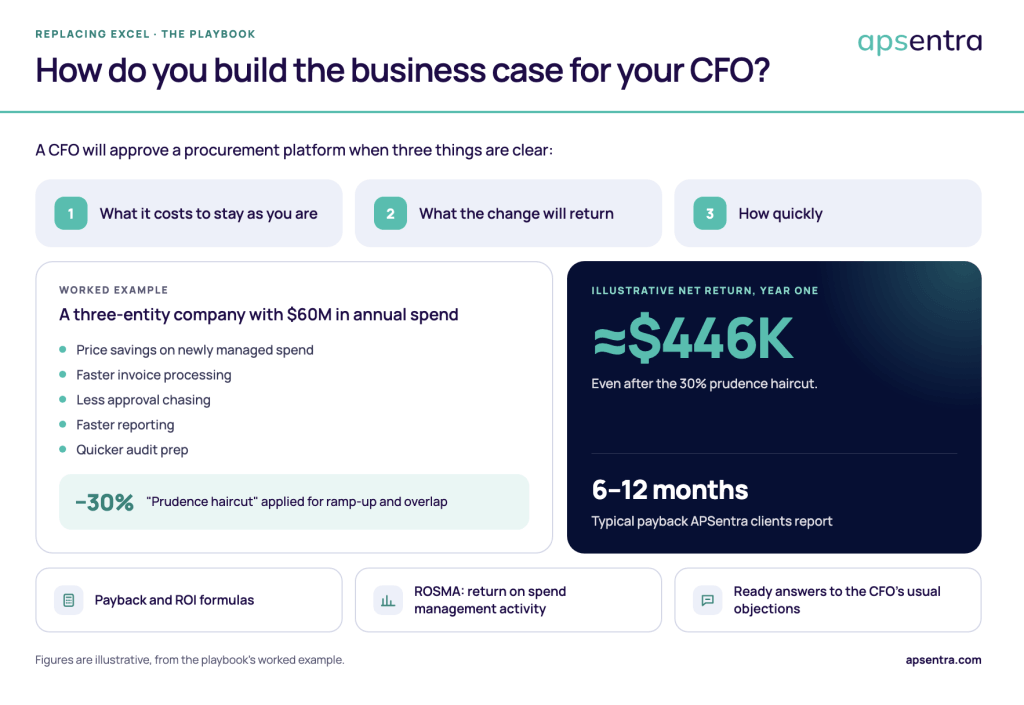
A CFO will approve a procurement platform when three things are clear: what it costs to stay as you are, what the change will return, and how quickly.
The playbook includes a worked example for a three-entity company with $60M in annual spend. It counts price savings on newly managed spend, faster invoice processing, less approval chasing, faster reporting and quicker audit prep. Then it applies a 30% “prudence haircut” for ramp-up and overlap. Even with that cut, the illustrative net return comes to about $446,000 in year one.
APSentra clients typically report payback within 6-12 months.
You also get the payback and ROI formulas, a second lens called ROSMA (return on spend management activity), and ready answers to the CFO’s usual objections.
What else is in the Playbook?
Beyond the chapters above, the 48-page playbook includes:
- Field notes from 10+ companies that moved off spreadsheets. One energy company cut approval time from 2–3 weeks to about 10 hours.
- What to replace and what to keep. This is not an anti-Excel book: Excel stays for analysis, and procurement workflows move to a system of record.
- Ten questions to ask any vendor before you sign.
- Adoption tactics for getting people to stop emailing purchase requests, plus a 30-60-90 day checklist.
- 12 KPIs to track after go-live, with independent benchmarks and a one-page monthly report layout.
- A toolkit with a starter approval matrix, a segregation-of-duties check, minimum fields for a purchase request form, and checklists for data migration and retiring the spreadsheet.
It’s written for procurement managers and heads of procurement at companies with roughly 200-2,000 employees, or any company buying across several entities, sites or regions. It’s equally useful for the CFO, controller or COO who has to sign off on the change.
Watch our Behind Procurement podcast