
Strategic Sourcing: Replace Fragmented Sourcing with Competitive Procurement | APSentra
Aps entra

Replace fragmented sourcing with competitive, data-driven procurement

When sourcing happens ad hoc — region by region, team by team, with no shared process or supplier data — you lose competitive leverage at every step.

The fragmented sourcing problem


Fragmented sourcing often goes unnoticed until you compare the numbers. Different entities may pay different prices for the same item or miss better rates secured elsewhere because sourcing decisions aren’t shared.

The problem isn’t poor decision-making — it’s a lack of shared data, consolidated volume, and competitive processes.

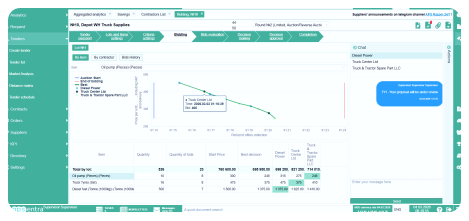
APSentra replaces ad-hoc sourcing with a structured, competitive process. RFQs, RFPs, and reverse auctions run in one platform, supplier responses are compared consistently, volume is consolidated, and every sourcing decision is documented.

200+
users on APSentra at one of Bunge European branches — one of the world’s largest agribusinesses — across full strategic sourcing workflows
25%
average cost reduction achieved through competitive tendering vs. direct award to incumbent supplier
16B
USD in verified savings generated across APSentra’s client portfolio through structured sourcing
8 weeks
typical time to activate APSentra’s sourcing module and run the first competitive tender
Aps entra Aps entra

What fragmented sourcing is costing you

Paying above-market rates with no competitive benchmark

Without a competitive tender, you have no way to know whether your current price is optimal. Supplier relationships — however valued — don’t create price pressure. Competition does.

Lost volume leverage from unconsolidated spend

When five entities are each buying independently in the same category, none of them has the volume to negotiate the rate that the group could achieve. The savings exist in the consolidation — but the structure to capture them doesn’t.

Supplier selection based on relationships, not performance

When there’s no structured evaluation, the incumbent wins by default — because switching has a cost and the competitive alternative isn’t visible. Over time, supplier performance drifts because there’s no mechanism to challenge it.

No shared supplier intelligence across teams or regions

Team A qualifies a supplier, negotiates a rate, and stores it in a personal spreadsheet. Team B qualifies the same supplier a year later with no knowledge of Team A’s work. The duplication of effort multiplies across a distributed organization.

Sourcing decisions without a documented rationale

When supplier selection is informal, the rationale isn’t recorded. Audit questions — why this supplier, at this price, vs. alternatives — can’t be answered. Compliance risk accumulates with every undocumented decision.

No category strategy or spend visibility across entities

Category management requires knowing what you’re spending, across whom, with which suppliers, at what price. Fragmented sourcing makes this picture impossible to assemble — which means category strategy stays theoretical.

What strategic sourcing looks like after APSentra

Ad-hoc, fragmented sourcing
  • Ad-hoc sourcing processes
  • Supplier selection based on relationships or convenience
  • Fragmented purchasing volumes
  • Scattered supplier data
  • Email-based RFP management
  • No market benchmarks
  • No documented sourcing rationale
  • Limited category management visibility
APSentra
  • Structured RFQ/RFP/auction processes
  • Standardized supplier evaluation criteria
  • Consolidated group sourcing volume
  • Centralized supplier database
  • Digital RFPs with automated scoring and comparison
  • Live market benchmarks from competitive tenders
  • Complete sourcing records and decision rationale
  • Category strategy based on group-level spend and supplier data

From fragmented sourcing to competitive advantage.
Aps entra Aps entra

The capabilities that make sourcing strategic

Competitive tendering: RFQ, RFP, and reverse auction

Run structured competitive processes — from simple price enquiries to complex multi-criteria RFPs — in a single platform. Suppliers respond in a structured format that enables direct comparison.

Centralised supplier database

All supplier information — qualification records, certifications, performance history, and contract data — lives in one place, visible to all procurement teams across all entities.

Spend analytics and category management

See what you’re spending in every category, with which suppliers, across all entities. Identify consolidation opportunities and category-level cost trends.

Sourcing decision record and audit trail

Every sourcing event — criteria, supplier responses, evaluation scores, and selection rationale — is logged automatically. The decision record is always available for audit or review.

Multi-entity sourcing coordination

Run category-level tenders that cover multiple entities simultaneously. Volume consolidates automatically. Local teams participate in the process without losing visibility into their own requirements.

Supplier qualification and risk assessment

Every supplier in the APSentra database has completed a standardized qualification process. Risk flags — financial, compliance, geographic — are visible before a supplier is awarded business.

What changes for your team

CPO / Category Managers

From reactive buying to strategic category management

Before
  • No spend visibility across entities for category planning
  • RFP process done by email, no standard evaluation
  • Supplier relationships managed individually
  • Savings hard to attribute or measure
After
  • Group-level spend visible by category and supplier
  • Structured competitive tendering as the default process
  • Centralised supplier database shared across teams
  • Savings tracked from competitive tender to contract
CFO / Finance

From assumed market rates to verified competitive pricing

Before
  • No way to benchmark whether current prices are competitive
  • Savings claims unverifiable without tender history
  • Budget planning based on historical spend, not market rates
  • Category cost trends unknown between annual reviews
After
  • Every tendered category benchmarked vs. market
  • Savings quantified from tender results vs. incumbent rate
  • Budget built on current market rates, not historical spend
  • Category cost trends visible continuously
Regional / Entity Procurement

From isolated sourcing to coordinated group buying

Before
  • Sourcing independently without knowledge of group agreements
  • Qualifying suppliers already qualified by other entities
  • No volume leverage — buying as a single entity
  • Policy unclear on when to tender vs. direct award
After
  • Access to group agreements and preferred supplier rates
  • Supplier qualifications shared across all entities
  • Participation in group tenders that consolidate volume
  • Clear policy on event type requirements by value and category
CEO / COO

From cost center to value driver

Before
  • Procurement savings theoretical — hard to measure
  • Category management dependent on individual knowledge
  • Supplier quality inconsistent across entities
  • Competitive advantage from procurement invisible
After
  • Procurement savings measured and attributed by category
  • Category management built on data, not individual knowledge
  • Supplier performance consistent and governed
  • Procurement a measurable source of competitive advantage

High-speed implementation

Go live in 8 weeks
Aps entra
Aps entra Aps entra
1 Week
Consulting
Review existing business processes, define goals, KPIs, and savings potential.
Aps entra
Aps entra Aps entra
3 Weeks
Implementation & Automation
Configure APSentra, launch workflows, and begin tracking key procurement KPIs.
Aps entra
Aps entra Aps entra
3 Weeks
Integration
Integrate APSentra with your ERP, accounting, and analytics systems to ensure seamless data flow.
Aps entra
Aps entra Aps entra
1 Week
Learning
Turn procurement into a growth lever through certified courses and practical use cases.
Aps entra
Aps entra Aps entra
Ongoing
Control & Optimization
Monitor performance, ensure processes run smoothly – optimize where needed.
Aps entra Aps entra

What APSentra customers achieve

Based on outcomes across 130+ enterprise clients, including one of Bunge European branches and other global organizations managing high-volume, multi-entity sourcing.
Aps entra
200+
Users at Scale
Active APSentra users at one of Bunge’s European branches — managing sourcing events across the full organization
Aps entra
25%
Cost Reduction
Average reduction in category cost achieved through competitive tendering vs. direct award to incumbent supplier
Aps entra
$16B
Verified Savings
In verified cost savings generated across APSentra’s global client portfolio through structured competitive sourcing
Aps entra Aps entra

Ready to replace fragmented sourcing with competitive, data-driven procurement?

APSentra standardizes your sourcing process, consolidates your supplier data, and gives you the competitive leverage your current approach doesn’t. See how it works.
Procurement Software for Modern Businesses | APSentra

FAQs

01.

What’s the difference between an RFQ, RFP, and reverse auction in APSentra?

APSentra supports all three event types, each suited to different sourcing situations. An RFQ (Request for Quotation) is used when you know exactly what you need and want competitive price quotes. An RFP (Request for Proposal) is used when you want suppliers to propose a solution, and evaluation is multi-criteria — including price, approach, team, and references. A reverse auction creates real-time competitive price pressure, with suppliers bidding in a live event.

APSentra lets you configure any of these event types with the appropriate template, evaluation criteria, and timeline. The choice of event type is made at the start of each sourcing event, and the platform guides the process from that point.

02.

How do suppliers participate in a tender on APSentra?

Suppliers are invited via email to participate in a sourcing event. They receive a link to the APSentra supplier portal, where they complete their response using a structured form. They don’t need to install anything or create a paid account.

The structured response format ensures that all supplier responses are directly comparable — eliminating the manual work of normalizing unstructured email responses into a comparison spreadsheet.

03.

Can APSentra run sourcing events that cover multiple entities or regions simultaneously?

Yes. APSentra supports multi-entity sourcing events where volume is consolidated across participating entities. Each entity defines its requirements; APSentra aggregates the full volume for the tender. Suppliers bid on the consolidated volume. Awards can be split by entity, product, or region after the event.

This is one of the primary mechanisms for capturing group-level savings: bringing together purchasing volumes that were previously fragmented and creating a competitive event around the consolidated requirement.

04.

How does APSentra support the supplier evaluation process?

APSentra uses a configurable scoring model. For each sourcing event, the procurement team defines the evaluation criteria (price, quality, delivery time, sustainability, financial stability, etc.) and their relative weighting. Supplier responses are scored against these criteria automatically — and the comparison view shows all suppliers ranked by total score.

For complex RFPs with qualitative criteria, evaluators can input scores directly in APSentra with supporting commentary. The full scoring record — criteria, weights, and individual scores — is preserved as part of the sourcing event record.

05.

What happens to the sourcing data after an event is complete?

The full sourcing event — including the criteria, all supplier responses, scoring, and the award decision with rationale — is stored in APSentra permanently. This creates an auditable record for every sourcing decision, which is available for internal review, compliance audit, or board scrutiny at any time.

Over time, this creates a library of market benchmarks by category: you can see what price you got in the last tender for a given category, how many suppliers competed, and what the winning bid was. This informs planning for the next sourcing cycle.

06.

How does APSentra help with supplier qualification before a tender?

APSentra maintains a supplier database where all approved suppliers have completed a standard qualification process — including document submission (insurance, certifications, financial statements), compliance checks, and procurement team review. Only qualified suppliers can be invited to participate in sourcing events.

For new suppliers identified during a sourcing process, APSentra initiates the qualification workflow before they can submit a final bid — ensuring that all competitive bids come from suppliers who have passed basic qualification criteria.

07.

How does APSentra handle categories where there are few competitive alternatives?

For sole-source or limited-competition categories, APSentra still provides structure and documentation — recording the rationale for direct award, the market research that was conducted, and the commercial terms agreed. This creates an audit trail even when a competitive event isn’t possible.

Over time, APSentra’s supplier database and category analytics help procurement teams identify new potential suppliers in categories that were previously sole-sourced — expanding the competitive universe over successive sourcing cycles.