Best Vendor Management Software in 2026
We also evaluated Coupa, SAP Ariba, Ivalua, and GEP SMART using verified G2, Capterra, and Gartner Peer Insights review data — all offer real vendor/supplier management functionality, but our research found each carries specific gaps (a documented, deteriorating supplier-side onboarding experience, enterprise-scale complexity, or module-level UX friction) that make it a weaker fit for a mid-market buyer than a purpose-built platform. Details below.
Why “vendor management” has outgrown the contact database
For years, vendor management software meant a structured place to store supplier contacts, contracts, and basic performance notes. That’s no longer sufficient. Gartner’s research on third-party risk describes a “perfect storm” of trade volatility, persistent cyberattacks, new regulatory requirements, and supply chain disruption that is rapidly advancing adoption of dedicated third-party risk management (TPRM) technology — and separately, Gartner has found that 62% of organizations still overly trust due diligence questionnaire answers, increasingly AI-generated, to inform risk decisions, rather than verifying them continuously.
The practical shift: vendor management in 2026 needs to answer not just “who is this supplier and what’s their contract,” but “how exposed are we to this supplier failing, and would we know before it happens.” That’s a different product category than a supplier contact list, even though both get marketed under “vendor management software.”
Editorial methodology: how we evaluated these platforms
We built this comparison from three sources:
(1) primary vendor documentation and product demos,
(2) an analysis of over 1,900 verified user reviews published on G2, Capterra, and Gartner Peer Insights between 2023 and 2026 covering Coupa, SAP Ariba, Ivalua, and GEP SMART, and
(3) our own product and implementation data for APSentra. We did not survey procurement leaders directly for this piece — where we reference “what users say,” it reflects patterns pulled from published, verified reviews, cited by vendor below.
Each platform was scored against: onboarding automation and time-to-value, third-party risk monitoring depth (financial, regulatory, cyber), supplier-side experience (since a vendor management tool’s data quality depends on suppliers actually using their portal), ESG/compliance tracking, and integration with sourcing, contracts, and spend data.
A note on objectivity: because APSentra is the publisher, we’ve deliberately anchored every claim about competitors in a citable, third-party source (G2, Capterra, Gartner Peer Insights, or a named analyst report) rather than our own characterization. Where we make a claim about APSentra itself, we’ve flagged it as vendor-reported rather than independently audited — and where our own materials didn’t include a quantified statistic, we’ve said so rather than inventing one.
Vendor management vs. supplier relationship management vs. TPRM
Vendor management is the broadest, most commonly searched term — typically covering onboarding, contact and contract records, and basic performance tracking. Supplier relationship management (SRM) implies a more strategic layer: performance scorecards, collaboration, and long-term partnership management, not just administrative records. Third-party risk management (TPRM) is narrower and specifically about continuously monitoring financial, regulatory, operational, and cybersecurity risk tied to external suppliers.
When you need all three vs. one: if your problem is purely administrative — you can’t find supplier contracts or contacts in one place — basic vendor management may be enough. If your problem is strategic — you want to actively manage supplier performance and diversify dependency risk — you need SRM capability. And if your exposure is regulatory or risk-driven — a supplier failure, breach, or compliance gap would materially hurt the business — you need TPRM specifically, which most basic “vendor management” tools do not provide in depth.
Signs your vendor management process needs software
- Supplier records live in spreadsheets, inboxes, or an individual buyer’s personal files — not a shared system.
- You can’t quickly answer “how concentrated is our spend with a single supplier or region?”
- Supplier onboarding takes weeks because documentation collection and validation are manual.
- A supplier’s financial distress or a regulatory change would surprise you, rather than being flagged in advance.
- ESG or diversity reporting requires manually assembling data from multiple sources each time it’s requested.
- Nobody can say with confidence how many active suppliers the company has, let alone their risk tier.
Must-have features in vendor management software for 2026
Onboarding and records
- Structured onboarding workflows with documentation validation and risk-based classification
- Contract linkage at onboarding, so supplier records connect to active agreements automatically
- Automated approval routing rather than manual document chasing
Risk management
- Continuous (not annual) third-party risk monitoring: financial health, regulatory exposure, compliance documentation
- Vendor concentration and geographic dependency analysis
- AI-assisted alerts for deteriorating supplier financial health or relevant regulatory change
Resilience and diversification
- Multi-tier supplier mapping beyond direct (tier-1) relationships
- Diversification and dependency risk tracking
- Supplier diversity program tracking with spend-by-segment reporting
Compliance and collaboration
- ESG documentation management and sustainability compliance tracking
- Performance scorecards and contract compliance monitoring
- A supplier-facing portal suppliers will actually use — this is a real differentiator; see the review data below on where it breaks down
Best vendor management software for 2026
1. APSentra — best overall for risk-aware vendor management
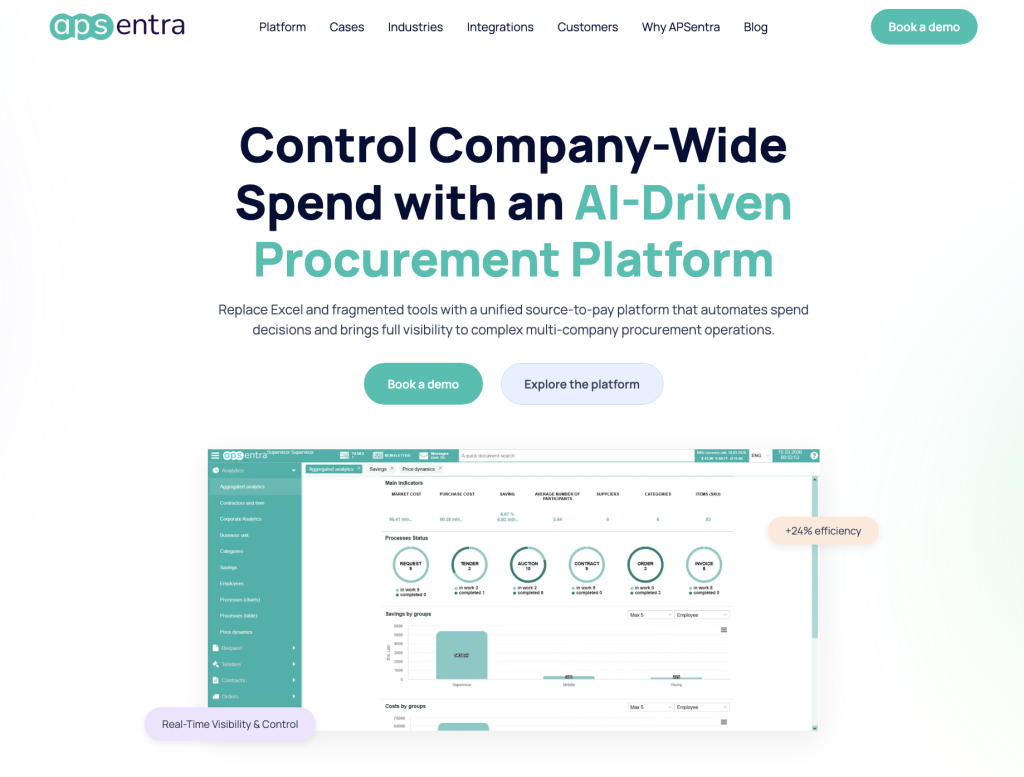
Best for: Procurement and risk teams that need continuous third-party risk visibility and supply chain resilience — not just a supplier contact database.
APSentra’s positioning treats supplier management as resilience orchestration rather than static record-keeping: geopolitical disruption, regulatory shifts, financial instability, cyber risk, and ESG scrutiny are treated as ongoing monitoring requirements, not annual review checkboxes.
Top features:
- Automated supplier onboarding with structured workflows, documentation validation, risk-based classification, and contract linkage at intake
- Continuous third-party risk management (TPRM): risk categorization frameworks, financial health monitoring, compliance documentation tracking, vendor concentration analysis, and regulatory exposure alerts
- Multi-tier supplier mapping with geographic concentration analysis and dependency risk monitoring with visibility beyond direct, tier-1 relationships
- ESG compliance tracking: documentation management, environmental compliance tracking, ethical sourcing validation, and diversity reporting dashboards
- Supplier diversity program tracking with spend-by-segment reporting and compliance documentation
- AI-assisted risk monitoring: alerts based on financial instability signals, regulatory change tracking, performance deviation detection, and global event-based disruption signals
- Performance scorecards and contract compliance monitoring framed around strategic partnership, not just vendor policing
On stated outcomes: APSentra’s own materials describe reduced third-party risk exposure, improved supply continuity, lower supplier concentration risk, faster onboarding cycles, enhanced ESG compliance reporting, and increased Spend Under Management as the expected outcomes of structured supplier management.
Unlike our PO, P2P, and spend management comparisons, APSentra’s supplier management materials don’t currently include a quantified percentage or dollar-figure stat block — we’re noting that explicitly rather than estimating one. For a directional benchmark, independent research cited below shows automated vendor onboarding solutions generally reducing onboarding time by 60-80%.
Best for: Mid-market and multi-entity organizations that need continuous, risk-aware supplier oversight, including ESG and TPRM — rather than a static supplier database.
Platforms we evaluated and why they didn’t top the list
We reviewed each of these using verified G2, Capterra, and Gartner Peer Insights data. All are legitimate, capable platforms with real vendor/supplier management functionality — several are Gartner Magic Quadrant leaders in adjacent categories — and may be the right choice depending on your scale. Here’s what the review data actually says about their vendor management fit specifically.
Coupa
Coupa’s platform includes supplier onboarding and management tied to its broader spend and procurement suite, and reviewers generally rate integrations and centralization positively. But the most striking finding in our review analysis specific to vendor management is what reviewers say about the supplier-side experience: vendors describe Coupa’s onboarding as repetitive and bureaucratic, requiring near-identical documentation submissions for every individual customer instance rather than a portable profile. Reviewers also describe paid “priority” placement offers within the supplier network as feeling like unfair monetization of a supplier’s dependency on a large buyer, and cite technical issues — lost or failed document uploads, unexplained errors — as a recurring, “massive” complaint pattern on supplier-facing forums.
Why it’s not our top vendor management pick: a vendor management system is only as good as the data suppliers actually provide, and the supplier-side experience is the most consistently negative pattern in Coupa’s entire review dataset — a structural risk for any buyer relying on supplier self-service data quality.
SAP Ariba
SAP Ariba’s core differentiator for vendor management is the Ariba Network itself — a large, pre-connected global supplier base that reviewers say meaningfully simplifies finding and onboarding new suppliers, with users describing Ariba as “the single place” for orders, invoices, delivery confirmation, and supplier relationship management. Integration with SAP ERP (especially S/4HANA) is also cited as a genuine advantage for centralized approval and compliance tracking.
The tradeoff, consistent with SAP Ariba’s broader review pattern: a steep learning curve, an interface reviewers describe as overloaded, and — specifically relevant to vendor management — small business and vendor reviewers report friction and cost in supplier registration, with smaller companies often onboarding onto Ariba not by choice but because a large customer requires it.
Why it’s not our top pick: the network effect is real, but reviewers frame the supplier registration experience as a burden for smaller vendors specifically — a meaningful consideration if your own supplier base skews toward smaller companies.
Ivalua
Ivalua’s supplier management functionality earns generally positive marks: reviewers describe easy supplier onboarding through a convenient portal, straightforward supplier addition without heavy customization, and performance monitoring that pulls together contract compliance and risk data to support data-driven risk management.
The tradeoff is consistent with Ivalua’s broader review pattern: average implementation time is reported around 9 months, and small and mid-sized companies specifically describe the platform as enterprise-oriented, with some reviewers noting that “such a clean, quality product isn’t accessible for smaller companies,” wishing for a leaner or more affordable version.
Why it’s not our top pick: genuinely solid onboarding and performance-monitoring capability, but a 9-month implementation and enterprise-oriented licensing are a heavy lift if vendor management is your primary near-term need.
GEP SMART
GEP SMART’s supplier management module is one of the more consistently well-reviewed parts of the platform: reviewers specifically cite strong onboarding processes, a collaboration portal for supplier engagement, comprehensive risk and compliance monitoring, centralized supplier profiles, and detailed KPI/scorecard tracking. The review data explicitly flags this as an area of strength, distinct from some of the platform’s more criticized modules.
The one gap reviewers call out directly: an “adoption gap” on the supplier side — supplier-facing UX needs improvement even where the buyer-side experience is strong, meaning the same “will suppliers actually use this” risk shows up here too, just less severely than with Coupa.
Why it’s not our top pick: among the strongest-reviewed modules in this comparison, but the platform’s broader enterprise complexity and cost (reviewers describe small/mid-market fit as “overkill”) apply here just as they do to GEP SMART’s other modules.
Other vendor management options worth knowing
A few additional platforms come up often in vendor management and TPRM searches, particularly specialized third-party risk platforms rather than full source-to-pay suites — names like Graphite Connect, Prevalent, and OneTrust (for TPRM/vendor risk specifically) are established in this narrower category.
We haven’t run the same depth of independent review analysis on these as we have on the four platforms above, so treat this as a starting point for your own research: dedicated TPRM specialists are often strong on risk scoring and continuous monitoring specifically, but typically require separate integration to connect vendor risk data back to sourcing, contracts, and spend — the closed-loop connection this article treats as a core evaluation criterion.
Feature comparison table
| Platform | Continuous TPRM monitoring | Multi-tier supply chain mapping | ESG/diversity tracking | Supplier-side UX (per reviews) | Reported implementation time |
|---|---|---|---|---|---|
| APSentra | Yes | Yes | Yes | Positive — easy onboarding, portal-based | Up to 8 weeks (vendor-reported, platform-wide) |
| Coupa | Basic | Not a highlighted feature in reviews | Not a highlighted feature in reviews | Consistently negative — repetitive onboarding, pay-to-play complaints, upload failures | Not consistently reported |
| SAP Ariba | Basic | Not a highlighted feature in reviews | Not a highlighted feature in reviews | Mixed — large network but registration burden flagged for smaller vendors | ~6 months (review-reported average) |
| Ivalua | Yes | Not a highlighted feature in reviews | Not a highlighted feature in reviews | Positive — easy onboarding, portal-based | ~9 months (review-reported average) |
| GEP SMART | Yes, review-praised | Not a highlighted feature in reviews | Not a highlighted feature in reviews | Adoption gap flagged specifically for suppliers | Long; not consistently disclosed |
Vendor management software pricing
Pricing for full vendor/supplier management platforms is largely quote-based, scoped to supplier count, entity count, and modules — self-serve pricing is uncommon once TPRM and ESG tracking are included.
| Vendor | Starting price (as publicly reported) |
|---|---|
| APSentra | CCustom quote (scoped to entity count and modules) |
| Coupa | Custom quote |
| SAP Ariba | Custom quote; enterprise licensing plus network/transaction fees |
| Ivalua | Custom quote; reviewers describe the licensing model as difficult to estimate upfront |
| GEP SMART | Custom quote; enterprise-scoped |
| Dedicated TPRM specialists (Graphite Connect, Prevalent, OneTrust and similar) | Published tiered pricing available on some vendor sites; typically scoped to supplier/vendor count monitored |
People searching “how much does vendor management software cost” should expect: dedicated onboarding/risk-only tools sometimes publish tiered pricing; full vendor management platforms tied to a broader source-to-pay suite (Coupa, SAP Ariba, Ivalua, GEP SMART, APSentra) are custom-quoted and scoped around supplier volume and entity count.
Common vendor management implementation mistakes
Independent reviews of every platform in this comparison point to the same handful of rollout failures:
- Optimizing the buyer experience while ignoring the supplier experience. Coupa’s review data is the clearest cautionary example: a vendor management system’s data quality depends on suppliers actually completing onboarding and keeping records current — if that experience is bureaucratic or unreliable, the buyer-side data degrades regardless of how good the internal dashboards look.
- Treating TPRM as an annual review instead of continuous monitoring. Gartner’s finding that 62% of organizations over-trust static due diligence questionnaire answers is a direct warning here — risk changes between review cycles, and a system that only checks in annually misses it.
- Scoping onboarding automation without documentation validation. Automated workflows that don’t verify tax IDs, addresses, and compliance documents against official sources miss the majority of the error-reduction benefit — Gartner research on automated onboarding found data entry error reductions of roughly 50% specifically tied to validation, not just digitization.
- No plan for multi-tier visibility. Direct (tier-1) supplier management is necessary but not sufficient — dependency risk often sits with tier-2 and tier-3 suppliers that never show up in a basic vendor database.
- Bolting risk data on after the fact instead of connecting it to sourcing and spend decisions. Risk information that doesn’t inform sourcing decisions or spend allocation is a report nobody acts on, not a management system.
Vendor management trends for 2026
- TPRM technology adoption is accelerating due to compounding pressure. Gartner describes a “perfect storm” of trade volatility, cyberattacks, new regulatory requirements, and supply chain disruption driving rapid growth and maturity in third-party risk management technology specifically.
- Autonomous resolution of supply chain disruption is on the horizon. Gartner predicts 60% of supply chain disruptions will be resolved without human intervention by 2031, as AI-enabled monitoring and response mature.
- Over-reliance on static due diligence is a known, named risk. Gartner’s finding that 62% of organizations over-trust (increasingly AI-generated) due diligence questionnaire answers is prompting a shift toward continuous, data-driven risk verification rather than point-in-time attestations.
- Onboarding automation delivers large, well-documented time savings. Independent benchmarks show automated vendor onboarding reducing time by 60–80% through digital portals, automated document validation, and integrated compliance screening, with some implementations reporting up to 90% reduction when validating tax IDs and addresses against official databases specifically.
- ESG and supplier diversity reporting is shifting from ad hoc to structured. As regulatory and customer expectations rise, the ability to generate reportable ESG and diversity data automatically — rather than assembling it manually for each request — is becoming a standard evaluation criterion rather than a nice-to-have.
Estimating the ROI of vendor management software
This is a simplified, illustrative framework — not a case study — meant to help you build your own estimate using your organization’s actual onboarding volume:
If your team onboards 100 new suppliers a year and manual onboarding (document collection, validation, approval routing) currently takes an average of 8 hours of staff time per supplier, that’s roughly 800 hours a year tied up in a process automated onboarding is designed to compress.
Using the independently reported benchmark of 60–80% time reduction from automated onboarding, that implies a potential savings of 480–640 hours a year — at a fully loaded cost of $40/hour, roughly $19,000–$26,000/year in labor time alone, before accounting for the harder-to-quantify cost of a risk event that continuous monitoring catches earlier than an annual review would have.
Run this math with your own onboarding volume and average handling time; the result will vary significantly based on supplier count, risk-tier complexity, and how much of the current process is already digitized.
Vendor management software buyer’s checklist
Use this as a working checklist when scoping vendors — including APSentra:
- Automated onboarding with documentation validation, not just digital forms
- Continuous (not annual) third-party risk monitoring covering financial, regulatory, and cyber exposure
- Multi-tier supplier mapping beyond direct, tier-1 relationships
- ESG and supplier diversity tracking with reportable data, not manual spreadsheet assembly
- A supplier-facing portal you’d actually test from the supplier’s perspective, not just the buyer’s
- Vendor concentration and geographic dependency analysis
- Native integration with sourcing, contracts, and spend data
- AI-assisted alerts for deteriorating supplier financial health or relevant regulatory change
- Named implementation support and a realistic go-live timeline in writing
- Reference customers at your approximate supplier count and industry — ask specifically about supplier-side adoption, not just buyer-side satisfaction
How to choose the right vendor management platform

Evaluate the supplier-side experience directly, not just the buyer dashboard

Decide how deep your TPRM needs actually go

Check whether risk data actually connects to sourcing and spend decisions

Scope multi-tier visibility if dependency risk matters to your business
Sources and methodology transparency
Competitor data in this article is drawn from verified reviews on G2, Capterra, and Gartner Peer Insights (2023–2026) and third-party industry research, including Gartner’s reporting on third-party risk management technology adoption, due diligence over-reliance (62% statistic), and supply chain disruption automation predictions, plus independent benchmarks on automated supplier onboarding time reduction.
Editorial policy: Vendors cannot pay for inclusion or ranking in this article. Platforms are included because they meet our evaluation criteria for the vendor management category, and every claim about a third-party product is tied to a citable source rather than our own characterization.