Pharmaceutical Procurement Consulting: How Pharma Companies Can Optimize Procurement and Reduce Supply Chain Risks
Procurement in a pharmaceutical company is never just “buying things for less.” Every sourcing decision has to hold up against four demands at once: regulatory compliance, supplier reliability, product quality, and cost. A cheaper active pharmaceutical ingredient (API) supplier that raises deviation risk, adds validation work, or increases shortage exposure isn’t a saving — it’s a liability with a discount attached.
That tension is exactly why pharmaceutical procurement consulting exists as a distinct discipline, separate from generic sourcing advice. And it’s why so many pharmaceutical companies still run procurement on spreadsheets, email approval chains, and disconnected supplier files: the stakes of getting it wrong are high, so many organizations default to the process they already trust, even when it can no longer keep up with the volume and complexity of modern supply chains.
This article looks at what pharmaceutical procurement consulting actually covers, why pharmaceutical companies increasingly need it, and — just as importantly — what happens after the consulting engagement ends, when strategy has to turn into a system that runs the business every day.
What Is Pharmaceutical Procurement Consulting?
Pharmaceutical procurement consulting is advisory work focused on how a pharmaceutical or biotech company sources, contracts, and manages the goods and services it depends on — from active ingredients and packaging to contract manufacturing capacity, clinical trial services, and indirect spend like IT, MRO, and professional services. For the provider side of the sector, see our guide to healthcare procurement consulting.
Boston Consulting Group frames this as a genuine transformation opportunity: companies that move early and scale a procurement transformation stand to gain a real, lasting edge in both cost and risk management.[1]
At a baseline level, this typically includes:
- Spend analysis — building a clean, categorized view of what the organization actually buys, from whom, and at what price.
- Supplier evaluation — assessing suppliers on quality history, financial stability, capacity, and regulatory standing, not price alone.
- Sourcing strategy — deciding how each category should be approached: competitive bidding, negotiation, dual-sourcing, or specification redesign.
- Procurement governance — defining who can buy what, at what threshold, and with what approval trail.
- Risk management — mapping single-source dependencies, geographic concentration, and geopolitical exposure across the supply base.
It’s worth separating two versions of this work that often get bundled under the same label.
- Traditional procurement consulting produces a strategy, a set of recommendations, and a savings target — and largely stops there.
- Modern procurement transformation consulting goes further: it pairs the strategy with process redesign, technology implementation, and the analytics needed to sustain results after the consultants leave. The difference matters, because it’s the second category — not the first — that tends to produce savings that survive past the first year.
Why Pharmaceutical Companies Need Procurement Consulting

1. Complex, high-risk supplier ecosystems
Pharma companies depend on a layered supplier base: API and excipient manufacturers, packaging suppliers, logistics and cold-chain providers, and contract manufacturers (CMOs/CDMOs). In small-molecule and generic manufacturing, API sourcing alone commonly accounts for 50% to 52% of total manufacturing cost of goods sold, according to industry analysis from DrugPatentWatch, which means volatility in that single category can move overall product margins directly.[2]
Qualifying an alternative API supplier or CDMO isn’t a quick switch — it typically requires technical validation, bioequivalence testing, and regulatory filings that can take one to three years to complete, which locks companies into supplier relationships far longer than in most other industries.
Recent geopolitical developments have made this concentration risk more visible. In one documented case, Clarkston Consulting worked with a biotech company that relied on a China-based contract manufacturer for a critical raw material; facing potential BIOSECURE Act restrictions and rising demand, the client had to build a short-, mid-, and long-term plan to forward-buy safety stock and qualify non-China-based manufacturers before disruption hit its commercial supply.[3] Whatever the exact regulatory shape a company is navigating, the underlying lesson is the same: supplier concentration that looked efficient in a stable environment becomes a serious operational exposure the moment the environment shifts.
2. Regulatory compliance requirements
Pharmaceutical purchasing has to be traceable and audit-ready by default, not by exception. Direct-spend categories carry heavy regulatory linkage — Drug Master Files, Certificates of Suitability, GMP standards, change-control obligations — and any supplier change can trigger a documentation and re-qualification cycle. When procurement runs on email threads and spreadsheets, the gaps show up exactly where they’re most costly: missing approval history, inconsistent supplier documentation, and audit preparation that turns into weeks of manual reconstruction rather than a report that already exists.
3. Lack of spend visibility
A recurring finding across procurement diagnostics is that companies simply don’t know their own spend well enough to manage it. Total spend by supplier, duplicate vendor records, price variance for the same material across sites, and purchasing that never passes through central procurement (commonly called tail spend or maverick spend) tend to stay invisible until someone builds a clean, reconciled spend cube from purchase orders, invoices, contracts, and ERP material masters. BCG identifies gaining a real-time view of spending as the essential starting point for any pharma procurement transformation, alongside clarifying budget accountability and aligning purchasing with production planning.[1]
Without that baseline, “savings” reported after a sourcing initiative are often just duplicate suppliers or unit inconsistencies canceling out — not real reductions.
Indirect spend is a particular blind spot. It typically represents 15% to 40% of total enterprise expenditure, and in many organizations the five largest indirect vendors absorb well over half of that total — a concentration that’s usually invisible until someone maps it deliberately.
4. Pressure to cut costs without compromising quality
Cost reduction in pharma procurement can’t mean “cheapest supplier wins.” The right framework is total cost of ownership, not purchase price: a CDMO quote that looks 10% cheaper can easily cost more once tech-transfer expenses, batch failure risk, release delays, minimum order quantities, and change-order fees are counted. Consulting engagements exist precisely to build that risk-adjusted view, so cost decisions don’t quietly create quality or continuity problems downstream.
Key Areas Covered by Pharmaceutical Procurement Consulting
Spend analysis and procurement diagnostics
Categorizing spend, identifying supplier consolidation opportunities, and prioritizing categories by addressable spend, price dispersion, demand-aggregation potential, and how complex a change would be to implement. The categories with the most savings potential and the least regulatory friction — packaging, MRO, logistics, professional services — are usually the right place to start, since they don’t require the multi-year re-validation that API or excipient changes can trigger.
Supplier management and risk assessment
This goes beyond a one-time qualification. It means maintaining a risk profile for every critical supplier — single-source status, site and country concentration, financial health, capacity headroom, quality signals, and recovery time if something goes wrong — and reviewing it on a cadence, not just when a problem surfaces.
Strategic sourcing and negotiation
Running structured RFP/RFQ processes, building should-cost models for materials and CDMO services, and negotiating contract structures — volume bands, indexed pricing, capacity reservation terms, IP protections — that hold up over multi-year relationships rather than a single purchase cycle.
Procurement process automation
This is where consulting recommendations either become permanent or quietly decay. A category strategy that lives in a slide deck and an approval process that still runs through email will drift back toward the old baseline within a year or two. This is also the point where consulting work and procurement technology need to connect directly.
From Procurement Consulting to Digital Procurement Transformation
Here’s the pattern that shows up repeatedly in pharma procurement transformation projects: they don’t fail because the strategy was wrong. They fail because there was no system to run the new process day to day.
A consulting engagement can correctly identify that a company needs supplier consolidation, standardized approval thresholds, and better spend visibility. But if the only output is a report, someone still has to manually enforce every one of those recommendations — indefinitely, against the same organizational habits that created the fragmentation in the first place. Within a few quarters, tail spend creeps back up, exceptions to the new approval thresholds become routine, and the “clean” supplier list starts accumulating duplicates again, because nothing in the day-to-day workflow makes the old, easier path harder to take.
Sustainable procurement transformation needs four things running continuously, not just recommended once:

- Centralized procurement workflows that route every purchase through the same process, regardless of site or business unit.
- Approval automation that enforces thresholds by policy, not by whoever happens to be reviewing a request that day.
- A single supplier database instead of parallel spreadsheets maintained by different teams.
- Contract visibility and spend analytics that make the savings-control system self-monitoring, rather than dependent on a quarterly manual reconciliation.
This is the layer where strategy becomes operational — and it’s typically the layer that gets underinvested in relative to the strategy phase itself.
How Procurement Software Supports Pharma Procurement Strategy

Consulting defines what needs to change. Software is what makes the change durable at scale, across multiple entities, sites, and years — without requiring a permanent team of external advisors to keep enforcing it.
Platforms such as APSentra are built for exactly this handoff point: turning a procurement strategy into a centralized operating system for sourcing, purchasing, contracts, suppliers, and analytics, so the improvements a consulting engagement identifies don’t depend on manual follow-through to survive.
A few capability areas matter most for pharmaceutical and other capital-intensive, multi-entity organizations:
Spend visibility
A real-time, structured view of where money goes — by category, supplier, site, and business unit — replaces the reconciliation exercise that normally has to be rebuilt from scratch every time someone asks “what did we actually spend on X last year?”
Approval workflows
Purchasing decisions run through standardized, policy-based approval chains instead of informal or inconsistent sign-off, which directly reduces uncontrolled (“maverick”) buying and gives every transaction a complete audit trail — a meaningful advantage in an industry where audit readiness is not optional.
Supplier management
Supplier information, qualification status, and performance history live in one governed system instead of scattered files, which is what actually makes tiered supplier governance (executive oversight for top-tier suppliers, standardized scorecards for the rest) operationally realistic rather than aspirational.
Source-to-pay automation
Connecting sourcing, purchasing, contracts, and payment into one workflow closes the gap where value most commonly leaks — between what a negotiated contract says and what actually gets purchased and paid for.
For pharmaceutical companies specifically, this kind of centralized architecture also supports the compliance side directly:
- automated policy enforcement,
- full transaction audit trails,
- and real-time compliance dashboards align with the same GxP-driven documentation standards that make pharma procurement more demanding than procurement in most other industries.
And because platforms like APSentra are designed to integrate at the process level with existing ERP systems (SAP, Microsoft, Oracle, and others) rather than sit alongside them as a disconnected tool, they extend governance across a company’s existing infrastructure instead of asking teams to abandon it.
Pharma Procurement Consulting + Procurement Technology: A Better Transformation Model
The two disciplines work best in sequence, feeding into each other rather than operating as separate projects:
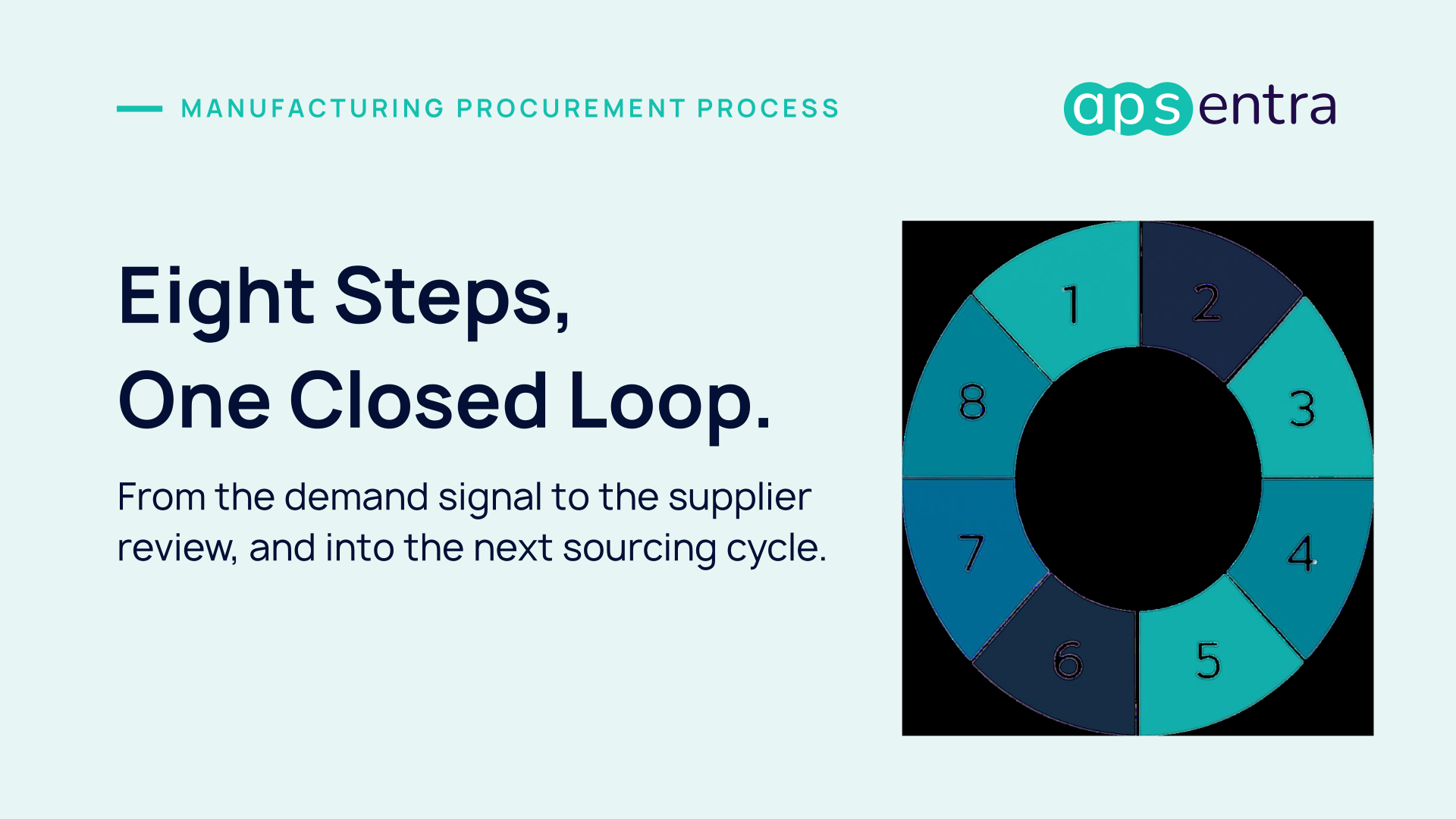
- Assessment — Consultants analyze current procurement processes, spend patterns, and supplier risk to establish the real baseline.
- Strategy — Sourcing priorities, governance rules, and savings targets are defined by category, with quality and supply continuity treated as non-negotiable gates.
- Digital implementation — A procurement platform operationalizes the strategy: workflows, approval rules, supplier data, and analytics are configured to enforce what the strategy defined, rather than relying on manual compliance.
- Continuous optimization — KPIs are monitored on an ongoing basis, category strategies are revisited, and the savings-control system flags drift before it becomes a pattern.
This is a meaningfully different model from a one-time consulting engagement with a report as its final deliverable. It treats procurement transformation as an operating capability the organization owns going forward, not a project that concludes when the consultants leave.
Key KPIs to Measure Procurement Transformation Success
| KPI | Why It Matters |
|---|---|
| Spend under management | Shows how much of total spend is actually governed by procurement, versus happening outside central oversight |
| Hard cost savings % | Direct, bottom-line savings against an audited baseline — the metric most tied to P&L impact |
| Procurement cycle time | Faster sourcing-to-purchase cycles reduce operational friction and improve supplier relationships |
| Supplier consolidation / concentration | Fewer, better-managed suppliers generally means more negotiating leverage and lower risk exposure |
| Contract compliance | Measures whether actual purchasing follows negotiated contract terms — a common source of quiet value leakage |
| Maverick / tail spend reduction | Tracks unmanaged purchasing outside preferred suppliers and approved processes |
| Supplier OTIF (on-time, in-full) rate | Protects against manufacturing downtime and clinical batch stock-outs caused by supplier failure |
| GMP vendor audit / defect rate | Directly tied to regulatory compliance and avoiding health authority findings |
Reviewing these at category level monthly, and at executive level quarterly, is what keeps a transformation program from quietly reverting to the pre-project baseline — the same failure mode that undermines strategy-only consulting engagements.
How to Choose a Pharmaceutical Procurement Consulting Partner
A short checklist worth applying to any prospective consulting partner:

- Experience with regulated industries — do they understand GMP, DMF/CEP requirements, and the qualification timelines specific to pharma, or are they applying a generic industrial procurement playbook?
- Technology fluency — can they recommend and help implement the systems needed to sustain their own recommendations, or does the engagement end at a strategy document?
- Supplier management approach — do they propose a tiered, risk-based governance model, or a flat, one-size-fits-all supplier process?
- Measurable outcomes — are savings targets defined against an audited baseline with a clear savings-control waterfall, or left vague enough to be unfalsifiable?
- Implementation support — will they stay engaged through the operational rollout, or hand off a plan and step away at the hardest part of the work?
The last point is usually the one that determines whether a procurement transformation actually changes how the organization operates a year later.
Conclusion
Pharmaceutical procurement consulting is valuable precisely because pharma sourcing carries constraints that generic procurement advice doesn’t account for: regulatory linkage, long qualification timelines, and quality requirements that can’t be traded away for a lower unit price. A good pharmaceutical procurement consulting engagement builds the fact base, sets category strategy, and defines governance rules that reflect those constraints.
But strategy alone doesn’t sustain itself. The organizations that see procurement improvements hold — rather than fade after the engagement ends — are the ones that pair consulting with a system built to run the new process every day: centralized workflows, enforced approvals, governed supplier data, and analytics that make drift visible before it becomes a pattern.
APSentra helps pharmaceutical and other capital-intensive, multi-company organizations move from fragmented, spreadsheet-driven purchasing to structured, data-driven procurement operations — with centralized sourcing, supplier management, approval automation, and spend visibility built to hold a strategy in place long after the consulting phase is over.