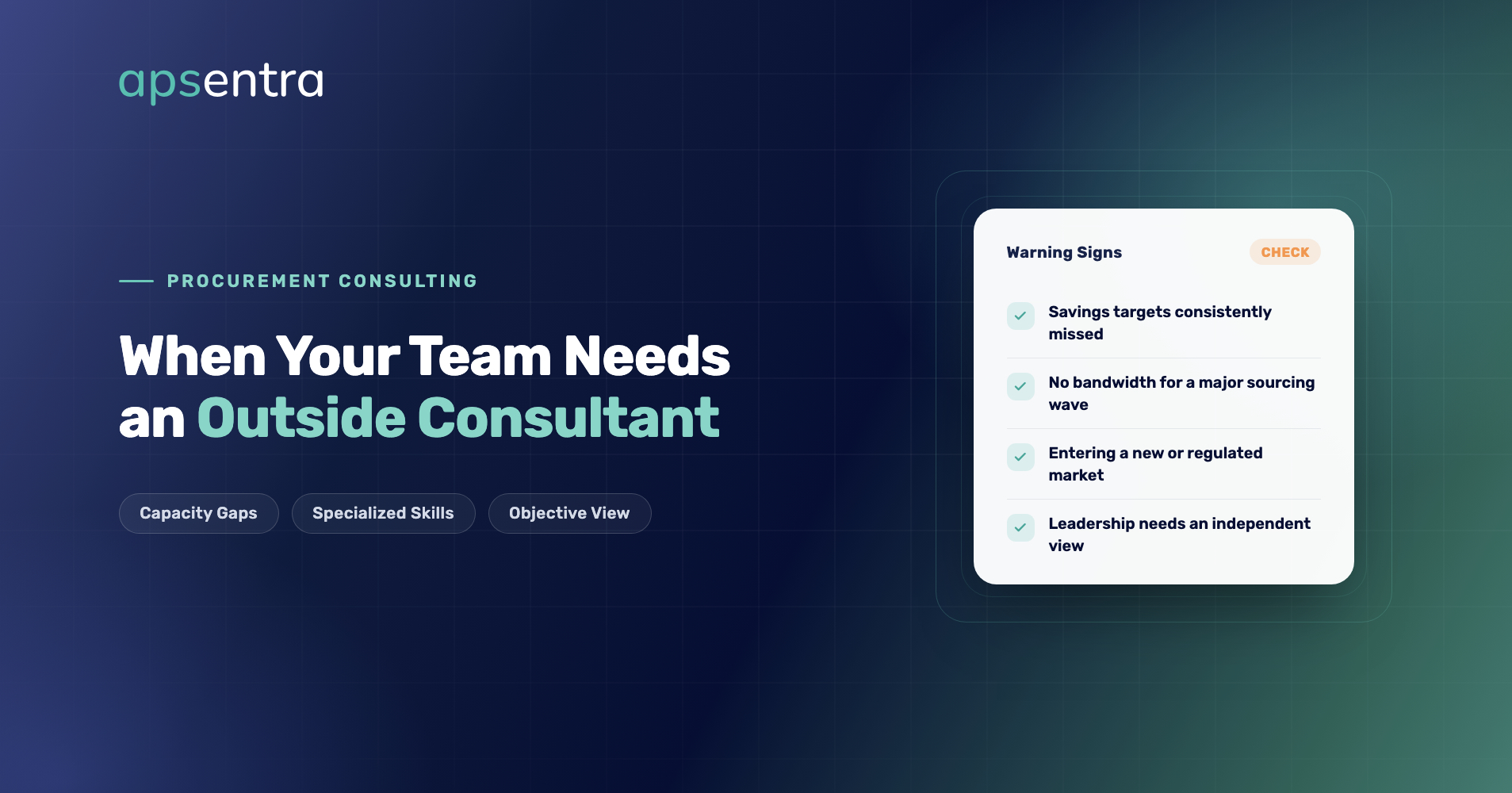
When Your Procurement Team Needs an Outside Consultant — and When You Just Need a Better System
Getting this wrong is expensive in both directions. Hire a strategy consultancy to fix what’s really a data and tooling gap, and you end up with a polished operating-model deck that nobody can execute, because there’s still no system to enforce it. Buy an expensive procurement platform to fix what’s really a strategy and governance gap, and you end up with expensive shelfware — a system nobody configured correctly because the underlying category strategy and operating model were never actually designed. This article is a practical framework for telling the two problems apart before you spend the budget.
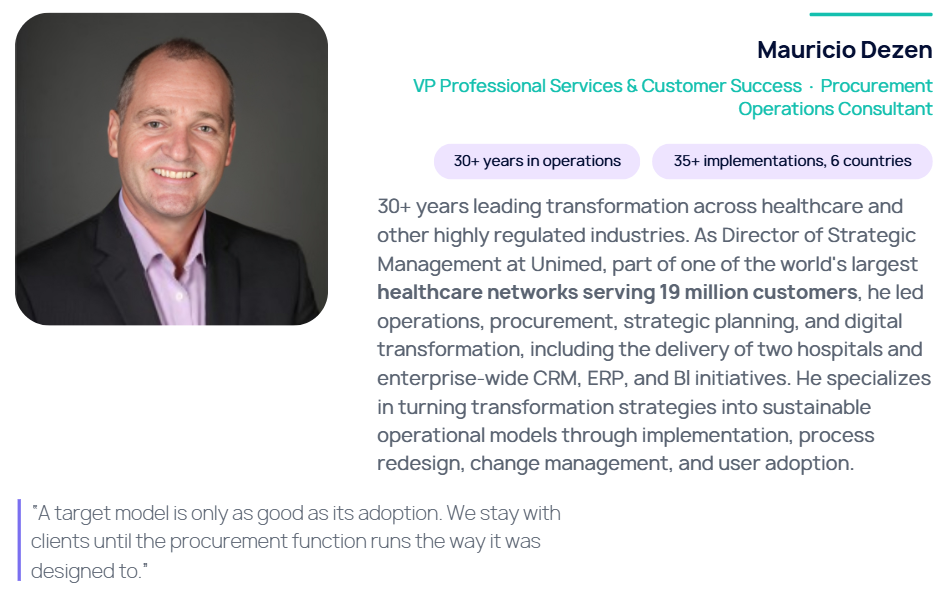
“Software solves enforcement and visibility problems. Consulting solves design and change problems. Most procurement pain sits at the intersection of both — but the dominant symptom usually points fairly clearly toward one side or the other.”
— Mauricio Dezen, VP Professional Services & Customer Success, APSentra
At a Glance
| If this is what you see… | …it usually means | Start here |
|---|---|---|
| Policies exist but nobody follows them; spend is invisible | Enforcement & visibility gap | A procurement platform |
| Policies conflict across units; new regulatory or ESG demands; past rollouts didn’t stick | Design & expertise gap | A consulting diagnostic |
| Some of both — common past a certain size and complexity | Sequencing problem, not an either/or | Platform first, then coordinated consulting |
The Question Most Teams Ask Wrong
The instinctive question is usually “do we need help?” That’s almost always yes — the more useful question is what kind of help. Consulting and software solve fundamentally different classes of problem:
- Software solves enforcement and visibility problems. It makes the rules you already have actually happen automatically, and it shows you what’s really going on in your spend data in real time.
- Consulting solves design and change problems. It figures out what the rules should be in the first place, adapts them to your specific industry and regulatory context, and gets skeptical humans to actually adopt a new way of working.
Most procurement pain sits at the intersection of both — but the dominant symptom usually points fairly clearly toward one side or the other, if you know what to look for. And the scale of the problem is real: research from CIPS found that maverick, off-contract buying can account for up to 80% of all invoices even at large organizations with a dedicated procurement function1, while Gartner research on software spend shows organizations typically have visibility into only about 40% of the applications actually in use across the business2.
Signal Check: When a Better System Solves It
These signals suggest your core problem is enforcement and visibility, not strategy — which means a platform, not a consulting engagement, is likely to move the needle fastest:
- Your policies are fine on paper, but nobody follows them because there’s no system routing purchases through the approved channel — people default to email and informal requests because that’s genuinely the path of least resistance.
- Spend data is scattered across spreadsheets, disconnected point tools, and individual inboxes, so nobody can answer a simple question like “how much are we really spending with this vendor across every business unit?”
- Sourcing cycles are slow primarily because RFx events are built manually in spreadsheets and email threads, not because your sourcing strategy itself is flawed.
- Approval workflows exist, but they’re manual and easy to route around, so requests routinely bypass the people who are supposed to sign off on them.
- You can’t see budget-versus-actual in real time — overspending gets caught in a monthly reconciliation instead of being flagged before the purchase happens.
If most of these sound familiar, the highest-leverage move is usually a platform that gives you real-time visibility and automatic enforcement — not a strategy engagement to redesign policies that are already reasonable but simply unenforced.
Signal Check: When You Need Outside Expertise
These signals point the other way — toward a genuine gap in strategy, structure, or specialized knowledge that a system alone can’t close:
- Policies and workflows differ wildly across business units or regions, with no shared target operating model tying them together — a tool can enforce a policy, but it can’t decide what the policy should be or reconcile conflicting ones across the business.
- You’re entering a new regulatory environment — a new country, a new industry vertical with its own compliance regime, or a newly acquired business that needs to be integrated into your procurement function.
- You’re being asked to report on ESG or Scope 3 metrics that procurement currently has no methodology to measure, let alone act on.
- Your sourcing approach is purely reactive — contracts get renegotiated when they expire, not as part of a deliberate, prioritized category strategy.
- You’ve tried to roll out new processes before, and they didn’t stick — this is usually a change-management and adoption problem, and no amount of additional software configuration fixes a trust or communication gap with the people who are supposed to use it.
- Leadership wants a structural transformation — a redesigned operating model, a new sourcing strategy, a supplier risk program — and nobody internally has actually designed one of these before.
If most of these sound familiar, you have a genuine design and expertise gap. A platform alone won’t tell you what your category strategy should be, how to structure a hybrid hub-and-spoke operating model for your specific business, or how to navigate industry-specific compliance you’ve never dealt with before.
Diagnose Your Situation at a Glance
The two signal checks above map to specific root causes and first moves. Use this table as a quick-reference summary:
| Symptom | Likely root cause | Recommended first move |
|---|---|---|
| Policies exist, nobody follows them | No system routes purchases through the approved channel | Deploy guided buying / approval workflows |
| Can’t answer “how much do we spend with X?” | Spend data is fragmented across tools and inboxes | Consolidate spend into a single platform |
| Sourcing takes weeks per event | RFx is built manually, not a strategy flaw | Automate sourcing workflows |
| Policies conflict across regions/units | No shared target operating model | Consulting: operating-model design |
| New country, industry, or acquisition | Specialized regulatory knowledge gap | Consulting: market-entry / integration diagnostic |
| Past rollouts didn’t stick | Change-management and trust gap | Consulting: adoption & change program |
The Trap: Solving the Wrong Problem With the Right Tool
The most expensive mistakes in procurement transformation come from misdiagnosing which side of this line you’re actually on.

Buying software to fix a strategy problem

Hiring consultants to fix a tooling problem
In both cases, the intervention wasn’t wrong in the abstract. It was aimed at the wrong layer of the problem. This is precisely why the failure mode shows up so often at the change-management stage: McKinsey research on large-scale transformations finds that roughly 70% fail to reach their stated goals, and Prosci’s research links that gap directly to change-management quality — projects with strong change management are far more likely to meet their objectives than those without it3.
Five Procurement Transformation Mistakes We See Most Often
Patterns repeat across procurement transformations, regardless of industry. The five below account for most of the wasted budget we see:

Buying the platform before agreeing on the operating model.
Treating change management as a launch-week afterthought.

Measuring the wrong thing.

Letting the loudest business unit set policy for everyone.

Hiring a consultant to produce a report instead of a capability.
A Simple Self-Diagnostic
Before deciding who to call, answer these five questions honestly. Score one point for every “yes”:
| # | Question | Points toward |
|---|---|---|
| 1 | Can you state, right now, what percentage of total spend is actively managed by procurement versus bought informally? | Platform |
| 2 | If an employee tried to buy outside an approved contract today, would anything stop them automatically — or would it only get caught later, if at all? | Platform |
| 3 | Do your procurement policies look meaningfully different from one business unit or region to another, and if so, is that intentional? | Consulting |
| 4 | Has your organization successfully redesigned a target operating model before, or would this be the first time? | Consulting |
| 5 | Are you being asked for metrics — ESG, Scope 3, supplier risk — that you currently have no reliable way to produce? | Consulting |
Questions 1 and 2 point toward a visibility and enforcement gap — start with a platform. Questions 3 through 5 point toward a design and expertise gap — start with a consulting diagnostic. Most mid-sized and growing organizations will find they’re answering “yes” to a mix of both, which points to the most common real-world answer.
The Most Common Answer: You Need Both
For most organizations past a certain size, the honest answer isn’t “consultant” or “software” — it’s both, in a deliberate sequence. Trying to design a sophisticated target operating model before you have basic spend visibility means the strategy is built on guesswork. Trying to configure a powerful platform before you’ve decided what your category strategy and governance model should actually be means you’re automating a process nobody has actually designed.
The practical sequence that works for most organizations looks like this: get a platform in place first to establish real, real-time visibility into spend and enforce baseline policy compliance — this alone resolves a surprising share of “we need a consultant” requests, because half the perceived strategy problem turns out to be an enforcement problem.
Then, once you can actually see what’s happening in your spend data, bring in outside expertise for the harder work that no system can do on its own: designing the operating model that fits your specific business, adapting policy to your industry’s regulatory reality, and managing the human change process of getting people to actually adopt it.
The payoff for getting the sequence right is measurable — Deloitte’s Global CPO research finds that organizations that invest early and deliberately in procurement technology (“Digital Masters”) hit their cost-savings targets 96% of the time, compared with 80% for organizations that don’t4.
This is precisely why the strongest procurement transformations pair a technology core with the right outside expertise, rather than choosing one instead of the other — a theme we’ve covered in more depth in how APSentra approaches procurement consulting through its platform and certified partner network.
A Note on How We Approach This
APSentra operates both a procurement platform and a network of certified consulting partners, so it’s fair to ask whether this framework is designed to steer you toward a purchase. It isn’t meant to — the self-diagnostic above is built to route you honestly, including toward “start with a platform and hold off on consulting” or vice versa, depending on your answers.
The patterns described here reflect what we and the wider procurement industry (see sources below) commonly observe across transformation engagements; they’re a practical heuristic, not a substitute for a full diagnostic of your specific environment.
How to Decide Who to Call First
- If your core issue is visibility or enforcement — spend is invisible, policies exist but aren’t followed, sourcing is manually slow — start with a platform. Much of what looks like a strategy problem resolves itself once the data is finally visible.
- If your core issue is structure, strategy, or specialized knowledge — you’re entering new regulatory territory, integrating an acquisition, or need an operating model redesigned by people who’ve done it before — start with a consulting diagnostic.
- If it’s genuinely both — which is common for larger, more complex organizations — look for a coordinated engagement where the platform and the consulting partner are working from the same data and the same plan, rather than two disconnected initiatives running in parallel.
Not sure which situation you’re in?
Take the Procurement Readiness Assessment — a 10-minute self-scoring version of the diagnostic above.
Or book a 30-minute diagnostic call and we’ll walk through your specific signals with you.
APSentra Partner Network can connect you with a certified partner experienced in your specific industry once you’re ready to scope the deeper work.
Sources
1. CIPS, Why Now Is the Right Time to Finally Tackle Maverick Spend — cips-download.cips.org
2. Gartner, Consult the Board: Software Asset Management (SAM) Strategy — gartner.com
3. McKinsey & Company, Why Do Most Transformations Fail? A Conversation with Harry Robinson; Prosci, Top Reasons Why Digital Transformation Fails — mckinsey.com / prosci.com
4. Deloitte, Global Chief Procurement Officer Survey (2025), as reported in Ivalua, Procurement Automation Software Buying Guide