




















From Excel and email to structured, traceable procurement

Lifecycle automation

Multi-entity scale

AI-driven intelligence

Governance & compliance


See how APSentra addresses your use case
From fragmented tools to control
- Spreadsheet-based procurement
- Manual approvals
- Reactive budget checks
- Uncontrolled spend
- Limited visibility
- Audit risk
- Structured workflows
- Automated enforcement
- Pre-commitment validation
- Spend under management
- Real-time intelligence
- Transparent governance


Procurement that works when complexity increases
From fragmented processes to full control — APSentra helps you build a system where every decision is visible, governed, and aligned with your financial goals.
FAQs
What are procurement use cases?
Procurement use cases describe specific operational situations where companies need more control, visibility, or efficiency in purchasing, budgeting, supplier management, and compliance.
They typically arise when:
- Procurement is managed across multiple tools or spreadsheets
- Approval processes become slow or inconsistent
- Budget control weakens
- Supplier management becomes fragmented
APSentra addresses these use cases by structuring procurement workflows, enforcing policies, and providing real-time financial visibility.
When should a company implement a procurement system?
A procurement system becomes necessary when manual processes no longer scale.
Common signals include:
- Procurement managed in Excel or email
- Lack of real-time spend visibility
- Frequent budget overruns
- Approval bottlenecks
- Increasing audit or compliance pressure
APSentra introduces structured governance that ensures procurement remains controlled as complexity grows.
What are the most common procurement use cases?
The most common procurement use cases include:
- Replacing Excel-based procurement
- Controlling approval workflows
- Enforcing budget and spend governance
- Reducing maverick spend
- Automating procure-to-pay (P2P)
- Managing distributed teams and entities
- Centralizing supplier lifecycle management
These use cases reflect the transition from fragmented procurement to structured, governed processes.
How does APSentra improve procurement efficiency?
APSentra improves efficiency by combining automation with governance.
Key improvements include:
- Structured intake and approval workflows
- Automated budget validation before approval
- Reduced manual processing in invoices and payments
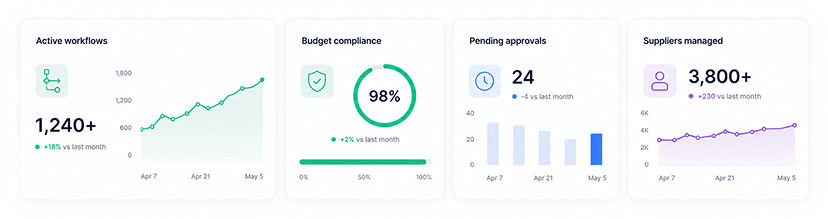
- Real-time visibility into spend and commitments
Efficiency comes not only from automation, but from eliminating errors, delays, and uncontrolled decisions.
What role does AI play in procurement use cases?
AI enhances procurement by improving decision-making and reducing manual effort.
Key AI-driven use cases in APSentra include:
- Spend analysis: identifying savings opportunities across categories and suppliers
- Automated invoice processing: matching POs and invoices, detecting discrepancies before payment
- Supplier risk signals: surfacing early indicators of supplier-related risks
- Demand forecasting: aligning procurement planning with expected business demand
- Anomaly detection: flagging unusual spend patterns in real time
APSentra integrates practical intelligence into workflows — improving outcomes without adding complexity.
How does APSentra reduce maverick spending?
Maverick spend occurs when purchases bypass established processes.
APSentra reduces it by:
- Enforcing structured intake workflows
- Validating requests against budgets and policies
- Routing approvals automatically
- Increasing transparency across all spend
Organizations typically reduce maverick spend by 30–50% through structured enforcement.
What procurement categories does APSentra support?
Most companies manage more than one type of procurement — and each comes with different workflows and risks.
APSentra supports:
- Indirect procurement: operational goods and services (software, office supplies, facilities)
- Direct procurement: materials and goods tied to production or delivery
- Services procurement: outsourced services, contractors, and consultants
- Capital procurement: long-term assets, equipment, and infrastructure investments
A common pain point is that different procurement categories end up in different tools — some in ERP, some in email, some in nothing. APSentra unifies all categories under one governed workflow, so approval logic, budget validation, and audit trails apply consistently regardless of what is being purchased.
How does APSentra support procurement for growing organizations?
As companies grow, procurement complexity increases.
APSentra supports scaling organizations with:
- Multi-entity governance
- Centralized visibility across teams
- Configurable workflows per department
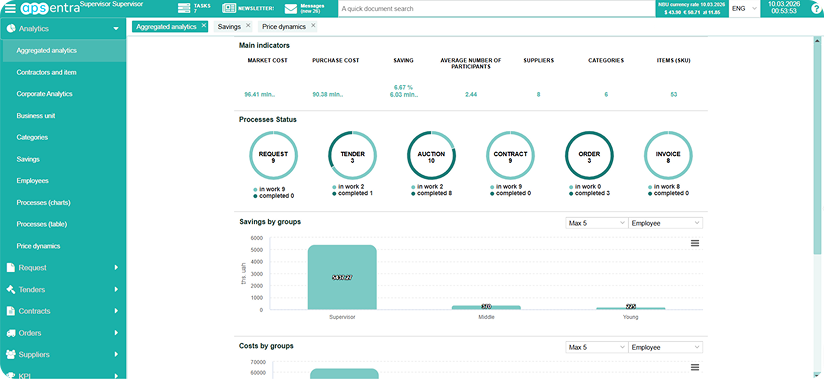
- Consolidated reporting and analytics
This allows companies to scale operations without losing control over spend and suppliers.
What is procure-to-pay (P2P) and why is it important?
Procure-to-pay (P2P) is the full procurement lifecycle:
request → approval → purchase order → invoice → payment.
A structured P2P process ensures:
- Financial control
- Process efficiency
- Reduced errors
- Full audit transparency
APSentra connects all stages into one system, eliminating fragmentation and improving financial accuracy.
Can procurement use cases improve cost control?
Yes — significantly.
When procurement processes are structured, companies gain:
- Real-time visibility into spend
- Stronger budget enforcement
- Better supplier negotiation leverage
- Reduced off-contract purchasing
- Improved financial predictability
APSentra transforms procurement from a reactive function into a proactive financial control system.
How does APSentra support procurement compliance and audit readiness?
Many organizations only discover compliance gaps when an audit happens.
APSentra builds compliance into the procurement workflow from the start:
- Every purchase request follows a documented approval chain
- Policy thresholds are enforced automatically — not manually
- Full audit trail is generated without extra work
- Deviations and exceptions are logged and visible in real time
When an audit arrives, the documentation already exists. There is no scramble to reconstruct approvals or track down paper trails. Companies that implement APSentra typically move from reactive compliance to continuous governance.
How does APSentra manage supplier onboarding and lifecycle?
Unstructured supplier management creates risk that is invisible until something goes wrong.
APSentra centralizes the full supplier lifecycle:
- Standardized onboarding with required documentation and approvals
- Supplier profiles with contact details, contracts, and performance history
- Risk flags and compliance checks tied to each supplier record
- Visibility into which suppliers are active, approved, or under review
Without a structured system, supplier information lives across inboxes, shared drives, and individual knowledge. APSentra makes it organizational — so supplier decisions are consistent, defensible, and auditable.
Can APSentra support procurement across multiple legal entities or subsidiaries?
Yes — multi-entity procurement is one of the most common reasons enterprise groups implement APSentra.
When each subsidiary runs procurement differently, the group loses visibility and control:
- No consolidated spend view across entities
- Group-level policies cannot be enforced consistently
- Reporting requires manual aggregation from multiple sources
- One entity’s compliance gap becomes a group-level risk
APSentra supports multi-entity structures with configurable workflows per entity, a shared supplier and contract registry, consolidated group-level reporting, and governance rules that can be set globally or locally. Organizations operating across multiple countries, business units, or holding structures use APSentra to standardize procurement without removing local flexibility.