Procurement Efficiency in Agriculture and Food Processing: Why Growth Now Depends on Operational Control
A harvest can fail for reasons no procurement team controls. A supplier region can be hit by drought, an export ban, or a currency shock. What a procurement team does control is whether the organization sees that exposure coming, and whether it can act on it faster than the disruption spreads. For businesses that combine agricultural sourcing with food processing, that gap between exposure and reaction is where growth is won or lost.
This is the argument behind the next Behind Procurement session. Land, harvest yield, and plant capacity used to be the primary constraints on how large an agribusiness could grow. Today, an equally binding constraint is how well procurement is governed across every farm, facility, and business unit the company operates. A company that cannot see its committed spend, its supplier concentration, and its tendering activity in one place cannot manage the volatility already built into agricultural commodity markets, let alone the volatility still to come.
Why Growth in Agriculture and Food Processing Now Depends on Procurement
Agriculture and food processing are two different procurement environments joined under one roof. Agricultural sourcing runs on seasons, weather, and commodity prices that move independently of any single company’s plans. Food processing runs on production schedules, quality certification, and shelf-life, where a delayed input does not just cost money. It can shut down a line.
Businesses that combine both, as many multi-location agribusinesses now do, inherit the complexity of each without automatically inheriting a procurement function built to manage either. Purchasing decisions are frequently made locally, by whoever is closest to the field or the plant, because that has historically been the fastest way to keep operations running.
That speed has a cost. When each location buys, tenders, and manages suppliers on its own logic, leadership loses the one thing that matters most when conditions change quickly: a single, current view of what the organization has committed to, where, and with whom. Procurement efficiency is not a back-office improvement in this context. It is the operational precondition for scaling agriculture and food processing at all.
“Farmland and plant capacity get most of the growth conversation. But the businesses that scale fastest right now are the ones that can see their full procurement exposure across every location, on the same day something changes, not at month-end.”
— Natalie Eksi, CEO at APSentra
What 2025 Research Shows About Agrifood Supply Chain Volatility
The scale of the volatility is no longer a matter of debate. Commodity markets for wheat, maize, and rice are experiencing their highest volatility since the start of this century, according to a 2025 analysis from BCG and Quantis. The firm modeled the projected impact of climate and geopolitical pressure on fifteen major crops, which together account for 65 percent of global crop production and 70 percent of the world’s caloric intake.
The headline projection is stark. Global production across these crops could fall by up to 35 percent by 2050, with an average decline of 12 percent, as extreme weather and shifting growing conditions compound existing pressure on agricultural output.
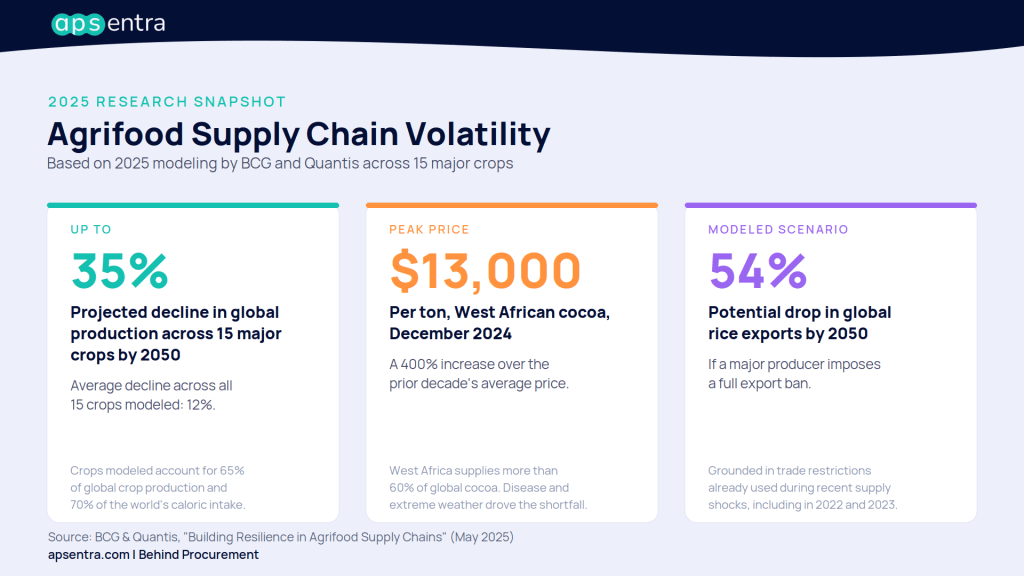
Concentration risk compounds the volatility. West Africa produces more than 60 percent of the world’s cocoa supply, and disease pressure and extreme weather in the region pushed prices to nearly 13,000 dollars per ton in December 2024, a 400 percent increase over the prior decade’s average. When sourcing depends on a small number of regions or suppliers, a single disruption becomes a company-wide problem rather than a local one.
Policy risk adds a further layer. The same modeling shows that global rice exports could drop by more than half by 2050 if a major producing nation imposed a full export ban in response to a shortfall in its own production, a scenario grounded in trade restrictions already used during recent supply shocks. Disruptions of this kind no longer arrive one at a time. They compound, and they move faster than most procurement functions can currently track.
None of this is a reason for agribusinesses to treat volatility as unmanageable. It is a reason to treat procurement visibility as infrastructure rather than as a reporting convenience.
Where Procurement Efficiency Breaks Down Across Multi-Location Agribusiness
The volatility described above lands on procurement functions that were often built for a simpler operating environment. A handful of patterns recur across multi-location agribusinesses and food processors, regardless of geography or crop.
- Fragmented processes by location: each farm, plant, or business unit tenders, approves, and documents purchases according to its own habits, which turns company-wide reporting into reconciliation rather than a live view.
- Delayed spend visibility: committed spend is assembled at month-end rather than tracked as it happens, so leadership sees exposure only after the decisions that created it are already final.
- Informal supplier and tendering management: supplier selection depends on individual relationships and local knowledge rather than documented, comparable criteria, which limits negotiating leverage and makes supplier risk hard to quantify.
- Disconnection from ERP, safety, and quality-control systems: procurement data lives apart from the systems that track production, compliance, and traceability, so a purchasing decision and its downstream operational impact are rarely visible together.
- Paper-heavy documentation: manual, location-specific record-keeping slows audits, complicates investor and lender reporting, and leaves gaps that are difficult to close after the fact.
These are structural gaps, not isolated inefficiencies, and they compound the volatility from the previous section directly. An organization that cannot see its committed spend and supplier exposure company-wide cannot respond quickly when a single region’s harvest, or a single supplier’s capacity, comes under pressure. It finds out about the disruption from the outside, usually later than its competitors do.
“The businesses I work with rarely lack procurement discipline at any single location. What they lack is a way to see all of those disciplined local decisions at once, as one picture, before a supplier or a region becomes a liability.”
— Emna Bahri, CEO at GROWTHLINK
Four Pillars of Procurement Efficiency in Agriculture and Food Processing
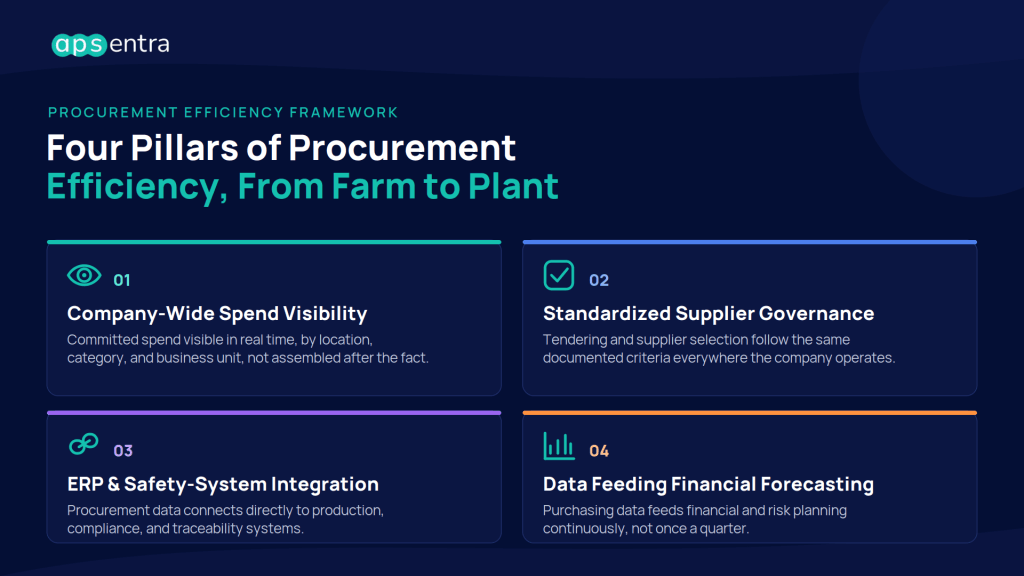
Closing these gaps does not require reinventing agricultural sourcing or food processing operations. It requires four pillars, applied consistently across every farm, plant, and business unit.
- Company-wide spend and commitment visibility. Committed spend should be visible in real time, by location, category, and business unit, not assembled after the fact. This is what turns budget management from reconciliation into control.
- Standardized, documented supplier governance. Supplier selection and tendering should follow the same criteria everywhere the company operates, rather than the informal, location-specific habits that develop when each site manages its own procurement. This is also the clearest lever against the concentration risk described earlier.
- Integration with ERP, safety, and quality-control systems. Procurement data should connect directly to the systems that track production, compliance, and traceability, so a purchasing decision and its operational consequence are visible in the same place, not reconstructed after an audit request.
- Procurement data feeding financial and risk forecasting. Procurement should function as an early-warning system for input cost and supplier risk, feeding financial planning continuously rather than producing a static report once a quarter.
None of these four pillars are software features. They are operating decisions that a platform can enforce at scale but cannot substitute for, a distinction covered in more detail later in this article. A platform built as a digital twin of the organization’s structure and procurement workflow, mapping controls to how the business actually operates rather than to a generic template, is what makes these four pillars practical to run company-wide rather than aspirational.
Procurement Efficiency in Practice: A Multi-Location Agribusiness
One APSentra implementation in agriculture and food processing shows what these four pillars look like once they are built into daily operations, sustained not for a single rollout year but across more than a decade.
A Multi-Location Agribusiness, Ten Years of Continuous Visibility
Agriculture & Agri-Processing | Food Processing & Production | 130+ Users | Multiple Locations
Challenge: Procurement activity was distributed across multiple locations and operational areas, with no consistent, centralized way for management to see purchasing activity, account for it, or connect it to the company’s existing ERP and safety control systems.
APSentra Solution: The company brought every core procurement activity into a single environment connected directly to its ERP, using the Tender & Surplus Disposition and Supplier Excellence modules to standardize tendering and supplier management across locations, and extended the platform to manage the sale of surplus goods and materials.
Outcome: More than a decade later, 100 percent of the company’s procurement activity runs through APSentra. Leadership has one source of truth for purchasing across every location, and the platform has scaled alongside a business that also carries a strategic investor from Saudi Arabia, where transparency and accountability are a standing requirement rather than an occasional audit item.
The detail worth pausing on is the compensation model. Buyers are paid on service quality and outcomes, and a commission model for supplier tender participation supports the unit’s financial self-sufficiency. Procurement did not simply contribute to growth in this holding. It acquired its own revenue logic and became a business that other organizations can buy from.
“The real value of a long-term implementation is that the system becomes part of the business itself. With all procurement managed through APSentra, the company has maintained visibility, accountability, and control as its operations have grown and evolved.”
— APSentra Implementation Manager
The Role of Technology: What It Solves and What It Does Not
A procurement platform enables governance in agriculture and food processing. It does not create that governance on its own, and this distinction is worth stating plainly, because it is the source of most procurement transformations that fail to deliver what leadership expected.
A platform makes a well-designed governance structure faster, more visible, and easier to enforce. It gives finance and operations leaders real-time access to committed spend that would otherwise require manual extraction from multiple locations. It applies approval routes consistently instead of leaving them to informal local practice, and it produces the audit trail that paper-based, location-specific processes cannot generate. APSentra’s digital twin of the organization’s structure and workflow means these controls map to how the business actually operates, across farms, plants, and business units, rather than to a generic template built for a different kind of company.
What a platform cannot do is substitute for the decisions that must precede it: who is accountable for procurement by category, location, and business unit; how supplier selection criteria are defined; how often procurement data should feed financial and risk forecasting; and which categories carry enough concentration risk to warrant active diversification. BCG’s own research points to a related idea for managing near-term disruption: a centralized tool that pulls together real-time environmental, supply chain, and market data so decision makers can answer questions before a shortfall becomes a crisis. A procurement platform serves a parallel function inside the purchasing process itself. It is only as useful as the governance decisions an organization has already made about how it wants procurement to work.
Organizations that deploy a platform without making these decisions first tend to reproduce their informal processes in digital form. The system changes. The governance does not.
How to Prepare for the Behind Procurement Session
The live session will build directly on the framework outlined here, for finance, procurement, and operations leaders working through procurement efficiency in their own agriculture or food processing organization. Three diagnostic questions are worth bringing into the conversation:
- How long does it currently take your organization to see total committed spend across every farm, plant, and business unit?
- Can procurement identify, within a day, which suppliers or regions carry the greatest concentration risk for a single input?
- Is tendering standardized company-wide, or does it still depend on who happens to be managing each location?
If any of these questions reveal a gap, the session will cover the specific organizational and technology steps that close it.
About APSentra
APSentra is an AI-driven source-to-pay platform designed to control, structure, and optimise company-wide spend. Trusted by leading organisations across telecom, logistics, agriculture, and financial services — including Kyivstar, Nova Post, Kernel, UkrLandFarming, Sense Bank, and Intesa Sanpaolo.