
Want a diagnostic that comes with a system already built to enforce what it recommends?
See how APSentra’s procurement advisory practice works
Book a Demo
Most procurement consulting roundups rank firms by size, brand recognition, or Gartner/Forrester analyst placement — useful signals, but incomplete ones. They rarely address the question that actually determines whether an engagement pays off: does the recommendation become an enforced, daily operating reality, or does it stay a slide deck?
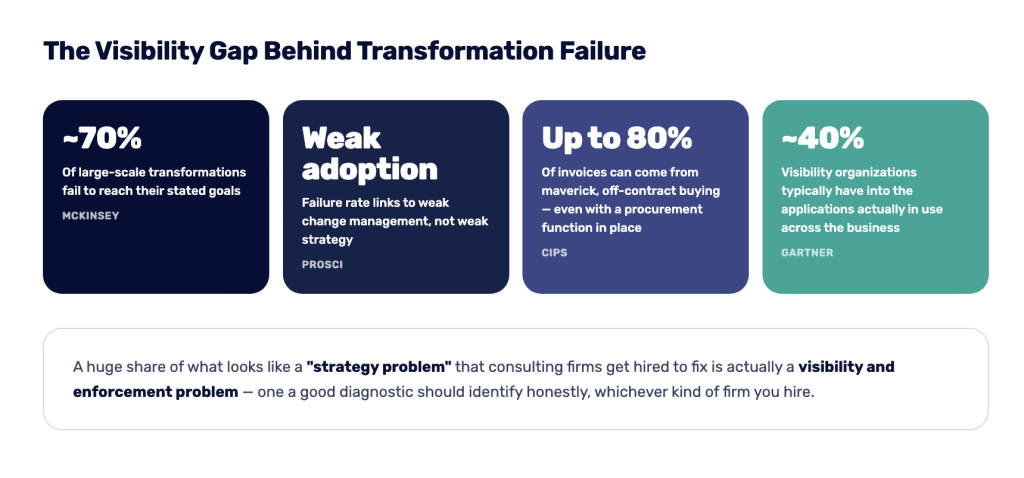
McKinsey’s research on large-scale transformations finds that roughly 70% fail to reach their stated goals, and Prosci’s change-management research links that failure rate directly to weak change management and adoption planning — not weak strategy.
Separately, CIPS research has found that maverick, off-contract buying can account for up to 80% of all invoices even at large organizations with a dedicated procurement function, and Gartner research on software spend has found organizations typically have visibility into only about 40% of the applications actually in use across the business.
In other words: a huge share of what looks like a “strategy problem” that consulting firms get hired to fix is actually a visibility and enforcement problem — one a good diagnostic should identify honestly, whichever kind of firm you hire.
That’s the lens we’ve applied throughout this comparison.
This comparison draws on a different evidence base than our software-category comparisons (purchase order, spend management, and similar), because procurement consulting firms aren’t reviewed on G2 or Capterra the way software products are.
We built this article from:
(1) each firm’s public materials, case studies, and press coverage of major transactions (e.g., BCG’s acquisition of Inverto, Bain’s acquisition of Proxima);
(2) independent industry rankings and directories (Consultancy.uk, Management Consulted, Advisory Ranking, Art of Procurement’s provider directory);
(3) publicly available headcount, headquarters, and founding data cross-checked across at least two sources where possible;
(4) for APSentra specifically, our own internal engagement methodology, named practice leadership, and a real (client-name-redacted) diagnostic template, which we’ve described transparently below rather than presenting as independently audited.
We evaluated every firm against:
“Procurement consulting” is a broad umbrella, and engagements under that label can look very different depending on scope:
The common thread across the category: procurement consulting has stopped being purely about price and started being about structure — how the function is designed, governed, and measured.
Not every consulting engagement needs a global strategy firm, and not every strategy firm can execute at the category level. The market is layered into a few fairly distinct tiers:
A notable trend across this landscape is consolidation between strategy and execution.
BCG’s 2016 acquisition of the specialist sourcing consultancy Inverto is a clear example: it closes the gap between C-suite strategy and category-level vendor negotiation by putting both under one roof.
Bain’s 2022 acquisition of Proxima — a London-headquartered procurement specialist with roughly 300 practitioners, founded in 1994 — follows the same logic.
Expect more of this: clients increasingly want a single partner who can both design the strategy and actually execute it, rather than handing off between a strategy firm and an implementation firm.
The commercial model behind a consulting engagement shapes incentives just as much as the framework does.
Fixed-fee and milestone-based engagements are priced against defined deliverables and can range from tens of thousands of dollars for a focused audit to seven figures for a multi-year transformation.
Gainshare (risk-share) arrangements are increasingly the default for cost-reduction engagements specifically. The mechanics generally follow a set sequence: the consultancy and client first agree on a baseline — historical spend, unit prices, and volumes over a lookback period, usually twelve months.
Once that baseline is locked, the consultant executes sourcing initiatives or renegotiations, and savings are calculated by comparing actual spend against the baseline. Mature contracts normalize that baseline for factors outside the consultant’s control — commodity index moves, currency swings, volume changes — so the consultant is paid for what they actually achieved, not a market tailwind. The fee is then a negotiated share of the verified, normalized savings, often with floors and caps built in.
It’s worth being clear-eyed about the downside of pure gainshare: a consultant paid purely on unit-price reduction has every incentive to squeeze suppliers hard on price, which can quietly damage supplier relationships, product quality, or delivery reliability — and it can produce savings that look great in a spreadsheet but never show up in the actual P&L if internal teams keep buying off-contract anyway.
The better-run engagements address this with hybrid structures and non-financial KPIs — supplier delivery performance, contract adoption rates, ESG compliance — alongside the pure cost number.
If instead your problem is that policies are fine but nobody follows them because there’s no system enforcing them, or spend is invisible because it’s scattered across spreadsheets, you may need better tooling more than a strategy engagement — see the buyers’ checklist below for a fuller self-diagnostic.
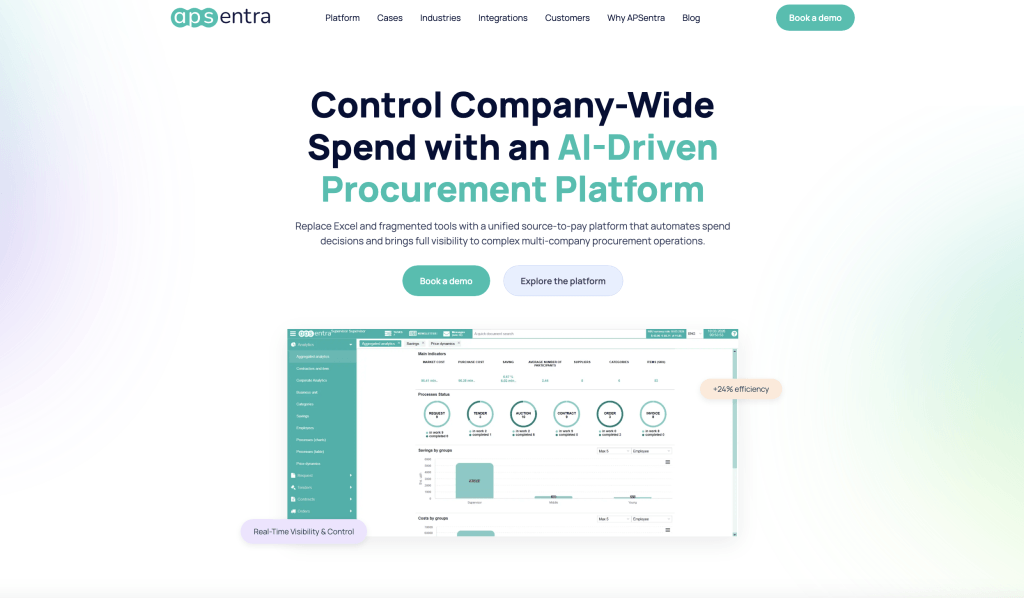
Best for: Mid-market and growth-stage companies that want a genuine diagnostic and target operating model — and want it connected directly to a system that enforces it, rather than a report that requires a separate technology initiative to become real.
APSentra runs its advisory practice on a structured, named methodology rather than an ad hoc approach. The engagement — documented in APSentra’s own Procurement Diagnostic & Transformation methodology — moves through six defined stages: objectives and scope; organizational structure (As-Is to To-Be); business process analysis across the four core procurement processes (purchase initiation, supplier selection/tender, contract conclusion, order and delivery); category and cost analysis; target model and roadmap; and expected impact and automation.
What the methodology is grounded in:
What a client receives: a current-state procurement map (structure, coverage, and spend sitting outside procurement’s control); As-Is/To-Be process maps with risk points identified and closed through automation; a category and cost analysis with ABC segmentation and savings potential; a procurement-efficiency benchmark (ROSMA) with a post-automation forecast; and a target operating model with staffing implications and a staged rollout plan.
Named practice leadership:
On illustrative outcomes: APSentra’s engagement template models, using representative, illustrative figures rather than a single named audited client result — process-level savings such as up to roughly 90% of buyer time in a modeled tender-automation scenario, and, across a sample multi-entity diagnostic, all identified risk points (19 of 19 in the modeled example) resolved through the recommended automation.
We’re flagging this explicitly: these are outputs of APSentra’s engagement template and methodology, illustrating how the framework quantifies impact — not an independently audited, named client case study. If you want to see it applied to your own numbers, that’s exactly what the diagnostic stage of an engagement produces.
Why it’s ranked first for this comparison specifically: the criterion we weighted most heavily does the recommendation connect to a system that enforces it after the engagement ends — is where APSentra’s model is structurally different from a pure advisory firm.
Where it’s not the right fit: if you need a large deployed team across dozens of countries for a multi-year, multi-billion-dollar global transformation, the firms below have deeper bench strength for that specific scale.
Kearney (formerly A.T. Kearney) is a global management consulting firm with a long-established procurement and supply chain practice, operating in more than 40 countries. Kearney is the originator of the Purchasing Chessboard, one of the best-known frameworks in the field, mapping procurement strategy against buyer power and supplier power in a given category to resolve into four broad sourcing approaches.
Best for: large enterprises that want a globally recognized strategic framework and a firm with decades of category-level and operating-model expertise across nearly every industry.
Efficio, headquartered in London, describes itself as the world’s largest independent international procurement and supply chain consultancy — a pure-play firm rather than a procurement practice inside a broader management consultancy. Public reporting puts headcount at roughly 1,000–1,200 people representing 50–60+ nationalities, across roughly 13–16 offices in Europe, North America, and the Middle East, with revenue reported at $76.1M and growth of more than 60% over the prior two years.
Best for: organizations that specifically want a pure-play procurement specialist with deep bench strength and don’t need the broader (and pricier) general management-consulting infrastructure that comes with a Big Four or MBB engagement.
Founded in 1999, GEP operates a dual model — cloud-native procurement software alongside consulting services — and is recognized as a leader in multiple Gartner Magic Quadrants for its software. This combination gives GEP’s consulting arm a genuinely close relationship between strategic recommendations and the technology used to execute them, similar in spirit to APSentra’s model but at a larger, more enterprise-oriented scale.
Best for: large enterprises that want a single vendor spanning both strategic sourcing consulting and a mature, analyst-recognized software platform, and have the budget and timeline for an enterprise-scale engagement.
Proxima was a London-headquartered, UK-founded (1994) procurement specialist with roughly 300 practitioners when Bain & Company acquired it in May 2022, folding it in as Bain’s specialist procurement implementation service line. The combination pairs Bain’s strategy-level brand and reach with Proxima’s category-level procurement execution bench.
Best for: organizations that want board-level strategic credibility from a top-tier strategy firm, with genuine procurement execution capability rather than a generalist team, thanks to the Proxima integration.
Boston Consulting Group acquired the specialist sourcing consultancy Inverto in 2016, and Inverto now operates as part of BCG, closing the same strategy-to-execution gap described above. The combination gives BCG clients access to category-level sourcing and negotiation expertise alongside BCG’s broader strategy and digital transformation capabilities.
Best for: large enterprises already working with BCG on broader strategy that want procurement-specific execution without switching to a separate specialist vendor.
Each of the Big Four (plus Accenture, often grouped alongside them for consulting scale) operates a dedicated procurement and sourcing practice within a much larger professional services organization. Their differentiator is breadth: the ability to run a procurement transformation alongside connected finance, tax, and ERP workstreams under one contract, at a global scale few pure-play firms can match.
Best for: large, multi-jurisdiction enterprises whose procurement transformation needs to be coordinated with simultaneous finance, tax, or systems-integration work, and who have the budget for a large, multi-workstream engagement.
The market includes a long tail of regional and boutique procurement specialists — names like Denali Group and Insight Sourcing Group are established U.S. boutique procurement consultancies frequently mentioned alongside the firms above, generally known for category-level cost-reduction engagements. We haven’t independently verified current headcount, ownership structure, or case-study detail for these firms to the same standard as the profiles above, so treat this as a starting point for your own research rather than a fully sourced comparison.
Separately, Art of Procurement operates primarily as a media, community, and training platform with a provider directory — a useful research starting point for finding specialists, but not itself a consulting firm delivering engagements.
| Firm | Model | Approx. scale | Procurement-specific (pure-play) | Platform/system connected to recommendations | Best-fit engagement size |
|---|---|---|---|---|---|
| APSentra | Platform-integrated advisory | Named practice leadership team | Yes | Yes, natively | Mid-market / growth-stage |
| Kearney | Global strategy firm | 40+ countries | No (procurement practice within broader firm) | No | Large enterprise |
| Efficio | Pure-play specialist | ~1,000–1,200 people, 13–16 offices | Yes | No | Mid-market to large enterprise |
| GEP | Software + consulting hybrid | Large enterprise-scale | Yes | Yes (GEP’s own platform) | Large enterprise |
| Proxima (Bain) | Strategy firm + specialist practice | ~300 practitioners (Proxima) within Bain | Yes (via Proxima) | No | Large enterprise |
| BCG / Inverto | Strategy firm + specialist practice | Global BCG scale + Inverto team | Yes (via Inverto) | No | Large enterprise |
| Big Four (Deloitte, Accenture, EY, KPMG, PwC) | Global professional services | Tens of thousands globally | No (practice within broader firm) | Varies by firm’s software partnerships | Large, multi-jurisdiction enterprise |
An organization whose real issue is that nobody can see spent data brings in a strategy firm to redesign category strategy and sourcing playbooks. The resulting recommendations are sound and well-researched — and undeliverable, because there’s still no system giving the team the spend visibility the new strategy assumes they have.
Communication and training bolted on in the final two weeks rarely overcomes months of skepticism built up beforehand — directly relevant given the ~70% transformation failure rate McKinsey’s research documents.
Tracking system logins instead of policy compliance or realized savings makes a rollout look successful while the underlying behavior hasn’t changed.
A strategy document that never gets operationalized into the systems and habits of the team was never going to change anything on its own — which is exactly the gap a platform-connected engagement is designed to close.
BCG/Inverto (2016) and Bain/Proxima (2022) both reflect the same market logic: clients want one partner who designs the strategy and can also execute it at the category level, rather than handing off between two firms.
Currency volatility, disrupted trade routes, new digital procurement infrastructure (Ukraine’s Prozorro is a widely cited example of a transparent, government-run e-procurement model), and shifting regulatory regimes mean the “right” engagement increasingly depends on where you operate, not just your industry.
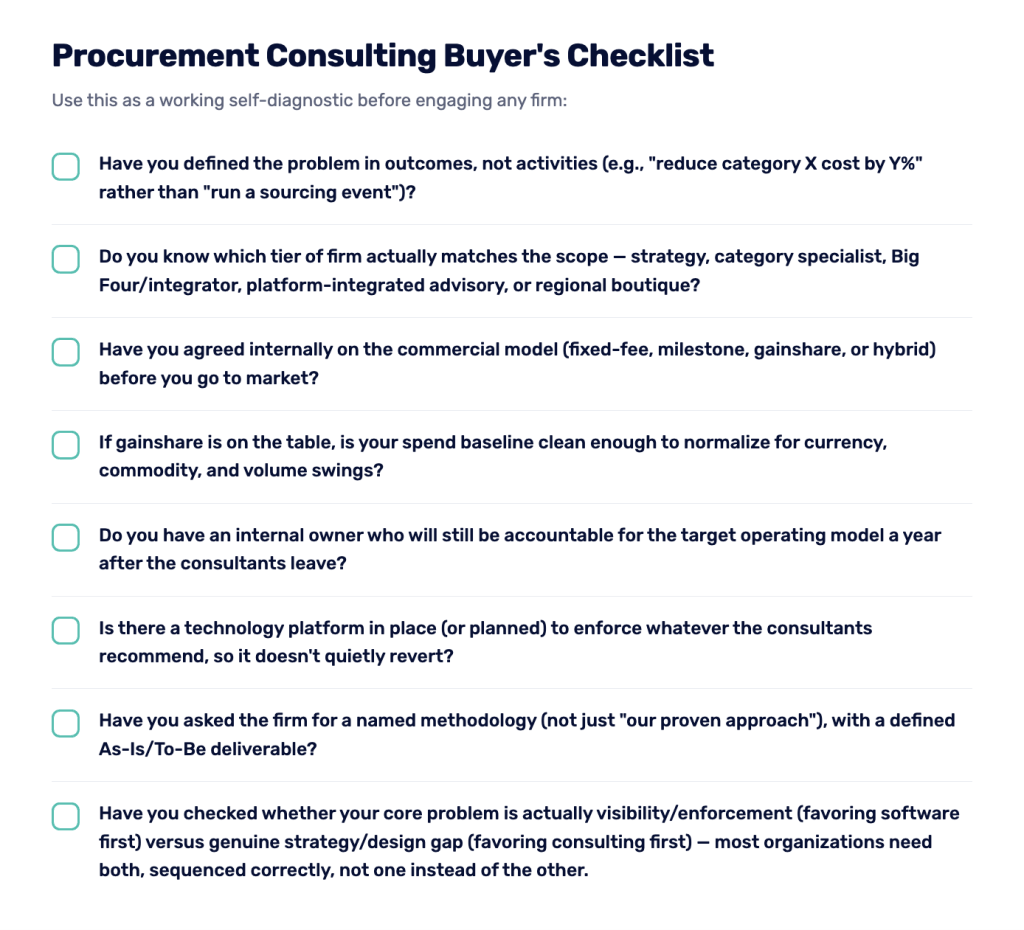
Use this as a working self-diagnostic before engaging any firm:
Match the tier to the actual scope
A global, multi-country operating-model redesign needs a different firm than a single-category cost-reduction sprint — don’t hire strategy-firm scale for a category-specialist problem, or vice versa.
Ask what happens after the engagement ends
The single highest-leverage question in this entire comparison: who owns the target operating model in twelve months, and what — system or person — keeps enforcing it?
Get the commercial model right before you go to market
Decide internally whether fixed-fee, milestone, or gainshare fits your engagement type, and make sure your spend baseline is clean enough to support it if gainshare is on the table.
Sequence consulting and technology deliberately if you need both
Establishing baseline spend visibility and enforcement through a platform first is often the more efficient sequence — it resolves a meaningful share of “strategy” complaints on its own and gives any subsequent consulting engagement real data to work from, rather than guesswork.
Firm data in this article is drawn from public company materials, press coverage of major transactions (Consultancy.uk on BCG/Inverto and Bain/Proxima), independent industry directories and rankings (Management Consulted, Advisory Ranking, Art of Procurement). Supporting research citations include McKinsey’s research on transformation failure rates, Prosci’s change-management research, CIPS research on maverick spend, and Gartner research on software spend visibility.
Editorial policy: Firms cannot pay for inclusion or ranking in this article. Firms are included because they meet our evaluation criteria for the procurement consulting category, and every claim about a third-party firm is tied to a citable public source rather than our own characterization.