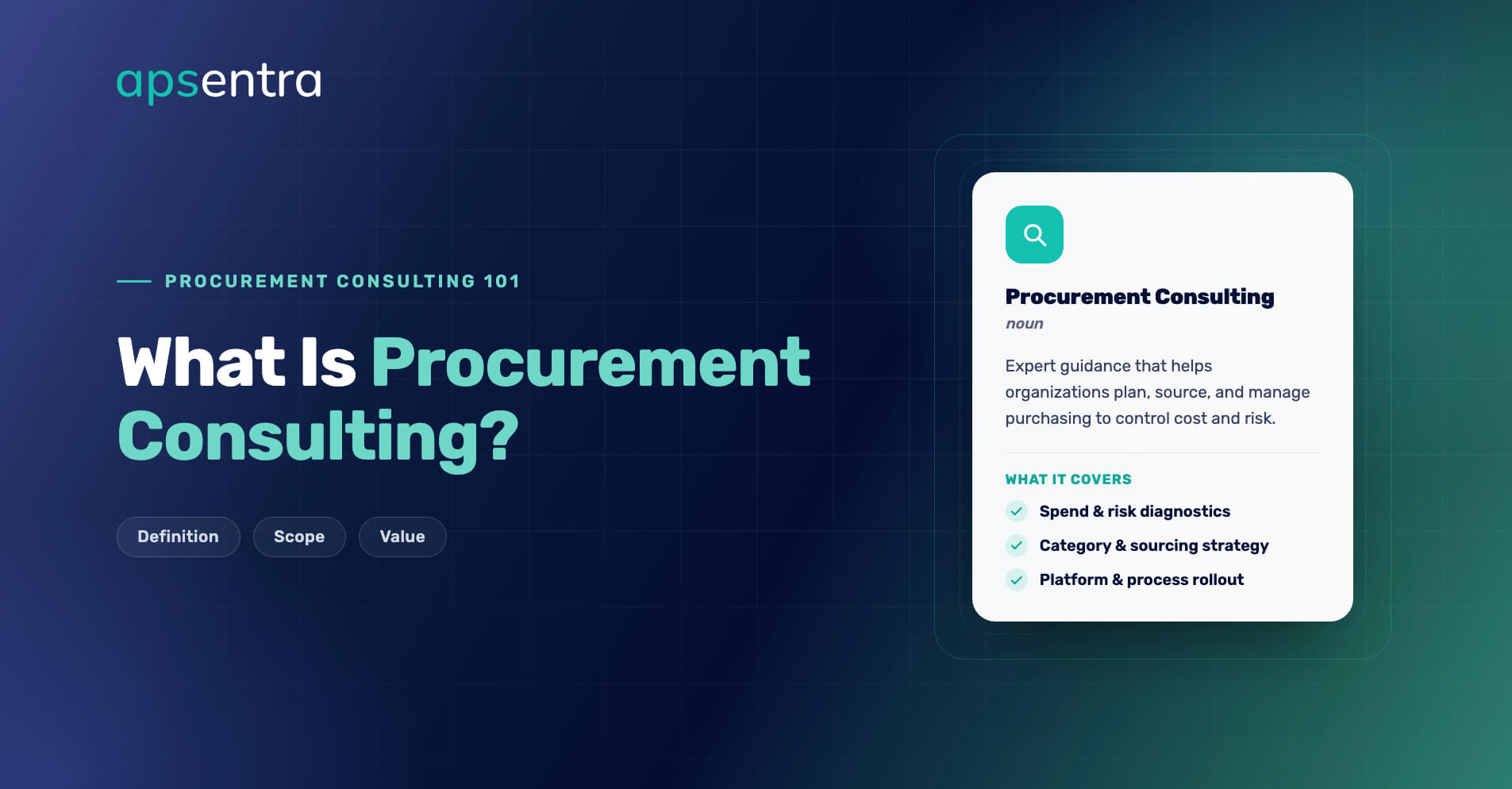
What Is Procurement Consulting? Services, Costs, and When to Hire a Consultant
Procurement consulting has moved in lockstep with that shift. What used to mean a short engagement to squeeze a better price out of a handful of suppliers now routinely means something much bigger: redesigning entire supply networks, rebuilding the target operating model for how a company buys, restructuring commercial pricing frameworks, and integrating all of it with modern digital systems.
If you’re evaluating whether your organization needs procurement consulting and if so, what kind — this guide walks through what the term actually covers, who delivers it, how they get paid, and how to tell whether you’re a good candidate for an engagement right now.
What Procurement Consulting Actually Covers
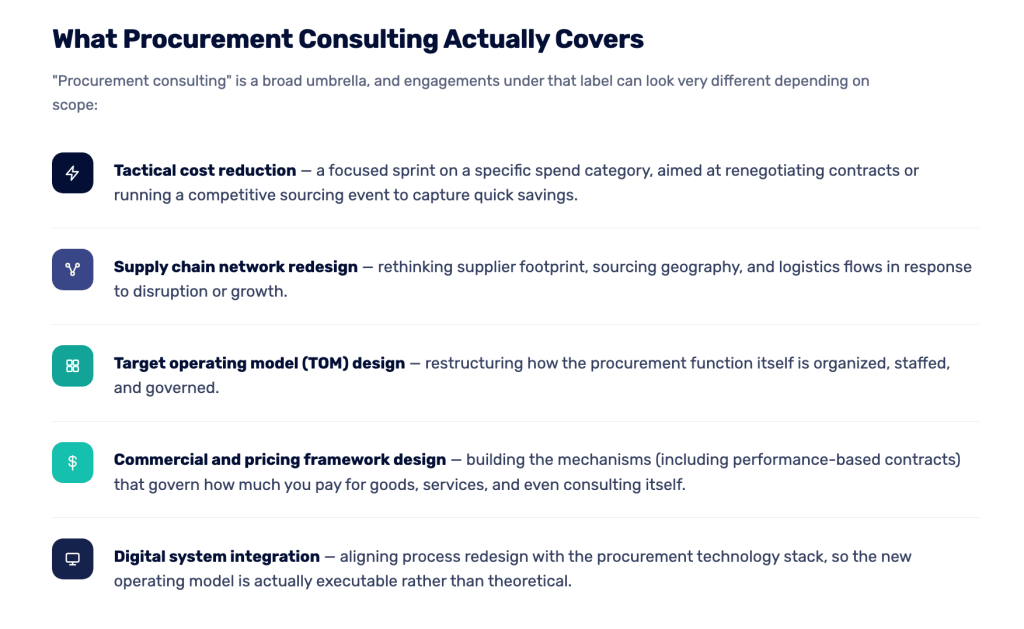
“Procurement consulting” is a broad umbrella, and engagements under that label can look very different depending on scope:
- Tactical cost reduction — a focused sprint on a specific spend category, aimed at renegotiating contracts or running a competitive sourcing event to capture quick savings.
- Supply chain network redesign — rethinking supplier footprint, sourcing geography, and logistics flows in response to disruption or growth.
- Target operating model (TOM) design — restructuring how the procurement function itself is organized, staffed, and governed.
- Commercial and pricing framework design — building the mechanisms (including performance-based contracts) that govern how much you pay for goods, services, and even consulting itself.
- Digital system integration — aligning process redesign with the procurement technology stack, so the new operating model is actually executable rather than theoretical.
Key takeaway
Procurement consulting today spans five distinct engagement types, from a two-week sourcing sprint to a multi-year operating model rebuild — scope, not price, is the defining variable.
The Procurement Consulting Landscape: Who Does What
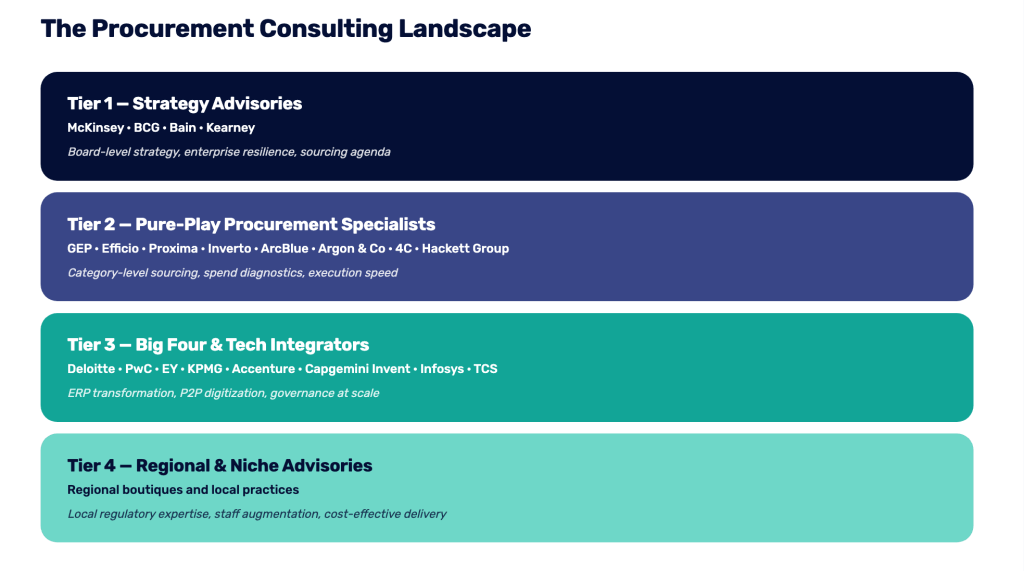
Not every consulting engagement needs a global strategy firm, and not every strategy firm can execute at the category level. The market is layered into a few fairly distinct tiers, and knowing which tier you actually need is half the battle.
| Tier | Representative Firms | Best Fit |
|---|---|---|
| Tier 1: Strategy advisories | McKinsey & Company, BCG, Bain, Kearney | Board-level strategy, enterprise-wide resilience, translating corporate strategy into a sourcing agenda |
| Tier 2: Pure-play procurement specialists | GEP, Efficio, Proxima, Inverto, ArcBlue, Argon & Co, 4C Associates, The Hackett Group | Category-level sourcing, spend diagnostics, supplier renegotiation, internal capability building |
| Tier 3: Big Four & tech integrators | Deloitte, PwC, EY, KPMG, Accenture, Capgemini Invent, Infosys Consulting, TCS | ERP transformations, Purchase-to-Pay digitization, governance frameworks at enterprise scale |
| Tier 4: Regional & niche advisories | locally focused practices | Local regulatory expertise, staff augmentation, cost-effective delivery in markets where global firms are thin |
A notable trend across this landscape is consolidation between strategy and execution.
BCG’s 2016 acquisition of the specialist sourcing consultancy Inverto is a clear example: it closes the gap between C-suite strategy and category-level vendor negotiation by putting both under one roof.
Expect more of this — clients increasingly want a single partner who can both design the strategy and actually execute it, rather than handing off between a strategy firm and an implementation firm.
Key takeaway
Match the tier to the job: strategy firms for board-level mandates, pure-play specialists for category execution, Big Four/integrators for ERP-scale transformation, and regional advisories where local regulatory depth matters more than global brand.
The Frameworks Behind a Good Engagement
Good procurement consultants don’t improvise. Most rely on structured frameworks to move a client from reactive, fragmented buying toward a centralized, data-driven function.
One of the best-known is Kearney’s Purchasing Chessboard, which maps procurement strategy against two variables: buyer power and supplier power in a given category. The framework resolves into four broad approaches:
| Power Balance | Strategic Focus | Typical Levers |
|---|---|---|
| High buyer power / low supplier power | Lean into competition | Global sourcing, aggressive tendering, reverse auctions, price benchmarking |
| Low buyer power / high supplier power | Understand true cost structure | Should-cost modeling, cost-breakdown audits, value engineering |
| Low buyer power / low supplier power | Turn the work inward | Demand management, specification standardization, consuming less |
| High buyer power / high supplier power | Collaborate for the long term | Joint value-chain re-engineering, strategic partnership over adversarial negotiation |
The other recurring structural theme is target operating model (TOM) design, which typically splits procurement into three functional layers: a centralized strategic layer (category strategy, vendor risk, ESG compliance, spend analytics), a tactical sourcing layer (regional bidding, supplier onboarding, contract formulation), and an operational Purchase-to-Pay layer (requisition routing, invoice matching, transaction execution).
Getting this structure right is often what separates a transformation that sticks from one that quietly reverts to old habits within a year.
Key takeaway
The Purchasing Chessboard and target operating model design are the two frameworks worth asking any prospective consultant to walk you through — if they can’t map your category onto one of the four chessboard quadrants, that’s a red flag.
How Procurement Consultants Get Paid — and Why It Matters
The commercial model behind a consulting engagement shapes incentives just as much as the framework does, so it’s worth understanding the main options before you sign anything.
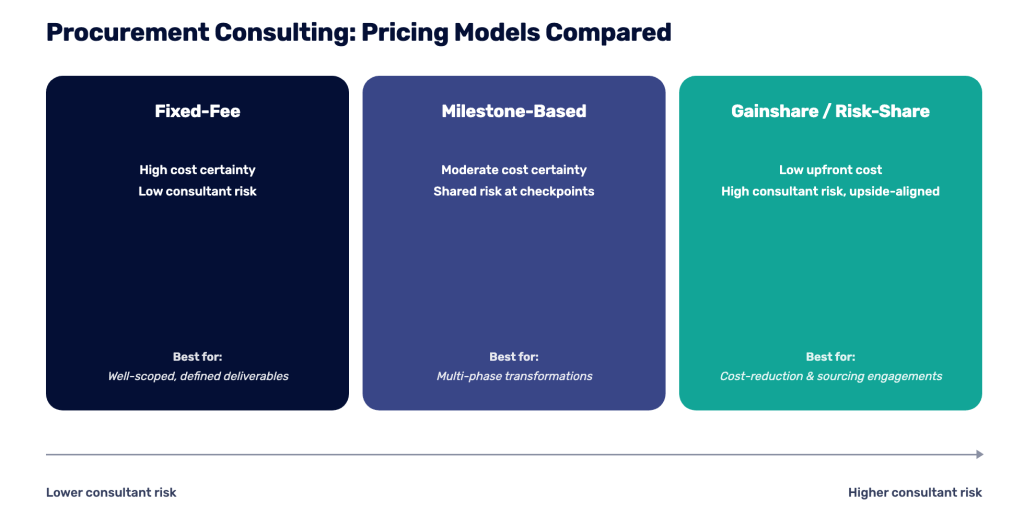
Gainshare arrangements deserve a closer look, because they’re increasingly the default for cost-reduction engagements specifically. The mechanics generally follow a set sequence: the consultancy and client first agree on a baseline — historical spend, unit prices, and volumes over a lookback period, usually twelve months.
Once that baseline is locked, the consultant executes sourcing initiatives or renegotiations, and savings are calculated by comparing actual spend against the baseline. Mature contracts go a step further and normalize that baseline for factors outside the consultant’s control — commodity index moves, currency swings, and volume changes — so the consultant is paid for what they actually achieved, not for a market tailwind. The consultant’s fee is then a negotiated share of the verified, normalized savings, often with floors (to protect the consultant’s minimum viable economics) and caps (to protect the client from open-ended payouts).
It’s worth being clear-eyed about the downside of pure gainshare: a consultant paid purely on unit-price reduction has every incentive to squeeze suppliers hard on price, which can quietly damage supplier relationships, product quality, or delivery reliability.
It can also produce savings that look great in a spreadsheet but never show up in the actual P&L, if internal teams keep buying off-contract anyway.
The better-run engagements address this with hybrid structures and non-financial KPIs — supplier delivery performance, contract adoption rates, ESG compliance — alongside the pure cost number, so the incentive isn’t purely “cheaper at any cost.”
Key takeaway
Ask any prospective consultant three questions before signing:
- what’s the baseline,
- is it normalized for factors outside their control,
- are there non-financial KPIs alongside the savings number.
A Regional Lens: Why Context Changes the Engagement
Procurement consulting doesn’t look the same everywhere, and it’s worth using a concrete example to see why. Ukraine offers a useful case study precisely because its procurement environment has had to solve for extremes: currency volatility, disrupted trade routes, and large-scale infrastructure reconstruction, all at once.
On the private-sector side, global networks like Deloitte, PwC, EY, and KPMG operate alongside strong local advisories, and the engagement mix skews heavily toward forensic auditing, supply-chain re-routing, and accounting conversion from local GAAP to IFRS — necessary groundwork for companies seeking capital from international financial institutions.
On the public-sector side, Ukraine’s Prozorro e-procurement system is a genuinely notable global model of digital reform: a centralized government platform connected to a competitive layer of private e-marketplaces, built to the Open Contracting Data Standard so that tender data is fully public and machine-readable. That transparency architecture is now directly integrated into how major international organizations channel recovery and infrastructure funding into the country.
The lesson generalizes well beyond Ukraine: local regulatory structure, market maturity, and even a country’s digital procurement infrastructure meaningfully change what a “consulting engagement” needs to include — sometimes the most valuable work isn’t sourcing strategy at all, but compliance, risk controls, and integration with a public procurement system.
Key takeaway
Before scoping strategy work in an unfamiliar market, check whether compliance, audit, and public-system integration are prerequisites — in some regions that’s most of the engagement, not a footnote to it.
Where Technology Fits Into Modern Consulting
The best consulting firms today are increasingly judged on their data and digital capabilities, not just their frameworks. Manual spend analysis and static reporting are giving way to real-time analytics, predictive sourcing tools, and AI-driven vendor risk monitoring. ESG and Scope 3 emissions tracking have also moved from a nice-to-have into a core category-strategy requirement, since most of a company’s environmental footprint typically sits in its extended supply chain rather than its own operations.
This is exactly where the line between“consulting” and “software” has started to blur — and why the quality of the underlying procurement platform increasingly determines how much value a consulting engagement can actually deliver. A brilliant target operating model redesign is only as good as the system that enforces it day to day; a should-cost model is only as accurate as the spend data feeding it.
Good consultants know this, which is part of why the strongest engagements today pair strategic and category expertise with a platform capable of turning that strategy into enforced, day-to-day behavior — rather than a plan that lives in a slide deck.
Key takeaway
A strategy that only lives in a deck reverts within a year. Ask prospective consultants how their recommendations get enforced day-to-day once the engagement ends.
So, Do You Actually Need Procurement Consulting?
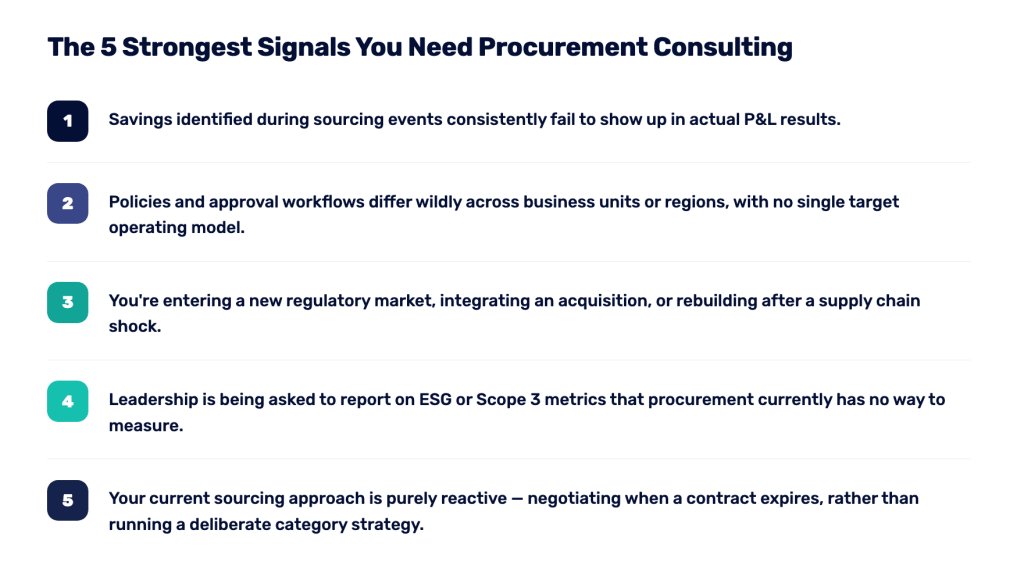
And a few signals suggest you may not need a heavy consulting engagement yet — you may just need better tooling:
- Your processes are reasonably sound, but nobody has visibility into spend because it’s scattered across spreadsheets and email.
- Maverick spend is a data and enforcement problem, not a strategy problem — the policies exist, they’re just not being followed because there’s no system enforcing them.
- You need faster sourcing cycles and cleaner supplier onboarding, not a redesigned operating model.
In practice, most organizations need some combination of both: a platform that gives real-time visibility and enforces governance automatically, and expert guidance to make sure the strategy, policies, and change management around that platform are actually right for your industry and market. Neither one substitutes for the other — which is exactly why the strongest procurement transformations pair a strong technology core with the right consulting partner, rather than treating the choice as either/or.
Decision Guide: Consulting, Software, or Both?
| If your situation looks like… | You likely need |
|---|---|
| Spend is invisible only because it’s scattered across spreadsheets/email; policies are otherwise sound | Software first — visibility and workflow tooling, minimal consulting |
| Policies exist but aren’t followed; maverick spend is an enforcement gap | Software with light process tightening |
| No single target operating model; workflows differ by region/business unit | Consulting — TOM design, then software to enforce it |
| Entering a new market, integrating an acquisition, or rebuilding after disruption | Consulting — market/regulatory expertise, likely with regional or niche advisory support |
| Sourcing savings never appear in the P&L, or ESG/Scope 3 reporting has no data backbone | Both — consulting to fix the model and KPIs, software to make the data real |
A Quick Buyer’s Checklist Before You Engage a Consultant
- Have you defined the problem in outcomes, not activities (e.g., “reduce category X cost by Y%” rather than “run a sourcing event”)?
- Do you know which tier of firm actually matches the scope — strategy, category specialist, Big Four/integrator, or regional advisory?
- Have you agreed internally on the commercial model (fixed-fee, milestone, gainshare, or hybrid) before you go to market?
- If gainshare is on the table, is your spend baseline clean enough to normalize for currency, commodity, and volume swings?
- Do you have an internal owner who will still be accountable for the target operating model a year after the consultants leave?
- Is there a technology platform in place (or planned) to enforce whatever the consultants recommend, so it doesn’t quietly revert?