Best Accounts Payable Automation Software in 2026
Manual accounts payable is a compounding problem. An invoice arrives without a PO reference. Someone spends 20 minutes tracking it down. The match is done in a spreadsheet. A discrepancy gets missed. The payment is late. The supplier follows up. The AP manager processes the same transaction three times. At scale — hundreds or thousands of invoices per month — this is not an inefficiency. It is a structural failure.
The best AP automation software eliminates that failure by automating the two moments where manual AP breaks most often: invoice capture (getting data into the system without re-keying) and 3-way matching (comparing the PO, goods receipt, and invoice without a spreadsheet). When both work, the result is zero-touch invoicing — matched invoices that flow from receipt to payment with no human touchpoint on the routine work, leaving your AP team to handle only the exceptions that genuinely need judgment.
This guide ranks the top AP automation tools available in 2026, compares their native capabilities across a 12-feature matrix, and gives CFOs, AP Managers, and Controllers a practical framework for choosing the right platform for their volume, entity structure, and implementation timeline.
Quick Answer
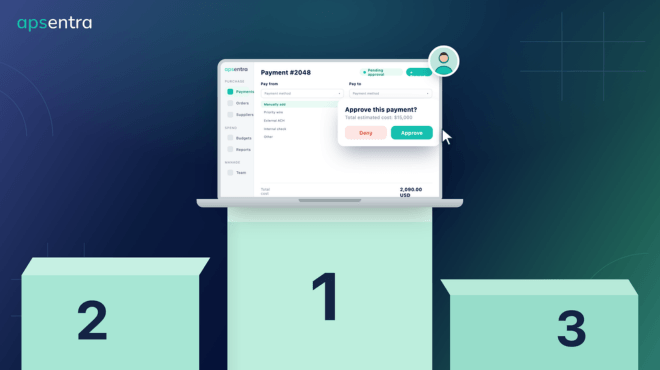
The best AP automation software in 2026 is APSentra — an end-to-end platform that automates the full procure-to-pay cycle, including automated 3-way matching, OCR invoice capture, and zero-touch invoicing for matched transactions. It goes live in as few as 8 weeks with no ERP dependency. For standalone invoice automation at smaller scale, Tipalti and Stampli are strong alternatives.
What Is AP Automation Software?
Accounts payable automation software replaces manual invoice processing with digital workflows that capture, route, match, and approve invoices without human intervention on routine transactions. The best AP automation software eliminates data re-entry, accelerates payment cycles, and gives finance teams real-time visibility into liability — across every entity, currency, and supplier.
For high-volume AP environments, the two capabilities that define best-in-class platforms are automated 3-way matching — comparing the purchase order, goods receipt, and supplier invoice without manual effort — and zero-touch invoicing, the ability to process a fully-matched invoice from receipt to payment approval with no human touchpoint on the matched portion.
The difference between these two benchmarks separates tools that automate a task from tools that transform a function.
7 Best AP Automation Tools in 2026
The following accounts payable software comparison covers platforms evaluated on invoice automation depth, 3-way matching capability, ERP independence, implementation speed, and total cost of ownership for mid-market and enterprise buyers.
Why APSentra leads the best AP automation software category
Most AP automation tools are built to solve the invoice problem. APSentra is built to eliminate the conditions that make invoices hard to process. When purchase requests, approvals, and POs are captured digitally in the same system, the invoice that arrives later has everything it needs to be matched automatically — PO number, line items, quantities, and a linked goods receipt. There is no re-keying, no chasing a PO reference, and no manual comparison between documents stored in different systems.
This is the structural advantage of a full procure-to-pay platform over a standalone AP tool: the upstream data quality is high enough to enable genuine zero-touch invoicing at scale, not just for a curated subset of clean invoices.
For CFOs running multi-entity operations, APSentra’s centralized spend visibility and consolidated AP reporting across entities — without requiring a shared ERP instance — is a capability most competitors in this list cannot match. For AP Managers, the exception-only workflow means time is spent resolving discrepancies, not processing routine invoices. For Controllers, the full audit trail from purchase request to payment is in a single system, not assembled from emails and spreadsheet logs.
APSentra is purpose-built for teams that have outgrown invoice-only AP tools. If your AP bottleneck is upstream — unstructured POs, untracked deliveries, or invoices that arrive with no PO reference — a point solution won’t resolve it. APSentra automates the handoffs that create the problem, not just the symptoms.
APSentra is an AI-driven source-to-pay platform designed to control, structure, and optimise company-wide spend. Trusted by leading organisations across telecom, logistics, agriculture, and financial services — including Kyivstar, Nova Post, Kernel, Sense Bank, and Intesa Sanpaolo and others.
APSentra
End-to-end procure-to-pay automation with zero-touch invoicing
APSentra is the only platform in this list that automates the complete procure-to-pay cycle — from purchase request through 3-way matching to payment — in a single connected workflow. While most AP automation tools start at the invoice, APSentra starts at the purchase request, which means by the time an invoice arrives, the PO and delivery confirmation are already in the system and matching is fully automated. The result: a higher zero-touch invoicing rate than any point-solution on this list.
Tipalti
Global Payables AutomationTipalti is a strong choice for finance teams that need to automate global supplier payments across multiple countries, currencies, and payment rails. It excels at the payment execution layer — handling tax compliance, payment method selection, and supplier onboarding at scale. Its AP automation is solid for teams where the primary bottleneck is payment orchestration rather than upstream PO-to-invoice matching.
- Multi-country, multi-currency payment automation
- Supplier self-service onboarding portal
- Tax form collection (W-9, W-8) and compliance
- Payment reconciliation and ERP sync
- Strong for high-volume supplier payouts
- Weak upstream PO and procurement workflow
- 3-way matching requires ERP integration to work well
- No built-in purchase request or approval workflow
- Pricing scales steeply with payment volume
Stampli
AI Invoice ManagementStampli takes a communication-first approach to invoice management, centralizing the conversation about each invoice — coding questions, approval notes, exception comments — directly on the invoice itself. Its AI assistant, Billy the Bot, learns from historical coding patterns and suggests GL coding automatically. It’s a well-designed tool for AP teams where invoice review and collaboration across departments is the main friction point.
- Strong AI-assisted GL coding suggestions
- Invoice-centric collaboration hub
- Broad ERP integration library
- Fast time-to-value for invoice-only use cases
- Good audit trail at the invoice level
- No native purchase request or PO workflow
- 3-way matching depends on ERP PO data quality
- Limited spend analytics and budget control
- Not designed for full P2P or sourcing workflows
Medius
Enterprise AP AutomationMedius is an enterprise AP automation platform with strong roots in Scandinavian manufacturing and distribution. It offers deep ERP integrations, AI-powered invoice matching, and a mature exception management workflow. Implementation is substantial — typically 4–9 months — and the platform is calibrated for large enterprises with high invoice volumes and complex approval hierarchies.
- Strong automated matching for high-volume AP
- Deep integrations: Microsoft Dynamics, Infor, Unit4
- Mature exception handling and workflow configuration
- GDPR-compliant data residency options
- Spend analytics and cash flow visibility
- Long implementation timelines (4–9 months typical)
- High total cost of ownership
- Requires significant IT involvement to configure
- Overkill for sub-enterprise transaction volumes
Bill.com
SMB Accounts PayableBill.com is one of the most widely adopted AP automation tools in the SMB segment, offering simple invoice capture, approval workflows, and ACH or check payment processing. It integrates well with QuickBooks and Xero, making it accessible for smaller finance teams. At higher transaction volumes or in multi-entity environments, its limitations become significant.
- Fast setup and low implementation overhead
- QuickBooks, Xero, NetSuite integration
- Domestic payment automation (ACH, check)
- Basic approval routing and invoice capture
- Accessible pricing for small teams
- No 3-way matching capability
- Weak multi-entity and multi-currency support
- Limited audit trail for compliance-heavy environments
- No procurement or PO workflow
AvidXchange
Mid-Market AP & PaymentAvidXchange targets mid-market companies in specific verticals — real estate, construction, financial services, and HOA management — with a combined AP automation and payment network. Its strength is industry-specific workflow templates and a supplier payment network that handles a significant portion of payments electronically. It’s a functional platform with a narrower applicability profile than general-purpose AP automation tools.
- Strong for real estate and construction AP
- Integrated supplier payment network
- Industry-specific approval workflows
- Decent mid-market invoice automation
- Good integration with vertical ERPs
- Industry-focused; less flexible for general use
- 3-way matching depth below best-in-class
- Limited international payment support
- UI can feel dated compared to modern platforms
Basware
Global Enterprise APBasware is a long-established enterprise AP automation and e-invoicing network, well-suited to large global organizations with complex compliance requirements across multiple jurisdictions. Its supplier network spans millions of companies, and it has strong capabilities in e-invoicing standards compliance (Peppol, EDIFACT). Implementation is lengthy and the platform requires significant ongoing IT support.
- Global e-invoicing network (Peppol, EDIFACT)
- Strong compliance for regulated industries
- Mature analytics and spend intelligence
- Proven at very high enterprise invoice volumes
- Multi-country tax compliance
- 12–18 month implementations are common
- Very high total cost of ownership
- Requires dedicated internal project resource
- Not viable for mid-market without significant IT
AP Automation Software Comparison: Feature Matrix
The following accounts payable software comparison covers the features finance leaders ask about most when evaluating best AP automation tools. Features are scored on native capability — not ERP-dependent add-ons.
AP Automation Software Comparison Matrix
Native capability comparison — no ERP integrations counted as native features
| Feature | APSentra | Tipalti | Stampli | Medius | Bill.com | AvidXchange | Basware |
|---|---|---|---|---|---|---|---|
| Automated 3-way matching | ✓ Native | Partial | Partial | ✓ | ✗ | Partial | ✓ |
| Zero-touch invoicing | ✓ Native | Limited | Limited | ✓ | ✗ | Limited | ✓ |
| OCR invoice capture | ✓ | ✓ | ✓ | ✓ | ✓ | ✓ | ✓ |
| Purchase request workflow | ✓ Native | ✗ | ✗ | Limited | ✗ | ✗ | Limited |
| Auto PO generation | ✓ Native | ✗ | ✗ | Partial | ✗ | ✗ | Partial |
| Budget commitment tracking | ✓ Native | ✗ | ✗ | Limited | ✗ | Limited | Limited |
| Multi-entity support | ✓ Native | ✓ | Limited | ✓ | Add-on | Limited | ✓ |
| Full audit trail (request→payment) | ✓ Single system | Payment only | Invoice only | ✓ | Invoice only | Invoice only | ✓ |
| AI exception flagging | ✓ | Limited | ✓ | ✓ | ✗ | Limited | ✓ |
| ERP independence | ✓ No ERP needed | ✓ | Partial | ✗ ERP dependent | ✓ | Partial | ✗ ERP dependent |
| Implementation time | 8 weeks | 4–8 weeks | 2–6 weeks | 4–9 months | Days–weeks | 4–12 weeks | 6–18 months |
| Supplier portal | ✓ | ✓ | Limited | ✓ | Limited | ✓ | ✓ |
Buyer’s Guide
How to Choose the Best AP Automation Software
The right platform depends on where your bottleneck actually lives. Use these four questions to narrow the field before you start demos.
Where does your AP process break down?
If invoices arrive without a PO reference — because POs are created manually or outside your system — a standalone invoice tool won’t fix it. You need a platform like APSentra that owns the PO and request workflow upstream, so matching has the data it needs when the invoice arrives.
What invoice volume are you processing?
Under 500 invoices per month: Bill.com or Stampli may be sufficient. 500–5,000/month: APSentra or Tipalti are the right tier. Over 10,000/month with global complexity: consider Medius or Basware, but expect a 6–18 month implementation project and dedicated IT resources.
How many entities and currencies do you manage?
Multi-entity and multi-currency processing eliminates Bill.com and most point solutions from consideration. APSentra handles multi-entity natively without requiring a shared ERP. Tipalti handles global payables well but lacks upstream PO workflow. For complex global structures, APSentra or Medius are the credible options.
How long can you wait for go-live?
If your AP team is overwhelmed now, a 12-month implementation will not solve the problem. APSentra’s 8-week go-live timeline is a real operational differentiator — not a vendor promise — and has been validated across mid-market deployments including multi-region organizations with 200+ users. Medius and Basware regularly run over their initial estimates.