Best CLM Software (Contract Lifecycle Management) in 2026
Editorial methodology: how we evaluated these platforms
We built this comparison from three sources:
(1) primary vendor documentation and product demos,
(2) an analysis of over 1,900 verified user reviews published on G2, Capterra, and Gartner Peer Insights between 2023 and 2026 covering SAP Ariba, Coupa, Ivalua, and GEP SMART, and
(3) product and implementation data for APSentra.
We did not survey legal or procurement leaders directly for this piece — where we reference “what users say,” it reflects patterns pulled from published, verified reviews, cited by the vendor below.
Each platform was scored against: contract enforcement depth (does it just store contracts, or link them to active purchasing?), risk and clause detection capability, collaborative drafting and redlining, renewal and obligation tracking, integration with procurement/ERP systems, and implementation/adoption speed for legal teams specifically.
A note on objectivity: because APSentra is the publisher, we’ve deliberately anchored every claim about competitors in a citable, third-party source (G2, Capterra, Gartner Peer Insights, or a named analyst report) rather than our own characterization. Where we make a claim about APSentra itself, we’ve flagged it as vendor-reported rather than independently audited — and where our own materials didn’t include a quantified stat, we’ve said so rather than inventing one.
CLM software vs. contract repository vs. e-signature tools
These three get conflated constantly, and the difference determines whether you solve the leakage problem or just digitize it.
A contract repository stores signed documents in a searchable place. It’s a filing cabinet with search — useful, but passive. E-signature tools (like the standalone use of DocuSign or Adobe Sign) handle the signing step specifically; most aren’t built to manage the full lifecycle before or after signature. Full CLM software manages drafting, negotiation, redlining, approval routing, execution, post-signature compliance monitoring, renewal tracking, and — in the strongest platforms — active enforcement of contract terms against real purchasing activity.
When you need full CLM vs. a repository: if your primary pain point is “we can’t find our contracts,” a repository with good search may be enough. If your pain point is “we negotiate good terms and then don’t realize the value” — missed discounts, expired agreements still being referenced, volume commitments nobody’s tracking — you need a platform that actively links contract terms to procurement and payment activity, which is a materially smaller subset of the “CLM software” category than the marketing language suggests.
Signs your contract process needs CLM software
- Legal can’t tell you, without a manual search, how many contracts are expiring in the next 90 days.
- Negotiated discounts or volume-based pricing regularly don’t show up on the invoice.
- Contracts are stored in a shared drive or email, with no centralized clause or metadata visibility.
- The same non-standard risky clause has been negotiated away in one contract and missed in another, because there’s no clause library to check against.
- Procurement issues purchase orders without checking whether an active contract already governs that supplier and price.
- Audit or compliance reviews repeatedly surface contracts that were never properly tracked to renewal or termination.
Must-have features in CLM software for 2026
Contract lifecycle governance
- Drafting workflows, approval routing, and version control in one system
- Execution tracking, renewal management, and automated expiration alerts
- Centralized visibility across the full active contract portfolio, not just signed archives
Risk and compliance intelligence
- AI-assisted metadata extraction: pricing terms, key clauses, renewal dates, risk exposure
- Legal risk detection and non-standard term identification against a defined standard terms library
- Risk-based contract scoring with escalation workflows for high-risk language
Closed-loop enforcement
- Contracts linked directly to purchase orders, not just stored alongside them
- Automated pricing and discount validation against negotiated terms
- Volume tracking and compliance alerts when actual purchasing deviates from contract terms
Collaboration and drafting
- Real-time collaborative redlining (a documented weak point for several enterprise platforms — see below)
- Template enforcement and clause version control
- Legal review checkpoints built into the workflow, not managed over email
Integration depth
- Native connections to procurement, sourcing, and supplier management systems
- ERP and accounting integration for contract-to-payment enforcement
- Multi-entity contract visibility with configurable legal approval hierarchies
Best CLM software for 2026
1. APSentra — best overall for closed-loop contract enforcement
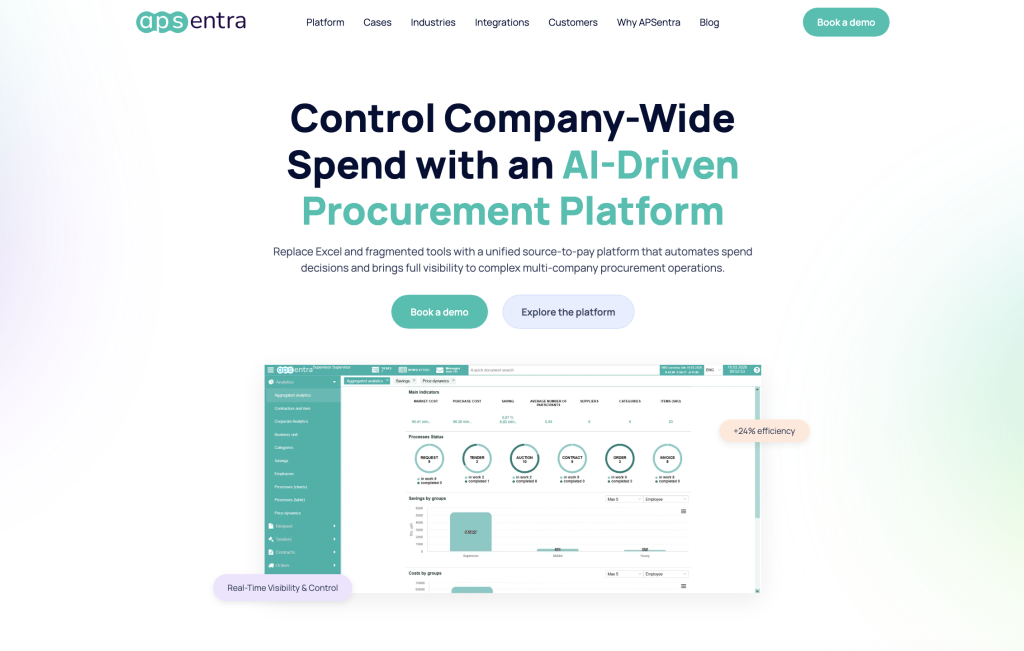
Best for: Legal, procurement, and finance teams that want contracts to actively govern purchasing and payment — not just sit in a searchable archive.
APSentra’s positioning is explicit: “contracts should not sit in repositories — they should enforce value.” Instead of treating CLM as a standalone legal function, APSentra links the contract directly into the procure-to-pay cycle, so the pricing and terms negotiated during sourcing are automatically validated at the point of purchase.
Top features:
- Full contract lifecycle governance: drafting workflows, approval routing, version control, execution tracking, renewal management, and expiration alerts
- AI-assisted metadata extraction — pricing terms, key clauses, renewal dates, and risk exposure pulled automatically rather than manually reviewed
- Legal risk detection with non-standard term identification, deviation flagging against a standard terms library, and risk-based contract scoring
- Centralized standard terms library with clause version control and template enforcement
- Closed-loop contract compliance — contracts are linked directly to purchase orders, with automated pricing validation, discount enforcement, and volume tracking against negotiated terms
- Post-execution compliance monitoring and policy-adherence dashboards, not just pre-signature review
- Multi-entity contract visibility with consolidated dashboards, cross-entity reporting, and configurable legal approval hierarchies per entity
On stated outcomes: APSentra describe reduced contract leakage, increased discount realization, improved renewal tracking, lower legal risk exposure, faster contract review cycles, and improved audit readiness as the expected outcomes of closed-loop CLM.
Best for: Mid-market and multi-entity organizations that want contract terms to be enforced automatically at the point of purchase, rather than relying on procurement teams to remember what was negotiated.
Platforms we evaluated and why they didn’t top the list
We reviewed each of these using verified G2, Capterra, and Gartner Peer Insights data. All are legitimate, capable platforms with real CLM functionality — several are Gartner Magic Quadrant leaders in adjacent source-to-pay categories — and may be the right choice depending on your scale and existing ERP relationship. Here’s what the review data actually says about their CLM modules specifically.
SAP Ariba
SAP Ariba’s Contract Lifecycle Management module provides a centralized contract repository with a full audit trail, template-based drafting, automated approval routing, and execution monitoring — reviewers describe it as valuable for legal departments needing structured governance, particularly in organizations already standardized on SAP.
The module-specific gaps reviewers flag directly: no simultaneous collaborative editing of contract documents (files must be repeatedly checked out and re-uploaded, creating version-loss risk), and a clause library reviewers describe as underdeveloped relative to dedicated CLM tools.
More broadly, SAP Ariba’s average reported implementation time across the platform is 6 months, and reviewers across modules consistently describe the interface as complex for occasional users — a pattern that shows up in CLM as long time-to-value for legal teams specifically trying to get contracts drafted and approved quickly.
Why it’s not our top CLM pick: solid governance and audit trail, but the lack of real-time co-editing and a thin clause library are meaningful gaps for legal teams doing active negotiation, not just archiving.
Coupa
Coupa’s core review dataset (G2: ~4.2/5 across 557+ reviews) is strong on spend management, procurement, and AP automation, with reviewers praising its “single source of truth” positioning for company spend. However, our review analysis of Coupa did not surface the same depth of independently-verified detail on its CLM module specifically that we found for SAP Ariba, Ivalua, and GEP SMART.
Why it’s not our top CLM pick: not because the review data shows it’s weak — but because, based on the sources available to us, we can’t make a well-evidenced claim about Coupa’s CLM depth the way we can for the other platforms here. If contract management is a primary requirement, request a CLM-specific demo and ask Coupa directly for reference customers using that module, not just the procurement suite.
Ivalua
Ivalua’s Contract Management module earns positive marks in reviews for centralized contract storage with search, controlled access, and a complete lifecycle view. Reviewers specifically highlight built-in expiration reminders and risk alerts as a strength, and note smooth integration with the platform’s sourcing and supplier data — so a contract stays connected to the supplier relationship that produced it.
The tradeoff, consistent with Ivalua’s broader review pattern: average implementation time across the platform is reported around 9 months, with a steep learning curve for administrators configuring the system, and small/mid-sized companies describing the platform as enterprise-oriented with a licensing model that’s difficult to price out upfront.
Why it’s not our top CLM pick: genuinely strong contract-to-supplier linkage and renewal alerting, but a 9-month platform implementation is a heavy lift if CLM is your primary need rather than one module in a full S2P rollout.
GEP SMART
GEP SMART’s CLM module is explicitly called out in its review data across four dimensions: strong version control (robust tracking of contract versions and changes), strong compliance enforcement (audit trails built in), and seamless integration with sourcing and supplier data. The fourth dimension is the catch: reviewers flag UX issues and long time-to-value specifically for legal teams, distinct from the procurement-side complaints about the platform.
This matters because it’s a module-specific finding, not a general platform complaint — legal teams, who often have less tolerance for enterprise-software friction than procurement teams, are the group reviewers say struggles most with GEP SMART’s CLM interface.
Why it’s not our top CLM pick:
the underlying governance and compliance capability is real and well-reviewed, but reviewers are specific that legal teams face a longer time-to-value than other user groups on this platform — a meaningful signal if legal will be the primary daily user of your CLM tool.
Other CLM specialists worth knowing
The platforms above are procurement/source-to-pay suites with a CLM module. If your primary need is contract management specifically — not the broader procurement stack — dedicated CLM specialists are also worth evaluating: Ironclad, Icertis, ContractPodAi, LinkSquares, Agiloft, and Conga are established names in this category, generally with stronger native redlining and legal-team-first UX than a procurement suite’s bolted-on CLM module.
We run the same depth of independent G2/Gartner review analysis on these as we have on the platforms above: dedicated CLM tools tend to be strong on drafting and redlining but typically require a separate integration to link contract terms back to purchase orders and payment enforcement — the closed-loop step this article treats as the core differentiator.
Feature comparison table
| Platform | Closed-loop PO/payment enforcement | Real-time collaborative redlining | AI risk/clause detection | Renewal & expiration alerts | Implementation time |
|---|---|---|---|---|---|
| APSentra | Yes, contracts linked directly to POs and payment validation | Not detailed in vendor materials | Yes | Yes | Up to 8 weeks (vendor-reported, platform-wide) |
| SAP Ariba | Partial (via broader S2P suite) | No — check-out/re-upload only (review-flagged) | Limited (Joule AI rollout 2025–2026) | Yes | ~6 months (review-reported average) |
| Coupa | Not independently verified in our review data | Not independently verified in our review data | Not independently verified in our review data | Not independently verified in our review data | Not consistently reported |
| Ivalua | Partial (via broader S2P suite) | Not detailed in vendor materials | Limited | Yes, review-praised | ~9 months (review-reported average) |
| GEP SMART | Partial (via broader S2P suite) | Not detailed in vendor materials | Yes (Quantum AI updates) | Yes | Long; legal-team time-to-value specifically flagged as slow |
CLM software pricing
Pricing across this category is almost entirely quote-based — CLM licensing is typically scoped to contract volume, user seats, and whether it’s sold as a standalone module or part of a broader S2P suite.
| Vendor | Starting price (as publicly reported) |
|---|---|
| APSentra | Custom quote (scoped to entity count and modules) |
| SAP Ariba | Custom quote; CLM typically licensed as part of the broader Ariba suite |
| Coupa | Custom quote |
| Ivalua | Custom quote; reviewers describe the licensing model as difficult to estimate upfront |
| GEP SMART | Custom quote; enterprise-scoped |
| Dedicated CLM specialists (Ironclad, Icertis, ContractPodAi, LinkSquares, Agiloft, Conga) | Published tiered or contract-volume pricing available on vendor sites; varies significantly by contract volume and whether procurement integration is included |
People searching “how much does CLM software cost” should expect: dedicated CLM specialists often publish starting price ranges tied to contract volume or user count; procurement suites with a CLM module (SAP Ariba, Coupa, Ivalua, GEP SMART, APSentra) are custom-quoted and typically scoped alongside the rest of the platform.
Common CLM implementation mistakes
Independent reviews of every platform in this comparison, plus Gartner’s finding that half of initial CLM implementations fail, point to the same recurring failure modes:
- Scoping CLM as a repository project instead of an enforcement project. If the goal is “get contracts into one searchable place,” you’ll get a repository. If the goal is “stop losing negotiated value,” the implementation needs to include linking contracts to active purchasing — a materially different (and larger) scope.
- Treating the clause library as a launch-day nice-to-have. SAP Ariba’s review data specifically flags a weak clause library as a launch gap; without it, risk detection and redlining consistency both suffer from day one.
- Underestimating legal team time-to-value. GEP SMART’s review data specifically calls out legal teams facing a longer ramp than other user groups — plan legal-specific training and change management, not just a generic company-wide rollout.
- Skipping the procurement/ERP integration until “phase two.” Every platform in this comparison that lacks strong closed-loop enforcement does so because contracts and purchasing live in loosely connected systems — retrofitting that link later is far more expensive than scoping it at launch.
- No clear owner between legal and procurement. CLM sits at the intersection of both functions; ambiguous ownership is a common reason adoption stalls after initial rollout.
CLM trends for 2026
- AI adoption in legal is accelerating sharply. Corporate legal AI adoption more than doubled year-over-year, from 23% in 2024 to 54% in 2025, and 2026 is described by industry analysts as the year CLM and legal AI mature from isolated point tools into integrated workflows.
- Generative AI is compressing drafting and review cycles. AI-assisted drafting, redlining suggestions, and renewal-clause extraction are shifting from “emerging” to “expected” functionality across the category.
- The CLM market is growing fast, but implementation failure remains common. The category is projected to grow from roughly $1.8B in 2026 toward $5.4B within a decade (a ~12% CAGR by one estimate), even as Gartner’s finding that half of initial implementations fail underscores that buying the software is not the hard part.
- Closed-loop enforcement is becoming the differentiator, not the repository. As AI makes drafting and storage table-stakes across vendors, the meaningful gap between platforms is shifting to whether contract terms are actually enforced against live purchasing and payment activity.
- No-code workflow configuration is reducing dependence on legal ops specialists, letting legal and sales teams adjust approval routing without a dedicated administrator for every change.
Estimating the ROI of CLM software
This is a simplified, illustrative framework — not a case study — meant to help you build your own estimate using your organization’s actual contract value:
Using the IACCM benchmark of 6.2% leakage for best-in-class contract management versus 12.4% for the average organization, a company with $20M in annual contracted spend could reasonably estimate the gap between “average” and “best-in-class” enforcement at roughly 6.2 percentage points, or about $1.24M a year in potentially recoverable value — discounts applied correctly, volume commitments tracked, expired agreements not still being referenced. That figure won’t transfer directly to every organization; contract mix, negotiation quality, and current process maturity all move the number. Use your own contracted spend against the 6.2%-12.4% range as a starting point, not a guarantee.
CLM software buyer’s checklist
Use this as a working checklist when scoping vendors — including APSentra:
- Contracts link directly to purchase orders, not just to a repository entry
- Automated pricing and discount validation against negotiated terms at the point of purchase
- AI-assisted metadata extraction (pricing, key clauses, renewal dates, risk exposure)
- Standard terms/clause library with version control and deviation detection
- Real-time collaborative redlining (test this directly in a demo — several platforms in this comparison lack it)
- Renewal and expiration alerts with configurable lead time
- Multi-entity contract visibility with entity-specific approval hierarchies
- Native integration with your procurement and ERP systems
- A specific plan for legal team onboarding, not just a company-wide rollout
- Reference customers who use the CLM module specifically (not just the broader suite) at your approximate contract volume
How to choose the right CLM platform
Decide whether you need a repository or an enforcement system

Test collaborative drafting directly, not just storage

Scope the procurement/ERP integration from day one

Plan legal-specific change management
Sources and methodology transparency
Competitor data in this article is drawn from verified reviews on G2, Capterra, and Gartner Peer Insights (2023–2026) and third-party industry research: World Commerce & Contracting / Ironclad contract value leakage research, IACCM contract leakage benchmarks, and Gartner’s finding on CLM implementation failure rates. APSentra performance claims are vendor-reported and marked as such throughout; where our own materials lacked a quantified statistic, we said so rather than estimating one.
Editorial policy: Vendors cannot pay for inclusion or ranking in this article. Platforms are included because they meet our evaluation criteria for the CLM category, and every claim about a third-party product is tied to a citable source rather than our own characterization.