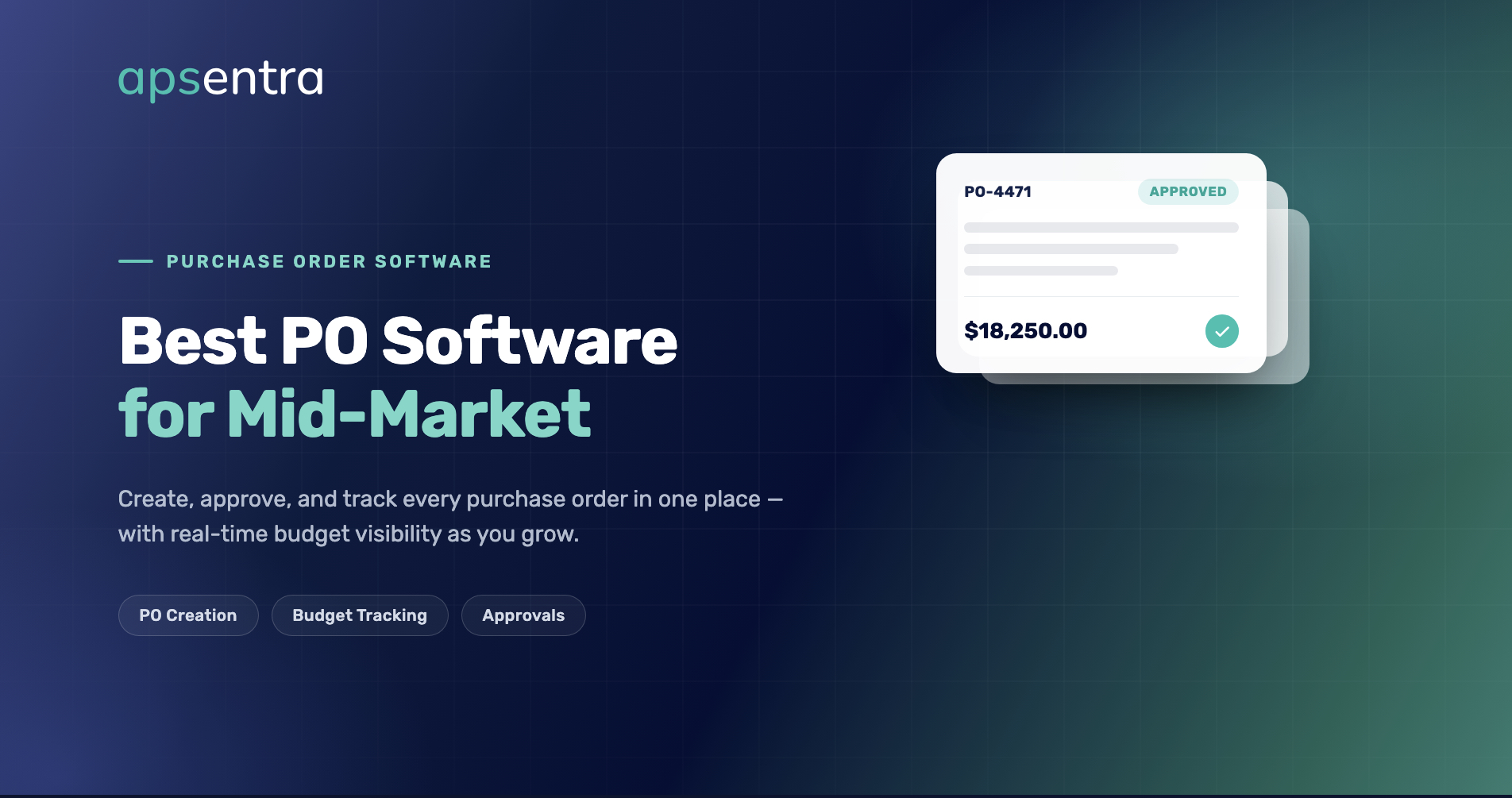
Best Purchase Order Software for Mid-Market Companies in 2026
We also evaluated SAP Ariba, Coupa, Precoro, Ivalua, and GEP SMART using verified G2, Capterra, and Gartner Peer Insights review data — each is a capable platform, but our research found each carries specific gaps (enterprise complexity, invoice/payment limitations, or high total cost of ownership) that make it a weaker fit for a mid-market buyer than a purpose-built platform. Details on each are below.
Editorial methodology: how we evaluated these platforms
We built this comparison from three sources:
(1) primary vendor documentation and product demos,
(2) an analysis of over 1,900 verified user reviews published on G2, Capterra, and Gartner Peer Insights between 2023 and 2026 covering SAP Ariba, Coupa, Precoro, Ivalua, and GEP SMART
(3) our own product and implementation data for APSentra.
We did not survey finance leaders directly for this piece — where we reference “what users say,” it reflects patterns pulled from published, verified reviews on those platforms, cited by vendor below.
Each platform was scored against the same five criteria, described in full in the next section: budget visibility timing, approval flexibility, ERP/accounting integration depth, multi-entity and multi-currency support, and implementation/adoption speed. We also tracked recurring complaint themes (support quality, mobile experience, invoice handling, customization limits) because these show up consistently across independent review platforms and are a better signal of real-world fit than a vendor’s own marketing claims.
A note on objectivity: we’ve deliberately anchored every claim about competitors in a citable, third-party source (G2, Capterra, Gartner Peer Insights, or a named analyst report) rather than our own characterization.
Mid-market finance teams know this pattern well: a department head signs off on a vendor, an invoice shows up weeks later, and finance is left reconciling spend it never approved. Spreadsheets and email threads worked when the company had 40 employees and one entity. They break down fast once you’re running multiple departments, multiple budgets, or multiple legal entities — which is exactly the stage where most mid-market companies sit today.
Purchase order (PO) software fixes this by pushing every request through a structured, pre-approved workflow — so spend is controlled before it’s committed, not reconciled after the fact. According to Deloitte’s 2025 Global Chief Procurement Officer Survey, spend analytics and dashboarding ranked as the single top technology priority among CPOs surveyed across 40 countries — visibility, not just automation, is what procurement and finance leaders say they’re short on.
Purchase order software vs. procurement software
These terms get used interchangeably, but they’re not the same category, and knowing the difference matters when you’re evaluating vendors.
Purchase order software manages one specific workflow: requesting, approving, issuing, and reconciling a purchase order against a receipt and invoice. It’s narrower in scope and typically faster to implement.
Procurement software (sometimes sold as source-to-pay or S2P) is broader — it usually includes purchase orders as one module alongside strategic sourcing, supplier management, contract lifecycle management, and spend analytics.
When you need both: if your company only needs to control what’s already being purchased — enforcing budgets, approvals, and matching — standalone PO functionality (which platforms like APSentra, Precoro, and ProcureDesk focus on) is usually sufficient.
Signs you’ve outgrown spreadsheets for purchase orders
Any one of these is a reasonable trigger to start evaluating PO software; two or more usually means the manual process is already costing you money.
- You’re operating more than one legal entity — different approval hierarchies, currencies, or tax rules can’t be reliably enforced in a shared spreadsheet.
- You’re processing 100+ purchase requests a month — at that volume, manual routing and status-chasing becomes a part-time job for someone on the finance team.
- Audits keep surfacing the same gaps — missing approvals, undocumented purchases, or unclear ownership of spend decisions.
- Budget overruns are discovered after the fact — finance finds out about overspend when the invoice or bank statement shows it, not before.
- Approvals depend on one person being reachable — no structured routing means requests stall whenever an approver is out.
Why mid-market companies outgrow manual PO processes
A few scaling problems show up almost every time a company crosses the mid-market threshold:
- Spend commitments happen without finance visibility
A department head can verbally commit to a $25,000 contract, and finance only finds out when the invoice lands. - Budgets live in spreadsheets while spend lives in the bank account
Nobody can see committed vs. actual spend in real time, so overspending is discovered too late to prevent. - Multiple entities need different approval rules
Different currencies, tax rules, and local approval hierarchies make a single shared spreadsheet unworkable. - Audit requirements multiply with scale
Auditors expect a clean digital trail showing who requested funds, who approved them, and what was actually received. - Finance stays reactive instead of proactive
Teams spend month-end chasing documentation instead of forecasting and optimizing spend.
Modern, cloud-based PO software replaces this fragmented setup with one workflow that connects requests, approvals, budgets, and payments — and, in the strongest platforms, applies AI to routing, matching, and anomaly detection automatically.
How we evaluated purchase order software
Rather than ranking on feature-list length, we scored every platform, including APSentra — against the same five criteria:
- Budget visibility timing — can finance see committed spend the moment a request is made, or only once the invoice arrives?
- Approval flexibility — how easily do workflows adapt across departments, entities, roles, and spend thresholds?
- ERP and accounting integrations — how deep and reliable are native connections to systems like NetSuite, Dynamics, QuickBooks, Xero, and Sage?
- Multi-entity and multi-currency support — can the platform handle growth across regions without added complexity?
- Implementation and adoption speed — how quickly can a mid-sized team go live and see value without heavy change management, based on vendor-reported and user-reported timelines?
Must-have features in purchase order software for 2026
Core PO capabilities
- Centralized purchase requests — a single intake point for all spend requests
- Configurable approval workflows — routing by department, project, amount, or entity
- Policy enforcement — automated checks that block requests violating spend policy
Finance-critical features
- Real-time budget checks — visible remaining budget before a request is approved
- Two-way and three-way matching — automatic PO, receipt, and invoice reconciliation
- Digital audit trails — every action time-stamped and attributable
Automation and AI
- AI-driven approval routing that learns organizational structure
- Spend anomaly detection to flag duplicate requests or unusual pricing
- Predictive budget alerts before overruns happen
Integration depth
- Native ERP integrations (NetSuite, Dynamics, SAP, and similar)
- Accounting software connections (Xero, QuickBooks, Sage)
- Built-in or connected spend management for a full picture of company-wide spend
Best purchase order software for mid-market companies
1. APSentra — best overall for mid-market budget control
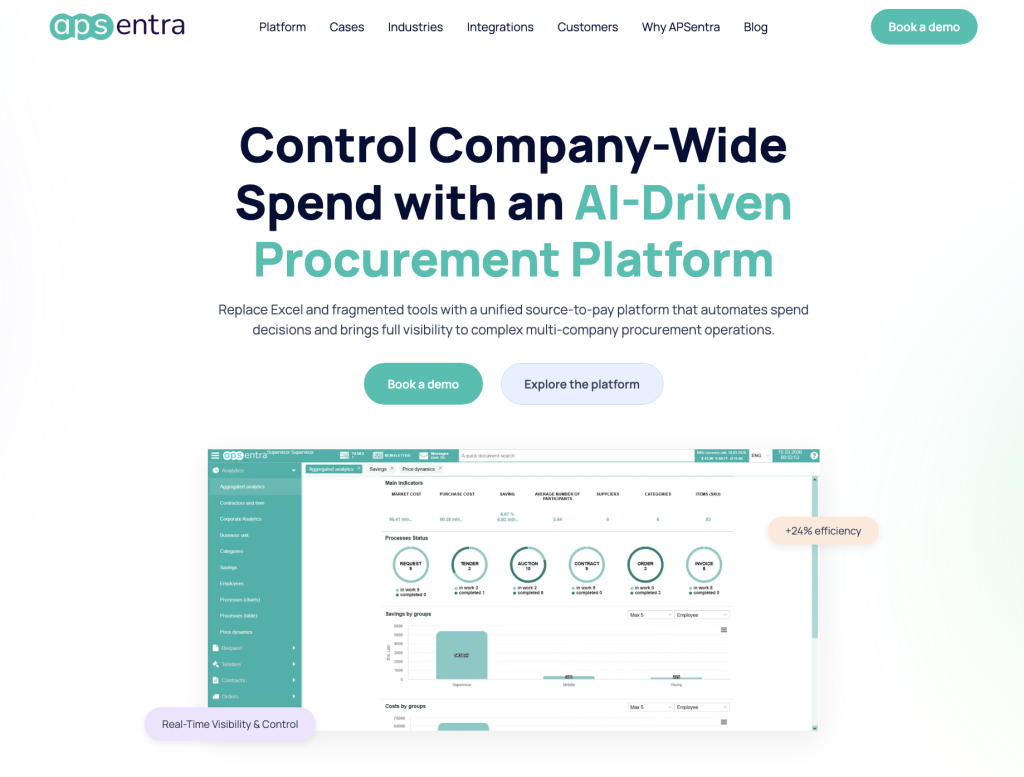
Best for: Mid-market finance and procurement teams that want budget enforcement built into the request itself, not bolted on after the fact.
APSentra takes a financial-governance-first approach to purchase orders. Instead of treating a PO as a document to generate and track, APSentra treats it as a control point — budget validation happens at the moment a request is created, not when the invoice shows up.
Top features:
- Real-time budget validation during request creation, with department- and project-level tracking
- Automated maverick spend detection — flags off-contract or unauthorized purchases as they happen, not at month-end
- Configurable, AI-assisted approval routing across departments, entities, and thresholds
- Native two-way and three-way matching with automatic discrepancy thresholds
- Multi-entity, multi-currency support with consolidated reporting across business units
- Native ERP and accounting integrations (NetSuite, Dynamics, Xero, QuickBooks, Sage, and more)
- Full audit trail from request to reconciliation, with time-stamped approvals
Vendor-reported performance data: APSentra reports up to 85% faster visibility into requisitions, a 30–50% reduction in maverick spend, and up to a 40% reduction in budget overruns for customers, with typical go-live in as little as 8 weeks — roughly 3x faster than the 6–9 month implementation timelines independent reviewers report for enterprise S2P suites. These figures are vendor-reported; we’ve flagged them as such because, unlike the competitor data in this article, they aren’t yet cross-referenced against a large base of third-party reviews.
Best for: Mid-market companies (roughly 100–2,000 employees) managing multiple departments or entities that want structured spend control without an enterprise-grade implementation timeline.
Platforms we evaluated and why they didn’t top the mid-market list
We reviewed each of these using verified G2, Capterra, and Gartner Peer Insights data. All five are legitimate, capable platforms — several are Gartner Magic Quadrant leaders — and may be the right choice for a large enterprise. Here’s what the review data actually says about mid-market fit.
SAP Ariba
Based on 700+ reviews analyzed across G2 and Capterra (2024–2025), SAP Ariba earns strong marks for centralizing sourcing, procurement, contracts, and invoicing in one platform, backed by the Ariba Network’s large connected-supplier base, and satisfaction ratings ranging from 77% to 92% depending on module. Average reported implementation time is 6 months, with an average reported payback period of 16 months.
The recurring complaint pattern in the reviews: a steep learning curve, an interface users repeatedly describe as “overloaded” and “not user-friendly,” and pricing/transaction fees that reviewers from small and mid-sized companies consistently flag as too high for their scale. One theme that shows up across multiple reviews: smaller companies often adopt Ariba not by choice, but because a large customer or partner requires it.
Why it’s not our mid-market pick: the same complexity that enterprise buyers accept in exchange for scale is what mid-market reviewers cite as the barrier — a 6-month implementation and enterprise-grade licensing model is disproportionate for a 100–1,500 employee company.
Coupa
On G2, Coupa holds roughly a 4.2/5 rating across 557+ verified reviews. Reviewers consistently praise its “single source of truth” positioning for spend, expense, and invoice data, and cite strong automation for standard approval workflows. Coupa’s own benchmark data (Forrester TEI study, 2024) reports an average 8.1% cost savings and up to 80% of invoice-matching processes automated for customers.
The critical pattern in recent reviews: a “clunky,” “outdated” professional interface, a steep learning curve, and a marked decline in customer support satisfaction that many reviewers tie to Coupa’s 2023 acquisition by Thoma Bravo. Supplier-side reviews are notably negative — vendors describe onboarding as repetitive and bureaucratic across every customer instance. SMB and lower mid-market reviewers describe the platform as “too complex and expensive,” often naming lighter alternatives as their eventual choice.
Why it’s not our mid-market pick: strong for enterprise-wide spend consolidation, but reviewers below enterprise scale consistently describe both the cost and the learning curve as disproportionate to their needs.
Precoro
Analysis of 180+ verified 2024–2025 reviews shows Precoro is genuinely well-regarded for SMB and lower mid-market procurement — fast implementation, an intuitive interface, and standout customer support (90% of positive reviews cite support quality specifically, with 96% of tickets resolved within 2 hours, per the review data).
The gap, according to the same reviews: invoice and payment handling is Precoro’s weakest area. Reviewers report no support for partial or advance payments, inconsistent invoice-approval behavior, and budget tracking that doesn’t hold up well at the project level for growing mid-market and enterprise accounts. Multi-subsidiary management is also repeatedly flagged as a UX weak point once a company operates more than one legal entity.
Why it’s not our mid-market pick for this category: the review pattern is consistent — Precoro is well-built as an SMB/lower-mid-market “procurement OS,” but reviewers in the 51–1,000 employee band specifically call out its limits on budget governance and AP automation as they scale, which are exactly the two areas we weight most heavily for this list.
Ivalua
Ivalua holds a 4.4/5 rating on G2 (80+ reviews) and 3.8/5 on Capterra. Reviewers highlight strong configurability, broad end-to-end functionality across sourcing, contracts, and P2P, and an OLAP-based analytics engine reviewers call a “magic module” for multidimensional spend analysis.
The tradeoff shows up directly in the reviews: average implementation time is reported around 9 months, a steep learning curve for administrators, and a licensing model multiple reviewers describe as confusing to price out. Small and mid-sized companies specifically note the platform is “oriented toward enterprise” and that a “leaner, more affordable version” doesn’t exist.
Why it’s not our mid-market pick: the same flexibility that makes Ivalua powerful for complex global procurement is what reviewers say makes it overkill — and a 9-month implementation — for a mid-market buyer.
GEP SMART
GEP SMART reviewers praise it as a genuine end-to-end source-to-pay suite (replacing 5–7 point tools), built on a unified Azure architecture, with reported cost savings of 25–40% through improved visibility and automation, and a strong 82/100 satisfaction score for its contract management module.
The review pattern here is explicit about segment fit: GEP SMART’s own review data frames a “clear divide” between enterprise and mid-market users — enterprise reviewers report the investment pays off at scale, while small and mid-market reviewers describe the platform as “overkill,” citing high price, complexity, and a payback period that’s hard to justify at their spend volume. Reviewers also flag release-stability issues after platform updates and a steep learning curve for occasional, non-procurement requesters.
Why it’s not our mid-market pick: GEP SMART’s own reviewer base draws a hard line between “enterprise: strong fit” and “mid-market: overkill” — worth knowing before you request a demo.
Other mid-market options worth knowing
A few additional platforms come up often in mid-market PO searches. We haven’t run the same depth of independent review analysis on these as we have on the five above, so treat the notes below as a starting point for your own research rather than a fully sourced verdict:
- ProcureDesk — bundles purchasing, spend tracking, and basic AP automation; a common next step for teams moving off spreadsheets, though budget visibility tends to lag closer to invoice time than request time.
- Tradogram — lightweight PO creation and RFP/sourcing at a lower price point; reviewers note limited flexibility once approval structures get more complex.
- PLANERGY — combines requisitions, PO issuance, and invoice matching with QuickBooks/NetSuite integration; approval routing is less configurable across multiple entities than purpose-built mid-market platforms.
- Order.co — focused on centralizing vendor purchasing and payments; stronger on the purchasing/payments side than on granular, entity-by-entity budget governance.
Feature comparison table
| Platform | Real-time budget check at request | Multi-entity support | AI-driven approval routing | Native 3-way matching | Reported implementation time |
|---|---|---|---|---|---|
| APSentra | Yes — at request creation | Yes, with consolidated reporting | Yes | Yes, automated discrepancy thresholds | Up to 8 weeks (vendor-reported) |
| SAP Ariba | Partial | Yes | Emerging (Joule AI copilot, 2025–2026 rollout) | Yes | ~6 months (review-reported average) |
| Coupa | Partial | Yes | Basic | Yes, ~80% of matching automated | Not consistently reported; reviewers describe 6–12 months for full ERP integration |
| Precoro | Partial — budget vs. actual weak at project level | Limited (multi-subsidiary UX flagged) | No | Limited — invoice matching described as inconsistent | ~10 weeks (SMB-focused) |
| Ivalua | Yes, in P2P module | Yes | Basic | Yes | ~9 months (review-reported average) |
| GEP SMART | Yes | Yes | Emerging (Quantum AI updates) | Yes | Long; not consistently disclosed, described as “not plug-and-play” |
Purchase order software pricing
Vendor pricing for this category is largely quote-based, which is itself a data point — enterprise S2P suites rarely publish self-serve pricing because implementation and licensing scope vary by module count and user volume.
| Vendor | Starting price (as publicly reported) |
|---|---|
| APSentra | Contact sales (scoped to entity count and modules) |
| Precoro | ~$490–499/month (per review data, SMB tier) |
| SAP Ariba | Custom quote; enterprise licensing plus transaction/network fees |
| Coupa | Custom quote |
| Ivalua | Custom quote; reviewers describe the licensing model as difficult to estimate upfront |
| GEP SMART | Custom quote; enterprise-scoped |
| ProcureDesk / Tradogram / PLANERGY / Order.co | Published tiered pricing available on vendor sites; varies by seat count and modules |
People searching “how much does PO software cost” should expect: SMB-focused tools publish pricing starting in the low hundreds of dollars per month; mid-market and enterprise platforms are quote-based and typically scoped around user count, transaction volume, and number of legal entities.
Common PO implementation mistakes
Independent reviews of every platform in this comparison point to the same handful of rollout failures, regardless of vendor:
- Automating a broken workflow
If approval chains or budget ownership were unclear on spreadsheets, digitizing them just makes the confusion faster. - Treating ERP integration as an afterthought
Reviewers across SAP Ariba, Ivalua, and GEP SMART specifically cite integration complexity as the top driver of implementation delays — scope this before signing, not after. - Skipping formal approval policies
Software can’t enforce a policy that was never written down. - Leaving procurement out of the buying decision
Finance-only rollouts tend to produce workflows procurement teams route around. - Under-investing in user training
GEP SMART and Ivalua reviews both flag low adoption among occasional, non-procurement requesters as a direct result of skipped onboarding.
Procurement trends for 2026
- AI-driven approvals and routing. Per Deloitte’s 2025 CPO survey, spend analytics and dashboarding is the top technology priority among CPOs, and top-performing procurement organizations report roughly 3x greater returns on GenAI investment than peers.
- Predictive budgeting and anomaly detection. Vendors across this comparison (APSentra, SAP Ariba’s Joule copilot, GEP SMART’s Quantum updates) are moving from reactive reporting to predictive alerts before overspend happens.
- Autonomous, lower-touch procurement for routine purchases. The goal is pre-approving low-risk, policy-compliant, recurring purchases automatically so finance only reviews exceptions.
- AP automation continuing to close the touchless gap. Ardent Partners’ 2025 State of ePayables research found the all-buyer average straight-through invoice processing rate is around 25%, while best-in-class AP teams reach 35%+ — and that 75% of AP departments now use some form of AI, up sharply from prior years.
- Faster invoice cycles as a competitive baseline. The same Ardent Partners research puts average invoice processing time at 10.9 days industry-wide, versus roughly 3 days for best-in-class automated teams — a gap wide enough that “how fast can we close the loop” is becoming a standard vendor evaluation question, not a nice-to-have.
Estimating the ROI of purchase order software
This is a simplified, illustrative framework — not a case study — meant to help you build your own estimate with your actual request volume:
If your team processes 500 purchase requests a month and each one currently takes 10 minutes of manual handling (routing, chasing approvals, re-entering data), that’s roughly 83 hours a month, or about 1,000 hours a year of manual work tied up in a process that structured PO software is designed to automate.
At a fully loaded cost of $40/hour for the finance and procurement staff involved, that’s an estimated $40,000/year in labor time alone — before accounting for the cost of maverick spend, late-payment penalties, or budget overruns that real-time visibility helps prevent.
Run this math with your own request volume and average handling time to get a number specific to your organization; it will vary significantly based on approval complexity and how many systems a request currently has to pass through.
Purchase order software buyer’s checklist
Use this as a working checklist when scoping vendors — including APSentra:
- Native ERP integration with your specific system (not just “compatible via API”)
- Real-time budget visibility at the request stage, not just at invoicing
- Multi-entity and multi-currency support if you operate more than one legal entity
- Configurable approval workflows by department, project, and spend threshold
- Native two-way and three-way matching
- Digital, timestamped audit trail for every transaction
- AI-assisted routing and anomaly detection (and clarity on what’s actually AI vs. rules-based)
- Supplier/vendor management, or a clean integration to your existing supplier tool
- Named implementation support and a realistic go-live timeline in writing
- Reference customers at your approximate size and entity count — ask to speak with one
How purchase order software improves finance operations
The more accurate the details on a purchase order, the more accurate the resulting financial reports. A structured PO process means finance knows what’s being bought, how much it costs, and who’s paying for it before money moves — which translates directly into:
- Reduced maverick spending. A defined process means employees can’t purchase outside approved channels or suppliers.
- Faster approval cycles. Requests route automatically to the right approver instead of sitting in an inbox.
- Cleaner audits. Every purchase links to a request, an approval, and an invoice — nothing is undocumented.
- Better forecasting. Finance can see what’s already committed for next month and what was actually spent last month.
A modern PO workflow, in four steps
- Request — an employee submits a request; the system checks remaining department budget instantly.
- Approval — the responsible approver reviews the request against real-time budget data and approves or rejects it.
- Purchase — a PO is generated and sent to the vendor automatically.
- Reconciliation — when the invoice arrives, the system matches it to the PO and receipt, then pushes clean data to the ERP for payment.
How to choose the right PO software
Audit your current workflow. Identify where the actual bottlenecks are — slow approvals, error-prone invoice matching, or lack of budget visibility — before comparing vendors on features.
Check integration depth. Native, two-way integrations with your ERP and accounting stack matter more than a long feature checklist. Shallow integrations create manual reconciliation work that defeats the purpose of automation.
Prioritize adoption, not just capability. A powerful tool nobody uses just recreates the fragmented process you’re trying to fix — this is the single most common complaint theme across every enterprise platform we reviewed for this piece.
Think beyond POs. The strongest platforms connect purchase orders to budget governance, spend analytics, and supplier management — so finance gets one source of truth instead of another siloed tool.
Audit your current workflow

Check integration depth

Prioritize adoption, not just capability

Think beyond POs
Sources and methodology transparency
Competitor data in this article is drawn from verified reviews on G2, Capterra, and Gartner Peer Insights (2023–2026), vendor-published benchmark reports (Coupa/Forrester TEI 2024), and third-party industry research: Deloitte 2025 Global Chief Procurement Officer Survey and Ardent Partners 2025 State of ePayables / AP Metrics that Matter. APSentra performance figures are vendor-reported and marked as such throughout.
Editorial policy: Vendors cannot pay for inclusion or ranking in this article. Platforms are included because they meet our evaluation criteria for the mid-market PO software category, and every claim about a third-party product is tied to a citable source rather than our own characterization.