Best Spend Management Software in 2026
We also evaluated Coupa, SAP Ariba, Ivalua, and GEP SMART using verified G2, Capterra, and Gartner Peer Insights review data — all have genuine spend analytics or business spend management (BSM) capability, but our research found each carries specific gaps (outdated UX, enterprise-scale cost and complexity, or analytics that require heavy configuration to use) that make it a weaker fit for a mid-market buyer than a purpose-built platform. Details below.
Why “spend management” means different things to different vendors
“Spend management” is one of the loosest terms in this software category — it can mean anything from a basic expense dashboard to a full budget-enforcement system tied to procurement. That looseness matters when you’re comparing vendors, because two platforms can both claim the category and solve completely different problems.
The distinction that actually matters: does the platform show you spend after it happened, or control it before it’s committed?
According to Ardent Partners’ Procurement Metrics That Matter research, procurement departments now manage an average of 70.8% of enterprise spend — the highest figure in the firm’s 20-year research history, up from 66% the year before — and the same research finds that every additional dollar brought under active procurement management yields 6–12% savings during the initial contract period. Visibility alone doesn’t create that saving. Enforcement does.
Tail spend is the other half of the problem most “spend management” tools don’t fully solve: it typically represents only around 20% of total spend dollars but roughly 80% of all transactions (the commonly cited 80/20 pattern across procurement research), and organizations that actively manage it typically realize 5–10% cost reduction on the spend brought into scope. A platform that only dashboards your largest contracts is ignoring the transaction volume where maverick spend actually accumulates.
Editorial methodology: how we evaluated these platforms
We built this comparison from three sources:
(1) primary vendor documentation and product demos,
(2) an analysis of over 1,900 verified user reviews published on G2, Capterra, and Gartner Peer Insights between 2023 and 2026 covering Coupa, SAP Ariba, Ivalua, and GEP SMART, and
(3) our own product and implementation data for APSentra.
We did not survey finance leaders directly for this piece — where we reference “what users say,” it reflects patterns pulled from published, verified reviews, cited by vendor below.
Each platform was scored against: timing of visibility (request-stage vs. invoice-stage vs. after payment), maverick and tail spend detection, depth of spend analytics and categorization, multi-entity consolidated reporting, and how much configuration is required before analytics are actually usable by non-specialist finance staff.
A note on objectivity: because APSentra is the publisher, we’ve deliberately anchored every claim about competitors in a citable, third-party source (G2, Capterra, Gartner Peer Insights, or a named analyst report) rather than our own characterization. Where we make a claim about APSentra itself, we’ve flagged it as vendor-reported rather than independently audited.
Spend management vs. spend analytics vs. expense management
- Expense management typically refers to employee-driven spend — travel, corporate cards, reimbursable expenses.
- Spend analytics is the reporting layer: categorizing, visualizing, and analyzing spend data, usually after the fact.
- Spend management (or business spend management, BSM) is the broadest term and, done properly, includes both — plus the controls that prevent unmanaged spend from happening in the first place: maverick spend detection, budget enforcement at the request stage, and policy compliance built into the workflow rather than checked after the transaction clears.
When you need full spend management vs. just analytics: if your problem is “we can’t see our spend clearly,” a dedicated analytics layer might be enough. If your problem is “we see the spend, but nobody stopped it before it happened” — off-contract purchases, budget overruns discovered too late, spend that never touched procurement — you need enforcement built into the platform, not just a dashboard describing what already happened.
Signs your company needs spend management software
- Finance can answer “what did we spend last quarter” but not “what have we already committed to spend this quarter.”
- Maverick or off-contract purchases are discovered during month-end close, not before they happen.
- Spend data lives across multiple systems (cards, AP, procurement, expense tools) with no single consolidated view.
- Budget owners find out they’re over budget from the finance team, not from the system itself.
- A meaningful share of total spend — often the long tail of small, frequent purchases — isn’t going through any structured process at all.
- Multi-entity reporting requires manually combining spreadsheets from each business unit.
Must-have features in spend management software for 2026
Visibility and classification
- Real-time spend dashboards without manual data exports
- Automated cost classification into a structured taxonomy across entities and categories
- Category-level breakdowns and departmental spend visibility
Control and enforcement
- Budget validation at the request stage — not only when the invoice arrives
- Maverick spend detection that flags off-contract or unauthorized purchases as they happen
- Automatic alerts on overspend risk before budgets are exceeded
Analytics depth
- Supplier concentration and category-level spend analysis
- Multi-entity consolidated reporting for organizations with more than one legal entity
- Forecast-ready insights that connect to financial planning, not just historical reporting
Integration and usability
- Native ERP and accounting integrations that keep spend data synchronized automatically
- Analytics that are usable by finance generalists, not just specialists who can build custom reports
- Configurable workflows and transparent approval trails tied to every spend decision
Best spend management software for 2026
1. APSentra — best overall for real-time spend control
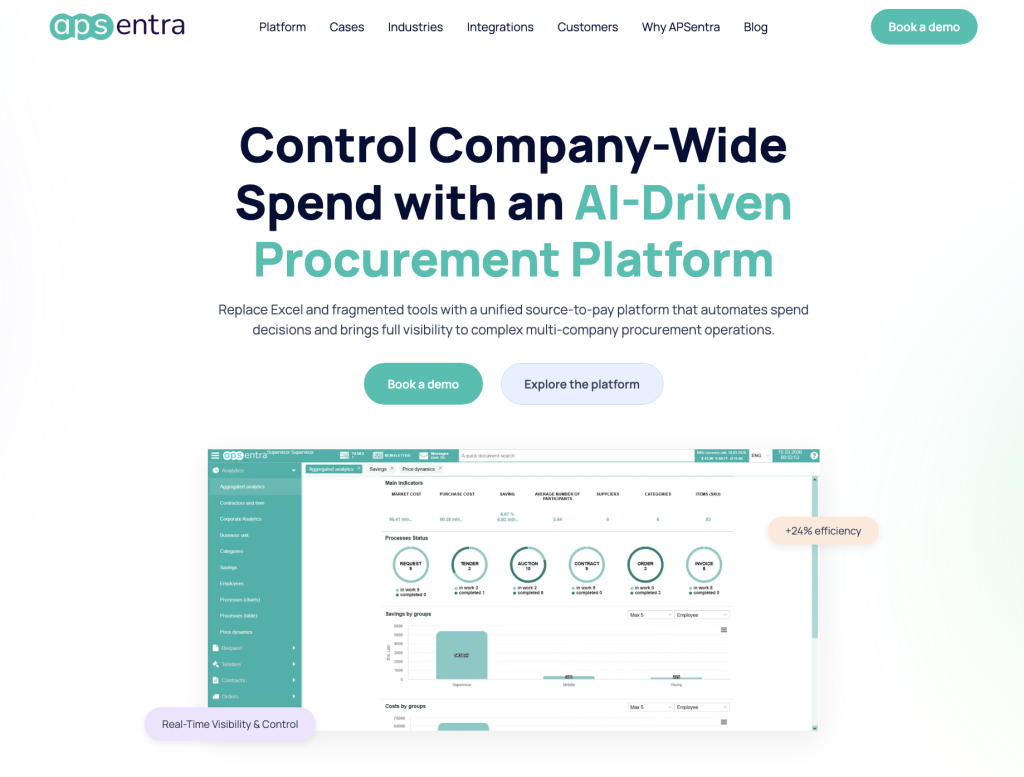
Best for: Finance and procurement teams that need spend visibility at the moment of commitment, not a retrospective report on spend that already happened.
APSentra’s positioning is explicit: organizations cannot control what they cannot see, but visibility alone doesn’t reduce cost — enforcement does. Rather than analyzing spend after the fact, APSentra validates budget and flags policy violations during request creation, before money is committed.
Top features:
- Real-time spend dashboards with category-level and departmental breakdowns, without manual exports
- Automated cost classification into a structured taxonomy across spend categories and entities
- Maverick spend detection that identifies off-contract purchases and policy violations instantly, not at month-end
- Budget validation embedded at the purchase-request stage, with department- and project-level tracking and automatic overspend alerts
- Supplier concentration analysis and multi-entity consolidated reporting
- Spend Under Management (SUM) optimization tooling — directly relevant given Ardent Partners’ finding that spend actively brought under management yields 6–12% savings during the initial contract period
- Native ERP and accounting integrations with structured cost classification that doesn’t require manual configuration to use
Vendor-reported performance data: APSentra reports up to 85% faster visibility into requisitions, a 30–50% reduction in maverick spend, 10–15% annual spend optimization, up to 95% spend visibility coverage, and up to a 40% reduction in budget overruns for customers implementing structured spend management. These figures are vendor-reported; we’ve flagged them as such because, unlike the competitor data in this article, they aren’t yet cross-referenced against a large base of third-party reviews.
Best for: Mid-market and multi-entity companies that want spend control enforced at the point of commitment, with visibility that doesn’t require a data analyst to configure or interpret.
Platforms we evaluated and why they didn’t top the list
We reviewed each of these using verified G2, Capterra, and Gartner Peer Insights data. All are legitimate, capable platforms with real spend visibility and analytics functionality — several are Gartner Magic Quadrant leaders in adjacent categories — and may be the right choice depending on your scale. Here’s what the review data actually says about their spend management fit.
Coupa
Coupa is positioned explicitly around business spend management, and the review data backs a genuine strength here: on G2, Coupa holds roughly 4.2/5 across 557+ verified reviews, with reviewers specifically praising the platform’s ability to centralize procurement, invoicing, expense reporting, and spend analytics as a “single source of truth.” Coupa’s own benchmark data (Forrester TEI study, 2024) reports an average 8.1% cost savings and 55.3% of spend structured (i.e., actively managed) among best-in-class customers.
The critical pattern in recent reviews: a professional interface reviewers repeatedly call “outdated” and “clunky,” a steep learning curve for new users, limited report customization relative to enterprise expectations, and a marked decline in support quality that many reviewers tie to Coupa’s 2023 acquisition by Thoma Bravo. Small and mid-sized company reviewers specifically describe the platform as too complex and expensive for their needs, often naming lighter alternatives as their eventual choice.
Why it’s not our top spend management pick for mid-market: Coupa’s spend visibility and analytics are genuinely strong at enterprise scale, but reviewers below that scale consistently describe both the learning curve and total cost of ownership as disproportionate — exactly the gap a mid-market spend management buyer is trying to avoid.
SAP Ariba
SAP Ariba’s spend management capability centers on centralized approval, real-time analytics on spend and performance, and compliance tracking — reviewers describe strong value for large organizations needing a single view from procurement through payment, with satisfaction ratings ranging from 77% to 92% depending on module. Average reported implementation time is 6 months, with an average reported payback period of 16 months.
The recurring complaint pattern: reviewers describe spend reporting as feeling dated, with real customer commentary noting that extracting data for deep, non-standard analysis goes beyond what the standard templates support. Combined with a steep learning curve and enterprise-scale licensing costs, small and mid-sized business reviewers consistently describe the platform as too complex and expensive relative to their spend volume.
Why it’s not our top pick: strong analytics for organizations with the internal resources to configure and interpret them, but reviewers say the reporting layer specifically is dated and inflexible for teams that need fast, self-service answers rather than a structured template.
Ivalua
Ivalua’s spend analytics module earns some of the most specific praise in the entire review dataset: reviewers describe the built-in OLAP Cube analytics tool as a “magic module” that enables easy multidimensional spend reporting “on the fly” for deep analysis of spend and supplier performance, with “excellent spend visibility” called out directly as important for financial control.
The tradeoff is consistent with Ivalua’s broader review pattern: average implementation time is reported around 9 months, a steep learning curve for administrators configuring the analytics environment, and small/mid-sized companies describing the platform as enterprise-oriented, with a licensing model that’s difficult to price out upfront.
Why it’s not our top pick: genuinely powerful analytics — reviewers’ own language (“magic module”) reflects real enthusiasm — but a 9-month implementation and enterprise-oriented licensing make it a heavy lift if spend visibility is your primary, near-term need rather than one module in a broader S2P rollout.
GEP SMART
GEP SMART’s spend analytics module scores well in reviewer satisfaction (81/100), with reviewers praising its power for strategic-level analysis and citing meaningful gains in spend transparency and reduced manual data classification time. The platform’s review data also frames spend analytics as core to its reported 25–40% cost savings from better visibility and automation.
The explicit tradeoff, in reviewers’ own words: “the spend analytics engine is powerful and scales well for strategic analysis. However, it requires significant training for non-experts and can be complex for casual users seeking quick insights.” Small and mid-market reviewers separately describe the platform overall as “overkill” for their needs, citing high price and a long payback period relative to enterprise buyers who report a strong fit.
Why it’s not our top pick: the analytics power is real and well-reviewed, but reviewers are explicit that it’s built for advanced, expert-level use — not the quick, self-service visibility a mid-market finance team typically needs day to day.
Other spend management options worth knowing
A few additional platforms come up often in spend management searches, particularly for teams whose primary need is expense and card spend rather than full procurement-linked spend control. We haven’t run the same depth of independent review analysis on these as we have on the four above, so treat the notes below as a starting point for your own research: dedicated expense and card-spend platforms (in the Payhawk, Ramp, Brex, and similar category) are generally strong on card-level visibility and employee expense workflows, but are typically weaker on the procurement-side enforcement — maverick spend detection tied to purchase requisitions, contract-linked pricing validation — that this article treats as the core differentiator for spend management versus spend tracking.
Feature comparison table
| Platform | Budget check at request stage | Maverick spend detection | Self-service analytics (non-specialist usable) | Multi-entity consolidated reporting | Reported implementation time |
|---|---|---|---|---|---|
| APSentra | Yes | Yes, instant flagging | Yes, structured taxonomy applied automatically | Yes | Up to 8 weeks (vendor-reported) |
| Coupa | Partial | Basic | Limited — report customization flagged as a gap | Yes | Not consistently reported; reviewer accounts suggest 6–12 months for full deployment |
| SAP Ariba | Partial | Basic | Limited — templates described as dated/inflexible | Yes | ~6 months (review-reported average) |
| Ivalua | Yes, via P2P module | Basic | Powerful but expert-oriented (review-flagged) | Yes | ~9 months (review-reported average) |
| GEP SMART | Yes | Basic | Powerful but requires significant training (review-flagged) | Yes | Long; not consistently disclosed |
Spend management software pricing
Pricing for full spend management platforms is largely quote-based, scoped to entity count, spend volume, and modules — self-serve pricing is rare once budget enforcement and multi-entity reporting are included.
| Vendor | Starting price (as publicly reported) |
|---|---|
| APSentra | Contact sales (scoped to entity count and modules) |
| Coupa | Custom quote |
| SAP Ariba | Custom quote; enterprise licensing plus transaction/network fees |
| Ivalua | Custom quote; reviewers describe the licensing model as difficult to estimate upfront |
| GEP SMART | Custom quote; enterprise-scoped |
| Dedicated expense/card-spend platforms | Often published tiered or per-card pricing on vendor sites; typically excludes procurement-linked enforcement |
People searching “how much does spend management software cost” should expect: card and expense-focused platforms often publish self-serve pricing; full spend management platforms with budget enforcement and multi-entity reporting (Coupa, SAP Ariba, Ivalua, GEP SMART, APSentra) are custom-quoted and scoped around spend volume and entity count.
Common spend management implementation mistakes
Independent reviews of every platform in this comparison point to the same handful of rollout failures:
- Buying analytics without buying enforcement. A dashboard that shows last quarter’s maverick spend doesn’t prevent next quarter’s — GEP SMART and Ivalua’s review data both show powerful analytics that still require a separate procurement enforcement layer to actually change spend behavior.
- Underestimating the training curve for advanced analytics. GEP SMART’s own review data is explicit: its spend analytics engine “requires significant training for non-experts” — plan for this cost, not just the license cost.
- Treating tail spend as out of scope. Because tail spend is roughly 80% of transaction volume on only ~20% of total dollars, ignoring it in your rollout scope means the platform never touches the majority of actual purchasing activity.
- Rolling out multi-entity reporting without standardizing cost classification first. Consolidated reporting only works if every entity is tagging spend consistently — this needs to be defined before go-live, not reverse-engineered from messy data afterward.
- No clear owner for policy enforcement. Visibility tools without an assigned owner to act on flagged maverick spend just produce reports nobody reads.
Spend management trends for 2026
- Spend under management continues climbing. Ardent Partners’ most recent Procurement Metrics That Matter research found procurement departments now manage an average of 70.8% of enterprise spend — the highest figure in the firm’s 20-year research history, up from 66% the prior year.
- The financial case for bringing more spend into scope keeps strengthening. The same research finds every additional dollar of spend brought under procurement management yields 6–12% savings during the initial contract period — a compounding argument for expanding scope rather than treating spend management as a one-time project.
- Tail spend is getting dedicated attention rather than being written off. With tail spend representing roughly 80% of transaction volume, organizations actively managing it are realizing 5–10% cost reduction on the spend brought into scope, and the global tail spend management software market is projected to keep growing through the end of the decade.
- AI-driven anomaly detection is moving upstream. Rather than flagging maverick spend during a monthly audit, leading platforms are shifting detection to the moment a request is created — matching the broader move across procurement technology toward pre-commitment control instead of post-transaction reporting.
- Self-service analytics is becoming a differentiator, not just a feature. As review data shows enterprise platforms’ analytics engines requiring expert-level configuration, platforms that make spend visibility usable by finance generalists — not just data specialists — are positioned to win mid-market deals specifically.
Estimating the ROI of spend management software
This is a simplified, illustrative framework — not a case study — meant to help you build your own estimate using your organization’s actual spend:
Using Ardent Partners’ benchmark that every additional dollar of spend brought under active management yields 6–12% savings during the initial contract period, a company with $10M in previously unmanaged or loosely managed spend could reasonably estimate a savings range of $600,000 to $1.2M in the first contract cycle after bringing that spend under structured management.
Separately, using the tail spend benchmark (5–10% cost reduction on actively managed tail spend, which is typically ~20% of total spend dollars), a $10M spend base implies roughly $2M in tail spend, with $100,000–$200,000 in potential savings from managing it actively. These ranges will vary significantly based on how much of your spend is currently unmanaged versus already under some form of control — run the math against your own AP or spend data for a number specific to your organization.
Spend management software buyer’s checklist
Use this as a working checklist when scoping vendors — including APSentra:
- Real-time budget visibility at the request stage, not just at invoicing or month-end
- Maverick spend and off-contract purchase detection that flags instantly, not retrospectively
- Spend analytics usable by finance generalists without specialist configuration
- Automated, structured cost classification across categories and entities
- Multi-entity consolidated reporting if you operate more than one legal entity
- Supplier concentration and category-level analysis
- Native ERP and accounting integration that keeps data synchronized automatically
- A defined plan for tail spend, not just top-supplier/contract visibility
- Named implementation support and a realistic go-live timeline in writing
- Reference customers at your approximate spend volume and entity count
How to choose the right spend management platform
Separate “visibility” from “control” in your requirements
Several platforms in this comparison offer strong analytics but leave enforcement to a separate procurement layer — decide upfront whether you need both in one system.
Test the analytics with a non-specialist user
Review data shows more than one enterprise platform’s spend analytics requiring significant training before it’s usable — have someone outside your data team try it in the demo, not just your most technical analyst.
Scope tail spend into the rollout, not as a “phase two.”
With roughly 80% of transaction volume sitting in the long tail, a platform that only manages your largest suppliers is managing a minority of your actual purchasing activity.
Confirm multi-entity reporting works with your real cost classification, not a demo dataset. Consolidated reporting is only as good as the underlying data consistency across entities — test this with your own messy data if possible.
Sources and methodology transparency
Competitor data in this article is drawn from verified reviews on G2, Capterra, and Gartner Peer Insights (2023–2026), vendor-published benchmark reports (Coupa/Forrester TEI 2024), and third-party industry research: Ardent Partners’ Procurement Metrics That Matter (Spend Under Management benchmarks) and multiple industry sources on tail spend benchmarks. APSentra performance figures are vendor-reported and marked as such throughout.
Editorial policy: Vendors cannot pay for inclusion or ranking in this article. Platforms are included because they meet our evaluation criteria for the spend management category, and every claim about a third-party product is tied to a citable source rather than our own characterization.
Looking for spend visibility that actually stops maverick purchases before they happen, instead of reporting on them afterward? See how APSentra’s spend management software works.