







Why feature checklists rarely decide the outcome
On paper, enterprise suites look interchangeable. In practice, results depend on factors a feature matrix does not capture:
What each comparison evaluates

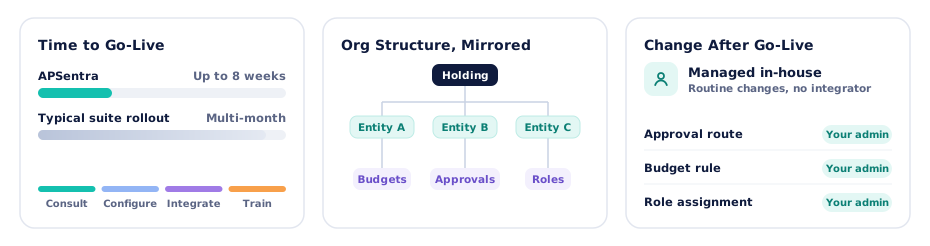
Implementation time

Configurability

Change after go-live

Ease of use

AI in operations

ERP and integration

Pricing and total cost
Explore platform comparisons
APSentra vs Coupa
Enterprise total spend management, compared with a platform configured around your organization.
- Customization and reconfiguration speed
- Up to 8 weeks vs. multi-month rollouts
- Embedded AI vs. community benchmarking data
- Supplier network experience and fees
APSentra vs GEP SMART
A broad, unified source-to-pay suite, compared on rollout effort and day-to-day usability.
- Functional breadth vs. time to value
- Ease of use for occasional requesters
- Release stability and reporting effort
- Professional-services dependency
APSentra vs Ivalua
Two platforms built to model the business as it works. The difference lies in who configures it and how long it takes.
- Configurability model and delivery
- Who manages changes after go-live
- Timelines that scale with scope
- Integrator dependency
APSentra vs Jaggaer
Deep sourcing and compliance in specialized sectors, compared with cross-industry procurement control.
- Sourcing and supplier-risk depth
- Sector specialization vs. industry breadth
- AI maturity in daily operations
- Implementation timeline
APSentra vs Precoro
Straightforward purchase-to-pay for mid-sized teams, compared with procurement governance modeled on the full organizational structure.
- Purchase-to-pay focus vs. full source-to-pay
- Setup simplicity vs. structural modeling
- Budget control across business units
- ERP integration depth
APSentra vs Oracle Fusion
Procurement within Oracle Fusion Cloud ERP, compared with a dedicated platform modeled on your organization.
- Native ERP integration vs. ERP-agnostic design
- Procurement depth beyond the core suite
- Configuration effort and quarterly release cadence
- Total cost of ownership
APSentra vs SAP Ariba
The largest supplier network in procurement, compared with a platform that runs independently of any ERP ecosystem.
- Supplier network reach vs. transaction fees
- SAP ecosystem fit vs. ERP independence
- Rollout scope and integrator involvement
- Usability for occasional requesters
APSentra vs Procurify
Accessible spend management for growing teams, compared with procurement control built for multi-entity enterprises.
- Speed of adoption vs. depth of control
- Multi-entity and holding structures
- Sourcing, tender, and contract coverage
- Scalability as the organization grows
APSentra vs Zycus
AI-led source-to-pay with deep sourcing modules, compared on deployment model and everyday adoption.
- Sourcing and contract management depth
- AI agents vs. AI embedded in workflow steps
- Module-by-module rollout vs. a single program
- Configuration ownership after go-live


Evaluate APSentra against your own processes
A comparison shows the pattern. A demo shows APSentra configured around your entities, approval hierarchy, and ERP.

FAQs
How does APSentra compare to enterprise source-to-pay suites?
APSentra covers the same end-to-end cycle as Coupa, GEP SMART, Ivalua, and Jaggaer: intake, sourcing, purchase orders, invoicing, contracts, and supplier management, with AI embedded in the workflow.
The differences sit in delivery rather than the feature list:
- Implementation within a fixed 8-week program
- Configuration that mirrors your org structure natively
- Routine changes managed by your own administrators
- An interface built for occasional requesters
APSentra is designed to deliver enterprise-grade governance without an extended, integrator-led rollout.
What sources do the comparisons rely on?
Each comparison draws on G2 and Gartner Peer Insights review analysis, analyst coverage such as the Gartner Magic Quadrant for Source-to-Pay Suites and the IDC MarketScape, and published platform data from each vendor.
We recommend reading first-hand reviews of every shortlisted platform, APSentra included, before making a decision.
Why do the comparisons include where competitors win?
No platform fits every organization. Coupa, GEP SMART, Ivalua, and Jaggaer each hold genuine strengths, from community benchmarking data to sector specialization and analyst recognition.
Naming those strengths plainly helps procurement and finance leaders shortlist the platform that matches their operating model.
Is APSentra suitable for large and multinational enterprises?
Yes. APSentra runs in large and multinational organizations, including complex multi-entity holding structures across several countries, with:
- Centralized governance across entities
- Multi-entity budget control
- Configurable approval hierarchies
- Regional compliance adaptation
The difference from larger suites lies in configuration speed, not company size.
How long does APSentra take to implement?
APSentra follows a fixed program of up to 8 weeks: consulting in week 1, configuration in weeks 2 to 4, integration in weeks 5 to 7, and certified training in week 8, followed by ongoing optimization.
The 8-week figure is the upper bound of the program, not a best-case minimum.
What should I evaluate when comparing procurement platforms?
Look beyond the feature list to the factors that shape long-term results:
- Time from contract to go-live
- Who manages configuration changes
- Usability for occasional requesters
- ERP integration effort
- Total cost, including services
APSentra applies these same criteria across every comparison on this page.
Can APSentra migrate data from an existing procurement suite?
Yes. A migration follows the standard 8-week program, with three additions: supplier and master data migration validated before cutover, a parallel-run window for critical approval chains and budget checks, and change management tailored to the transition.
Because APSentra mirrors your existing org structure, retraining focuses on a new interface rather than a new way of working.
Which ERPs does APSentra integrate with?
APSentra is ERP-agnostic and integrates with SAP, SAP Business One, NetSuite, Microsoft Dynamics 365 Business Central, and Odoo, plus custom systems through an open API.
No ecosystem dependency is required.
What is a digital twin in procurement?
A digital twin is a live model of your organizational structure and procurement workflow inside the platform: entities, departments, approval hierarchies, budget rules, and roles, reflected as they actually operate.
It allows APSentra to adapt to the organization, rather than requiring the organization to adapt to the platform.