














In logistics, rising volume shouldn’t mean rising coordination cost
Key challenges APSentra solves:

Fragmented carrier sourcing

Freight invoice complexity
Depot-level maverick spend

Fleet MRO cost blind spots

Thin-margin cost pressure

Coordination that scales with volume


APSentra — a unified source-to-pay procurement platform, built for logistics operations
From carrier tendering to freight invoice verification and depot-level fleet purchasing, APSentra handles every dimension of logistics procurement in one connected platform.


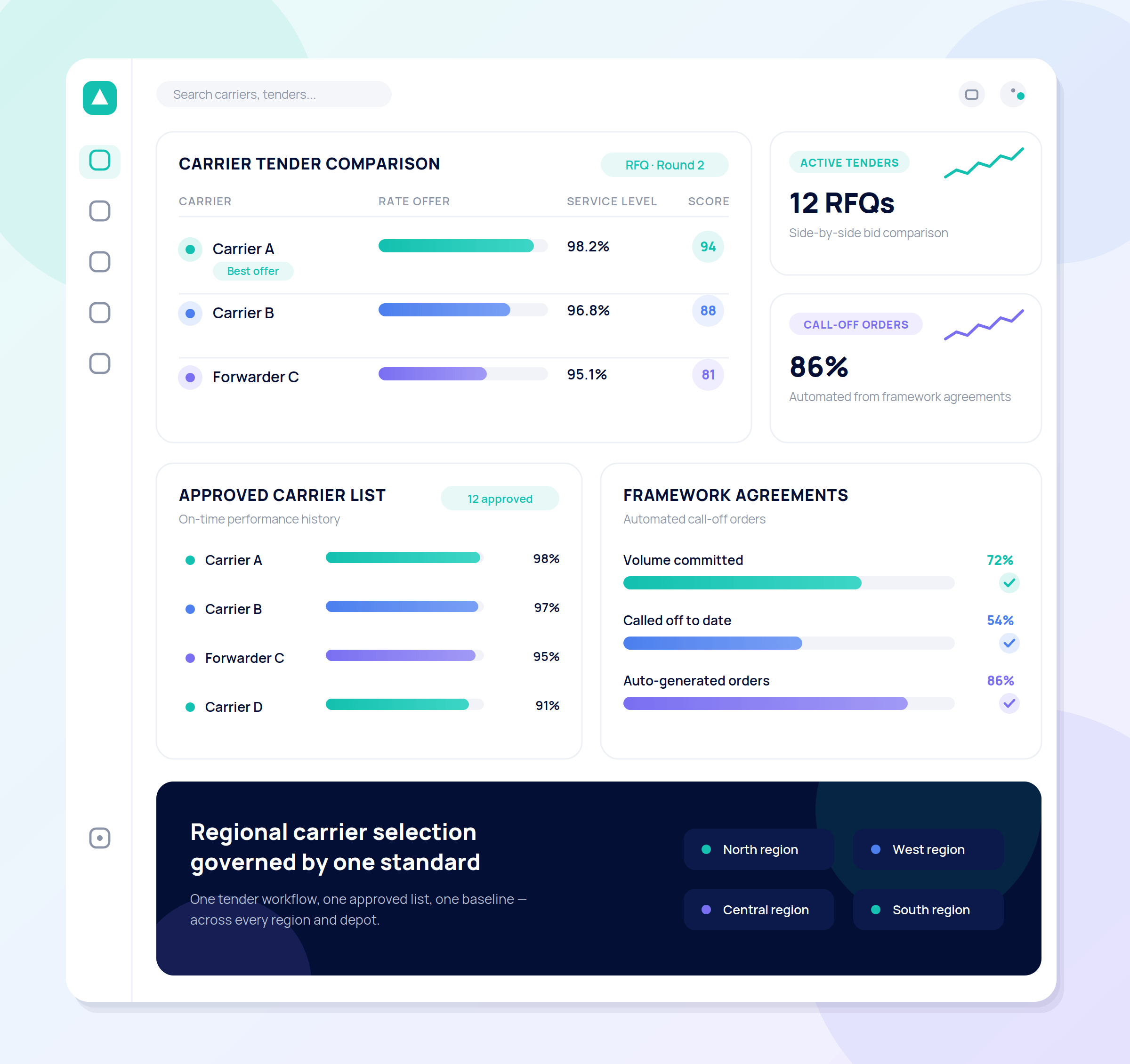
Carrier & forwarder sourcing
Every lane tendered against a shared baseline.
- Structured RFQ and mini-bid workflows per lane and mode
- Side-by-side rate and service-level comparison
- Approved carrier lists with performance history
- Framework agreements with automated call-off orders
Regional carrier selection governed by one standard.
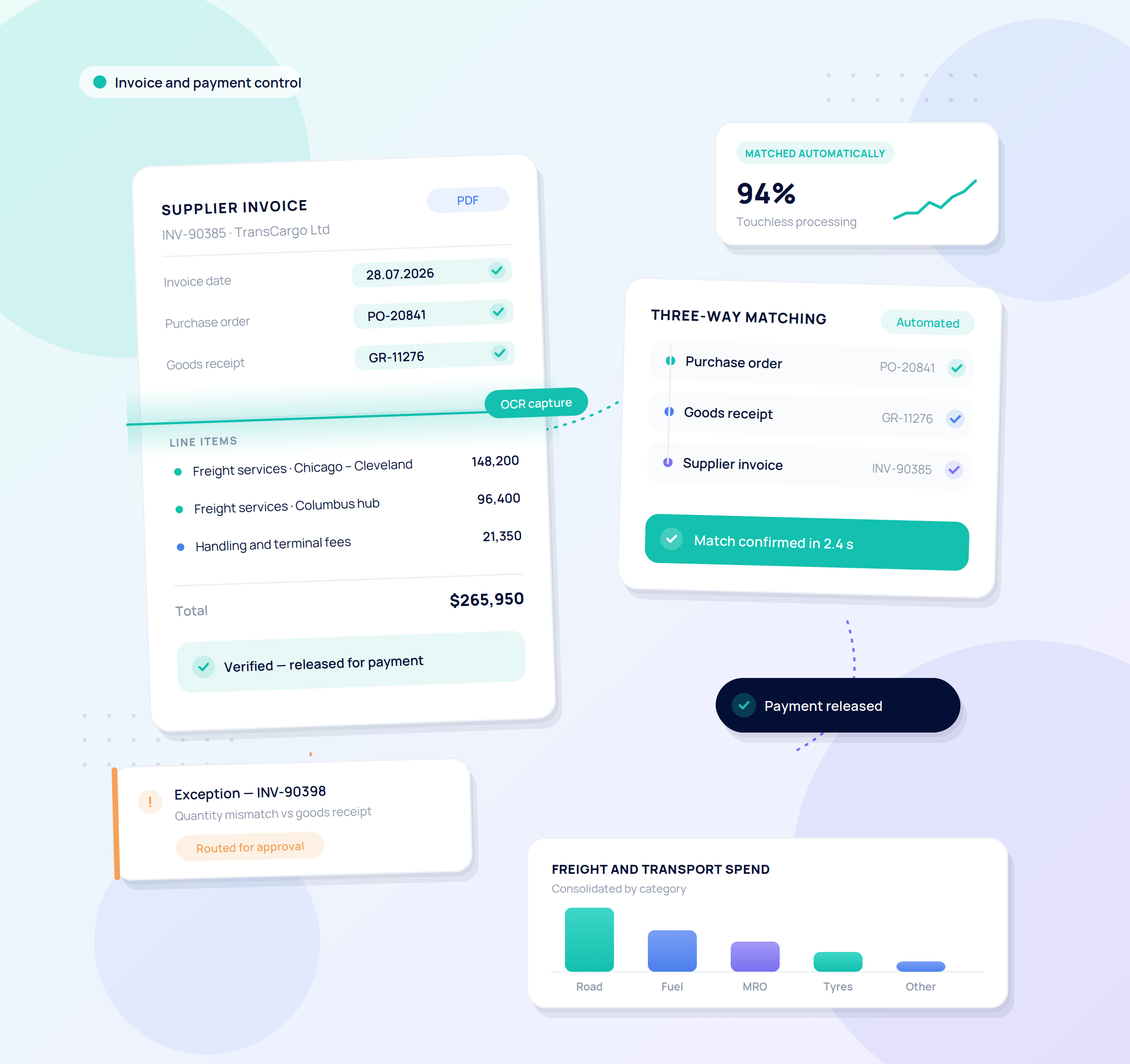
Freight cost & invoice control
Rate leakage caught before payment, not after.
- Three-way matching of contracted rate, shipment, and invoice
- Accessorial and fuel-surcharge validation rules
- Exception-based review for rate variances
- Consolidated freight spend analytics by lane, mode, and carrier
High-volume freight invoices verified without manual audit.
Depot & fleet MRO purchasing
Local purchasing within company-wide rules.
- Catalog-based ordering for parts, tires, and consumables
- Depot-level budgets with real-time consumption tracking
- Approval routes matched to the depot hierarchy
- Preferred-supplier enforcement at the point of request
Maverick spend closed where it starts — at the depot.
Supplier performance & resilience
Carrier reliability measured, not assumed.
- On-time performance and claims tracking per carrier
- Financial and capacity risk signals on critical suppliers
- Structured supplier reviews and scorecards
- Alternative-carrier options per critical lane
No critical lane resting on a single carrier.

Procurement analytics for thin margins
Cost visibility at the level where margins are won.
- Spend analysis by route, depot, mode, and category
- Budget vs actual tracking in real time
- Savings pipeline and realization tracking
- Management dashboards for network-wide oversight
Decisions made on network data, not regional estimates.
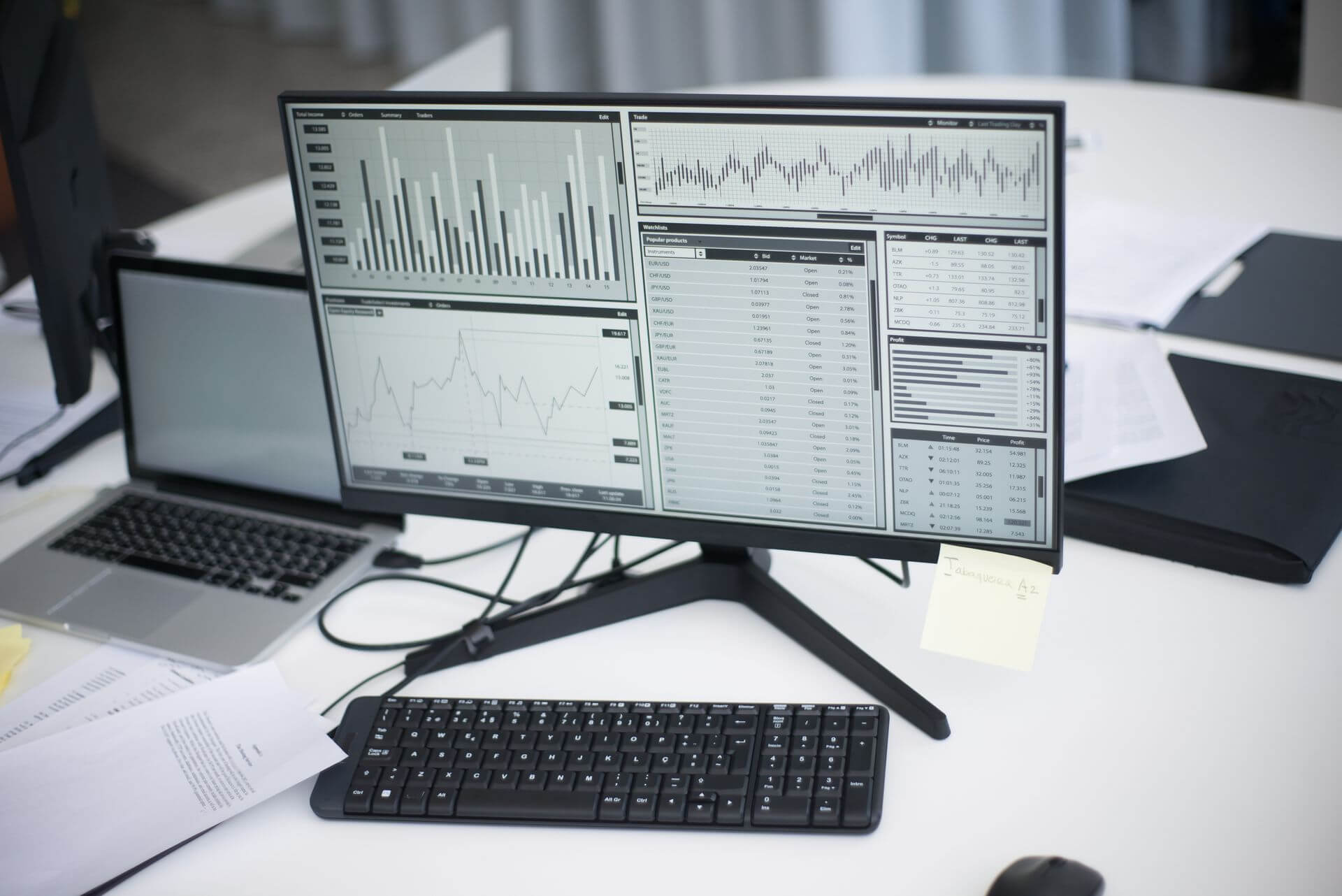








Other companies vs APSentra
- Indirect corporate spend workflows only
- Invoice audit after payment
- One approval chain for every location
- Static supplier records
- Spend reports weeks after close
- Carrier, freight, and fleet MRO spend governed in one platform
- Three-way rate matching before payment
- Depot-level routing mirrored to the network structure
- Carrier performance tracking per lane and mode
- Real-time network-wide spend visibility
Smooth custom & ERP-agnostic integrations
Seamlessly integrates with your ERP, accounting, collaboration, analytics, and supplier ecosystems.
Keep budgets, contracts, purchase orders, tenders, and payments aligned across all enterprise systems.




Why logistics operators choose APSentra




Latest articles
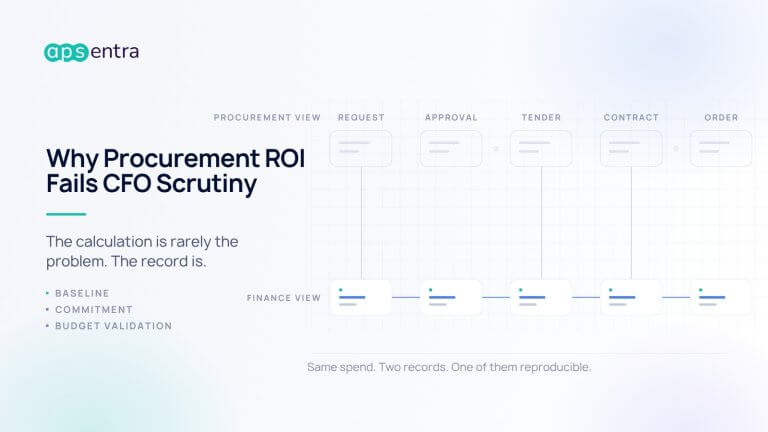
Why Procurement ROI Fails CFO Scrutiny
AI Tender Creation: From a Sentence to a Ready Tender
Best Procurement Software Platforms
FAQs
What is logistics procurement?
Logistics procurement is the end-to-end sourcing, contracting, and payment control of transportation capacity, fleet assets and maintenance, fuel, and depot operations spend. Unlike generic corporate procurement, it runs at extreme transaction volume, on thin margins, and against rate structures — lanes, modes, accessorials, surcharges — that standard purchasing tools were never designed to handle.
APSentra unites carrier tendering, freight invoice verification, and depot-level purchasing into a single governance engine, so cost discipline holds at every point where spend actually happens.
What should logistics companies look for in procurement software?
The sector’s demands go well beyond indirect corporate spend. Operators need lane-level carrier tendering, contracted-rate-to-invoice matching, depot-level budgets and approval routes, catalog-based fleet MRO purchasing, and analytics that break spend down by route, mode, and location — because that is the level where logistics margins are won or lost.
APSentra is built for that: structured carrier RFQs, exception-based freight invoice control, preferred-supplier enforcement at every depot, and network-wide spend visibility in real time.
How does a procurement platform differ from a TMS (Transportation Management System)?
A TMS plans and executes shipments: routing, dispatch, load optimization, and tracking. It governs how freight moves. It does not govern how carriers are selected and contracted, how invoices are verified against agreed rates, or how depot and fleet spend is controlled.
APSentra operates upstream and alongside a TMS — governing sourcing decisions, contract terms, and payment accuracy before and after execution — so the two systems complement rather than replace each other.
How can logistics companies control freight invoice accuracy?
Freight invoices are among the hardest to verify in any industry: accessorial charges, fuel surcharges, re-weighs, and rate changes create constant variance between what was agreed and what is billed. At high volume, manual auditing catches only a fraction of the leakage — and usually after payment.
APSentra applies three-way matching between the contracted rate, the shipment record, and the invoice, routing only exceptions for human review. Discrepancies surface before payment, not in a quarterly audit.
Why is maverick spend a bigger problem in logistics than in other industries?
Logistics networks are physically distributed, and vehicle downtime is expensive — so depots buy parts, tires, and services locally, under time pressure, outside negotiated agreements. Each purchase looks small; across a national network on thin margins, the leakage compounds into a material cost line.
APSentra keeps urgent local purchasing inside company rules: catalog ordering from preferred suppliers, depot-level budgets, and fast mobile approvals — so speed at the depot no longer requires bypassing procurement.
What are the best cloud-based procurement tools for industrial companies?
Different industries operate under fundamentally different conditions — regulatory and compliance requirements, spend structures, supply-chain dependencies, contract and pricing models, and CapEx vs OpEx governance — yet most procurement tools treat them the same, forcing teams into manual workarounds.
APSentra aligns procurement workflows, controls, and data structures with how each industry actually operates — reducing risk and improving decision-making.