Why Procurement ROI Fails CFO Scrutiny
Every procurement organisation of any size reports savings. Very few can survive the follow-up question. A CFO who asks where a reported figure sits in the general ledger, and receives a spreadsheet in reply, has learned everything needed about the reliability of that figure.
This is not a dispute about arithmetic. Procurement and finance are measuring two different things, on two different clocks, from two different sets of records. Until those records converge, the reported return stays a claim rather than a result.
What Is Procurement ROI, and Why Does Finance Measure It Differently?
Procurement ROI is the financial return generated by procurement activity, measured as validated cost reduction, avoided cost, and working capital benefit set against the cost of running the function. Finance accepts the figure only when every input traces to a contract, an approval, and a booked transaction.
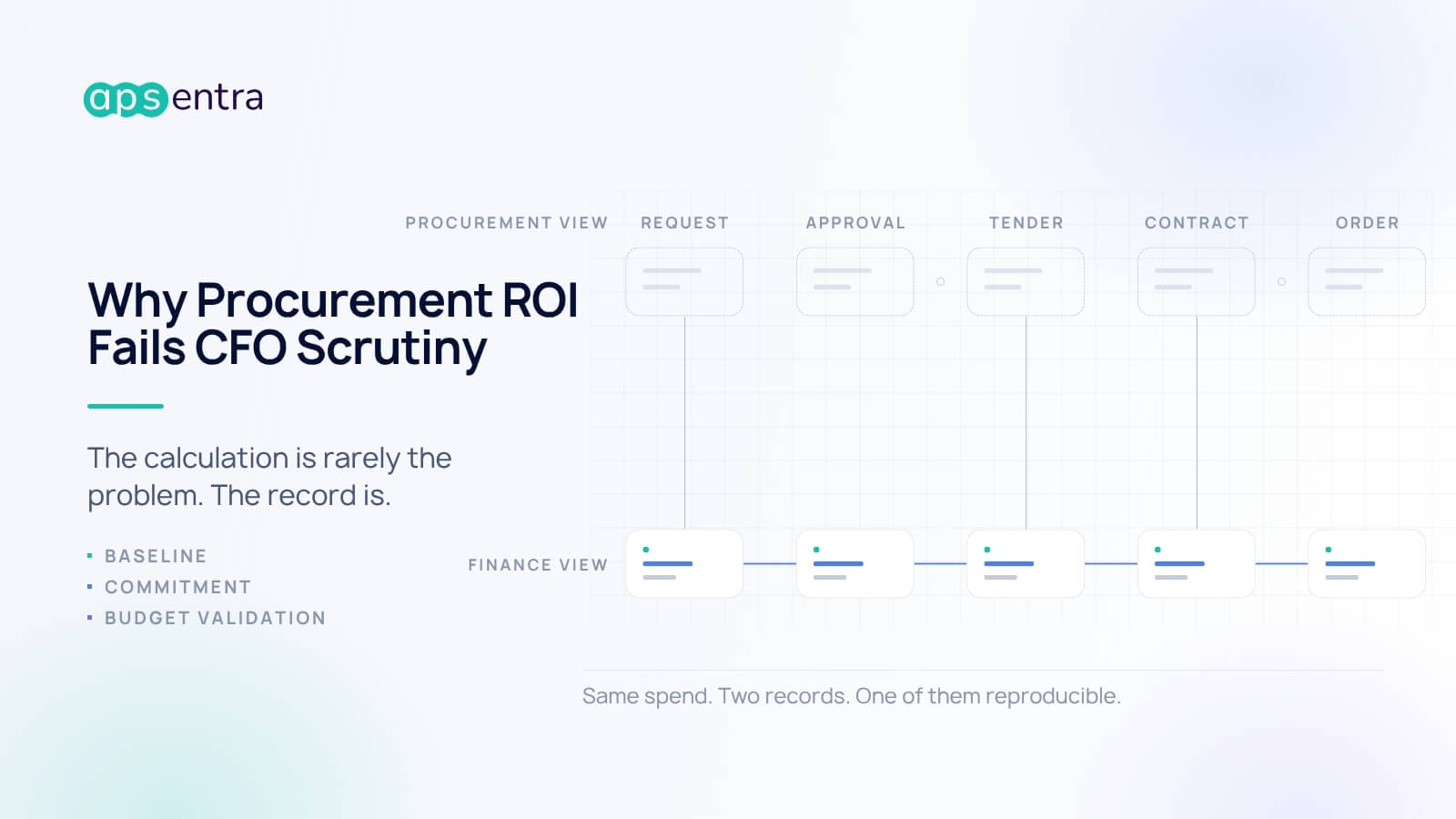
Procurement measures performance against a negotiated baseline: what the category cost before, what it costs now, and the delta the team produced. Finance measures against the approved budget and the general ledger. Both methods are internally consistent, and they routinely produce different answers about the same year.
The gap is structural rather than political. Procurement owns the moment of commitment. Finance sees the moment of payment. Between those two points sit change orders, unplanned volumes, released budget spent elsewhere, and price adjustments nobody logged against the original award.
So when a CFO reviews a savings submission, three questions decide its fate. Is the baseline defensible to someone outside the function? Did the benefit reach a budget line or a P&L line? Can the calculation be reproduced from finance systems, without procurement rebuilding it?
“A savings number produced by the team being measured is a proposal, not a result. Finance does not reject procurement ROI because it distrusts procurement. It rejects it because it cannot reproduce the calculation from its own records.”
— Mauricio Dezen, VP of Professional Services and Customer Success, APSentra
Why Procurement ROI Fails CFO Scrutiny: Five Recurring Breakdowns
Across finance-led procurement reviews, the same five failures account for most rejected numbers. None of them requires bad faith. Each one is a predictable output of fragmented data and manual reporting.

The baseline is set by the party being measured

Cost avoidance is presented as cash

The saving never reaches the budget line

The number is assembled by hand

Commitments become visible only after they harden
Three causes, one broken number.
Deloitte traces procurement data-quality problems to limited data governance, reliance on manual inputs, and disparate systems. The consequences it names run from inaccurate reporting through to ineffective decision-making, with missing, duplicate, or inconsistent attributes as the visible symptom.
Source: Deloitte, Elevating data standards in the procurement function
Read that list against the five breakdowns above and the overlap is close to total. Weak governance produces baselines nobody owns. Manual inputs produce reporting whose accuracy depends on who assembled it. Disparate systems produce two versions of the same spend, with neither able to validate the other.
Auditability: The Property That Makes a Procurement ROI Number Survive
Auditability means an independent reviewer can rebuild the number from primary records without asking the procurement team for help. Every price has a documented origin, every award has a named approver, every commitment has a budget check attached, and every step is timestamped in one connected chain.
Applied to procurement ROI, auditability converts each claim into a testable statement. The table below maps the claims procurement usually submits to the evidence a CFO actually needs.
| Reported claim | What the CFO asks | Evidence that answers it |
|---|---|---|
| We reduced category cost by 12% | Against which baseline, and who set it? | Prior contract price, full bid set, award decision with named approver, all held in the tender record |
| We avoided a 9% price increase | Is this cash, or a budget event that never happened? | Supplier notification, negotiated final rate, reported in a line separate from cash savings |
| We delivered EUR 4.2M in savings | Where does the ledger show it? | Plan reduced at budget level, commitments validated against live financial data before approval |
| Maverick spend is down | What prevents an out-of-policy purchase, rather than reporting it later? | Approval routing mapped to the legal entity structure, requests blocked without verified budget availability |
| Supplier selection is competitive | Would the same decision be made in every region? | One documented criteria set and identical tender rules applied across all entities |
The right-hand column is the interesting one. None of it is analysis. It is all operational record, produced automatically or not produced at all.
“The question a CFO is really asking is not how much you saved. It is where I can see it. If the answer involves a file that someone rebuilds every month, the number has already failed, whatever it says.”
— Mauricio Dezen, Procurement Consultant, APSentra
What Changes When Procurement ROI Becomes Audit-Ready
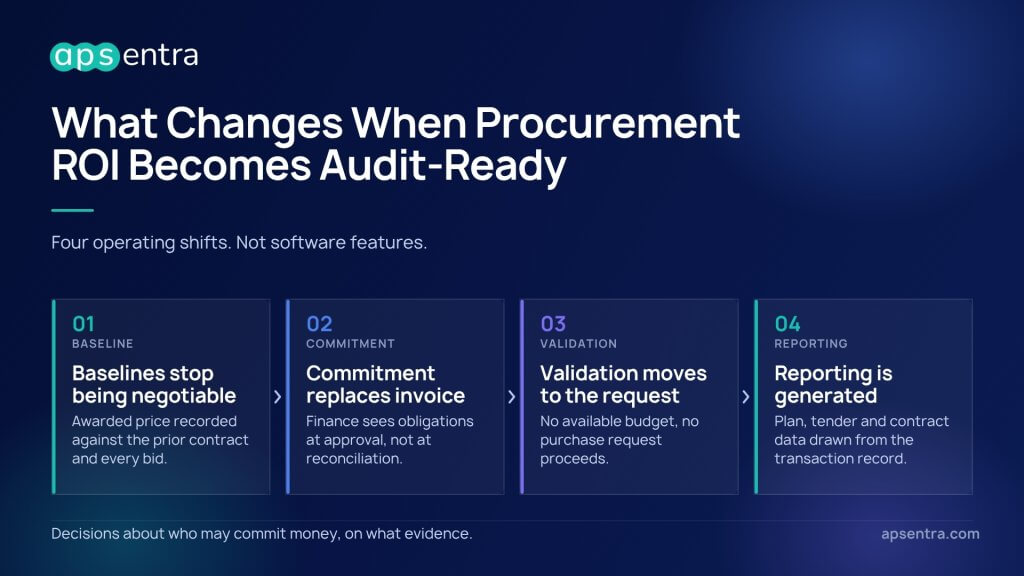
Making the number defensible is an operating decision before it is a technology one. Four shifts do most of the work.
- Baselines stop being negotiable. Every awarded price is recorded against the prior contract and the complete set of received bids, so the comparison exists before anyone needs to defend it.
- Commitment replaces invoice as the reporting moment. Finance sees obligations as they are approved rather than at reconciliation, which is the difference between control and commentary.
- Budget validation moves to the request stage. A purchase request checked against live financial data cannot proceed without available budget, so savings survive into the plan instead of leaking sideways.
- Reporting is generated, not assembled. Plan utilisation, tender outcomes, contract status, and order fulfilment come from the transaction record itself, which removes both the delay and the reconstruction risk.
None of these is a software feature. They are decisions about who may commit money, on what evidence, and how quickly the rest of the business gets to see it. A platform makes them enforceable at scale, which is where the two cases below start.
Procurement ROI in Practice: Two Implementations
Two APSentra implementations in large, multi-entity organisations show what audit-ready procurement data looks like once it is running.
Case 1: A National Pipeline Operator, 260 Users and a Direct Line into SAP
State-Owned Enterprise | National Oil Pipeline Operator | 260+ Procurement and Operations Users | SAP ERP
Challenge: Procurement activity spread across numerous departments and regional divisions was difficult to consolidate or control from the centre. The existing SAP environment managed financial and operational data independently of procurement workflows, resulting in duplicate entry, reconciliation overhead, and hand-assembled reporting across every procurement stage.
APSentra Solution: A full-cycle procurement management system covering annual planning through to order fulfilment, integrated bidirectionally with SAP for budget data, purchase orders, contract information, and goods receipt confirmations. Multi-level approval routing was configured to mirror the organizational hierarchy of the central and regional divisions, with integration into the public tender system to ensure public procurement compliance.
Outcome: Budget validation now runs at the purchase request stage across all divisions, drawing on live SAP financial data, so commitments cannot proceed without verified budget availability. Consolidated analytics covering plan utilisation, request volumes, tender outcomes, contract status, and order fulfilment are generated by the system rather than compiled manually. Every element a CFO would test in a savings review is now a system record.
“At the scale of a national infrastructure operator, procurement control is not a back-office concern. It is an enterprise risk. Integrating APSentra with SAP gave this client the unified system that scales to meet demands.”
— Project Lead, APSentra
Case 2: Kernel, One Sourcing Logic Across 700+ Users
Agriculture and Agri-Processing | Multi-Entity Regional Structure | 700+ Procurement and Operations Users
Challenge: Sourcing ran separately across regions, each with its own workflows, tools, and approach to supplier interaction. Request handling, tendering, and supplier management were not connected in one system, which limited performance tracking and left management without a real-time picture of procurement activity.
APSentra Solution: Regional sourcing was centralised into one governed environment over 24 weeks, with a single set of tendering rules, standardised supplier selection criteria, procurement documentation moved into a traceable digital format, and business-wide analytics for management.
Outcome: More than 700 employees now work in one system, tendering and supplier selection follow the same rules in every region, and management holds real-time visibility of procurement activity. Comparability is the financial result: awards made under identical criteria can be aggregated into a group-level number that means the same thing in every entity.
“We moved from a system where every region had its own way of working to one shared logic. With 700+ users now on one platform, our decisions are easier to trust, and our teams spend far less time on manual coordination.”
— Senior Manager at Kernel
The two cases solve different halves of the same reporting problem. National Pipeline Operator connected procurement to the financial system of record. Kernel made regional decisions comparable in the first place. A defensible number needs both properties to survive review.
Does AI Fix Procurement ROI Reporting?
AI improves procurement ROI reporting only where the underlying record is already reliable. In its perspective on data standards in the procurement function, Deloitte reports that surveyed chief procurement officers named data quality as one of the biggest obstacles to success and a major internal barrier to AI adoption. In the same global survey of 100 CPOs, 92% were beginning to envision the possibilities of generative AI and planning to invest, while only 37% were piloting or deploying it.
The same analysis is precise about where generative models genuinely help. Deloitte groups the opportunity into data normalisation, which cleanses and standardises inconsistent entries and removes duplicates even without exact matches; data imputation, which generates plausible values where records are missing; and data augmentation, which builds synthetic datasets for scenario work such as modelling the cost and timeline impact of a sudden supplier outage.
Every one of those is useful to a savings baseline. Deloitte separates procurement data into master data, such as catalogue items, units of measure, and supplier records, and transactional data, such as contracts, purchase orders, and invoices. A baseline is only comparable across entities when both layers are consistent, which is exactly the clean-up work these models do well.
What AI cannot do is manufacture evidence. Deloitte is blunt that intelligent analytics produce meaningful inputs only where the underlying data is accurate and comprehensive, and that poor data leads to flawed recommendations even with the most advanced capabilities. Its own example is scenario modelling for supply continuity risk, which depends on accurate supplier, inventory, and categorised spend data.
The point transfers directly to reporting. A model that classifies spend elegantly across five disconnected systems still cannot tell a CFO who approved a commitment, or whether budget existed when it was made. Those are governance records, not analytics outputs, and no amount of modelling creates them after the fact.
“Automating a broken measurement process gives you the wrong number faster and with more confidence attached to it. Fix the record first, then let the models work on it.”
— Mauricio Dezen, Procurement Consultant, APSentra
Five Questions a CFO Will Ask Before Accepting a Procurement ROI Number
For teams assessing their own position, these questions are more revealing than any savings dashboard.
- How much time passes between a committed purchase and the moment finance can see it?
- Can you produce total committed spend by entity, category, and approval status within 24 hours, without manual assembly?
- Who set the baseline for your three largest reported savings, and where is that baseline stored?
- Are cash savings, cost avoidance, and working capital benefit reported in separate lines with rules agreed by finance?
- If a purchase request exceeds available budget, is it blocked by the system or flagged in a report afterwards?
Where any of these exposes a gap, the constraint is the record rather than the calculation. That is a solvable problem, and it is solved in the operating layer rather than in the reporting layer.
About APSentra
APSentra is an AI-driven source-to-pay platform designed to control, structure, and optimise company-wide spend. Trusted by leading organisations across telecom, logistics, agriculture, and financial services — including Kyivstar, Nova Post, Kernel, UkrLandFarming, Sense Bank, and Intesa Sanpaolo.