Procurement in 3PL: How Sourcing Discipline Protects Logistics Margin
Logistics runs on narrow margins. The difference between a profitable lane and a loss-making one is usually the quality of the buy, not the size of the network. In third-party logistics, the largest line on the P&L is the transportation an operator purchases on behalf of its clients. Procurement is where that line is controlled or quietly conceded.
The argument here is direct. A 3PL’s margin is not set on the day a rate agreement is signed. It is set in how disciplined the organization stays while executing thousands of buying decisions across regions, lanes, and carriers.
Where 3PL Margin Is Won or Lost
Purchased transportation is the dominant cost in third-party logistics, and the scale is easy to underestimate. In the United States, the 3PL market rebounded through 2025: net revenue rose about 5 percent to roughly $138 billion, while gross revenue reached $323.4 billion, according to Armstrong & Associates figures reported by Transport Topics. The gap between those two numbers is the point. More than half of gross 3PL revenue is purchased transportation and pass-through cost, and that is precisely the spend procurement governs.
This is why sourcing discipline reads straight through to profitability. When a carrier is qualified before peak, when a rate is committed through a controlled route, and when an accessorial is reviewed rather than absorbed, margin holds. When those decisions happen ad hoc, the same volume moves at a worse price and no one sees it until reconciliation.
Rich Richardson has operated inside this problem for more than two decades across freight brokerage, contract logistics, and 3PL operations. His growth framework for logistics operators frames margin across three connected layers: the facility economics that set the cost base, the operational leadership that governs daily execution, and the move from vendor to strategic partner that lets an operator price on value rather than rate. Procurement lives in that middle layer. His observation is consistent: the discipline that protects margin is not applied once a year in a negotiation. It is applied, or abandoned, in the daily buy.
“You do not win a margin at the negotiating table once a year. You win it, or lose it, on every lane, every week, in how disciplined your buy stays.”
— Richard Richardson, CEO at RicheRich LLC
The Execution Gap in Logistics
The execution gap is the distance between the moment a commitment is made and the moment finance can see it. In a high-volume logistics network, that distance can run for weeks. A spot buy covers a capacity shortfall, an accessorial is added at delivery, a carrier is substituted mid-lane. Each event carries a financial consequence, and each one usually surfaces later, in a report that arrives too late to change the outcome.
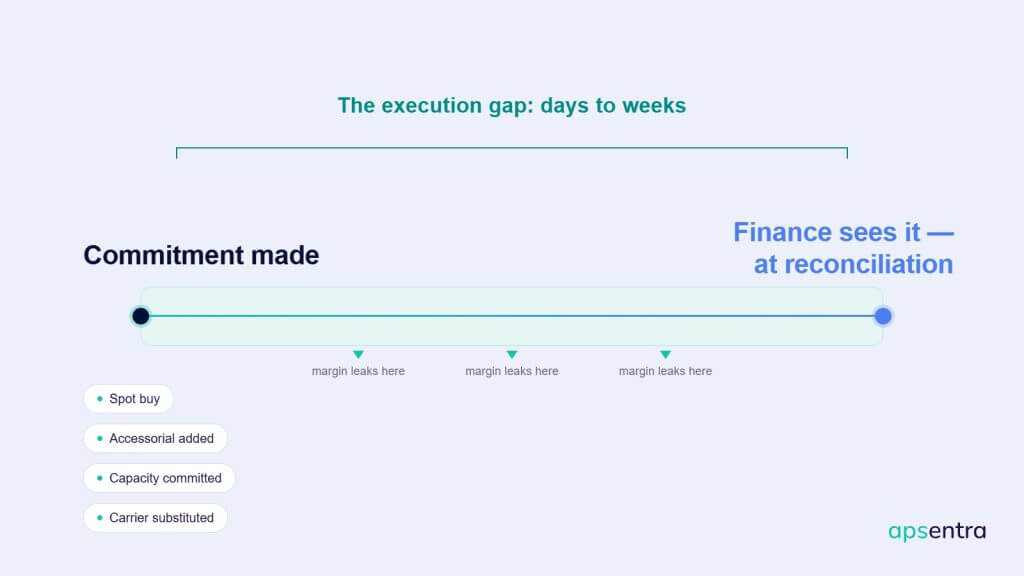
Value leaks through a small set of recurring channels. Spot buys made outside contracted rates. Accessorials that accumulate without review. Capacity commitments that outlast the demand that justified them. Supplier underperformance that was foreseeable but never screened for. None of these are unusual. They are the ordinary friction of running freight at scale, and in aggregate they separate a lane that earns its margin from one that erodes it.
The point is not that logistics operators manage badly. It is that the control surface is enormous, coordination is manual, and the financial signal arrives late. Closing the execution gap is a governance and workflow problem before it is a technology one.
What the 2025 Data Shows
Two patterns stand out in recent data. The first is that logistics partners remain under-leveraged as a strategic function. In a 2026 McKinsey analysis, only about half of surveyed supply chain executives regard their 3PL and parcel partners as strategic; the rest treat them as transactional service providers or do not collaborate with them at all. A relationship treated as transactional is rarely governed with discipline.
The second is that cost pressure is structural, not cyclical. In the 2025 Inbound Logistics 3PL market research, cutting transportation cost remained the single most-cited shipper challenge, and rising operational cost stayed the top concern for 3PLs themselves. When cost is the permanent constraint, the quality of the buy becomes the primary lever a logistics operator controls.
>50% of gross U.S. 3PL revenue is purchased transportation and pass-through cost, the spend procurement governs directly.
Armstrong & Associates 2025 figures: $323.4B gross vs. $138B net revenue, via Transport Topics.
Four Controls That Protect Logistics Margin
Procurement protects 3PL margin through four controls. Together they move buying decisions out of the moment and into a governed rhythm.
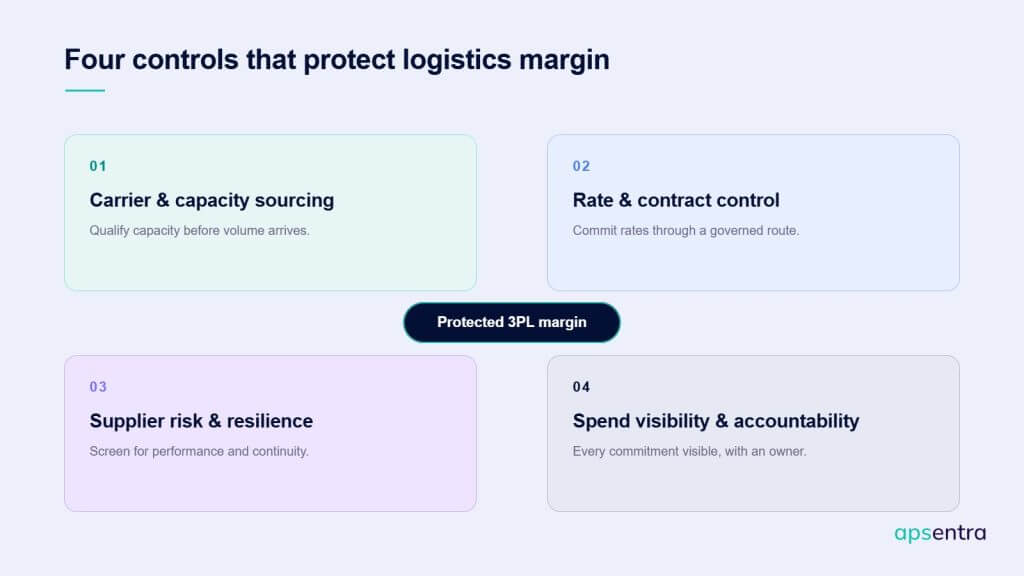

Carrier and capacity sourcing.

Rate and contract control.

Supplier risk and capacity resilience.

Spend visibility and accountability.
None of these require a large team. They require a structure that holds as volume scales, which is where technology earns its place.
Procurement in 3PL in Practice: Nova Post
Nova Post grew into a national logistics operator moving high delivery volumes across a large regional network. That growth set a demanding internal rhythm. As requests, suppliers, and decisions multiplied, regional procurement teams handled similar tasks without a shared approach, tender processing slowed, and full visibility across regions became harder to hold. Existing manual and fragmented processes were not built for that trajectory.
Manufacturing & Industrial | 60+ Users | Multi-Entity Group
Challenge: Coordination friction across regions, slow tender processing, and scalability bottlenecks as volume grew faster than the process.
APSentra Solution: Over a 12-week implementation, procurement across all regions was brought into one system, with simplified tender management and standardized supplier selection.
Outcome: Unified regional procurement, faster tendering without added headcount, consistent supplier selection, and more than 100 users working to a shared operational rhythm as volumes rise.
The Nova Post implementation shows the pattern in miniature. The problem was not the size of the network; it was coordination. Once buying decisions ran through one governed structure, higher volume stopped translating into higher operational load.
“The goal was to ensure our growth didn’t become our bottleneck. By bringing all regions into one system, increasing volume no longer adds complexity to the day-to-day work of our teams.“
— Operations Manager, Nova Post
The Role of Technology: What It Solves and What It Does Not
Technology closes the execution gap by making commitments visible and routing them through governed workflows. It does not decide which carriers deserve trust or which lanes are worth defending. Those remain judgment calls. What technology does is ensure that once a judgment is made, it is recorded, owned, and visible, so the same discipline applies at ten thousand transactions as at ten.
APSentra approaches this through a digital twin of the organizational structure and procurement workflow. Every request, approval, and commitment maps to who owns it and where it sits in the process. Spend stays visible and accountable as the operation scales, which is the condition Nova Post described as a shared operational rhythm. The technology serves the governance model, not the other way around.
The Discipline That Protects Margin
For a logistics operator, one question is worth answering directly: in your operation, is procurement a strategic lever or a back-office buy? The answer shows up in how carrier capacity is sourced, how rates are committed, and how quickly finance sees a commitment. Where those decisions run through a governed structure, margin holds as volume grows. Where they stay ad hoc, the same volume moves at a worse price.
That same discipline shapes how the operator is seen from the outside: an operator who controls the buy can price on value and hold a strategic partner’s position with clients, while one who cannot competes on rate and stays replaceable. Sourcing discipline is not a one-time program. It is an operating rhythm, applied to every lane and every week, sustained by visibility and clear ownership rather than by effort. That is the difference between a network that scales its margin and one that scales its cost.
“Margin in logistics is a governance outcome. When procurement can see every commitment and everyone knows who owns it, thin margins stop leaking.“
— Natalie Eksi, CEO at APSentra
About APSentra
APSentra is an AI-driven source-to-pay platform designed to control, structure, and optimise company-wide spend. Trusted by leading organisations across telecom, logistics, agriculture, and financial services — including Kyivstar, Nova Post, Kernel, UkrLandFarming, Sense Bank, and Intesa Sanpaolo.