Procurement Challenges: From Tools to Operational Control
In large European organizations, procurement has outgrown its back-office origins. Banking groups operating across several markets, industrial companies with plants in multiple countries, and logistics networks scaling at speed now treat the function as accountable for continuity, resilience, and financial control.
Yet the procurement challenges in Europe that dominate board discussions are routinely misread. They present as technology gaps when most are coordination gaps: commitments form faster than the organization can see them, and every entity runs its own version of the process.
This analysis was developed jointly with the procurement advisory team at NoOne Consulting, drawing on their work with structured European groups.
The New Mandate for Procurement in Europe
European procurement teams now carry a remit that extends well past negotiation. They are expected to defend margins against volatile input and energy costs, keep supply moving through geopolitical disruption, evidence sustainability performance under EU rules, and manage a supplier base that many groups are actively rebalancing toward nearer markets. In sectors such as fashion and luxury, beauty, automotive, and pharmaceuticals, competitive advantage increasingly depends on the strength and reliability of that supplier ecosystem rather than on unit price alone.
Multi-country structure adds a further layer. A European group typically buys through separate legal entities, in different currencies and languages, under one consolidated budget. Unless a single procurement logic spans those entities, each develops its own criteria, its own suppliers, and its own blind spots.
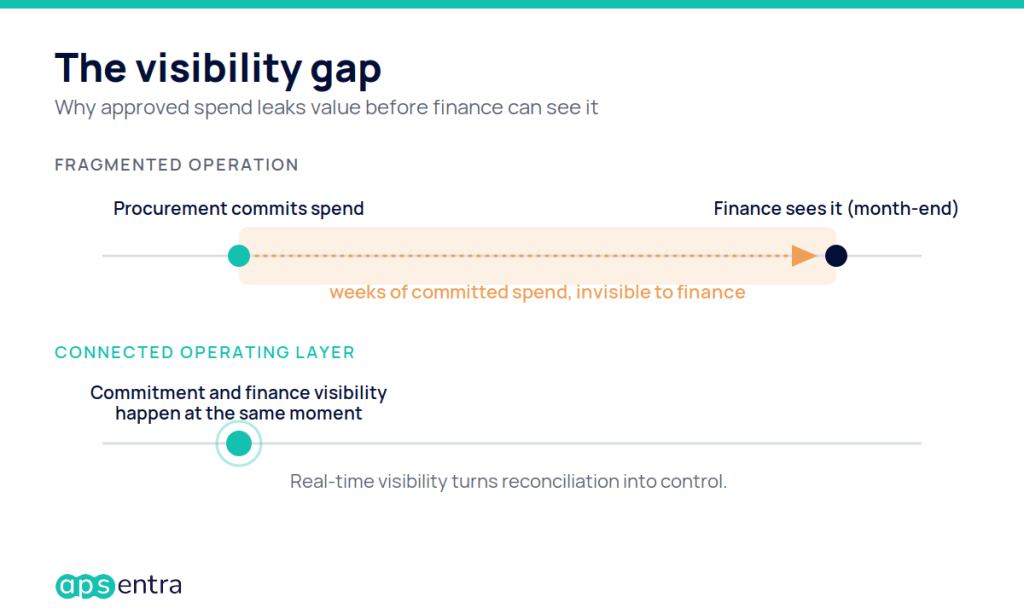
The most persistent gap is timing. Procurement tends to enter after the capital decision, the product launch, or the technology selection is already committed, when the value that early involvement would have created is gone. That is less a cultural failing than a visibility one: functions the organization cannot see in real time are the functions it involves last.
“In the Italian companies we advise, the challenge is rarely a lack of ambition, talent, or strategic vision. Procurement teams are highly capable, and the direction is often clear. What holds procurement back is that the rest of the organization lacks real-time visibility into procurement activities and decisions. And the real constraint lies in the organization’s ability to turn procurement decisions into timely, visible, and actionable insights—enabling the wider business to respond quickly and effectively.”
— Barbara Mariotti, Co-Founder & Managing Partner at NoOne Consulting
Procurement Challenges in Europe: A Problem of Connection, Not Capability
When procurement underperforms, the reflex across European companies has been to add capability: another e-procurement module, another analytics layer, another integration project. The investment is real. So is the persistence of the friction, because the underlying shortage was never one of systems.
The most recent industry data makes the point directly. In Deloitte’s 2025 Global Chief Procurement Officer Survey, drawn from more than 250 CPOs across 40 countries, the single most cited barrier to delivering value was siloed ways of working, named by 57 percent of respondents. Competing priorities followed at 46 percent, organizational and technology capability at 40 percent, and the talent gap at 34 percent. The leading obstacle is not the absence of tools. It is the absence of connection between the people, processes, and data that tools are supposed to join.
57% of chief procurement officers cite siloed ways of working as the leading barrier to delivering value, ahead of competing priorities (46%), capability gaps (40%), and talent shortages (34%).
Source: Deloitte 2025 Global CPO Survey
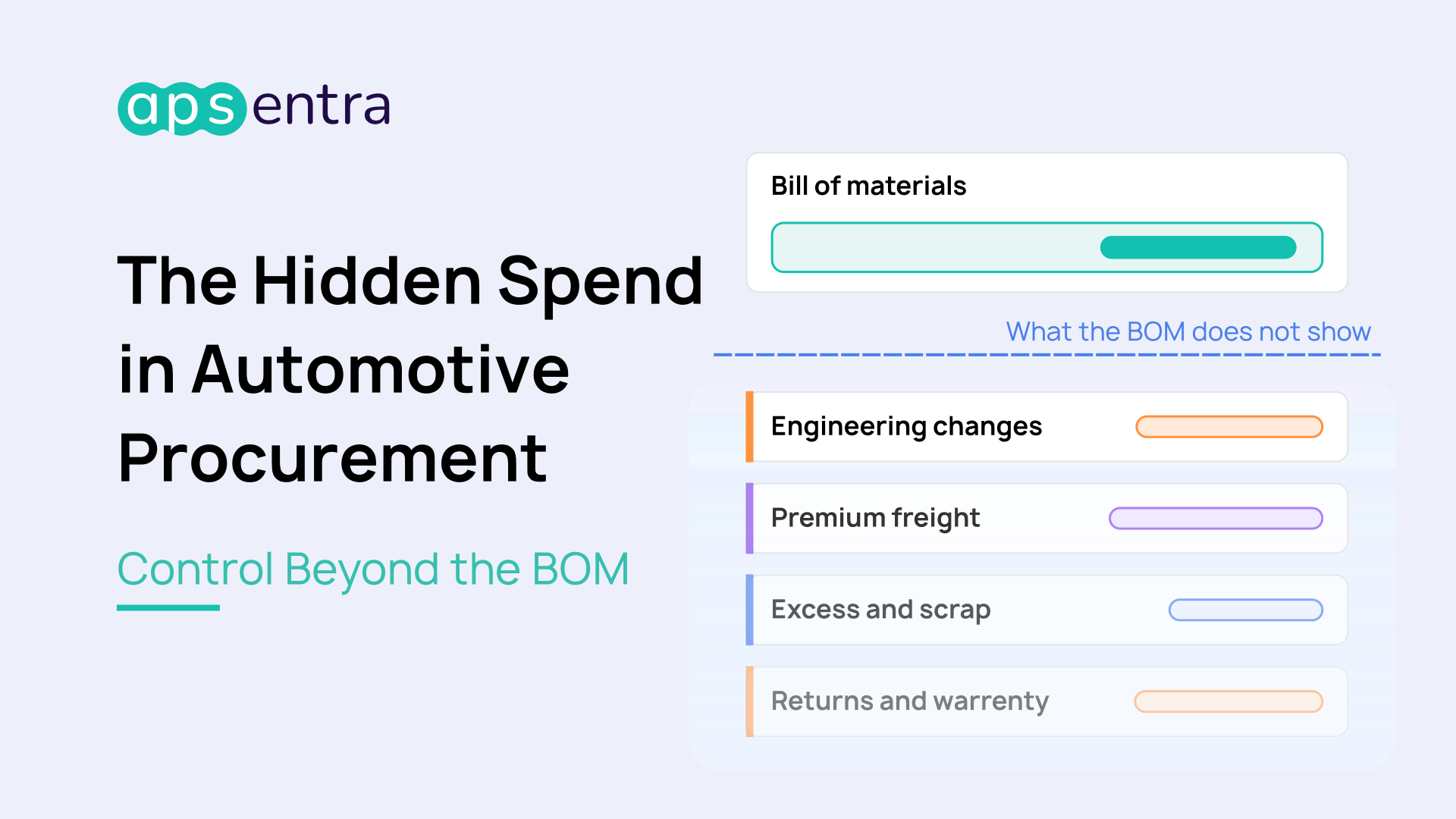
This reframes the entire challenge list. Cost volatility, supplier risk, regulatory pressure, and stalled digital transformation are not ten separate problems to be solved with ten separate tools. They are symptoms of one condition: data scattered across systems that do not talk to one another, processes that run manually between them, and a finance function that sees committed spend only after it has hardened into liability.
“Connection is what separates a capable procurement function from a controlled one. Once spend, suppliers, and approvals sit in a single view, the same team begins to deliver outcomes that used to look structural.”
— Luca Bernardini, Co-Founder & Senior Partner at NoOne Consulting
Three Pressures That Expose the Gap
Procurement leaders across Europe describe many pressures. Four recur in nearly every conversation, and fragmentation makes each of them harder to manage than it needs to be.
Cost discipline under volatility
Risk and resilience across the supplier network
From technology to decisions
What Changes When the Operating Layer Is Connected
Closing the gap does not require a new theory of procurement. It requires a connected operating layer that gives the function, and finance alongside it, a single shared view. Four shifts follow.
- Spend visibility before commitments harden. Committed spend becomes visible in real time, by entity, category, and approval status, rather than being assembled at month-end. Budget discipline moves from reconciliation to control, and procurement can be engaged earlier because its activity is finally visible to the rest of the business.
- One governance logic across entities and sites. Supplier selection and approvals follow standardized, documented criteria that apply consistently across business units. How a decision is made depends on which entity makes the request, which restores competitive pressure and closes the most common route for supplier risk to enter unnoticed.
- Traceability from request to receipt. Every request, tender, contract, order, and receipt is logged in one chain, with received quantities verified against contracted volumes. This is the same capability that satisfies sustainability and due diligence reporting, because traceable procurement data is traceable supply-chain data.
- Procurement data feeds financial oversight. Procurement data flows continuously into financial forecasting, narrowing the variance between approved budget and actual committed spend. At this point, procurement stops being a downstream cost and becomes an instrument of financial control.
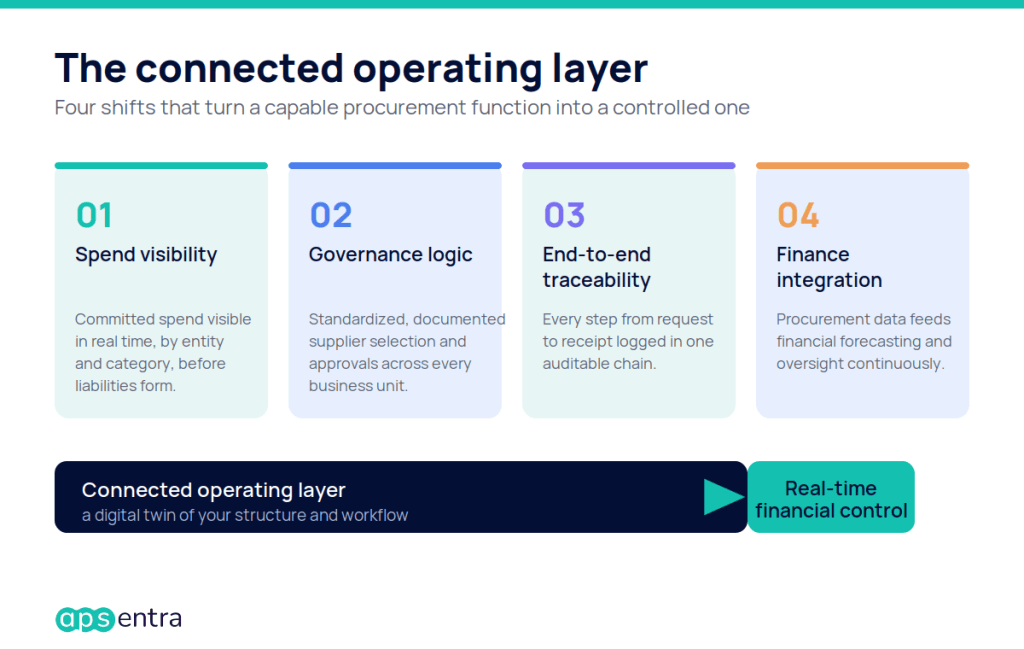
None of these is a software feature. They are operating decisions about how the organization wants to run. Technology makes them enforceable at scale, which is the subject of a later section, but the decisions come first.
Procurement in Practice: Two Implementations
Two APSentra implementations in structured, multi-entity organizations show what a connected operating layer looks like in practice.
Case 1: Intesa Sanpaolo — Centralized Procurement Across a European Banking Group
Financial Services & Insurance | Leading European Banking Group | 250+ Users
Challenge: Request handling, tendering, contract management, and supplier coordination were not fully connected in a single environment. That fragmentation made real-time budget alignment difficult and left management without a consolidated view, in a sector where every action requires strict traceability and compliance.
APSentra Solution: Implemented end-to-end centralized procurement covering every stage from request to reporting, with structured automated approval workflows and full integration into internal budgeting and financial controls. Contract management moved into a digital, searchable format.
Outcome: More than 250 users now operate in one environment with full transparency and budget alignment. Approvals follow a defined path, every action is traceable for compliance, and management has consolidated reporting for clearer oversight. Procurement fits the way the organization works rather than requiring constant manual attention.
“By connecting our entire process from request to contract, we have created a reliable environment where 250-plus users can operate with full transparency and budget alignment.”
— Business Unit Director, Intesa Sanpaolo
Case 2: UMG Investments — One Procurement Logic Across an Industrial Group
Manufacturing & Industrial | Mining, Machinery, Logistics, Infrastructure | Multi-Entity Group | 60+ Users
Challenge: Requests, tenders, and supplier communication had developed separately in each business unit. The fragmentation slowed group-wide decisions and left leadership without a consistent view, and any change had to work alongside the existing ERP without adding friction.
APSentra Solution: Within a fe-week rollout, APSentra brought every key procurement activity into a single environment connected directly to the existing ERP: one unified tendering logic, simplified and comparable supplier selection, and a centralized hub in place of localized approaches.
Outcome: Procurement now runs as one coordinated function across all units, with standardized tendering, transparent supplier selection, and group-level reporting. Sixty users operate on shared logic, so how a decision is made no longer depends on which company makes the request, which strengthens control over how capital is deployed across the group.
“By bringing our key activities into one environment, managing our purchasing no longer depends on which company is making the request. It depends on one shared, efficient logic.”
— Procurement Manager, UMG Investments
The Role of Technology: What It Solves and What It Does Not
A procurement platform enables a connected operation. It does not create one. This distinction is the source of most disappointing procurement transformations, and it is worth stating plainly.
A platform makes a well-designed structure faster, more visible, and more enforceable. It gives finance real-time access to committed spend that would otherwise require manual extraction, enforces approval routes that would otherwise be observed informally, and generates the audit trail that manual processes cannot maintain. APSentra builds a digital twin of an organization’s structure and workflow, so the controls map to how the business actually operates across its entities, rather than to a generic template imposed from outside.
What a platform cannot do is substitute for the decisions that must precede it: who is accountable for procurement by category, value, and business unit; how the approval structure maps to the budget hierarchy; what criteria govern supplier selection; and how often procurement data feeds financial forecasting. Organizations that deploy technology without settling these questions tend to digitize their existing fragmentation. The system is adopted; the connection is not. Reported efficiency gains of up to 25 percent in cost, up to 80 percent in process speed, and full spend transparency follow the governance work, not the software install.
Questions Procurement Leaders Should Be Asking
For leaders weighing where their own operation sits, four diagnostic questions tend to be more revealing than any feature comparison:
- How long passes between a committed purchase and the moment finance can see it?
- Can the organization produce, within 24 hours, total committed spend by entity, category, and approval status?
- Is supplier selection governed by documented criteria, or by individual discretion that varies across business units?
- Could you evidence supplier and sustainability data across your network without a manual scramble?
Where any of these reveals a gap, the constraint is almost always a connection rather than a capability. Read this way, the procurement challenges in Europe resolve into one addressable question of operational connection, which is the more useful place to start.
About APSentra
APSentra is an AI-driven source-to-pay platform designed to control, structure, and optimise company-wide spend. Trusted by leading organisations across telecom, logistics, agriculture, and financial services — including Kyivstar, Nova Post, Kernel, UkrLandFarming, Sense Bank, and Intesa Sanpaolo.