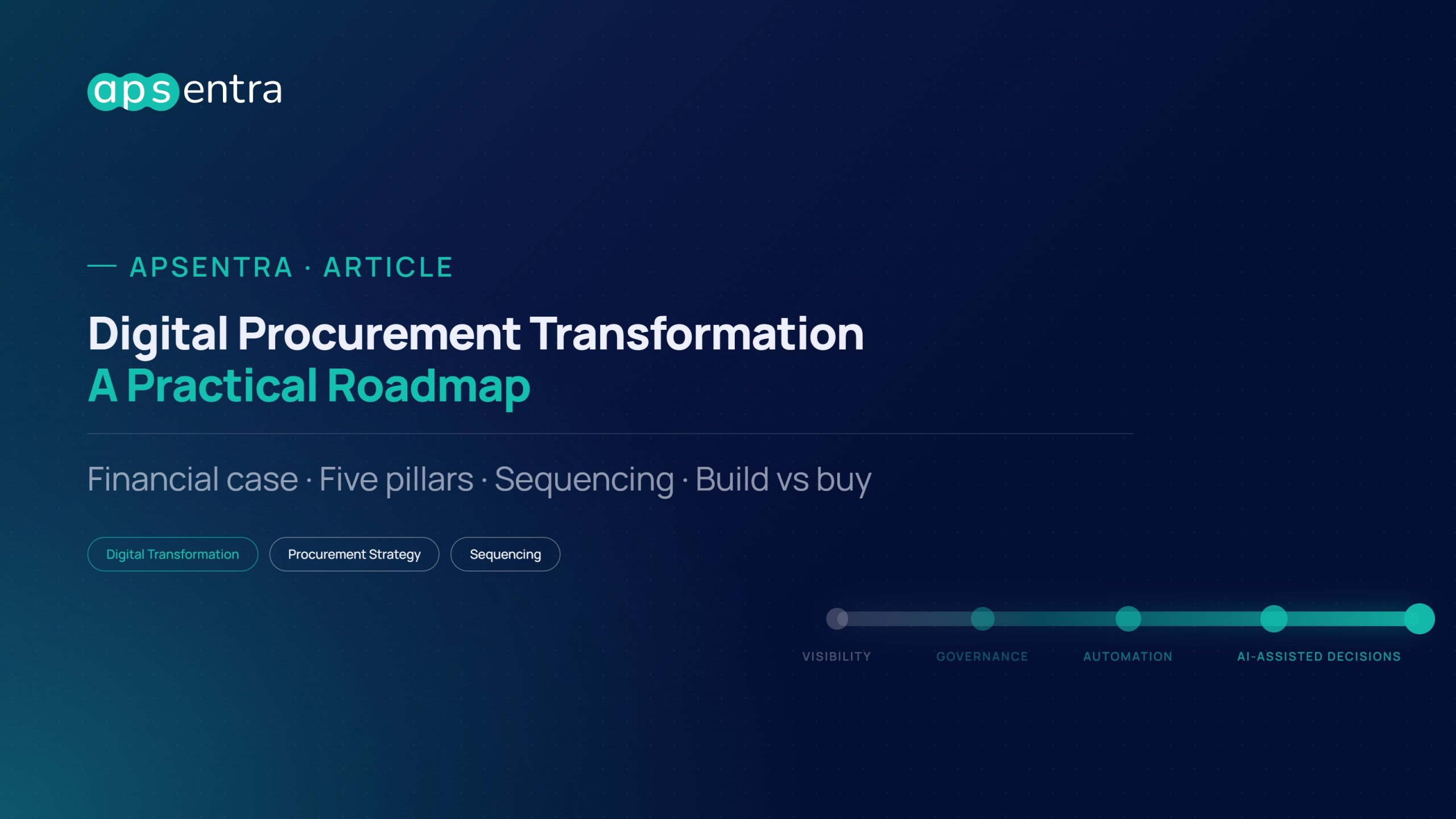
Digital Procurement Transformation: A Practical Roadmap
This guide sets out what the term should mean, why the financial case for it has shifted from IT modernization to EBITDA protection, the order in which the work actually has to happen, and the two structural paths (build vs buy, consultant-led vs software-led) that determine how fast an organization gets there.
What Digital Procurement Transformation Actually Means
Digital procurement transformation is the redesign of the source-to-pay cycle so that spend data, approval workflows, and supplier interactions run through connected systems rather than manual, disconnected steps. It is measured by a change in operating capability, not by which tools were purchased.
Three distinctions separate a genuine transformation from a software rollout:
| This, not that | What it actually means |
|---|---|
| Coverage, not adoption | A tool with low usage across categories and business units has not transformed anything, regardless of what the contract says. |
| Decision rights, not dashboards | Visibility that nobody is accountable for acting on does not change outcomes. |
| Workflow enforcement, not policy documents | A threshold that lives in a PDF is optional. A threshold built into an approval path is not. |
Organizations that treat the purchase as the finish line typically end up with a well-funded system running the same fragmented process it replaced, just with a login screen in front of it.
The Financial Case: Why This Is Now an EBITDA Conversation, Not an IT Line Item
Procurement transformation used to be justified on efficiency grounds: fewer manual steps, faster cycle times, lower headcount per transaction. Those arguments still hold, but they are no longer the primary case a CFO expects to see. The primary case is margin protection under conditions finance cannot fully control from its own seat, including tariff volatility, supplier concentration risk, and cost inflation that shows up in contracts before it shows up in the ledger.
Framed this way, transformation stops being a cost center’s technology refresh and becomes a lever finance actively sponsors:
| Mechanism | Why finance cares |
|---|---|
| Spend visibility | Spend that is visible can be governed before commitment, not reconciled after the fact. |
| Supplier structure | A structured supplier base is a hedge against single-source exposure and unbudgeted cost pass-through. |
| Auditable workflow | Reduces the compliance and audit-readiness burden finance otherwise absorbs manually at quarter close. |
The pressure is not hypothetical. Deloitte’s 2025 Global Chief Procurement Officer Survey, drawing on responses from more than 250 CPOs across 40 countries, found that the large majority are now actively involved in digital transformation initiatives, with digital transformation and generative AI ranking among procurement’s top enterprise priorities alongside cost reduction. None of this requires a specific savings percentage to be credible on its own terms; the case rests on control, not a promised return. Where a savings figure is used in a business case internally, it should be sourced to the organization’s own baseline spend data, not a template industry average. For the workflow-governance argument specifically, see our companion guide on procurement as a strategic finance function.
The Five Pillars: Automation, Visibility, Governance, Supplier Collaboration, AI-Driven Decisions
Every credible transformation program touches the same five areas. They are not strictly sequential (each builds on the others, which is the subject of the sequencing section below), but each has a distinct job, and a distinct way of breaking when it is rushed:
| Pillar | Its job | Where it breaks when rushed |
|---|---|---|
| Automation | Removes manual steps from requisitioning, approvals, PO generation, invoice matching. | Automates a process nobody has validated yet. |
| Data visibility | A single, classified view of spend that doesn’t depend on a quarterly export. | Skipped entirely in favor of dashboards built on partial data. |
| Governance | Thresholds and policy enforcement built into the workflow, not communicated separately. | Treated as a policy document instead of a workflow rule. |
| Supplier collaboration | Structured onboarding and performance tracking that replaces individual buyer knowledge. | Left dependent on relationships held by one or two buyers. |
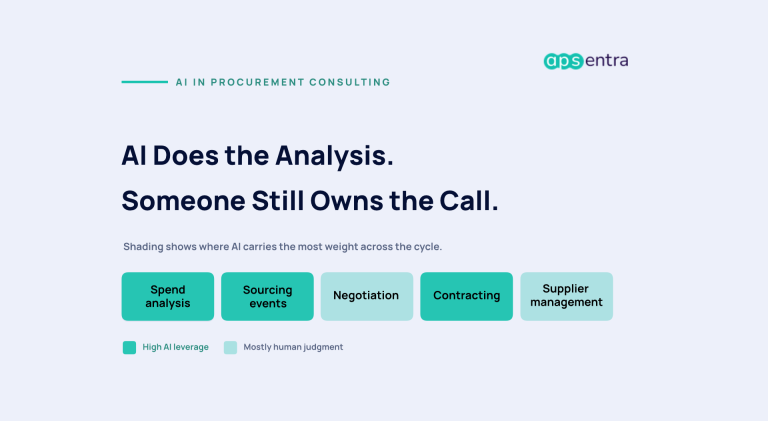
| AI-driven decisions | Pattern detection and recommendation logic applied to data that is already clean. | Deployed first, on ungoverned data, so it inherits every existing error. |
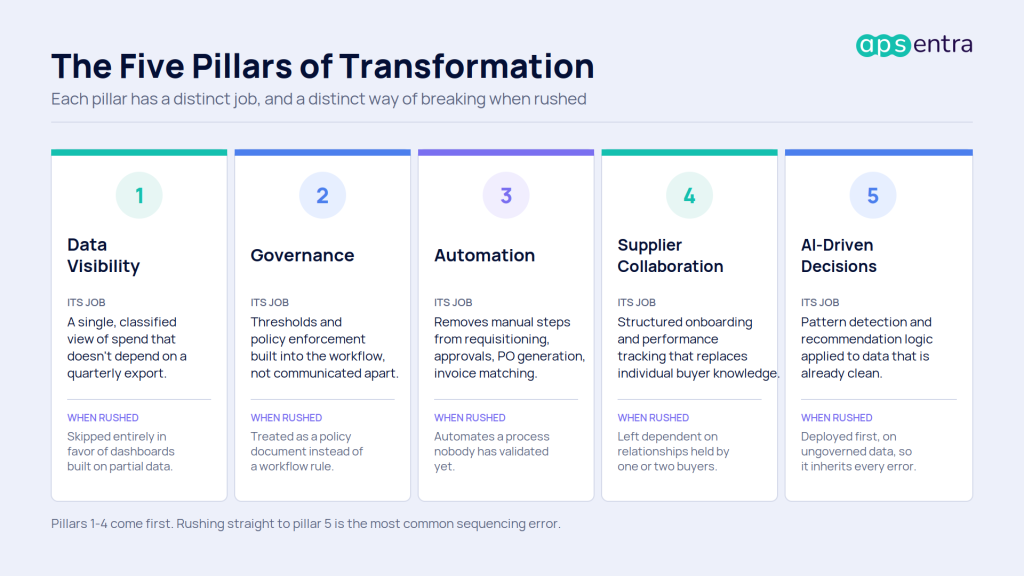
Organizations frequently start with the fifth pillar because it is the most visible in vendor demonstrations. That ordering is the most common reason transformation programs underdeliver, which the sequencing section addresses directly.
“The correct sequence for a digital procurement transformation is data and visibility first, governance second, automation third, and AI-assisted decisions last.”
— Natalie Eksi, CEO and Co-Founder, APSentra
Why Most Transformation Initiatives Stall
Three failure patterns account for most stalled programs, and none of them is primarily a technology problem. Our analysis of procurement challenges in European organizations reaches the same conclusion: the constraint is rarely the tool and almost always operational control.
| Pattern | What it looks like | What avoids it |
|---|---|---|
| Change management, not the system, is the bottleneck | Category managers and requesters don’t use the platform in practice; fragmentation persists with an added subscription cost. | Treating rollout as an operating change, not a software install. |
| Fragmented systems keep doing the old work | Contract data lives in one system, spend data in a spreadsheet, supplier records in email. | Making the platform the actual system of record, not one more thing to reconcile. |
| No single executive owns the outcome | Jointly sponsored by procurement and IT, with no named finance owner accountable for the result. | A named executive sponsor accountable for the financial outcome specifically. |
Sequencing: What to Fix Before You Automate Anything
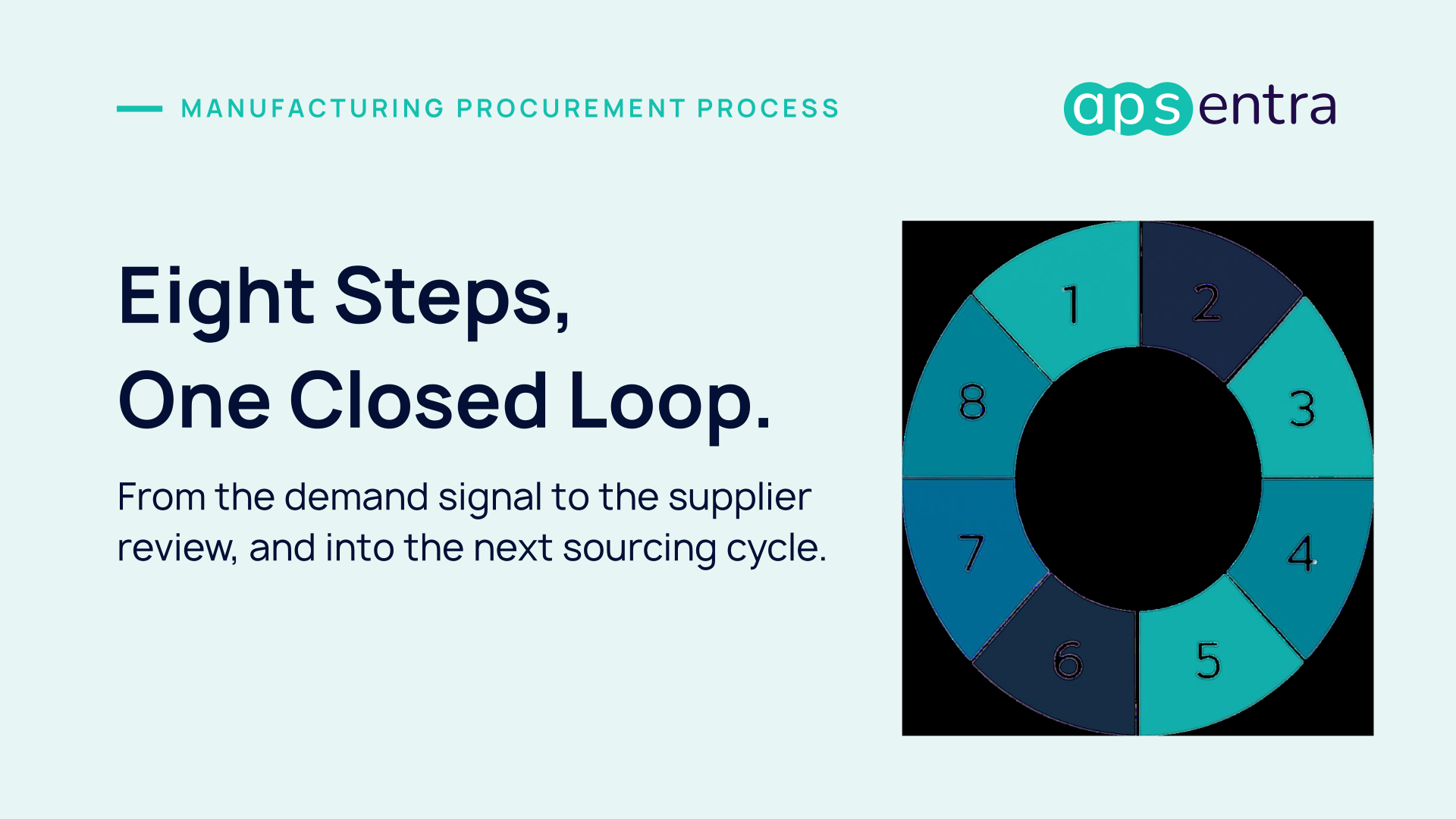
The correct sequence for a digital procurement transformation is data and visibility first, governance second, automation third, and AI-assisted decisions last. Automating a process before its underlying data is trustworthy scales the existing errors instead of removing them.
| Stage | Establish | Why it has to come first |
|---|---|---|
| 1 | Visibility. A single classified view of spend. | Automation applied to spend that isn’t yet visible tends to optimize the wrong category. |
| 2 | Governance. Thresholds, approval routing, segregation of duties. | Automating an ungoverned process increases the speed at which policy gets bypassed. |
| 3 | Automation. PO generation, three-way matching, routine approvals. | Highest-volume, lowest-judgment steps, where rules are clear and exceptions are well understood. |
| 4 | AI-assisted decisions. Pattern detection and anomaly flags. | Only realistic once there is a reliable data and governance base for the model to work against. |
Skipping straight to automation or AI because it is the most visible line item in a vendor pitch is the single most common sequencing error we see in transformation programs that later need to be re-scoped.
Measuring Success in Financial Terms, Not Process Terms
Cycle-time and adoption metrics are useful operationally, but they do not answer the question finance is actually asking. A transformation program should be measured against a small set of financial and control indicators, tracked before and after each phase:
| Metric | What it tells finance |
|---|---|
| Spend under management | Share of total spend flowing through governed, visible workflows rather than off-contract purchasing. |
| Maverick spend | Purchases outside approved channels, tracked as a trend, not a one-time audit finding. |
| Approval cycle time against threshold | Whether high-value commitments are reviewed before they become liabilities, not after. |
| Audit exceptions per cycle | Leading indicator of whether governance is enforced by the workflow or still manual. |
Reporting these figures in board or CFO updates, rather than adoption percentages alone, keeps the transformation program answerable to the case that funded it. This is also where most transformation business cases actually lose credibility with finance; for a closer look at why, see our guide to why procurement ROI figures fail CFO scrutiny. For a broader framework on tracking capability across dimensions rather than a single score, see our guide to the procurement maturity model.
Build vs Buy, and Consultant-Led vs Software-Led Transformation Paths
Two separate decisions get conflated in most transformation planning, and they deserve to be pulled apart.
| Build in-house | Buy a platform | |
|---|---|---|
| Control over the data model | Full control | Some configuration trade-off |
| Time to a working governance layer | Slower; engineered from scratch | Faster; approval engine exists day one |
| Ongoing investment required | Continuous engineering effort | Vendor-maintained |
For most enterprises outside of very large in-house engineering organizations, buy is the faster and lower-risk path to the sequencing outlined earlier, since the governance and workflow layer does not need to be engineered from scratch.
| Consultant-led | Software-led | |
|---|---|---|
| Primary deliverable | Diagnosis, target operating model, roadmap documents | A working, governed system |
| Strongest at | Strategy and organizational change management | Keeping visibility and governance current after go-live |
| Stays current after the engagement ends | Not by itself; the roadmap is a point-in-time report | Yes; the platform is the ongoing system of record |
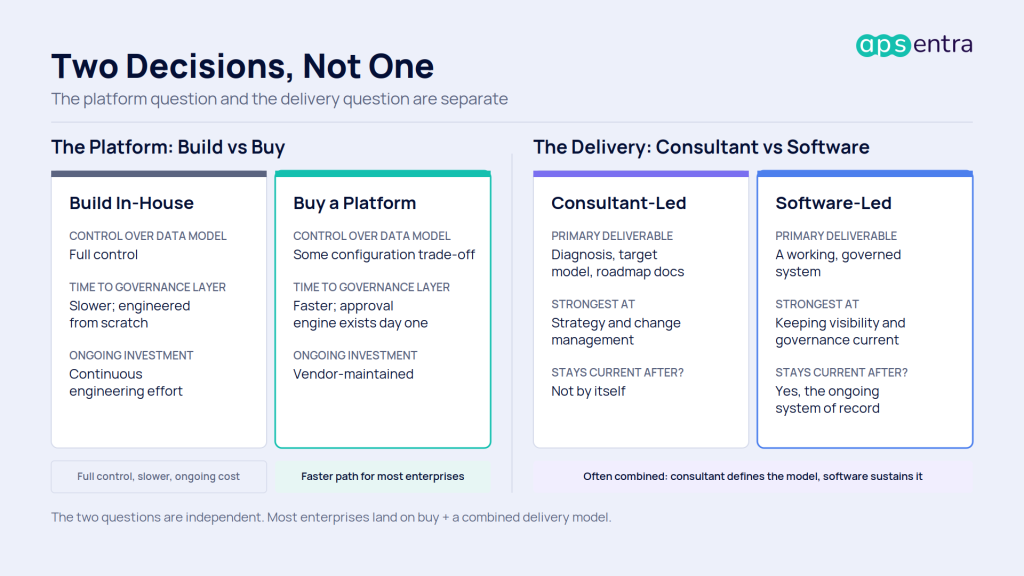
The two are not mutually exclusive: many organizations use a short advisory engagement to define the target model, then implement it on a software platform. For a closer look at where each approach earns its cost, see our guide to end-to-end procurement consulting.