Best E-Invoicing Software in 2026
We evaluated SAP Ariba, Coupa, Ivalua, and GEP SMART using verified G2, Capterra, and Gartner Peer Insights review data — all offer real e-invoicing capability, but our research found each carries specific gaps (mobile stability issues, dated reporting, or enterprise-scale cost and complexity).
2026 is the biggest year yet for e-invoicing mandates — why that changes the buying criteria
E-invoicing software used to be primarily an efficiency purchase. In 2026, it’s increasingly a compliance purchase too. More countries are implementing mandatory e-invoicing requirements in 2026 than in any prior year, with new rules landing across Europe, the Middle East, and Asia-Pacific on a rolling quarterly basis. Belgium made B2B e-invoicing mandatory on January 1, 2026; Poland’s KSeF system reaches its largest taxpayers on February 1, 2026; Saudi Arabia’s ZATCA e-invoicing program continues its phased rollout through mid-2026; and France’s national B2B mandate begins September 1, 2026.
The EU’s broader VAT in the Digital Age (ViDA) initiative is pushing the entire bloc toward standardized digital reporting and e-invoicing over the next several years.
That shifts the evaluation question. It’s no longer just “does this reduce manual invoice entry” — it’s “does this vendor actively track and support the specific country-level formats and mandates my business operates under, today and as new requirements phase in.” A platform that’s excellent at OCR but has no visibility into regulatory roadmap is a growing liability, not just a missed efficiency gain.
Editorial methodology: how we evaluated these platforms
We built this comparison from three sources:
(1) primary vendor documentation and product demos,
(2) an analysis of over 1,900 verified user reviews published on G2, Capterra, and Gartner Peer Insights between 2023 and 2026 covering SAP Ariba, Coupa, Ivalua, and GEP SMART,
(3) our own product and implementation data for APSentra.
We did not survey finance leaders directly for this piece — where we reference “what users say,” it reflects patterns pulled from published, verified reviews, cited by vendor below.
Each platform was scored against: OCR/data-capture accuracy, matching automation (2-way and 3-way), regulatory/compliance breadth, mobile and supplier-side invoicing experience, ERP/accounting integration depth, and implementation/adoption speed. We weighted mobile experience specifically because a meaningful share of the negative review data across this category concentrates there.
E-invoicing software vs. AP automation vs. OCR scanning tools
OCR scanning tools extract data from invoice documents — a narrow, specific capability. E-invoicing software is broader: it covers the structured exchange, validation, and often regulatory formatting of invoices between buyer and supplier systems, increasingly in compliance with country-specific mandates (like PEPPOL, KSeF, or ZATCA formats). AP automation software is the broadest term, covering the full invoice-to-payment workflow including approval routing, matching, and payment execution — e-invoicing is typically the data-capture and compliance layer that feeds into it.
When you need full e-invoicing vs. just OCR: if your primary pain point is manual data entry from PDF invoices, an OCR layer might solve the immediate problem. If you operate in or sell into — jurisdictions with mandatory e-invoicing requirements, or if invoices routinely arrive disconnected from any purchase record, you need e-invoicing software with both regulatory compliance coverage and matching automation, not just character recognition.
Signs your invoicing process needs e-invoicing software
- You operate in, or sell to, a country implementing new e-invoicing mandates in 2026 and don’t have a documented compliance plan.
- Invoice data entry is still manual, or OCR accuracy is low enough that AP spends significant time correcting extracted data.
- Invoices routinely arrive with no linked purchase order, requiring manual matching after the fact.
- AP can’t say with confidence what’s owed to suppliers right now without checking multiple systems.
- Duplicate invoices or duplicate payments have happened more than once in the past year.
- Your mobile/remote approvers regularly delay invoice sign-off because the mobile experience is unreliable.
Must-have features in e-invoicing software for 2026
Capture and compliance
- OCR-based invoice data capture with high extraction accuracy, validated against PO terms automatically
- Support for country-specific e-invoicing formats and mandates relevant to where you operate (PEPPOL, KSeF, ZATCA, and similar)
- A visible regulatory roadmap from the vendor — not just current-state compliance, but a track record of keeping pace with new mandates
Matching and validation
- Automated 2-way and 3-way matching with instant discrepancy flagging before payment approval
- Duplicate invoice detection before payment, not after
- Exception-based workflows so only flagged invoices require manual review
Mobile and supplier experience
- A stable, full-featured mobile experience for approvals and receipt capture (a documented weak point for more than one platform in this comparison)
- A supplier-facing submission experience that doesn’t create friction serious enough to affect on-time invoicing
Integration and payment
- Native ERP and accounting integration with general ledger and cost-center mapping kept synchronized
- Payment-term visibility and automated early-payment discount detection
- Centralized, real-time liability visibility across entities
Best e-invoicing software for 2026
1. APSentra — best overall for compliant, connected e-invoicing
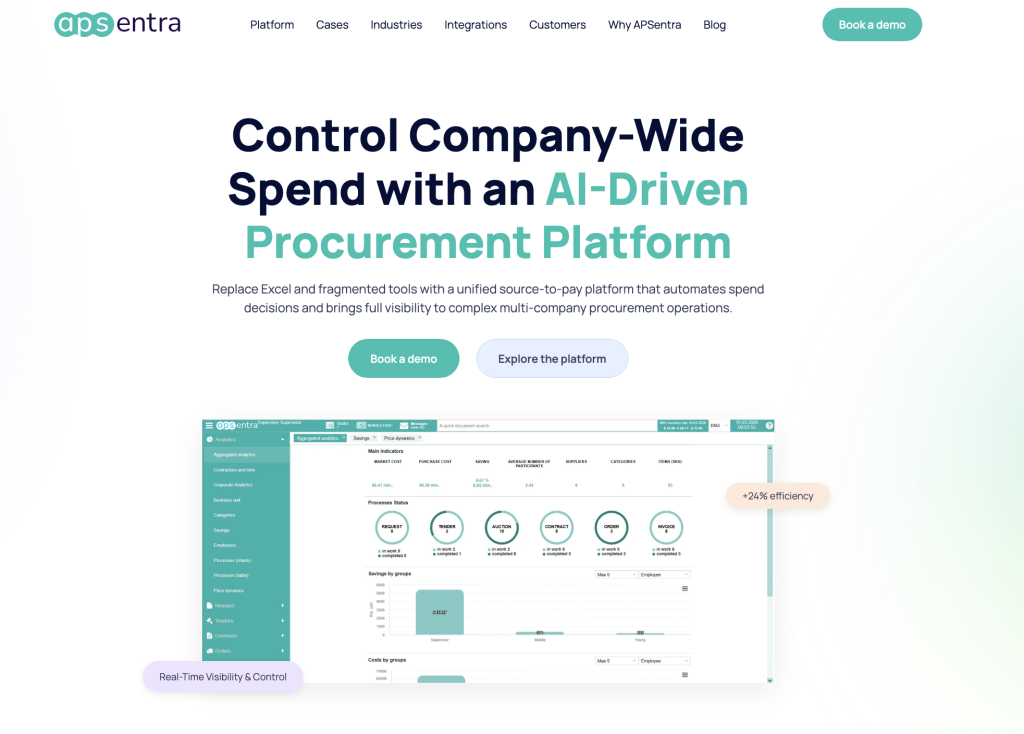
Best for: Finance and AP teams that want invoice capture connected directly to purchasing and payment data, with matching automated rather than manually reconciled.
APSentra treats e-invoicing as part of the full procure-to-pay cycle rather than an isolated capture tool — an invoice arrives already linked to its originating purchase order and receipt, and is validated automatically before it reaches a human for exception handling.
Top features:
- OCR-based invoice recognition that captures invoice data automatically, extracts structured financial information, and validates it against PO terms
- Automated 2-way and 3-way matching between purchase order, goods receipt, and invoice, with instant discrepancy flags before payment approval
- Exception-based AP workflows: automatic invoice validation, duplicate invoice detection, and centralized liability visibility, with only flagged exceptions routed for review
- Payment optimization: automated early-payment discount eligibility detection and accelerated approval routing to capture supplier discount windows
- Native ERP and accounting integration with general ledger and cost-center mapping kept synchronized automatically
- Full audit trail from invoice receipt through payment, supporting both internal audit and external regulatory review
Vendor-reported performance data: organizations implementing APSentra’s invoicing automation typically report a 40–60% reduction in invoice processing time, a significant reduction in duplicate payments, improved cash flow predictability, and increased early-payment discount capture.
Best for: Mid-market and multi-entity companies that want invoice processing connected to purchasing data automatically, rather than managing OCR, matching, and compliance as separate, disconnected steps.
Platforms we evaluated
We reviewed each of these using verified G2, Capterra, and Gartner Peer Insights data. All are legitimate, capable e-invoicing platforms — several are Gartner Magic Quadrant leaders in adjacent categories — and may be the right choice depending on your scale and existing ERP relationship. Here’s what the review data actually says about their e-invoicing capability specifically.
SAP Ariba
SAP Ariba’s e-invoicing capability draws some of the most specific positive commentary in our entire research set. Finance reviewers describe electronic invoice submission as fast and paperless, with automated routing through the approval chain and centralized invoice data replacing stacks of paper. One reviewer specifically described submitting travel expenses and getting reimbursed as “extraordinarily easy,” calling Ariba “a favorite tool for expense reporting.” The supplier payment cycle is reported as significantly accelerated, with reviewers citing better cash flow visibility and centralized invoice data storage.
The gaps that show up specifically around invoicing: reviewers describe reporting tools as feeling outdated and difficult to customize for non-standard analysis beyond templates, and — a broader platform issue that directly affects invoicing workflows — a steep learning curve and enterprise-scale licensing/transaction fees that small and mid-sized business reviewers consistently flag as disproportionate to their scale. SAP Ariba’s average reported implementation time is 6 months, with an average reported payback period of 16 months.
Why it’s not our top e-invoicing pick: the core e-invoicing experience is genuinely well-reviewed, but the surrounding cost, complexity, and reporting limitations mean mid-market buyers pay an enterprise-scale price for a capability a purpose-built platform delivers with a materially shorter implementation.
Coupa
Coupa’s invoice automation technology — branded “Invoice Smash” — uses machine learning to extract data from PDF invoices and perform automated 3-way matching, which reviewers describe as a genuine “lifeline” for AP departments: high extraction accuracy (reviewers cite 70–80%) and automation of up to 80% of invoice-reconciliation processes, per Coupa’s own Forrester TEI benchmark data (2024).
The critical, specific pattern for e-invoicing: Coupa’s mobile app draws sustained, recurring criticism— reviewers report bugs when uploading receipts, slow synchronization between mobile and web, and a generally “heavy” mobile interface compared to desktop. Reviewers also note the algorithm needs “too many iterations” to learn new supplier invoice formats, and flag limited flexibility for suppliers with multiple billing addresses or complex global invoicing scenarios. Combined with a documented decline in support quality since Coupa’s 2023 acquisition by Thoma Bravo, this is a meaningful risk for AP teams that rely on mobile approval.
Why it’s not our top pick: strong core OCR and matching technology, but the mobile reliability issues are specifically relevant to e-invoicing workflows (receipt capture, on-the-go approval) and are a sustained complaint pattern, not a one-off.
Ivalua
Ivalua’s procure-to-pay module supports invoice processing as part of its broader P2P cycle, with reviewers confirming effective support for scaling purchasing volume, real-time expense tracking, and adherence to established procedures. The platform’s OLAP-based analytics also extend to invoice and spend data for deeper reporting.
The gap that’s specifically relevant to e-invoicing: reviewers explicitly flag the absence of a mobile application, meaning invoice approvals and reconciliation happen from desktop only — a meaningful limitation for distributed AP or approval teams. Combined with the platform’s broader 9-month average implementation timeline and enterprise-oriented licensing, this narrows Ivalua’s near-term fit for a mid-market e-invoicing buyer.
Why it’s not our top pick: solid invoice-processing functionality within the P2P cycle, but no mobile approval capability is a significant gap for a category where remote and mobile invoice handling is increasingly standard.
GEP SMART
GEP SMART’s procure-to-pay functionality includes invoice processing with strong approval workflows, policy enforcement, and — distinct from Ivalua — mobile approval capability specifically called out as an advantage in reviews. The platform’s AI (Quantum updates) also targets automated contract/invoice clause extraction and anomaly detection in pricing.
The tradeoff, consistent with GEP SMART’s broader review pattern: reviewers describe the P2P workflow as “heavy” for simple, routine transactions, creating friction for occasional users submitting or approving a straightforward invoice. Small and mid-market reviewers separately describe the platform overall as “overkill” for their needs and scale.
Why it’s not our top pick: mobile approval is a genuine advantage here, but reviewers are explicit that the broader invoicing workflow carries friction disproportionate to routine, low-complexity invoices — exactly the majority use case for most mid-market AP volume.
Other e-invoicing options worth knowing
A number of platforms specialize specifically in e-invoicing and compliance rather than selling it as part of a broader procurement suite — names like Rossum, Tipalti, and Pagero (now part of Thomson Reuters) come up frequently in e-invoicing-specific searches, particularly for global regulatory compliance coverage. We haven’t run the same depth of independent review analysis on these as we have on the four platforms above, so treat this as a starting point for your own research: dedicated e-invoicing/compliance specialists are often strong on country-specific regulatory formats specifically, but may require separate integration to connect invoice data back to purchase orders and budget enforcement — the closed-loop connection this article treats as a core evaluation criterion.
Feature comparison table
| Platform | OCR extraction accuracy (per reviews) | Automated 3-way matching | Mobile approvals | Regulatory/compliance breadth | Reported implementation time |
|---|---|---|---|---|---|
| APSentra | Vendor-reported, third-party benchmarked | Yes, instant discrepancy flags | Yes | Confirm current country-mandate coverage directly | Up to 8 weeks (vendor-reported) |
| SAP Ariba | Reviewer-praised for paperless, automated submission | Yes | Yes, but described as “secondary” to desktop | Broad, per large enterprise customer base | ~6 months (review-reported average) |
| Coupa | 70–80% (Coupa/Forrester TEI 2024) | Yes, ~80% of matching automated | Yes, but recurring bug/sync complaints (review-flagged) | Broad, enterprise-scale customer base | Not consistently reported |
| Ivalua | Not consistently reported | Yes | No mobile app (review-flagged) | Not a highlighted differentiator in reviews | ~9 months (review-reported average) |
| GEP SMART | Not consistently reported | Yes | Yes, review-praised | Not a highlighted differentiator in reviews | Long; “heavy” for routine invoices (review-flagged) |
E-invoicing software pricing
Pricing for full e-invoicing/AP automation platforms is largely quote-based, scoped to invoice volume, entity count, and modules — dedicated compliance-focused specialists sometimes publish tiered or volume-based pricing.
| Vendor | Starting price (as publicly reported) |
|---|---|
| APSentra | Contact sales (scoped to entity count and modules) |
| SAP Ariba | Custom quote; enterprise licensing plus transaction/network fees |
| Coupa | Custom quote |
| Ivalua | Custom quote; reviewers describe the licensing model as difficult to estimate upfront |
| GEP SMART | Custom quote; enterprise-scoped |
| Dedicated e-invoicing/compliance specialists (Rossum, Tipalti, Pagero and similar) | Often published tiered or volume-based pricing available on vendor sites |
People searching “how much does e-invoicing software cost” should expect: dedicated compliance-focused specialists often publish volume-based pricing tied to invoice count; full e-invoicing capability inside a broader procurement/AP suite (SAP Ariba, Coupa, Ivalua, GEP SMART, APSentra) is custom-quoted and scoped around invoice volume and entity count.
Common e-invoicing implementation mistakes
Independent reviews of every platform in this comparison point to the same handful of rollout failures, and the 2026 regulatory wave adds a new one specific to this category:
- Treating regulatory compliance as a future problem. With more countries implementing e-invoicing mandates in 2026 than any prior year, waiting until a mandate takes effect to confirm vendor support is a real operational risk, not a hypothetical one.
- Underestimating mobile reliability requirements. Coupa’s review data specifically shows sustained mobile bug and sync complaints as a driver of user frustration — test the mobile workflow directly with real receipts and invoices before committing, not just in a controlled demo.
- Letting OCR accuracy claims go unverified. Extraction accuracy varies by invoice format and supplier mix; run a pilot batch of your own actual invoices, including your messiest suppliers, before assuming vendor-quoted accuracy numbers will hold.
- Skipping exception-handling design. If nobody defines what counts as a matching discrepancy worth flagging before go-live, automated matching either flags everything (defeating automation) or nothing (defeating the control).
- Ignoring supplier-side friction. An e-invoicing rollout that makes submission harder for suppliers — inconsistent formats, unclear rejection reasons — creates late invoices and strained relationships, independent of how good the buyer-side tooling is.
E-invoicing trends for 2026
- The largest wave of new mandates yet. New e-invoicing requirements are landing across Europe, the Middle East, and Asia-Pacific on a rolling quarterly basis throughout 2026 — including Belgium (January), Poland’s KSeF reaching its largest taxpayers (February), Saudi Arabia’s ZATCA continuing its phased rollout (through mid-year), and France’s national mandate (September).
- The EU’s ViDA initiative is pushing standardization. The VAT in the Digital Age initiative is driving the EU toward harmonized digital reporting and e-invoicing requirements over the next several years, adding pressure for platforms to support cross-border standardized formats rather than country-by-country patchwork solutions.
- AI-driven exception handling continues to reduce manual touch. Per Ardent Partners’ 2025 research, the all-buyer average straight-through (touchless) invoice processing rate sits near 25%, while best-in-class AP teams reach 35%+, and 75% of AP departments now use some form of AI.
- Invoice cycle time remains a competitive differentiator. The same research puts average invoice processing time at 10.9 days industry-wide versus roughly 3 days for best-in-class automated teams — a gap wide enough that vendors are increasingly marketing cycle-time benchmarks directly.
- Mobile reliability is becoming a differentiator, not an afterthought. With review data across multiple major platforms showing mobile-specific friction (bugs, missing apps, “secondary” treatment relative to desktop), platforms that treat mobile as a first-class experience are positioned to win deals specifically on that basis.
Estimating the ROI of e-invoicing software
This is a simplified, illustrative framework — not a case study — meant to help you build your own estimate using your organization’s actual invoice volume:
If your AP team processes 500 invoices a month and manual data entry, matching, and exception-chasing currently take 12 minutes per invoice on average, that’s roughly 100 hours a month, or about 1,200 hours a year tied up in a process automated OCR and matching are designed to compress. At a fully loaded cost of $40/hour, that’s an estimated $48,000/year in labor time — before factoring in the harder-to-quantify cost of late-payment penalties, missed early-payment discounts, or the compliance risk of manually tracking country-specific e-invoicing mandates across jurisdictions.
Run this math with your own invoice volume and average handling time; the result varies significantly based on invoice complexity, current OCR accuracy (if any is already in place), and how many jurisdictions’ compliance requirements you’re managing.
E-invoicing software buyer’s checklist
Use this as a working checklist when scoping vendors — including APSentra:
- Confirmed support for the specific country e-invoicing mandates relevant to your operations, not just general “compliance” claims
- OCR/data-capture accuracy tested against your own real invoice sample, including your messiest suppliers
- Automated 2-way and 3-way matching with configurable discrepancy thresholds
- A stable, full-featured mobile experience — test it directly, don’t take vendor claims at face value
- Duplicate invoice detection before payment
- Native ERP integration with GL and cost-center mapping kept synchronized
- Automated early-payment discount detection
- A visible vendor roadmap for upcoming regulatory mandates in your jurisdictions
- Named implementation support and a realistic go-live timeline in writing
- Reference customers at your approximate invoice volume and jurisdiction mix
How to choose the right e-invoicing platform
Start with your regulatory footprint, not just your invoice volume
Pilot OCR accuracy with your own invoices

Test mobile specifically, with real documents
Confirm matching and exception logic before go-live, not after
Sources and methodology transparency
Competitor data in this article is drawn from verified reviews on G2, Capterra, and Gartner Peer Insights (2023–2026), vendor-published benchmark reports (Coupa/Forrester TEI 2024), and third-party industry research on 2026 global e-invoicing mandates (Belgium, Poland KSeF, Saudi Arabia ZATCA, France, and the EU’s ViDA initiative) and Ardent Partners’ 2025 State of ePayables / AP Metrics that Matter research. APSentra performance figures are vendor-reported and marked as such throughout.
Editorial policy: Vendors cannot pay for inclusion or ranking in this article. Platforms are included because they meet our evaluation criteria for the e-invoicing category, and every claim about a third-party product is tied to a citable source rather than our own characterization.