Project overview
| Industry | Retail & FMCG |
| Scale | National supermarket chain, Equipment category |
| Engagement type | Process diagnostic & automation roadmap |
| Consulting service | Digital Procurement Transformation |
| Also supports | Procurement Consulting & Advisory |
| Frameworks applied | As-Is / To-Be process mapping, Four-process automation map (initiation, supplier selection, contracting, order & delivery) |
About the client
Our client is one of the largest supermarket chains in Eastern Europe. This engagement focused on its Equipment category — purchasing, contracting, and delivery of store and warehouse equipment across the network.
APSentra, together with our trusted partners, helped a retailer digitalize and automate its equipment procurement process, from requisition to delivery.
Challenge
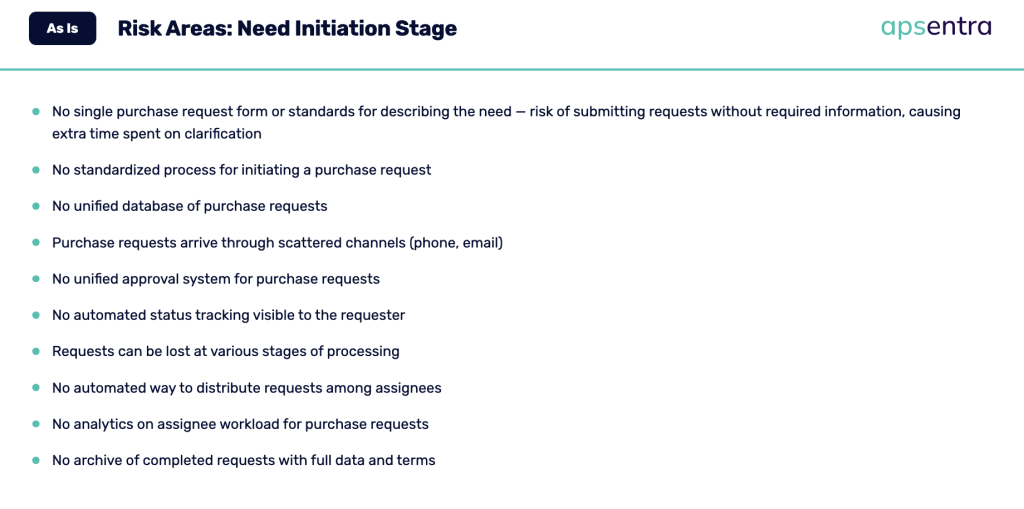
Our process diagnostic mapped requests for equipment as they actually moved — through phone calls and emails, with no shared system of record and found risk exposure at every stage of the purchase.
This led to several issues:
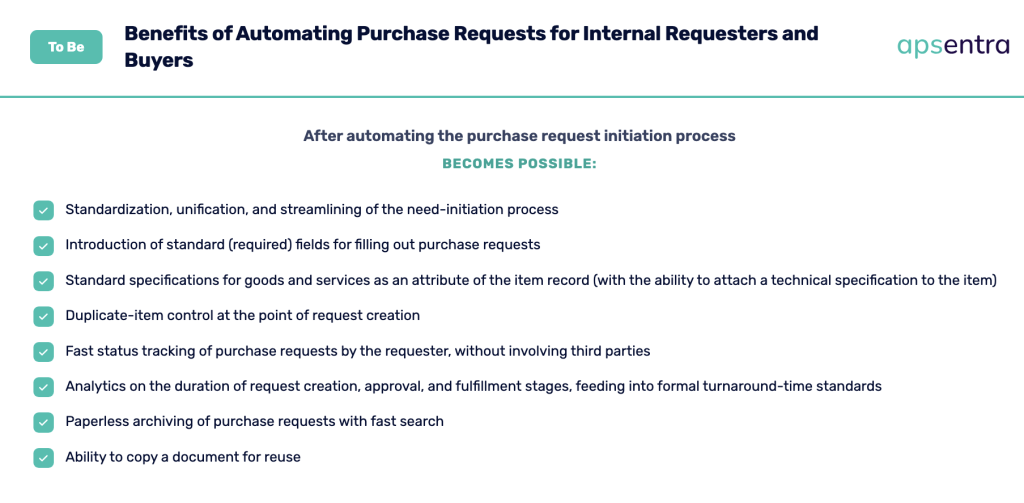
- No standard purchase request form, so requests often arrived missing required information
- No regulated process for initiating a purchase, and no single database of requests
- Requests came in through mixed channels — phone and email — with no unified intake
- No structured approval workflow for purchase requests
- Requesters had no way to check request status without contacting the buyer directly
- Requests could get “lost” between departments with no tracking
- No workload analytics on buyers, and no searchable archive of completed purchases
- Contract terms were reconciled against tender results manually, with no automatic data transfer
- No delivery registry — supplier delivery commitments were tracked verbally, with no way to confirm dates, connect a shipment to its original request, or analyze on-time performance

Our consulting approach
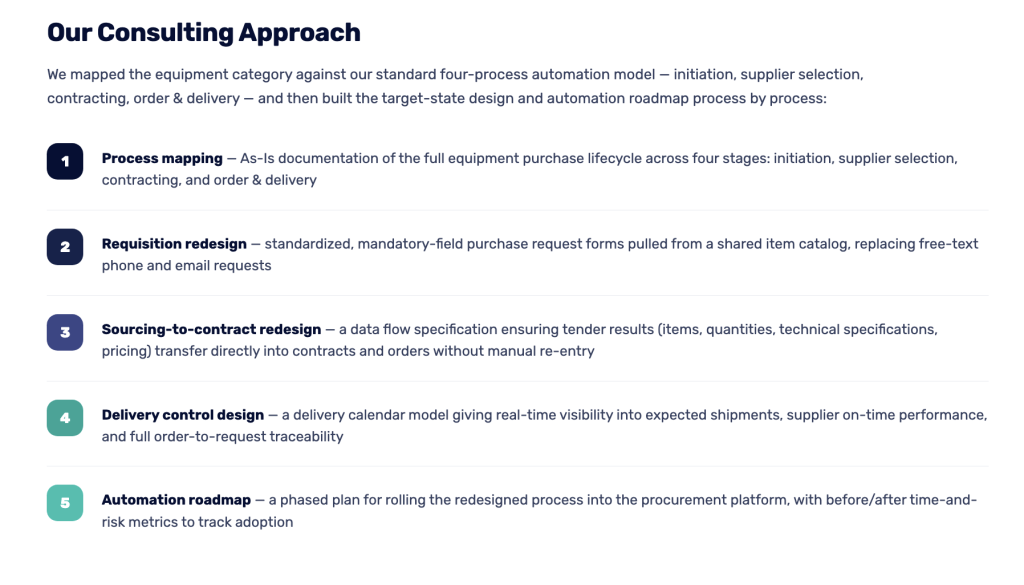
We mapped the equipment category against our standard four-process automation model — initiation, supplier selection, contracting, order & delivery and then built the target-state design and automation roadmap process by process:
- Process mapping — As-Is documentation of the full equipment purchase lifecycle across four stages: initiation, supplier selection, contracting, and order & delivery
- Requisition redesign — standardized, mandatory-field purchase request forms pulled from a shared item catalog, replacing free-text phone and email requests
- Sourcing-to-contract redesign — a data flow specification ensuring tender results (items, quantities, technical specifications, pricing) transfer directly into contracts and orders without manual re-entry
- Delivery control design — a delivery calendar model giving real-time visibility into expected shipments, supplier on-time performance, and full order-to-request traceability
- Automation roadmap — a phased plan for rolling the redesigned process into the procurement platform, with before/after time-and-risk metrics to track adoption
Deliverables
- Procurement consulting & digital procurement automation
- As-Is process maps across initiation, supplier selection, contracting, and order & delivery
- Standardized requisition form specification
- Tender-to-contract data flow design
- Delivery visibility / supplier scorecard model
- Automation roadmap with before/after time-and-risk metrics
Business impact
Mapping the equipment category against our four-process automation model exposed exactly where manual handoffs were causing lost requests, mismatched contract terms, and unconfirmed deliveries — and gave our client a sequenced roadmap to close each gap.
Store and warehouse teams gained self-service visibility into their equipment orders, while procurement leadership gained the data needed to manage supplier performance and buyer workload.
Results

Mandatory-field requests
A single system of record

Automatic contract population
Delivery visibility