Procurement Outsourcing Services: What They Include, What They Cost, and When They Make Sense
Sometimes it’s a way to hand off a problem you’d be better off fixing at the root. This guide walks through what these services actually include, what they cost under the three common pricing models, the risk that rarely makes it into the sales deck, and a framework for deciding whether outsourcing, software, or some mix of the two fits your situation.
What Do Procurement Outsourcing Services Actually Cover?
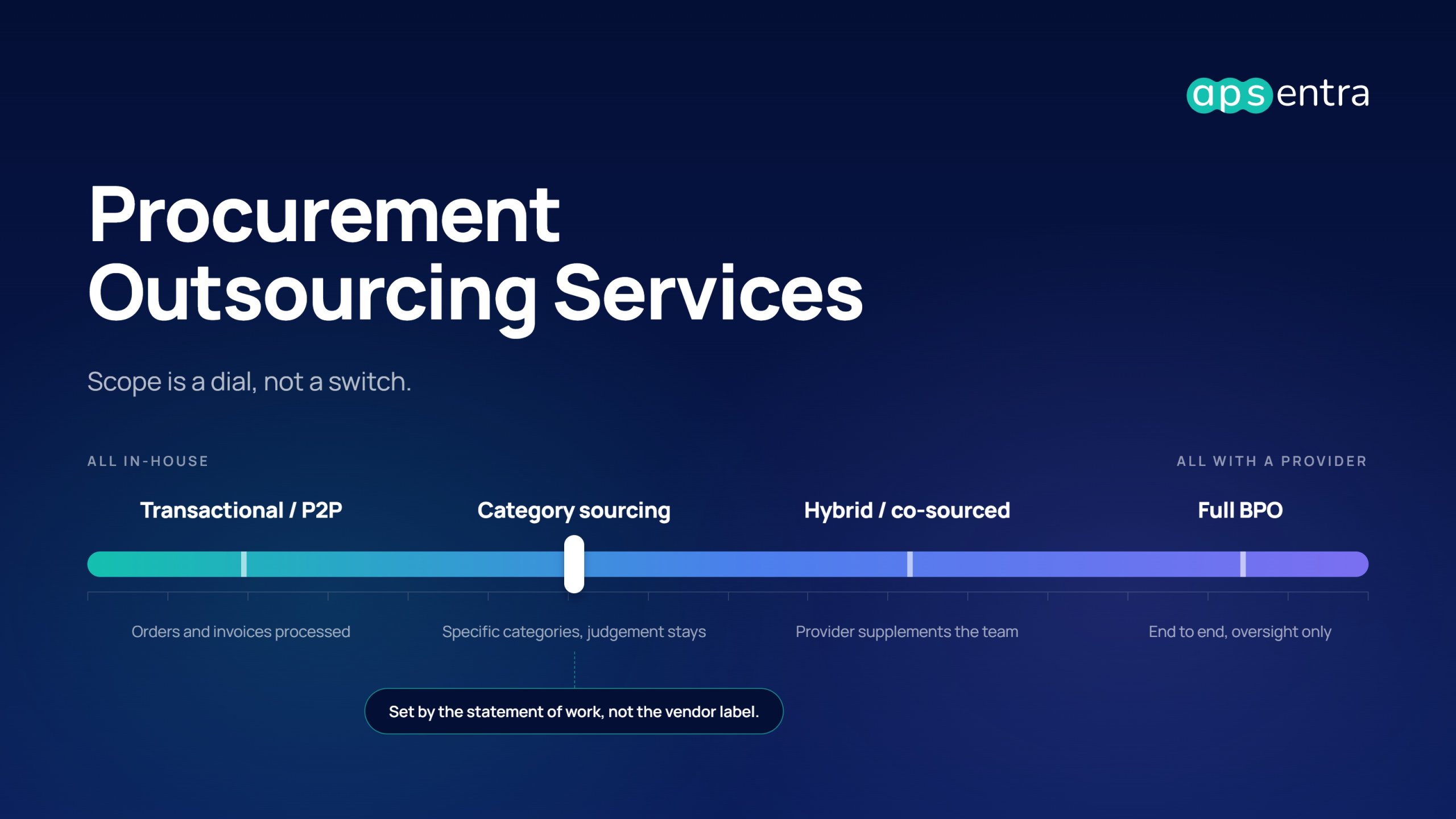
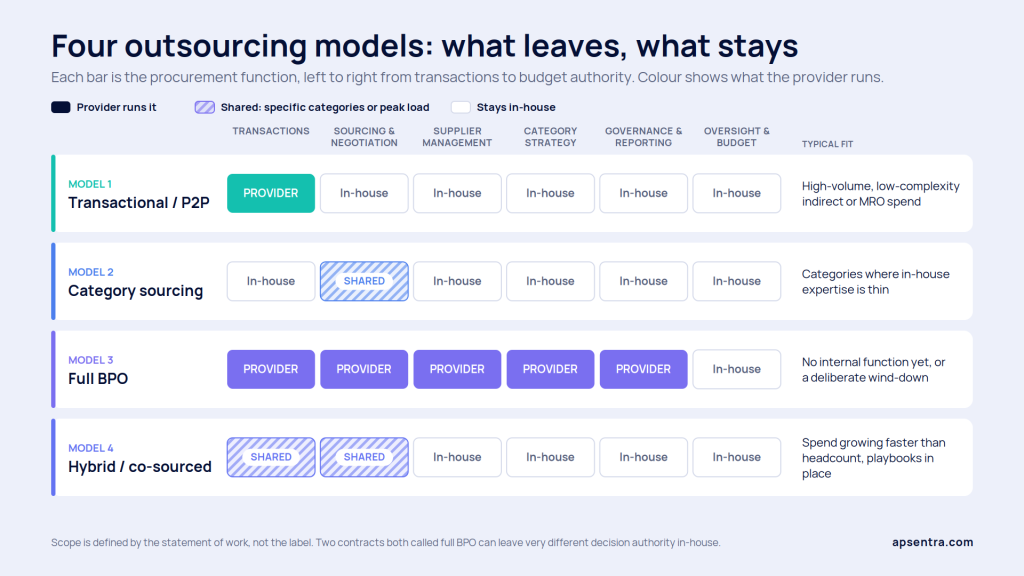
Procurement outsourcing services are the delegation of some or all purchasing activity, sourcing, purchase order processing, supplier management, or category strategy to a third-party provider. Scope ranges from a single transactional process to the entire procurement function, and what’s included is defined entirely by the contract, not by the vendor’s category label.
| Model | What the provider runs | What stays with you | Typical fit |
|---|---|---|---|
| Transactional / P2P outsourcing | Purchase order processing, invoice matching, help-desk tickets | Category strategy, supplier relationships, approval policy | High-volume, low-complexity indirect or MRO spend |
| Category sourcing outsourcing | RFPs and negotiations for specific categories | Overall governance, final approval, the supplier relationship post-signature | Categories where in-house expertise is genuinely thin |
| Full BPO | Sourcing, purchasing, supplier management, and reporting end to end | Strategic oversight and budget authority only | No internal procurement function yet, or a deliberate wind-down of one |
| Hybrid / co-sourced | Supplements the internal team on specific categories or peak load | Ownership of strategy and top supplier relationships | Spend growing faster than headcount, with playbooks already in place |
The label a provider uses matters less than the process boundary written into the statement of work. Two contracts both called “full BPO” can leave very different amounts of decision authority in-house, so read the RACI chart before the marketing page.
Why Do Companies Outsource Procurement?
Three reasons show up in almost every business case, and they rarely arrive alone.
- Headcount cost. A fully loaded procurement hire, salary, benefits, tools, management overhead, is expensive to carry through a slow quarter. A variable fee that scales with volume is easier to defend in a budget review than a fixed salary line.
- Scalability. Spend rarely grows in a straight line. A provider can absorb a spike in sourcing activity, an acquisition, a new product launch, without a hiring cycle that takes three months to clear.
- Lack of category expertise. Most internal teams are generalists. A provider with a dedicated packaging or logistics desk has run more negotiations in that category this year than most in-house teams will run in five.
None of these three is a reason to outsource everything. They’re reasons to outsource the specific slice of the function where the argument actually applies, which is exactly what the scope table above is for.
What Does Procurement Outsourcing Cost?
Three pricing models cover most contracts. None of the figures below describe what outsourcing saves you, only what it costs to run, that distinction matters enough to get its own note at the end of this section.
Per-transaction fee
You pay per purchase order or invoice processed, so the fee scales directly with volume. This is the default for transactional and P2P outsourcing.
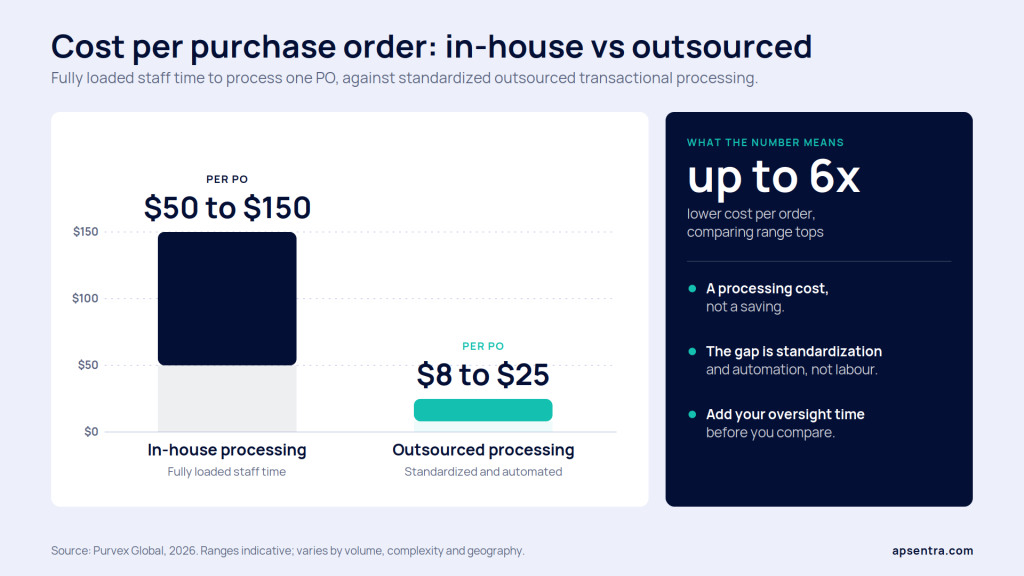
Processing a purchase order in-house typically runs $50 to $150 in fully loaded staff time. Standardized, outsourced transactional processing brings that down to roughly $8 to $25 per PO, according to Purvex Global’s 2026 procurement outsourcing cost analysis, mostly through process standardization and automation rather than cheaper labor alone.
Percentage of spend managed
The provider’s fee is calculated as a share of the total spend they source or manage on your behalf. This is common for category sourcing and full BPO, where spend, not transaction count, is the more natural unit to price against.
Everest Group’s 2025 Procurement Outsourcing PEAK Matrix methodology defines a qualifying multi-process engagement as more than $1 million in annual contract value against managed spend typically above $50 million, a ratio that works out to roughly 2 percent at the entry point of that range. Smaller or more specialized engagements commonly run higher as a percentage, since a provider’s fixed delivery cost doesn’t shrink along with scope.
Flat retainer
A fixed monthly or annual fee, independent of transaction volume or spend, usually attached to a dedicated resource or a narrowly scoped category rather than the whole function.
For a dedicated outsourced procurement resource, 1840 & Co’s 2026 outsourcing cost guide puts offshore rates around $1,200 to $5,000 a month and nearshore around $2,000 to $8,000, against a US in-house equivalent closer to $4,000 to $12,500 once benefits and overhead are included.
What none of these numbers tell you is what you’ll actually save. Savings depend heavily on category, starting baseline, and how disciplined the internal process already was, so treat a vendor’s headline savings percentage as a claim to verify against your own data, not a figure to budget against upfront.
The Hidden Risk: Loss of Control, Data Visibility, and Audit Trail Gaps
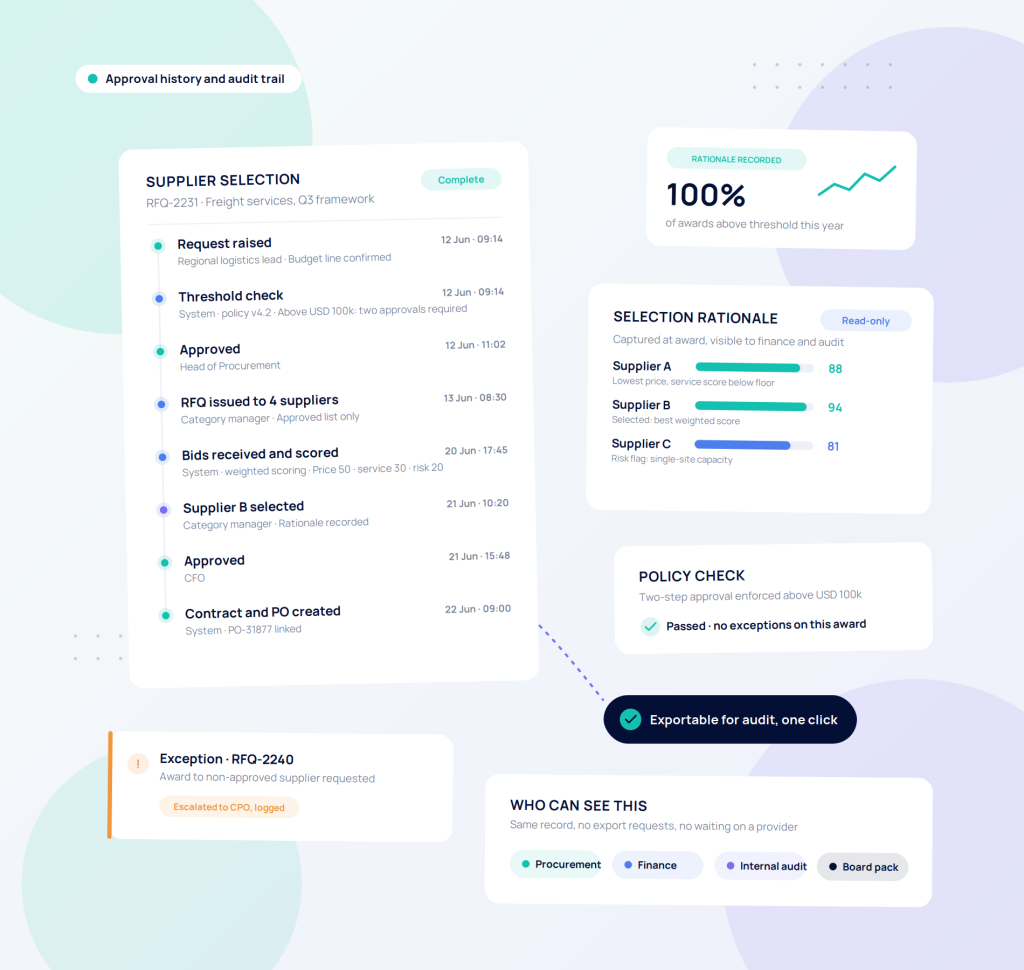
The pitch deck covers cost and capacity. It rarely covers what happens the first time an auditor, a new CFO, or a board member asks why a specific supplier was chosen, and the answer lives in a system you don’t have login access to.
When a provider executes sourcing and purchase orders on your behalf, the transaction record, who was contacted, what was negotiated, why an exception was approved, often lives primarily in their system, not yours. Reconstructing that history for an internal audit or a compliance review means requesting it from the vendor, not pulling it yourself, and the request queue on their side is not your emergency.
This compounds a gap that already exists at most companies. Deloitte’s 2025 Global CPO Survey found 81 percent of organizations report at least half their spend under formal management, which leaves a meaningful share that isn’t. Layering an outsourced, less visible process on top of spend you already couldn’t fully trace doesn’t close that gap, it just moves it one level further from view. Our analysis of why procurement ROI fails CFO scrutiny covers what finance actually needs to trust a number, outsourced or not.
“There are times you are going to lose margin no matter what. If you have a plan and you are conscious of it, that is a strategic approach: I chose to lose here. That is very different from finding out at the end that you lost, and backtracking.”
— Richard Richardson, Founder and Chief Equity Officer, RicheRich LLC, on the Behind Procurement Podcast
Richardson was talking about margin decisions in freight brokerage specifically, but the same test applies to any outsourcing decision. Did you consciously trade some control for cost or capacity, with a plan to monitor it, or did you find out later, at an audit or a board review, that you’d lost visibility you assumed you still had?
What Outsourcing Providers Can’t Give You
Two things, specifically, and both come down to who the reporting is built for.
- Real-time governance. A provider enforces the rules you gave them at the start of the contract. If your approval thresholds or supplier risk policy change mid-year, that update moves at the speed of a contract amendment, not a settings change.
- Board-ready financial reporting. Providers report on their own performance against agreed SLAs, cost savings claimed, cycle time, compliance rate, on a schedule that suits their delivery cadence, usually monthly or quarterly. That’s a different document from a live, board-ready view of committed spend, and translating one into the other is work somebody on your side still has to do.
Neither gap is a flaw in the provider’s service. It’s a structural consequence of the reporting being built around their delivery obligations, not your governance needs. Closing it is the specific job of the model in the next section.
The Alternative Model: Software-Driven Procurement With Internal Ownership
The alternative to handing sourcing decisions to an outside team isn’t necessarily hiring more people. It’s putting the same spend, contract, and approval data a provider would use in a system your own team controls directly, so the judgment stays in-house even as the volume grows.
The distinction is ownership, not headcount. A software-driven model can still involve outside expertise for a specific negotiation or a technical category, the way the earlier scope table describes category sourcing outsourcing. What changes is that governance, the approval rules, the audit trail, the reporting cadence, is owned and configured by your team, live, rather than delivered back to you on someone else’s schedule.
“You cannot have regional people making decisions for the entire organization, because most of those decisions are simply going to be based on price. You have to bring it in-house, standardize the process, the timelines, the bottlenecks, the risk, and then disseminate that to the regional teams.”
— Bob Houston, Founder, FreightThis; Head of Partnerships, APSentra, on the Behind Procurement Podcast
Houston was describing regional buying decisions inside a single company, not third-party outsourcing specifically, but the underlying argument transfers directly. Whichever party sits closest to a single transaction tends to optimize for that transaction, on price, on speed, on whatever is easiest to measure in the moment, unless the standard it’s working against is centralized and enforced. That’s as true of an outsourced provider as it is of a regional office.
Our overview of how APSentra combines a governed platform with certified partners covers what this looks like in practice, and our comparison of when a team needs a consultant versus when it needs a better system applies almost directly to outsourcing as well.
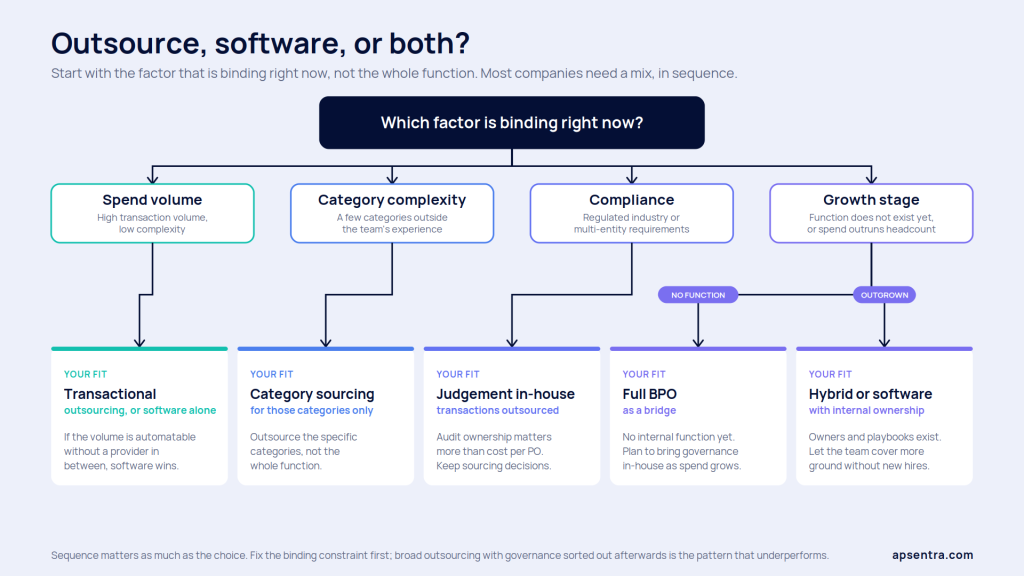
Outsource, Software, or Both? A Decision Framework
Spend volume, category complexity, compliance requirements, and growth stage each point toward a different answer. Most companies need a mix, sequenced by which factor is binding right now.
| If this is your situation | This is your fit |
|---|---|
| High transaction volume, low complexity (indirect or MRO spend), no real expertise gap | Transactional outsourcing, or software alone if the volume is automatable without a provider in between |
| A handful of categories are technically complex and genuinely outside your team’s experience | Category sourcing outsourcing for those categories specifically, not the whole function |
| No internal procurement function exists yet, and building one would take too long | Full BPO as a bridge, with a plan to bring governance in-house as spend and risk grow |
| Spend is growing faster than headcount, but category owners and playbooks already exist | Hybrid or co-sourced model, or software that lets the existing team cover more ground |
| Heavily regulated industry or multi-entity compliance requirements | Keep sourcing judgment in-house; outsource transactional volume only, since audit ownership matters more than cost per PO |
| Fast growth stage, needing spend control to scale without a large hiring cycle | Software-driven procurement with internal ownership, since it scales without adding outsourcing management overhead |
Sequence matters as much as the choice itself. Start by fixing whichever factor is actually binding, spend volume you can’t process, a category you can’t staff, a compliance requirement you can’t evidence, rather than outsourcing the whole function because one piece of it is under strain. The pattern shows up consistently in APSentra client cases: the companies that scope outsourcing narrowly, against a specific constraint, get more value from it than the ones who outsourced broadly and tried to sort out governance afterward.