Best Procure-to-Pay (P2P) Automation Tools for Mid-Market Companies in 2026
We also evaluated SAP Ariba, Coupa, Precoro, Ivalua, and GEP SMART using verified G2, Capterra, and Gartner Peer Insights review data — all are capable P2P platforms, but each carries specific gaps (enterprise-grade complexity, invoice/payment limitations, or implementation timelines of 6–9 months) that make it a weaker fit for a mid-market buyer than a purpose-built platform. Details below.
Editorial methodology: how we evaluated these platforms
We built this comparison from three sources:
(1) primary vendor documentation and product demos,
(2) an analysis of over 1,900 verified user reviews published on G2, Capterra, and Gartner Peer Insights between 2023 and 2026 covering SAP Ariba, Coupa, Precoro, Ivalua, and GEP SMART
(3) our own product and implementation data for APSentra.
We did not survey finance leaders directly for this piece — where we reference “what users say,” it reflects patterns pulled from published, verified reviews, cited by vendor below.
Each platform was scored against the same criteria:
- invoice-to-payment cycle time,
- 3-way matching accuracy and automation depth,
- approval flexibility,
- ERP/accounting integration depth,
- AP automation maturity (OCR, exception handling, duplicate detection),
- implementation/adoption speed.
Because P2P automation touches both procurement and accounts payable, we weighted AP-specific outcomes — touchless processing rate, invoice exception rate, payment-cycle time — alongside procurement-side criteria like budget enforcement and approval routing.
A note on objectivity: because APSentra is the publisher, we’ve deliberately anchored every claim about competitors in a citable, third-party source (G2, Capterra, Gartner Peer Insights, or a named analyst report) rather than our own characterization. Where we make a claim about APSentra itself, we’ve flagged it as vendor-reported data rather than independently audited.
Procurement creates value; execution protects it. That’s the gap most mid-market finance teams are actually fighting: not a lack of purchasing policy, but a purchasing process that’s still stitched together from email approvals, manual invoice entry, and a spreadsheet tracking what’s been ordered versus what’s been paid.
According to Ardent Partners’ 2025 State of ePayables research, the all-buyer average invoice processing time is still 10.9 days, while best-in-class automated teams close the loop in roughly 3.1 days – a 72% gap that shows up directly in cash flow visibility, discount capture, and audit readiness.
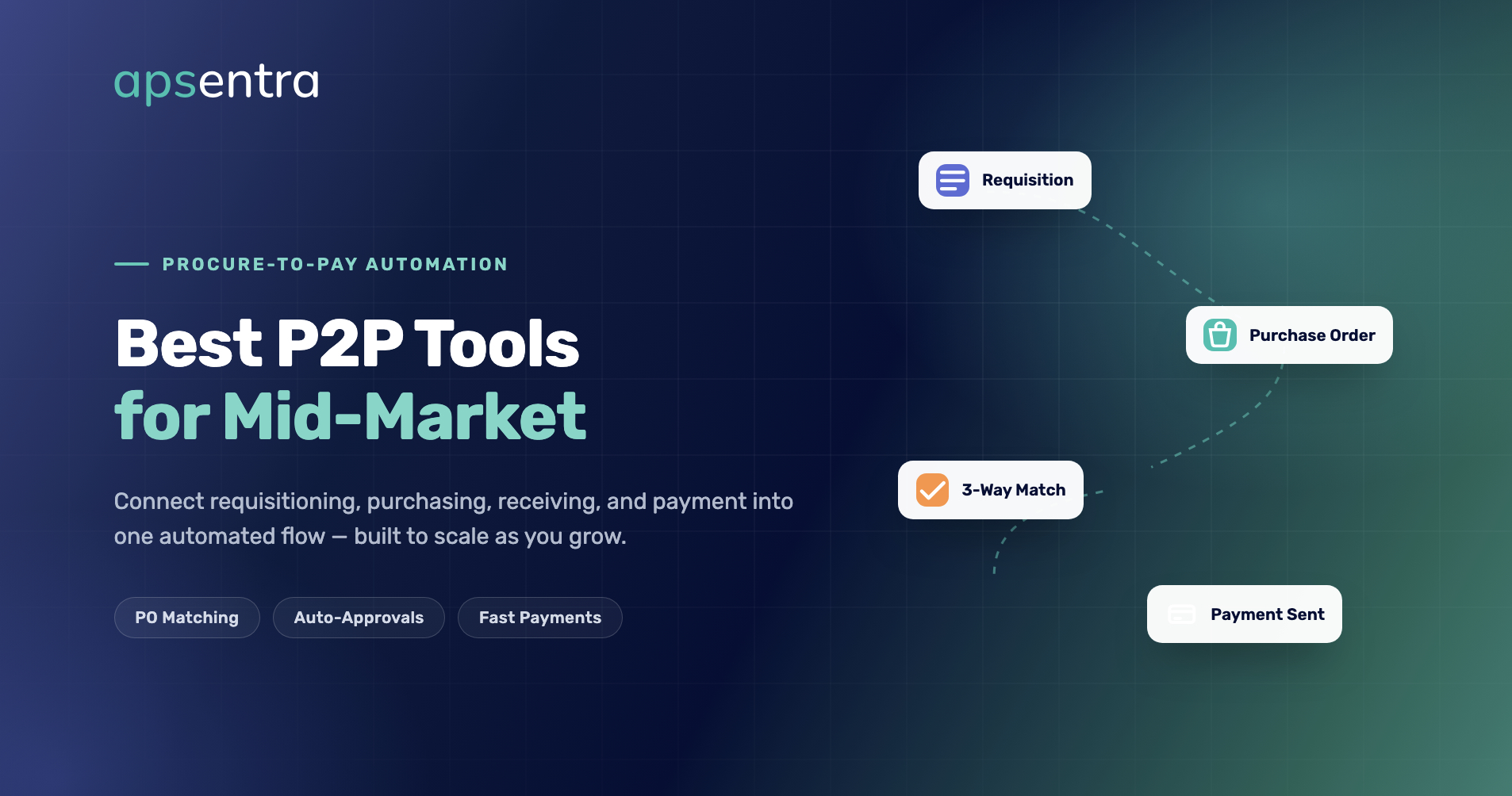
Procure-to-pay (P2P) automation software closes that gap by connecting the entire cycle — requisition, approval, purchase order, goods receipt, invoice, and payment — into one workflow instead of five disconnected steps.
What is procure-to-pay (P2P) automation?
P2P covers the full operational lifecycle of a purchase:
Requisition → Approval → Purchase Order → Goods Receipt → Invoice → Payment.
It’s the point where procurement’s operational execution meets accounting’s precision requirements. Automating this cycle means every stage — from the initial request to the final payment flows through one connected system rather than being manually re-keyed at each handoff.
The core mechanics that make P2P automation valuable:
- 3-way matching — automatically verifying that the purchase order, goods receipt, and supplier invoice all agree before payment is released, catching discrepancies before money moves rather than after.
- OCR-based invoice capture — extracting structured data from incoming invoices automatically instead of manual entry, then validating it against PO terms.
- Exception-based AP workflows — routing only invoices with a mismatch or policy flag for human review, so straight-through invoices process without anyone touching them.
- Payment optimization — surfacing early-payment discount windows and payment-term visibility so payment timing becomes a deliberate cash strategy rather than a reactive scramble.
P2P software vs. standalone PO or AP tools
This distinction matters because vendors in this space are not all solving the same scope of problem.
Purchase order software manages one segment of the cycle: requesting, approving, and issuing a PO. AP automation software manages the back half: invoice capture, matching, and payment. Procure-to-pay software connects both ends into a single workflow, so a purchase order created at the start of the cycle stays linked to its receipt and invoice at the end — instead of three separate systems that each need manual reconciliation between them.
When you need full P2P vs. a point solution: if your team already has decent AP tooling but purchasing requests are still informal, a PO-focused tool may be enough. If invoices are arriving disconnected from any purchase record and your team is manually matching them after the fact, you need the full P2P cycle connected — which is where point solutions (PO-only or AP-only tools) start to break down at mid-market transaction volume.
Signs your P2P process needs automation
- Invoices routinely show up with no linked purchase order or approval on file.
- AP spends significant time each month chasing 3-way match discrepancies manually.
- Duplicate payments have happened more than once in the past year.
- Early-payment discounts are missed because approvals take too long to clear in time.
- Month-end close is delayed by reconciling POs, receipts, and invoices that live in separate systems.
- Finance can’t answer “what do we owe suppliers right now” without pulling data from multiple places.
Must-have features in P2P automation for 2026
End-to-end workflow automation
- Structured purchase requisitions with automated approval routing
- Digital PO issuance and real-time delivery status tracking
- Invoice processing and payment authorization inside the same workflow
Matching and AP automation
- Automated 3-way matching (PO, goods receipt, invoice) with instant discrepancy flagging
- OCR-based invoice capture that extracts and validates data against PO terms automatically
- Duplicate invoice detection before payment, not after
- Exception-based approval routing so only flagged invoices need human review
Financial control and optimization
- Real-time budget checks before a request is approved, not just before payment
- Payment-term visibility and automated early-pay discount eligibility detection
- Liability forecasting and centralized visibility into what’s owed and when
Integration depth
- Native ERP integrations (NetSuite, Dynamics, SAP, and similar)
- Accounting platform connections (Xero, QuickBooks, Sage)
- General ledger and cost-center mapping that stays synchronized automatically
Best procure-to-pay automation tools for mid-market companies
1. APSentra — best overall for full-cycle mid-market P2P automation
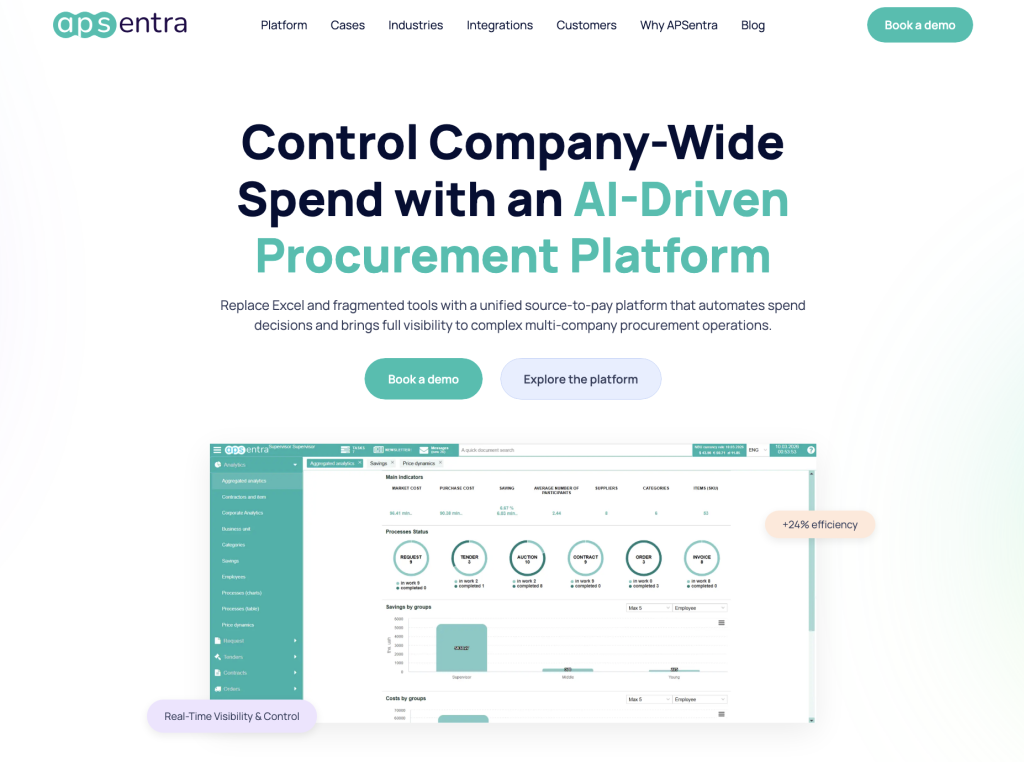
Best for: Mid-market finance and procurement teams that want the entire requisition-to-payment cycle automated in one system, with budget governance built into the front end rather than bolted onto AP at the back end.
APSentra automates the operational core of procurement rather than treating P2P as a set of disconnected modules. Budget validation happens when a request is created; 3-way matching happens automatically when an invoice arrives; and payment timing is optimized rather than reactive.
Top features:
- End-to-end workflow automation: requisition, approval routing, digital PO issuance, delivery tracking, invoice processing, and payment authorization in one flow
- Automated 3-way matching between purchase order, goods receipt, and supplier invoice, with instant discrepancy flags before payment approval
- OCR-based invoice recognition that captures, extracts, and validates invoice data against PO terms automatically
- Exception-based AP automation: automatic invoice validation, duplicate detection, and centralized liability visibility, with only exceptions routed for manual review
- Early-pay discount capture: automated eligibility detection and accelerated approval routing to hit supplier discount windows
- Real-time PO delivery status tracking connecting finance and operations
- Native ERP and accounting integrations, with general ledger and cost-center mapping kept synchronized automatically
Vendor-reported performance data: organizations implementing APSentra’s P2P automation typically report a 40–60% reduction in invoice processing time, a significant reduction in duplicate payments, improved cash flow predictability, faster month-end reconciliation, and increased early-payment discount capture. These figures are vendor-reported; we’ve flagged them as such because, unlike the competitor data in this article, they aren’t yet cross-referenced against a large base of third-party reviews.
Best for: Mid-market companies (roughly 100–2,000 employees) that want the full requisition-to-payment cycle connected, not just a faster PO tool or a faster AP inbox, but both ends of the process working off the same data.
Platforms we evaluated and why they didn’t top the mid-market list
We reviewed each of these using verified G2, Capterra, and Gartner Peer Insights data. All five are legitimate, capable P2P/source-to-pay platforms — several are Gartner Magic Quadrant leaders and may be the right choice for a large enterprise. Here’s what the review data actually says about mid-market fit.
SAP Ariba
Based on 700+ reviews analyzed across G2 and Capterra (2024–2025), SAP Ariba earns strong marks for automating the full cycle from requisition to invoicing, backed by the Ariba Network’s large connected-supplier base for e-invoicing, with satisfaction ratings ranging from 77% to 92% depending on module. Average reported implementation time is 6 months, with an average reported payback period of 16 months.
The recurring complaint pattern: a steep learning curve, an interface users repeatedly describe as “overloaded,” and pricing/transaction fees reviewers from small and mid-sized companies consistently flag as too high for their scale. Vendor-side onboarding is also cited as a friction point that can affect supplier participation in e-invoicing.
Why it’s not our mid-market P2P pick: the same breadth that makes Ariba strong for global enterprise P2P is what reviewers cite as disproportionate for a mid-market team — a 6-month implementation and enterprise licensing model for a process that, at mid-market volume, doesn’t need that scale.
Coupa
On G2, Coupa holds roughly a 4.2/5 rating across 557+ verified reviews. Reviewers consistently praise its invoice tooling — Coupa’s Invoice Smash OCR technology and automated 3-way matching are cited as strong, with the vendor’s own benchmark data (Forrester TEI study, 2024) reporting up to 80% of invoice-matching processes automated and an average 4-hour requisition-to-order cycle for enterprise customers.
The critical pattern in recent reviews: a “clunky,” “outdated” professional interface, a steep learning curve, and a marked decline in customer support satisfaction that many reviewers tie to Coupa’s 2023 acquisition by Thoma Bravo. The mobile app draws particularly consistent criticism for receipt-upload bugs and slow sync. Supplier-side reviews are notably negative on onboarding friction, which matters for P2P specifically since supplier invoice submission runs through the same portal.
Why it’s not our mid-market P2P pick: strong invoice-matching technology, but reviewers below enterprise scale consistently describe both cost and learning curve as disproportionate, and the mobile/support gaps directly affect day-to-day AP operations.
Precoro
Analysis of 180+ verified 2024–2025 reviews shows Precoro is genuinely well-regarded for SMB and lower mid-market procurement — fast 10-week implementation, strong approval workflows, and standout customer support (90% of positive reviews cite support quality specifically, with 96% of tickets resolved within 2 hours).
The gap, according to the same reviews, sits squarely in the P2P back half: invoice and payment handling is Precoro’s most consistently flagged weakness. Reviewers report no support for partial or advance payments, invoice approval that behaves inconsistently, comments and context that don’t carry over from requisition to PO to invoice, and no native global payment execution — meaning it doesn’t fully close the P2P loop without a separate AP tool bolted on.
Why it’s not our mid-market P2P pick: the review pattern is explicit — Precoro’s own reviewers describe it as strong on the procurement/approval side but not built to handle the full invoice-and-payment half of procure-to-pay, which is the exact scope this comparison evaluates.
Ivalua
Ivalua holds a 4.4/5 rating on G2 (80+ reviews) and 3.8/5 on Capterra. Reviewers confirm the P2P module effectively supports the full cycle from intake through invoice processing, with real-time spend tracking and strong procedure compliance called out specifically. The OLAP-based analytics engine also draws praise for deep spend visibility.
The tradeoff shows up directly in the reviews: average implementation time is reported around 9 months, and — notably for a P2P tool — reviewers specifically flag the absence of a mobile app for approvals, meaning reconciliation and sign-off are desktop-only. Small and mid-sized companies describe the platform as enterprise-oriented, with a licensing model multiple reviewers find difficult to price out upfront.
Why it’s not our mid-market P2P pick: a 9-month implementation and desktop-only approvals are hard to justify for a mid-market team trying to speed up its purchase-to-payment cycle, not slow it down further during rollout.
GEP SMART
GEP SMART reviewers praise it as a genuine end-to-end source-to-pay suite, with strong approval workflows, policy enforcement, and mobile approval capability called out as advantages in the P2P module specifically. Reported cost savings run 25–40% through improved visibility and automation.
The review pattern here is explicit about segment fit: GEP SMART’s own review data frames a “clear divide” between enterprise and mid-market users. On the P2P side specifically, reviewers describe the requisition workflow as “heavy” for simple, low-value purchases — too many fields and steps for a routine buy — creating friction for occasional requesters and low adoption without significant change management investment.
Why it’s not our mid-market P2P pick: GEP SMART’s P2P workflow is built for governance-heavy, complex purchasing; reviewers say it’s disproportionate friction for the routine, high-volume purchases that make up most of a mid-market company’s P2P volume.
Other mid-market options worth knowing
A few additional platforms come up often in mid-market P2P searches. We haven’t run the same depth of independent review analysis on these as we have on the five above, so treat the notes below as a starting point for your own research rather than a fully sourced verdict:
- ProcureDesk — combines procurement, spend tracking, and invoice management aimed at teams moving off manual processes for the first time; three-way matching exists but is generally described as more basic than purpose-built P2P suites.
- PLANERGY — automates the purchasing lifecycle from requisition through invoice processing, with integrations into QuickBooks and NetSuite; approval routing and AP automation depth are lighter than platforms built specifically for multi-entity mid-market P2P.
- Order.co — centralizes vendor purchasing and payment execution across multiple vendors; stronger on the purchasing/payments consolidation side than on deep 3-way matching or AP exception automation.
- Tradogram — covers PO creation and light sourcing at a lower price point; invoice and payment automation is limited compared to full P2P platforms, so it typically needs to be paired with a separate AP tool.
Feature comparison table
| Platform | Automated 3-way matching | OCR invoice capture | Mobile approvals | Early-pay discount automation | Reported implementation time |
|---|---|---|---|---|---|
| APSentra | Yes, instant discrepancy flags | Yes | Yes | Yes | Up to 8 weeks (vendor-reported) |
| SAP Ariba | Yes | Yes (Joule AI rollout 2025–2026) | Yes | Limited detail in reviews | ~6 months (review-reported average) |
| Coupa | Yes, ~80% of matching automated | Yes (Invoice Smash OCR) | Yes, but reviewers flag stability/sync bugs | Not a highlighted feature in reviews | Not consistently reported; 6–12 months per reviewer accounts |
| Precoro | Inconsistent, per reviews | Limited | Yes | No advance/partial payment support | ~10 weeks (SMB-focused) |
| Ivalua | Yes | Yes | No mobile app for approvals (review-flagged) | Not a highlighted feature in reviews | ~9 months (review-reported average) |
| GEP SMART | Yes | Yes (OCR contract/invoice extraction) | Yes | Not a highlighted feature in reviews | Long; described as “not plug-and-play” |
P2P software pricing
Vendor pricing for full P2P suites is largely quote-based, scoped to entity count, transaction volume, and modules — self-serve pricing is rare once invoicing and payment execution are included.
| Vendor | Starting price (as publicly reported) |
|---|---|
| APSentra | Custom quote (scoped to entity count and modules) |
| Precoro | ~$490–499/month (per review data, SMB tier; note: back-half AP/payment functionality is limited at this tier) |
| SAP Ariba | Custom quote; enterprise licensing plus transaction/network fees |
| Coupa | Custom quote |
| Ivalua | Custom quote; reviewers describe the licensing model as difficult to estimate upfront |
| GEP SMART | Custom quote; enterprise-scoped |
| ProcureDesk / Tradogram / PLANERGY / Order.co | Published tiered pricing available on vendor sites; varies by seat count and modules, and AP-side functionality varies significantly between them |
People searching “how much does P2P software cost” should expect: SMB-focused procurement tools publish pricing in the low hundreds of dollars per month, but often without full AP/payment automation included; mid-market and enterprise full-cycle P2P platforms are quote-based and scoped around transaction volume and entity count.
Common P2P implementation mistakes
Independent reviews of every platform in this comparison point to the same handful of rollout failures, regardless of vendor:
- Automating procurement without automating AP, or vice versa
Several platforms in this comparison are strong on one half of the cycle and weak on the other (Precoro on approvals but not payments; Ivalua on procurement but with no mobile approvals) — a genuine P2P rollout needs both halves connected, not just the one your team happens to prioritize first. - Treating ERP integration as an afterthought
Reviewers across SAP Ariba, Ivalua, and GEP SMART specifically cite integration complexity as the top driver of implementation delays — scope this before signing, not after. - Skipping exception-handling design
If nobody defines what counts as a “discrepancy” worth flagging before go-live, 3-way matching either flags everything (defeating automation) or nothing (defeating the control). - Leaving AP out of the vendor selection
P2P tools chosen by procurement alone often under-deliver on invoice and payment automation, which is exactly the gap several reviewed platforms show. - Under-investing in requester training for low-value purchases
GEP SMART’s review data specifically flags friction and low adoption when routine, low-dollar requests go through a heavy enterprise workflow.
Procure-to-pay trends for 2026
- AI-driven exception handling over full manual review
Per Ardent Partners’ 2025 research, 75% of AP departments now use some form of AI, and the all-buyer average touchless (straight-through) processing rate sits near 25%, while best-in-class AP teams reach 35%+ — the direction of travel is fewer invoices touched by a human at all. - Faster invoice cycles as a competitive baseline
Ardent Partners puts average invoice processing time at 10.9 days industry-wide versus roughly 3 days for best-in-class automated teams — a gap wide enough that cycle time is becoming a standard vendor evaluation question. - Lower invoice exception rates through better upfront matching
Top-performing AP teams report a 9% invoice exception rate versus a 22% industry average (Ardent Partners 2025) — largely a function of cleaner 3-way matching earlier in the cycle, not better manual review later. - Spend visibility as the top procurement technology priority
Deloitte’s 2025 Global Chief Procurement Officer Survey found spend analytics and dashboarding ranked as CPOs’ top technology priority, with top-performing organizations reporting roughly 3x greater returns on GenAI investment than peers. - Payment timing becoming a deliberate cash strategy
As interest rates keep cash management front of mind, automated early-pay discount detection and liability forecasting are shifting from a nice-to-have to a standard evaluation criterion.
Estimating the ROI of P2P automation
This is a simplified, illustrative framework — not a case study — meant to help you build your own estimate with your actual invoice volume:
If your AP team processes 400 invoices a month and manual 3-way matching, data entry, and exception-chasing currently take 15 minutes per invoice on average, that’s roughly 100 hours a month, or about 1,200 hours a year tied up in a process automated matching is designed to eliminate for the majority of invoices. At a fully loaded cost of $40/hour, that’s an estimated $48,000/year in labor time before factoring in the cost of missed early-payment discounts, duplicate payments, or the interest value of faster cash visibility.
Run this math with your own invoice volume and average handling time; the result varies significantly based on how many invoices already arrive linked to a valid PO versus how many require manual matching from scratch.
P2P software buyer’s checklist
Use this as a working checklist when scoping vendors — including APSentra:
- Automated 3-way matching with configurable discrepancy thresholds
- OCR invoice capture that validates against PO terms automatically
- Exception-based AP workflow (only flagged invoices need human review)
- Native ERP integration with your specific system, including GL and cost-center mapping
- Real-time budget checks at the request stage, not just at invoicing
- Mobile approvals for both purchase requests and invoices
- Duplicate invoice detection before payment
- Automated early-payment discount detection and payment-term visibility
- Multi-entity and multi-currency support if you operate more than one legal entity
- Named implementation support and a realistic go-live timeline in writing
- Reference customers at your approximate size and transaction volume — ask to speak with one
How to choose the right P2P platform
Map your current cycle end to end

Evaluate both halves of the cycle, not just one

Check integration depth, not integration claims

Prioritize adoption for routine, low-value purchases
Sources and methodology transparency
Competitor data in this article is drawn from verified reviews on G2, Capterra, and Gartner Peer Insights (2023–2026), vendor-published benchmark reports (Coupa/Forrester TEI 2024), and third-party industry research: Deloitte 2025 Global Chief Procurement Officer Survey and Ardent Partners 2025 State of ePayables / AP Metrics that Matter. APSentra performance figures are vendor-reported and marked as such throughout.
Editorial policy: Vendors cannot pay for inclusion or ranking in this article. Platforms are included because they meet our evaluation criteria for the mid-market P2P automation category, and every claim about a third-party product is tied to a citable source rather than our own characterization.