













A hidden failure three tiers down can take the whole network offline
Key challenges APSentra solves:
5G infrastructure complexity
Multi-tier supply chain gaps
Strict regulatory mandates
Asset-heavy utility CapEx
Single-source vulnerabilities
Framework contract leakage


APSentra — a unified source-to-pay procurement platform, built for telecom and utility infrastructureoperations
From multi-tier supply-chain mapping to 5G infrastructure tenders and regulatory vendor assessments, APSentra handles every dimension of telecom and utility procurement in one connected platform.


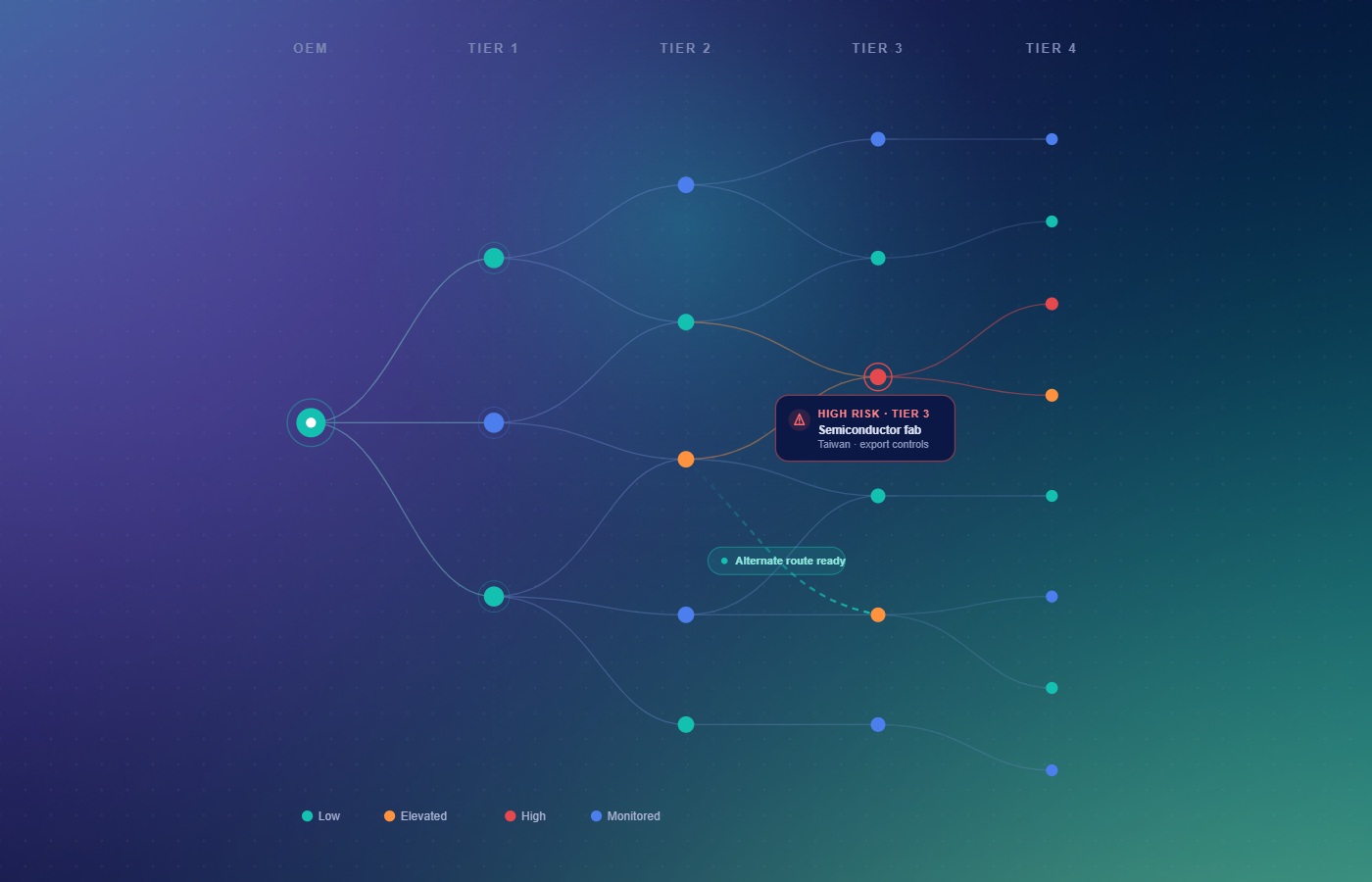
N-tier supply chain mapping
Sub-tier risk is visible before it hits the network.
- Multi-tier visual dependency mapping down to Tier 4
- Geopolitical and geographic risk scoring
- Early sub-supplier disruption alerts
- Alternative component sourcing routes
Component, semiconductor, and raw material risk caught early.
Complex 5G & infrastructure tendering
Long, multi-round tenders run on one workflow.
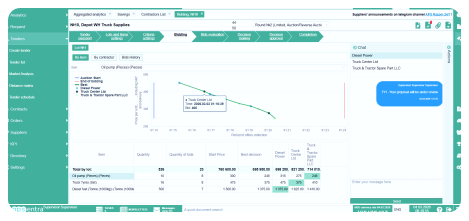
- Multi-round complex RFP workflows
- Joint technical and commercial evaluation
- Side-by-side bid comparisons
- Automated framework call-off orders
Radio, core network, and passive infrastructure are all governed.
Security & CNI compliance
Due diligence without the manual bottleneck.
- CNI-aligned security assessment templates
- Automated vendor risk questionnaires
- Ownership and country-of-origin tracking
- Continuous compliance renewal alerts
High-risk vendor mandates are met at the point of award.

Capital program & milestone control
CapEx and frameworks are governed by the milestone.
- Delivery-verified milestone triggers
- Variation-order cost-impact analysis
- SLA breach tracking and escalation
- Volume-commitment spend tracking
Framework leakage closed across multi-year programs.

Supplier resilience & dual sourcing
No critical build phase resting on one vendor.
- Approved vendor alternatives per critical component
- Supplier risk scoring on delivery, quality, and financial signals
- Dual-sourcing workflows for high-criticality equipment
- Ongoing supplier performance monitoring
Single-source exposure reduced before a delay stalls a build.



Other companies vs APSentra
- Static company-wide budgeting
- Standard corporate indirect workflows
- General, lagged expense tracking
- Blind to Tier-4 sub-supplier risk & origins
- Manual due diligence for regulatory mandates
- Dynamic, milestone-based CapEx & contract management
- Automated three-way matching for high-volume utility bills
- N-tier supply-chain mapping with visual dependency graphs
- Pre-award compliance gating & automated risk screening
- Configurable multi-round RFP workflows for 5G infrastructure
Smooth custom & ERP-agnostic integrations
Seamlessly integrates with your ERP, accounting, collaboration, analytics, and supplier ecosystems.
Keep budgets, contracts, purchase orders, tenders, and payments aligned across all enterprise systems.




Why telecom & utility operators choose APSentra




Build resilient networks on resilient procurement
No blind sub-tiers. No compliance gaps.
Latest articles
Procurement Governance in Capital Projects: How to Protect Investment Returns
The State of AI Adoption in Procurement in 2026
AI Procurement Workflows That Improve Decision Quality
FAQs
What is telecom procurement?
Telecom procurement is the end-to-end sourcing, purchasing, and contract-lifecycle management of high-value ICT infrastructure, critical network components, and multi-location carrier services. Unlike generic business procurement, it is heavily exposed to complex n-tier supply chains, long multi-round infrastructure RFPs, and strict critical-national-infrastructure (CNI) requirements.
APSentra unites upfront vendor due diligence, 5G radio and core hardware tendering, and framework-agreement compliance into a single governance engine.
What should telecoms and utilities look for in procurement software?
The connectivity sector’s demands go well beyond indirect corporate spend. Operators running 5G rollouts or grid modernization need to link direct hardware sourcing to multi-tiered deployment timelines, map sub-tier dependencies down to Tier 4, automate vendor security vetting, coordinate multi-round technical evaluations, and tie supplier payments to verified physical delivery.
APSentra is built for that: long-lead CapEx tendering, n-tier dependency mapping, country-of-origin checks before signing, and enforcement of volume-based discount milestones across multi-year buildouts.
How does a procurement platform differ from TEM (Telecom Expense Management) software?
A telecom management system governs the operational, technical, and financial footprint of a network. Traditional TEM software is one reactive slice of that: it manages corporate wireline invoices, tracks mobile-device inventory, and audits recurring bills after they are generated — looking backward at spend that already happened.
APSentra operates upstream and proactively, governing hardware configurations, framework agreements, and infrastructure CapEx before spend leaks occur, rather than auditing it afterward.
Do telecom operators still need procurement software if they have a CRM?
Yes — they solve opposite sides of the ledger. CRM platforms such as Salesforce Communications Cloud or Oracle Communications manage revenue coming in: billing, subscriber retention, and sales pipelines. They don’t monitor capital going out.
APSentra governs the supply chain behind the network — preventing unauthorized field spending and keeping infrastructure builds on budget — so it runs alongside a CRM rather than replacing it.
What are telecom aggregator companies, and how do they affect the supply chain?
Telecom aggregators are wholesale intermediaries that package and resell network capacity, SMS gateways, or hardware components from Tier 1 carriers and manufacturers to smaller providers. They simplify sourcing but create blind spots around sub-supplier concentration and component origins.
APSentra mitigates that single-source exposure with deep n-tier mapping, visually tracking suppliers’ sub-tiers and issuing early disruption alerts if a component or chip shortage emerges further down the chain.
What are the best cloud-based procurement tools for industrial companies?
Different industries operate under fundamentally different conditions — regulatory and compliance requirements, spend structures, supply-chain dependencies, contract and pricing models, and CapEx vs OpEx governance — yet most procurement tools treat them the same, forcing teams into manual workarounds.
APSentra aligns procurement workflows, controls, and data structures with how each industry actually operates — reducing risk and improving decision-making.