Procurement Governance in Capital Projects: How to Protect Investment Returns
A majority of organizations commit capital before procurement has a meaningful say. Industry data shows exactly what that costs — and what fixing it is worth.
This article draws on a recent APSentra Behind Procurement Podcast session, McKinsey analysis on capital project delivery, and practitioner experience across CapEx and OpEx procurement in manufacturing, construction, and infrastructure.
What Is Procurement Governance in Capital Projects?
Procurement governance in capital projects is the structured process of defining who has authority to make sourcing decisions, how suppliers are selected and evaluated, how spend is tracked against budget across the full project lifecycle, and how performance is reported to financial decision-makers.
It is not a one-time event at contract signature. A capital investment is approved once — but it is governed every day thereafter. The gap between those two facts is where investment returns are won or lost.
Effective procurement governance covers three phases: market intelligence and supplier landscape analysis before scope and budget are finalized; sourcing decisions and contract structuring during the procurement phase; and spend visibility, supplier performance management, and contract compliance throughout execution.
When Should Procurement Be Involved in Capital Investment Decisions?
Procurement should be involved before the investment decision is made — not after the budget is set, and not at final sign-off. Involving procurement at the beginning of a capital project gives decision-makers access to real market pricing, supplier risk assessments, and sourcing alternatives before commitments are locked.
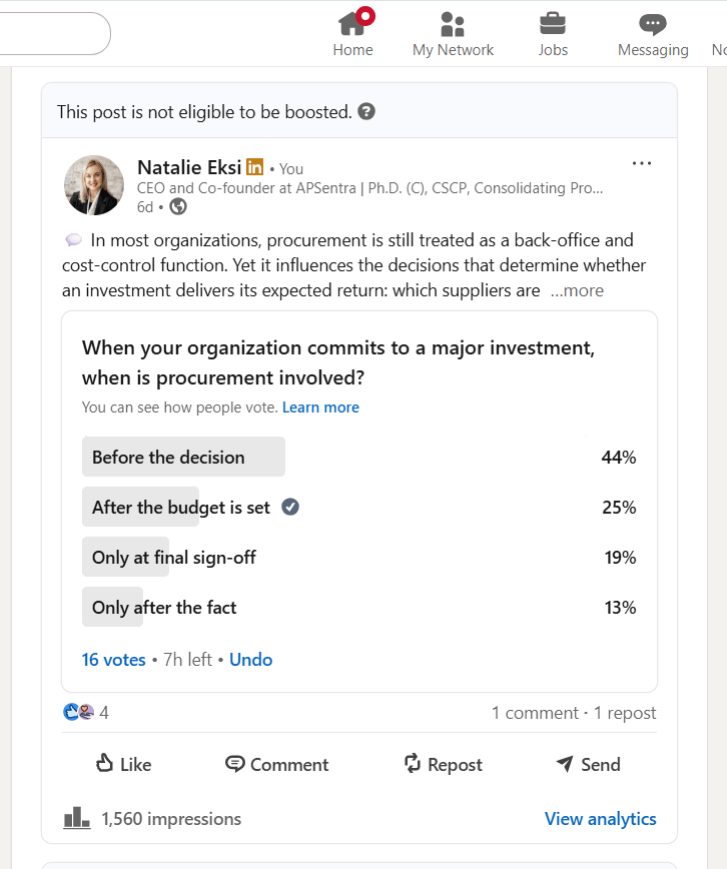
A poll of procurement and supply chain professionals conducted ahead of the Behind Procurement Podcast session asked exactly this question. The results:
- 44% — Procurement is involved before the investment decision
- 25% — Procurement is involved after the budget is set
- 19% — Procurement is involved only at final sign-off
- 13% — Procurement is involved only after the fact
That means 56% of organizations bring procurement to the table too late — after the decisions that define the cost structure, supplier base, and risk profile of the investment are already made.
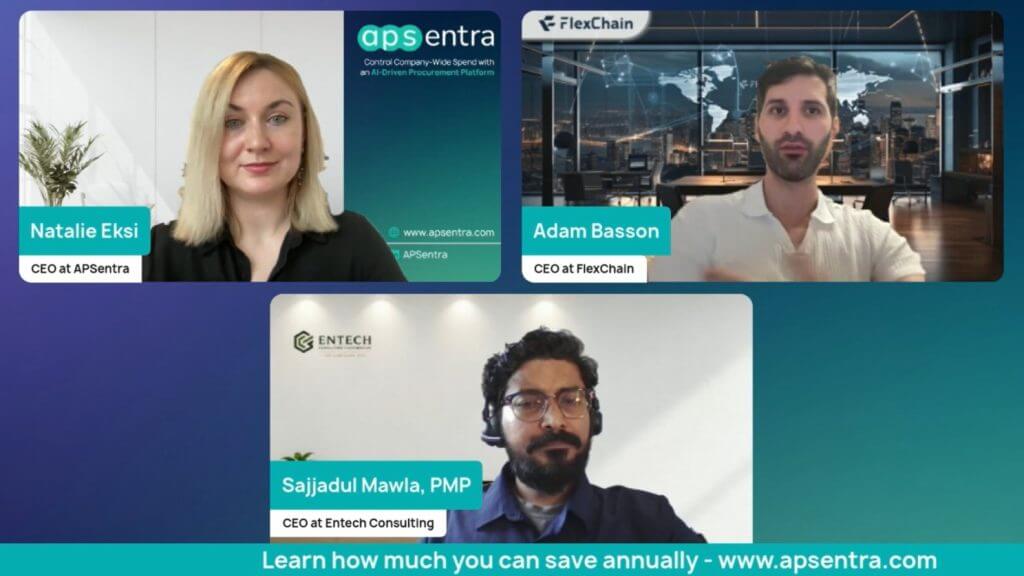
Sajidul Mawla, CEO of NTAC Consulting and Professor of Supply Chain at George Brown Polytechnic, reads that split as a direct measure of organizational maturity in capital investment governance.
“That split shows maturity in decision-making. And the fifty-six percent need to work on their procurement strategy and procurement operations.”
— Sajidul Mawla, CEO, NTAC Consulting
Adam Besson, CEO of FlexChain and President of the Supply Chain Management Professionals South Florida Roundtable, notes that the answer reflects something deeper: how an organization defines procurement in the first place.
“Some organizations have this concept of strategic procurement as core to their strategy. And other businesses have a very different view — procurement is something you do. You figure out the supplier once you’ve figured out everything else.”
— Adam Besson, CEO, FlexChain
How Much Does Late Procurement Involvement Cost?
Late procurement involvement in capital projects costs between 5% and 15% of total project value, according to McKinsey analysis on the delivery of tech-focused capital projects. Better contracting and capital procurement discipline can recover that range.
In North America alone, where construction spending runs at approximately $3 trillion annually, that translates to $150 billion to $450 billion in recoverable value — a figure comparable to the GDP of a mid-sized country.
McKinsey also identified a second cost driver: during the past two years, price volatility across construction materials — steel, copper, concrete — has produced cost shifts of more than 30%. Organizations without active procurement governance and market intelligence are absorbing that volatility entirely. Those with structured procurement in place can hedge it through earlier supplier engagement, framework agreements, and scenario-based sourcing.
In capital expenditure, the stakes compound differently than in operational spend. You are not buying something to consume. You are buying something to build an asset that will generate or protect value for decades. Any wrong decision — wrong supplier, poor negotiation, unstructured specification — carries consequences that run the full life of the project.
“If the process is not right, the output would be definitely bad for you.”
— Sajidul Mawla, CEO, NTAC Consulting
Why Do Capital Investments Lose Returns After Approval?
Capital investments lose returns after approval because the governance discipline applied to the investment decision is rarely sustained through execution. Investment decisions go through significant scrutiny — business cases, financial models, board sign-off. Execution does not.
The result is a gap between investment discipline and execution discipline. Budget approval is treated as investment protection. It isn’t. Investment protection requires spend governance that runs continuously — tracking committed spend against budget, verifying supplier delivery against contract, flagging deviations before they compound.
Adam Besson frames this through contract management. One of the most consistent failures he has seen across organizations is treating the signed contract as the end of procurement’s involvement. In practice, that is the moment the real work begins.
“A lot of procurement projects error because they think — okay, we’ve now completed the contract and the procurement team is done. But really, part of that has to be the value capture element.”
— Adam Besson, CEO, FlexChain
The mature approach involves reviewing all spend at a regular cadence — quarterly at minimum — even for contracts mid-cycle. It means setting procurement KPIs at the start and verifying they are flowing through to the P&L, not just living in a procurement report. And it means defining supplier performance metrics at the contract stage, not retroactively when performance falls short.
Sajidul Mawla describes the governance baseline that makes this possible through a three-part framework: SSO — Structured, Standardized, Optimized. Structure defines who holds sourcing authority and how decisions are made. Standardization creates consistency in supplier evaluation, benchmarking, and contract terms. Optimization drives maximum value extraction from spend across the project lifecycle — the right SLAs, right delivery conditions, right contract management.
Without SSO, organizations find that sick projects are almost always preceded by unstructured procurement: wrong supplier selection, poor negotiation, no process accountability.
What Does Spend Visibility Actually Require in Capital Projects
Spend visibility in capital projects requires a centralized, real-time view of committed spend by supplier, by category, and by business unit — tracked against approved budget from the first purchase order through final delivery.
Before any governance work can function, the foundation is visibility. You cannot govern spend you cannot see. You cannot negotiate better terms without knowing what you are currently paying and to whom.
Adam Besson has experienced this at scale. Working at a major consumer goods business formed through a large merger — sixteen divisions, dozens of brands — procurement was identified as the single largest driver of synergy value, with a multiple nine-figure savings target. The first obstacle was not negotiation strategy. It was knowing where the money was going.
“Without visibility, you’re just riding blind. You need to know where the money is going — who your suppliers are, what you’re paying each of them, which parts of the business are using which products, and how that maps to actual business value.”
— Adam Besson, CEO, FlexChain
Spend visibility also means being precise about what type of value procurement is actually delivering. Three categories matter:
Direct savings are negotiated cost reductions that move year-over-year spend downward. Cost mitigation holds spend flat against a supplier-proposed increase — the cost doesn’t change, but the alternative was worse. Demand reduction reduces total volume purchased, saving money without changing the unit price.
Conflating these gives leadership an inaccurate picture of procurement performance and makes it harder to defend procurement’s contribution at the investment level. Organizations that track and report all three correctly give their CFOs and CPOs a shared financial language — which is how procurement earns a permanent seat in capital allocation discussions.
How Do Investment Groups Unify Procurement Across Portfolio Companies?
Investment groups unify procurement across portfolio companies by establishing a single governance framework — standardized workflows, consolidated supplier management, consistent approval hierarchies, and shared KPI reporting — that applies across all entities in the portfolio.
Without this, group-level investment governance is structurally impossible. Each business unit runs its own tender process. Contract management is disconnected from operations and finance. Stakeholders at the portfolio level cannot assess procurement performance or spend exposure in aggregate. Strong procurement in one entity is invisible at the group level. Weak procurement in another doesn’t surface until it has already created a problem.
This is the situation one major industrial group — operating across manufacturing, infrastructure, and development — brought to APSentra. Their challenges were specific: fragmented tender management, inconsistent supplier communication, contract workflows that ran entirely parallel to operations and financial oversight, and no consistent process across the entities in the group.
The solution was not to layer more process on top of existing silos. It was to build one unified procurement framework: standardized workflows across all business units, consolidated supplier management, integrated contract tracking, and KPI reporting that the group’s leadership could actually use to manage investment exposure.
Procurement became a governance instrument at the portfolio level — not a function that each company managed differently and reported on inconsistently.
The principle that work validated: you can only protect what you can see. You can only improve what you can measure. For investment groups, this requires procurement to be the same thing everywhere — not a different discipline in each entity.
What Is the Difference Between Strategic Procurement and Supporting Procurement?
Strategic procurement is a function that operates before investment decisions are finalized, contributes market intelligence to capital allocation, governs spend throughout the project lifecycle, and reports results in financial terms. Supporting procurement is a transactional function that activates after decisions are made to execute what has already been decided.
The 56% figure from the APSentra poll is a measure of how many organizations still operate procurement as a supporting function. The cost of that positioning — $150 billion to $450 billion in recoverable value in North American construction alone, before accounting for manufacturing, infrastructure, and development — is the business case for moving procurement into the strategic tier.
“Procurement is a proactive function. It’s not a reactive one. It should become forward.”
— Sajidul Mawla, CEO, NTAC Consulting
Organizations that have made this transition share a set of structural characteristics: procurement has a direct line to C-level decision-makers; sourcing strategy is set before project scope is finalized; supplier performance is measured against contract terms on a defined cadence; and spend reporting uses a consistent taxonomy that finance can use directly.
Those that haven’t tend to share a different set: procurement is called in after budget is locked, sourcing timelines are compressed, there is no standardized framework for evaluating supplier performance, and the gap between projected savings and realized savings is never independently verified.
The first group protects its investment returns. The second hopes it will.
Watch the Full Episode
The full conversation from Behind Procurement Podcast Episode 2 is available on the APSentra YouTube channel. Behind Procurement runs bi-weekly, covering procurement industry statistics, case studies, and expert perspectives.
About APSentra
APSentra is an AI-driven source-to-pay platform designed to control, structure, and optimise company-wide spend. Trusted by leading organisations across telecom, logistics, agriculture, and financial services — including Kyivstar, Nova Post, Kernel, UkrLandFarming, Sense Bank, and Intesa Sanpaolo.
Sources Referenced in This Article
- Accelerating the Delivery of Tech-Focused Capital Projects, McKinsey & Company
- Procurement in Capital Projects: How Spend Governance Protects Investment Returns, APSentra
- Behind Procurement Podcast, Episode 2: “Procurement as a Key Function to Drive Investment” — featuring Adam Besson (FlexChain) and Sajidul Mawla (NTAC Consulting / George Brown Polytechnic)