The State of AI Adoption in Procurement in 2026
It isn’t. The same report found that only 11% of procurement organizations consider themselves “fully ready” to deploy AI with confidence and scale, while 65% describe themselves as “mostly ready,” still leaning on pilots and discrete applications. A separate 2026 benchmarking study from Procurement Tactics and Suplari, built on survey data from 121 procurement professionals across six continents, puts a number on that gap directly: the industry’s average AI readiness score sits at 2.1 out of 5, below the 2.5 threshold the study identifies as the minimum needed for AI to function reliably at organizational scale.
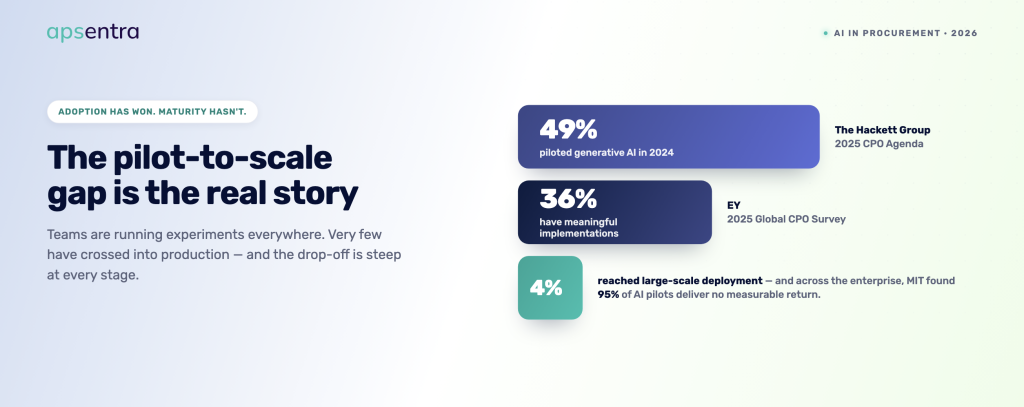
Almost everyone has turned AI on. Almost no one has finished building what it needs to run on.
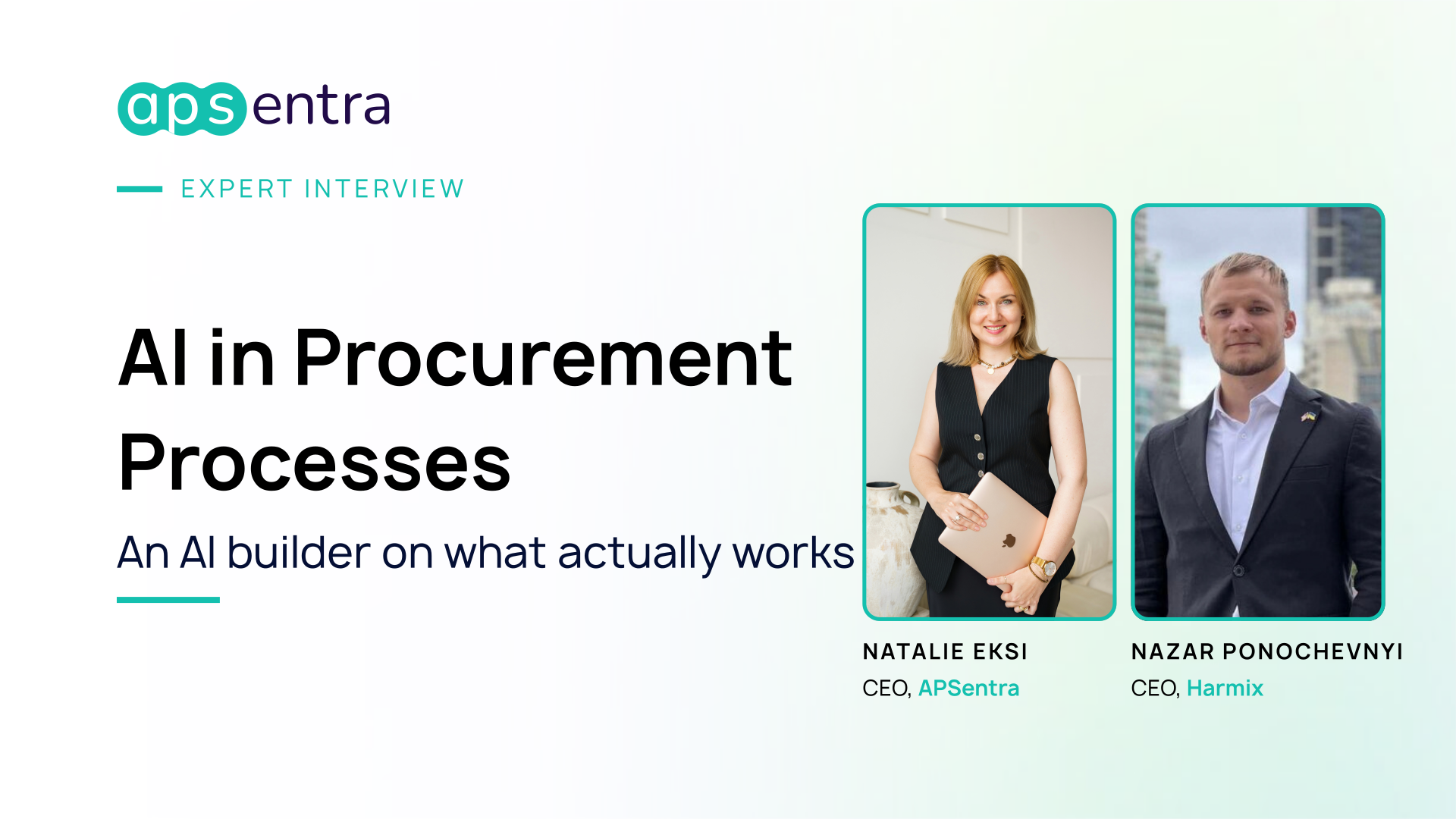
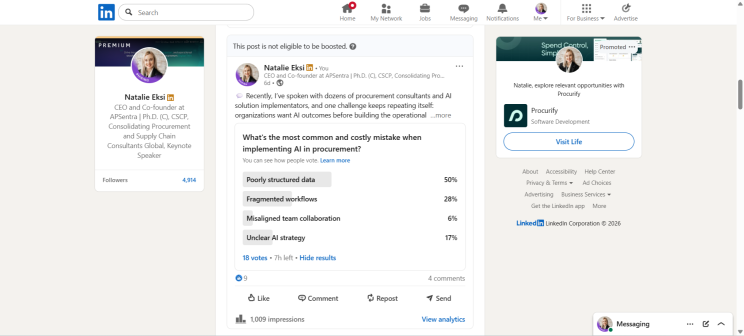
That exact gap was the starting point for the first episode of APSentra’s Behind Procurement Live Show. Ahead of the session, CEO Natalie Eksi ran a poll of procurement and supply chain professionals with one question: What’s the most common and costly mistake when implementing AI in procurement? Half of them gave the same answer. Not the model. Not the budget. Not change management. Poorly structured data. She was joined for the conversation by Sharon Custer, founder of Inventory Optimization Pro, and Mauricio Dezen, who leads Professional Services and Customer Success at APSentra after three decades in digital transformation. What follows is what came out of that conversation, read alongside the wider 2025–2026 research on where procurement AI actually stands.
Garbage In Still Wins
The phrase is old, but it has never been more expensive. AI doesn’t repair messy spend data, duplicated records, or three disconnected systems, it inherits them, and scales the mess faster than any team could by hand.
Sharon’s framing of this was direct: inventory and procurement data isn’t a warehouse problem, it’s a financial one. When a single item is fragmented across three different SKUs, the organization stops seeing the signal that it’s actually the strongest margin driver in the catalog. The data hides the very thing leadership most needs to see.
“People think inventory is a warehouse problem. It’s a financial problem.”
— Sharon Custer, Founder, Inventory Optimization Pro
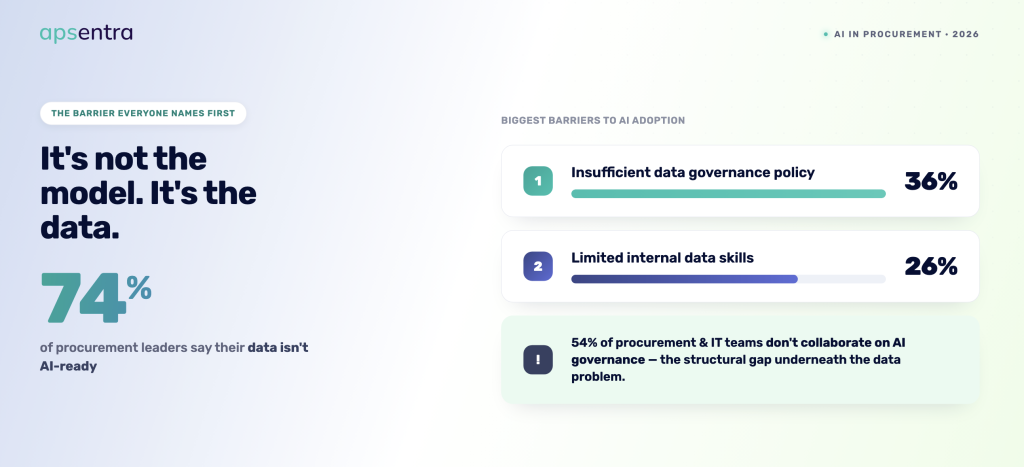
The research backs this up at scale. Gartner’s 2025 Leadership Vision for CPOs found that 74% of procurement leaders say their data isn’t AI-ready. Deloitte’s 2025 global AI ROI research, surveying 1,854 executives, found that one in four organizations cite inadequate infrastructure and data as a direct barrier to realizing AI returns, and that improving data foundations is now among the top reasons companies are increasing their AI budgets in the first place.
Natalie Eksi’s own poll landed almost exactly there: 50% named poorly structured data as the costliest implementation mistake, ahead of fragmented workflows (28%), unclear AI strategy (17%), and misaligned team collaboration (5%).
What changed Sharon’s own view of AI is that the same technology people fear will consume bad data can also be used to structure it, deduplicating records, flagging what’s missing, fuzzy-matching inconsistencies no human team could reconcile across millions of rows. The obstacle, in her experience, is rarely technical. The data looks too messy to start, so teams put it off, and the mess compounds.
Don’t Touch the Keyboard
This was Mauricio’s contribution, and it was the most quotable idea of the session. Most organizations buy a platform and start implementing immediately. His advice runs in the opposite direction: before anyone touches the keyboard, map the process, bring the teams together, define the rules and responsibilities, and analyze the data structure. AI in procurement isn’t plug-and-play. It can move fast, but only once that foundation is in place.
“Map your process, align the teams, define the rules, before you touch the keyboard.”
— Mauricio Dezen, VP of Professional Services & CS, APSentra
He draws a clean line between two failure modes. Strategy failures happen before execution even starts, when no one has defined where the organization is actually going. Execution failures happen when teams start touching the keyboard too soon, integrating the system before the data, workflows, and team alignment are ready.
The numbers describe exactly this pattern at industry scale. The Hackett Group’s 2025 CPO Agenda report found that 49% of procurement teams piloted generative AI in 2024, but only 4% reached large-scale deployment.
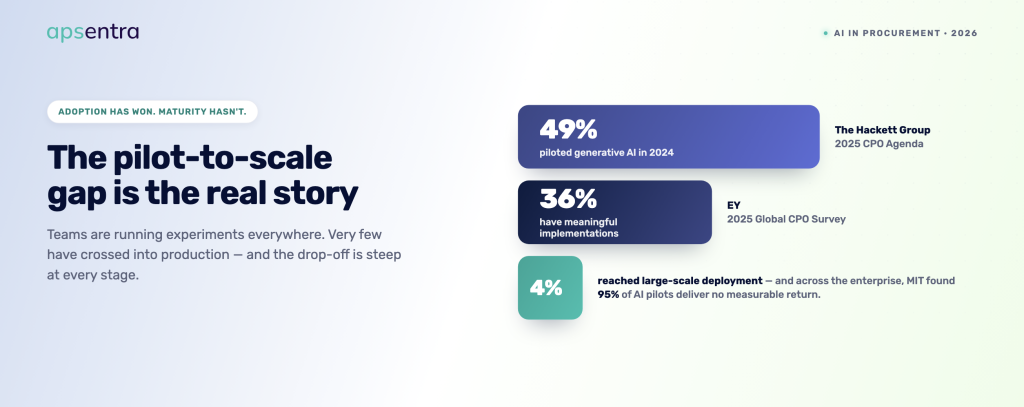
MIT’s 2025 State of AI in Business study, covering an estimated $30–40 billion in recent generative AI investment, found that 95% of enterprise pilots deliver no measurable return, and that fewer than 5% of organizations piloting generative AI reach mature, production-stage adoption.
ISG’s 2025 State of Enterprise AI Adoption study, drawn from roughly 1,200 enterprise AI implementations, found procurement still accounts for only 6% of AI use cases across business functions, behind sales, product management, and operations. None of that is a sign procurement lacks ambition. It’s consistent with a function that, in most organizations, hasn’t yet done the mapping work Mauricio described.
More Decisions, Not More Reports
Here’s the cultural shift most teams haven’t made yet. When Mauricio asks prospects what they want from AI, the most common answer is “automated reports.” His response tends to surprise them: in the AI era, why do you need most of those reports at all? If the system can model the data and surface the decision directly, an organization may not need 50% to 60% of what it currently produces.
“We’re in the AI era. Why do you need the report at all?”
— Mauricio Dezen, VP of Professional Services & CS, APSentra
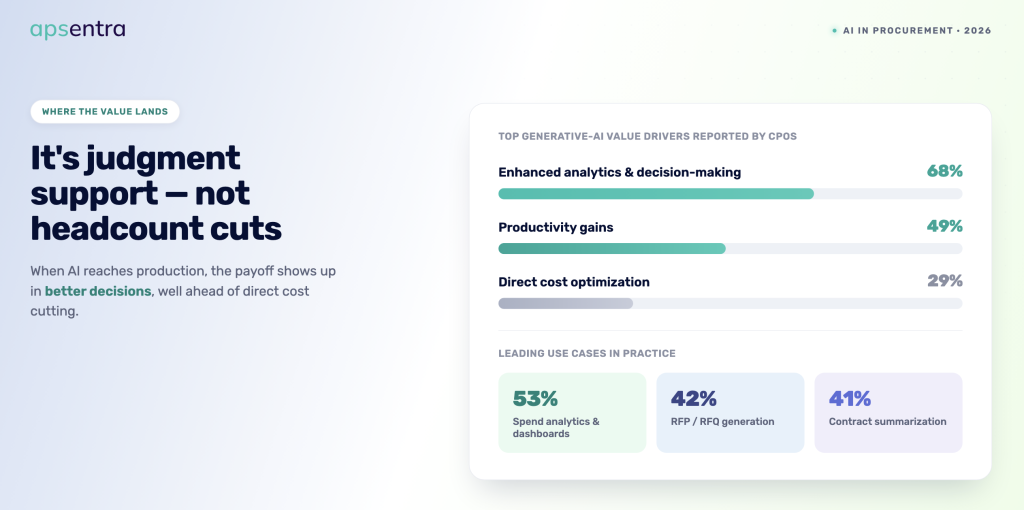
People resist this, understandably, they’re attached to their reports. But automating a report nobody actually needed isn’t transformation, it’s just faster busywork. The shift Mauricio is describing, from information to decisions, is also where the research says the real value sits. Deloitte’s 2025 Global CPO Survey found that procurement leaders rank enhanced analytics and decision-making as the top GenAI value driver at 67.68%, well ahead of direct cost optimization at 28.90%. Leaders already say, in survey after survey, that they want decisions, not dashboards. The gap is that most workflows are still built to produce the dashboard.
The Bottleneck Nobody Puts on a Slide
This is the part of the conversation worth sitting with the longest. Without a solid data foundation, organizations run on tribal knowledge, a small group of experienced people applying if-then logic in their heads. If the data looks like this, adjust it like that. It works quietly until AI enters the picture.
AI runs end-to-end. The moment it hits a data point that a person used to fix by hand, the logic breaks. The result, in Mauricio’s words, is a robotic arm bolted onto an outdated manual process, with people still patching data in the middle of what’s supposed to be an automated flow.
“It’s like a robotic arm with an outdated team fixing things in the middle.”
— Mauricio Dezen, VP of Professional Services & CS, APSentra
Tribal knowledge isn’t a quirky workaround in this picture, it’s the bottleneck. And it’s a large part of why ROI takes so long to show up. Deloitte’s 2025 AI ROI research found that most organizations need two to four years to reach satisfactory ROI on a typical AI use case, well beyond the seven-to-twelve-month payback window typical of other technology investments, and that only around one in five organizations qualify as genuine “AI ROI Leaders.” Among companies already using agentic AI, just 10% report significant, measurable returns today. Layering automation on top of manual correction doesn’t move the bottleneck. It just hides it for a while longer.
Sharon’s answer to this was practical: don’t let tribal knowledge quietly bypass the system. Build the rule into the workflow itself. If something falls outside the agreed structure, have the system flag it rather than let a person fix it off to the side, so the exception becomes a data point the organization learns from, instead of a permanent workaround.
Every Override Is a Liability
This connects directly to an article Sharon and Natalie published recently on designing AI procurement workflows that actually improve decision quality, and to Deloitte’s broader 2025 research on AI ROI, which makes a similar point: the foundation, not the model, is what determines the outcome.
Mauricio took the override question somewhere most procurement conversations don’t go: governance and audit. Procurement is one of the most heavily audited functions in any company, because nearly all of the company’s money flows through it, every expense, every cost center, not just parts and logistics.
“Every override is a liability. All the company’s money flows through procurement.”
— Mauricio Dezen, VP of Professional Services & CS, APSentra
When users constantly override the process, adjusting data points, changing the flow, working around the system, that isn’t agility. It’s audit exposure and, potentially, a financial loss issue. It’s a weak spot even if no regulator is currently looking, and a serious one for any public company. This lines up with what Deloitte’s 2025 Global CPO Survey found at the structural level: 57% of CPOs cite siloed working as the top barrier to realizing AI value, more than any single technical constraint.
ProcureAbility’s 2026 ProcureCon CPO-CIO Report adds the missing piece: while 96% of procurement and IT teams collaborate to some degree,54% are not collaborating specifically on AI governance, the exact seam where override-as-habit tends to live. The fix isn’t more discipline from people. It’s one auditable source of truth that makes the override a rare exception rather than a daily habit.
What This Looks Like at a Thousand Users
To make the framework concrete, Mauricio shared a case from APSentra’s own implementation history: a large financial institution spanning insurance, financing, and equity, which can’t be named for confidentiality reasons. Over a thousand users companywide, with around 250 people in procurement alone.
Picture the overhead of controlling what 250 people are doing in real time, inside a heavily regulated, document-heavy function with thousands of suppliers. The single most important change wasn’t a feature, it was establishing one source of truth. Traceability that lets the organization pass an audit in a click. Onboarding went from a long manual process to a couple of days, because the system now carries the complexity instead of each new hire having to learn it informally.
Mauricio draws a distinction worth keeping in mind here: AI is not an ERP. An ERP organizes data. AI models it, studies it, and raises an alarm when something looks wrong. It’s a different kind of system, and adopting it is a cultural change, not a software install. The case worked because it had an executive sponsor who wanted exactly that kind of change, not just a faster version of the old process.
The Thread That Tied It Together
Every theme in the conversation, the poll, the data foundation, the override problem, and the bank pointed back to the same place. The technology was never the hard part.
AI doesn’t work without human intelligence. Innovation doesn’t work without experience. And in the current market, cost reduction has stopped being a nice-to-have, it’s closer to survival mode. The organizations that come through this period in better shape will be the ones building the foundation now, before the pressure decides for them.
Watch the Full Episode
The full conversation from the first Behind Procurement Live Show episode is available on the APSentra YouTube channel. Behind Procurement also runs as a bi-weekly newsletter on the real decisions, conversations, and tensions shaping procurement leadership in 2026.
Sources Referenced in This Article
- The 2026 Annual ProcureCon CPO Report, ProcureAbility
- The 2026 ProcureCon CPO-CIO Report, ProcureAbility
- AI Readiness in Procurement 2026, Procurement Tactics & Suplari
- 2025 CPO Agenda Report, The Hackett Group
- 2025 Global CPO Survey, Deloitte
- AI ROI: The Paradox of Rising Investment and Elusive Returns, Deloitte Global, 2025
- State of AI in Business 2025, MIT
- 2025 State of Enterprise AI Adoption, ISG
- 2025 Leadership Vision for CPOs, Gartner
- State of AI in Procurement in 2026, Art of Procurement
- AI Procurement Workflows That Improve Decision Quality, APSentra