Life Science Procurement Consulting: What It Covers and What It Costs
That is not a cultural quirk. It is the structure of the regulation. This guide covers what life science procurement consulting actually does, what changed for supplier controls in February 2026, why qualification timelines dominate every sourcing decision, and what a serious engagement costs.
What Life Science Procurement Consulting Covers
Life science procurement consulting is specialized sourcing and supply management for pharmaceutical, biotech, and medical device companies. It covers CDMO and CRO sourcing, active pharmaceutical ingredient and raw material supply, packaging, cold chain logistics, lab consumables, and equipment, and it operates within quality and regulatory constraints that determine which suppliers are permitted before price is discussed.
The defining constraint is that the supplier list is not open. In a normal category, any capable vendor can compete. In a regulated category, only qualified vendors can compete; qualification takes months, and switching after approval triggers change control that can reach as far as a regulatory filing.
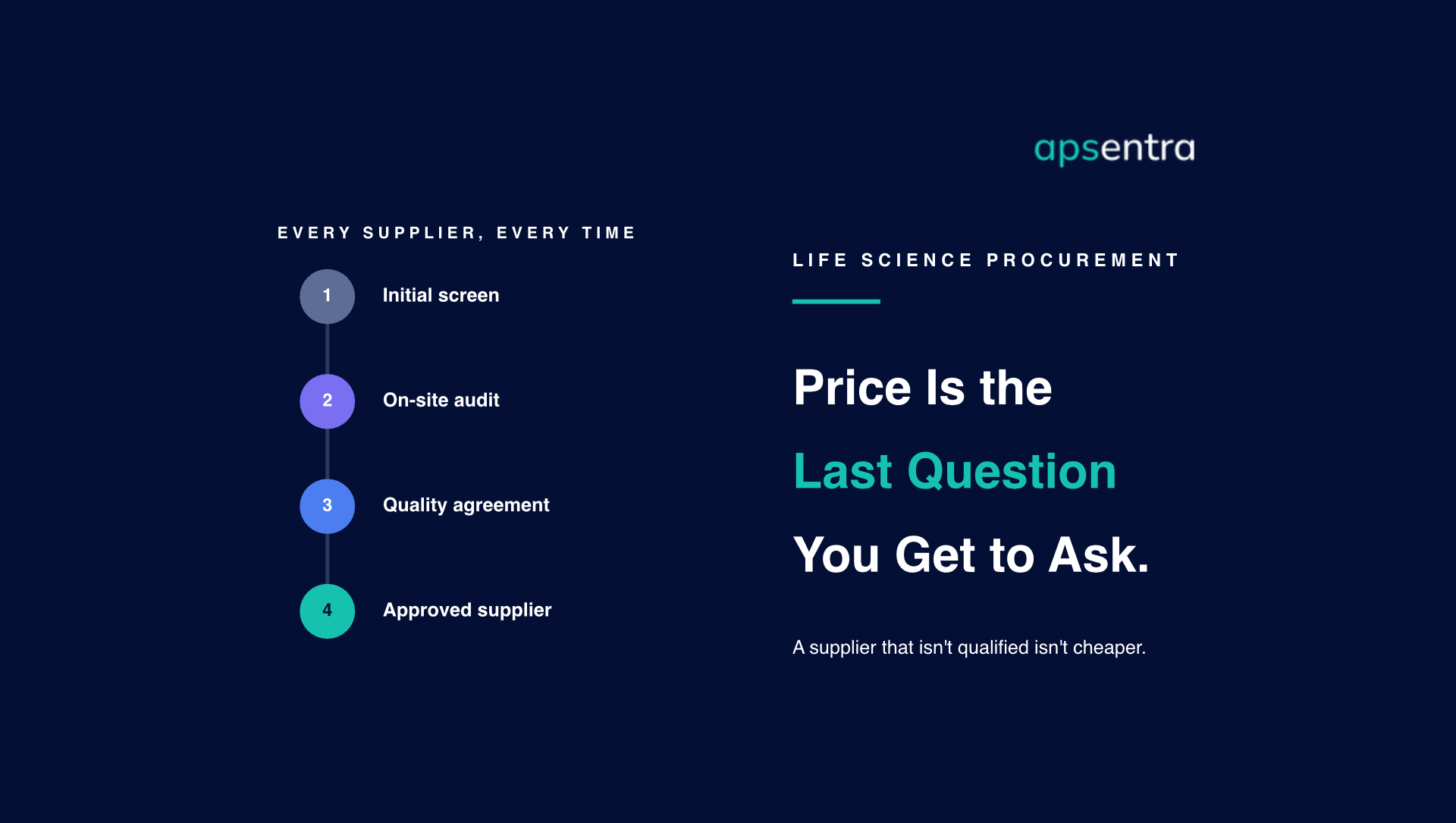
This inverts the usual sequence. Conventional sourcing runs market scan, then shortlist, then negotiate, then award. Life sciences sourcing runs qualification feasibility first, and a supplier that cannot be qualified in the available window is not a cheaper option; it is not an option.
Why Life Sciences Procurement Is Genuinely Different
Four structural differences separate this from general industrial procurement, and every one of them changes how a sourcing project has to be run.

The supplier base is pre-filtered by quality, not by procurement

Change is expensive by design

R&D commits before procurement is consulted

Single-source is often unavoidable
The practical consequence is that the highest-value procurement work in life sciences happens earlier than in other industries. Once a material is in a filing, procurement’s remaining influence is mostly commercial terms. Before that point, it can influence the choice itself.
Where the Spend Sits, and Where the Risk Sits
These are not the same place, which is the most common planning error in this sector.
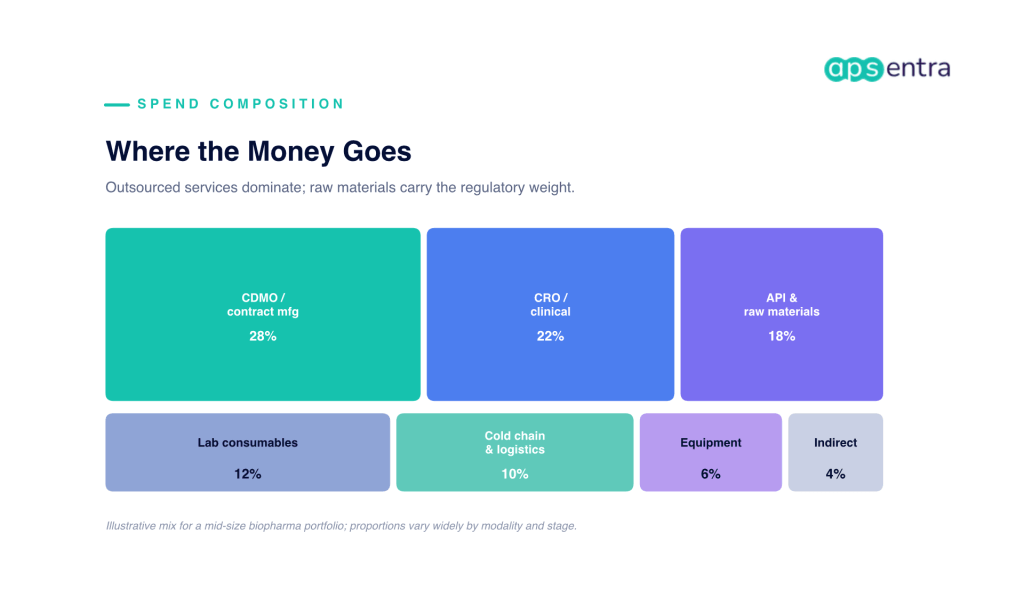
Outsourced services dominate the dollars. CDMO and CRO spend together typically make up around half of external spend at a mid-size biopharma, and both have grown faster than internal R&D budgets for a decade as companies outsourced more of the development and manufacturing chain.
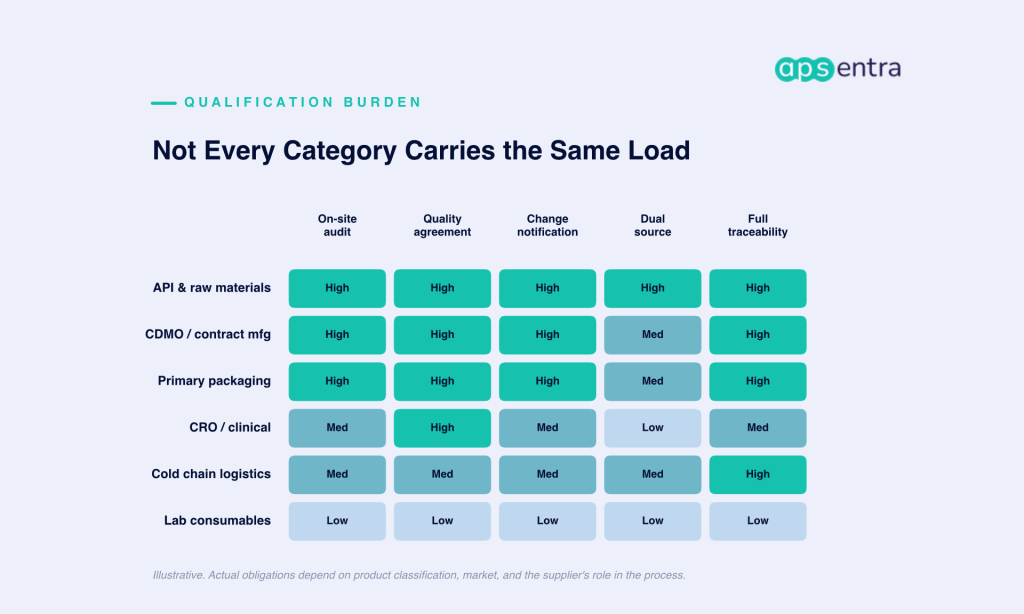
Regulatory exposure sits elsewhere. Active pharmaceutical ingredients, excipients, and primary packaging carry the heaviest qualification and change-control burden relative to their share of spend. A category that is 18 percent of the budget can account for the majority of the audit surface.
A sourcing program sequenced purely by spend size will therefore start in the right place commercially and the wrong place from a risk perspective. Building the view that lets you see both at once is a spend-analysis exercise first, covered in spend analytics consulting, and the prioritization logic itself in procurement cost reduction strategies.
Supplier Qualification After the QMSR
For medical devices, supplier control requirements changed on February 2, 2026. FDA’s Quality Management System Regulation amended 21 CFR Part 820 to incorporate ISO 13485:2016 by reference, which means the purchasing controls formerly written out in 21 CFR 820.50 now come from ISO 13485 clause 7.4. The regulation number is unchanged. What sits inside it is not.
The FDA’s own QMSR page confirms the effective date and the incorporation by reference of ISO 13485:2016, the international quality management standard for medical devices. FDA also replaced its inspection program on the same date, retiring the Quality System Inspection Technique in favor of an updated compliance program.
Two practical implications follow for procurement teams, both of which change what a consulting engagement should deliver.
- Monitoring is now explicit, not implied. A one-time qualification file is no longer a sufficient record. The expectation is evidence of ongoing supplier performance monitoring from onboarding forward, which is a data problem more than a quality-documentation problem.
- Supplier controls are risk-proportionate. The standard expects the depth of control to scale with the supplier’s effect on product quality. That gives procurement a defensible basis for running lighter processes on low-risk categories, which is a real efficiency gain if it is documented deliberately rather than just done.
For drugs and biologics rather than devices, the framework is unchanged but the logic is similar: written quality agreements define responsibilities in contract manufacturing, and ICH Q7 sets GMP expectations for APIs. In both worlds the durable question is the same one raised in our procurement audit checklist: can you produce the evidence on request, or would you have to reconstruct it?
Who Actually Approves a Supplier
Ask three people in a life sciences company who owns supplier approval and you will often get three different answers, all delivered with confidence.
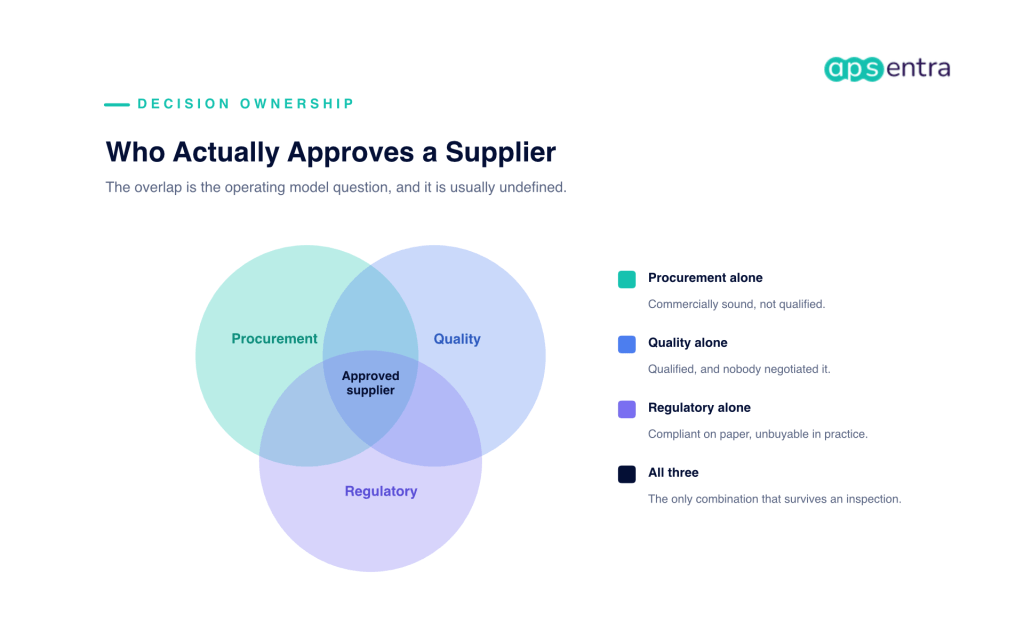
Each function holds a genuine veto, and none of them holds the whole decision. Procurement owns commercial terms and supply continuity. Quality owns qualification and the approved vendor list. Regulatory owns what has been filed and what a change would require. A supplier is only truly approved where all three overlap.
The failure mode is not conflict between these functions. It is silence: each assumes another has covered something, and the gap is only discovered when an inspector asks for a document nobody owns. Written decision rights prevent this, and almost nobody writes them down.
That is a procurement operating model problem wearing a lab coat. The specific question worth resolving in writing is which decisions are procurement’s alone, which are quality’s alone, and which genuinely require all three signatures. Most organizations can answer that in a workshop and have simply never been asked to.
Why Adding a Supplier Takes Months, Not Weeks
Every sourcing plan in this sector lives or dies on qualification lead time, and it is routinely underestimated in project planning.
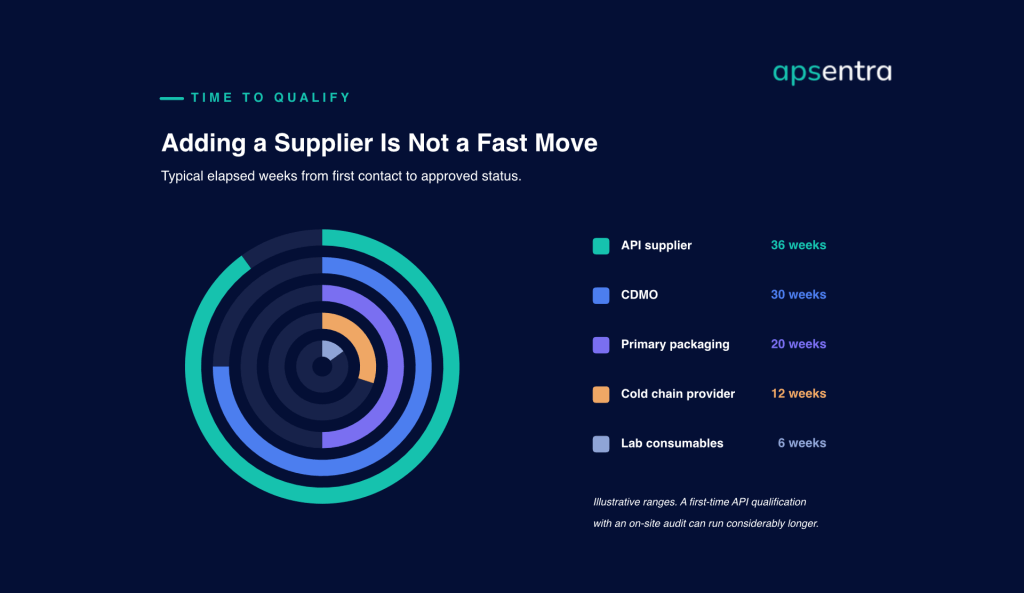
The elapsed time is rarely consumed by the supplier. It goes to audit scheduling, document exchange, sample testing and stability work, quality agreement negotiation between two legal teams, and internal change control. Most of those steps are sequential, and several depend on people who do not report to procurement.
This is why qualification should start before the commercial case is finalized, not after. A team that waits for budget approval to begin qualifying an alternate API source has already lost two quarters of the timeline they were trying to protect.
It is also why the honest answer to “can we dual-source this?” is often “yes, starting eighteen months ago.” The disciplined version of that conversation, including how to sequence it against a savings target, is covered in strategic sourcing consulting.