Procurement Financial Efficiency in Construction: A CFO’s Guide to Margin Protection
Construction and real estate development are among the most capital-intensive industries in the global economy. They are also among the least efficient at converting that capital into planned returns.
According to KPMG’s Global Construction Survey, only 25% of construction projects finish within 10% of their original budget. McKinsey Global Institute research puts the average cost overrun at 28–33%, across all project sizes, all geographies, all sectors. These are not exceptional outcomes. They are the industry baseline.
Only 25% of construction projects finish within 10% of their original budget, and the average cost overrun is 28–33%.
Source: KPMG Global Construction Survey / McKinsey Global Institute
The causes are well documented: uncontrolled procurement spending, late detection of budget deviations, scope changes without cost tracking, and fragmented visibility into real-time project costs. In other words, procurement failures. Not design failures, not financing failures — procurement failures. The function that controls the largest share of construction project outflows is also the function with the least structured governance in most development organizations.
For a development CFO, this is the problem that matters most. Capital is allocated. Projects are modeled. Return assumptions are built. And then procurement decisions made below the finance waterline, informal subcontract awards, undocumented change orders, and purchase commitments that bypass approval workflows, erode the margin that the financial model assumed would be there.
The path forward is not a contingency budget. It is procurement financial efficiency: the deliberate alignment of procurement decisions with financial governance, so that every commitment is authorized, visible, and traceable before it becomes a liability.
“Most construction margin problems are not discovered at completion. They are created in the first 30% of a project’s procurement cycle, through commitments made without proper authorization, change orders not tracked, and supplier decisions not competitive. By the time the P&L reflects the damage, it is already too late to prevent it.”
— Natalie Eksi, CEO at APSentra
Why Construction CFOs Cannot See What Procurement Is Spending
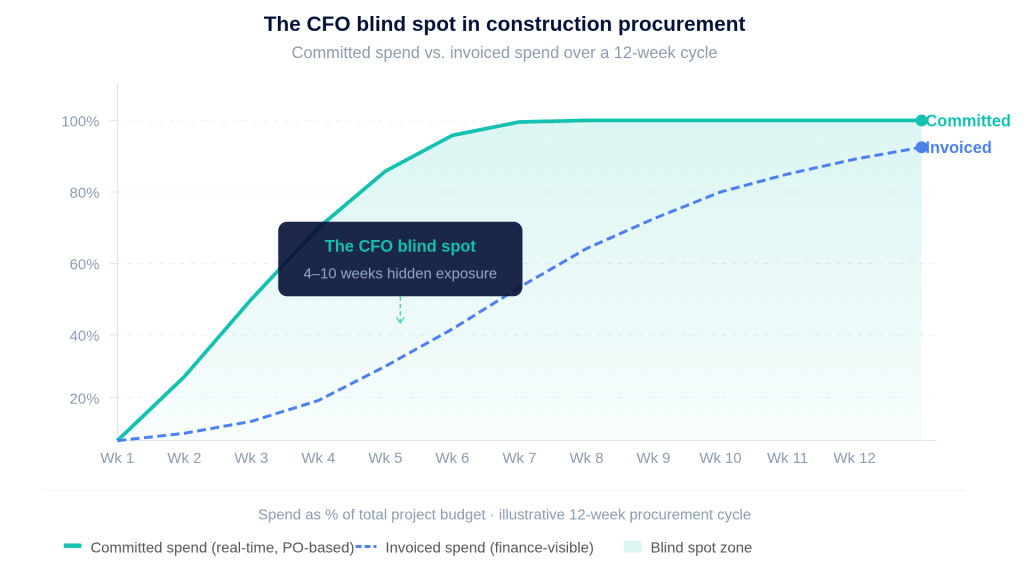
Finance leaders in most construction and development organizations face a structural blind spot: their financial reports reflect what has been invoiced, not what has been committed. A purchase order issued today, a subcontract mobilization instructed by email, a material deposit paid on site, none of these appear in the financial picture until an invoice arrives and is processed. In a typical construction procurement cycle, that lag can be four to ten weeks.
With stable market conditions, this lag is uncomfortable but manageable. In volatile conditions, material price escalation, tightening credit, and compressed project timelines become operationally dangerous. CFOs are making capital allocation decisions, drawdown requests, and cash flow projections based on a financial picture that is systematically incomplete.
Finance workloads are expected to grow 4.1% in 2025, but organizations with high spend visibility achieve 30% better cost savings than those with low visibility.
The root cause is not a technology gap. It is a governance gap. In organizations where procurement decisions are made informally, by project managers acting on established relationships, by site teams ordering on verbal authority, by subcontractors mobilizing on email instructions, there is no structured point at which finance is brought into the loop. The commitment is made. The obligation is created. Finance finds out later.
“In construction, the gap between what has been committed and what finance can see is where margin disappears. Digital transformation in procurement is not about automating purchasing. It is about connecting every spend decision to financial governance at the moment the decision is made, not weeks later when the invoice arrives.”
— Dyci Manns Sfregola, CSCP, Founder & CEO at New Gen Architects
This visibility gap has a second consequence beyond the margin: it impairs the quality of decisions made by the CFO. Drawdown requests are based on incomplete commitment data. Cash flow projections undercount near-term obligations. Budget-to-actual reporting arrives too late to enable corrective action. The financial picture that informs executive and lender-facing decisions is not the real picture.
The Three Procurement Decisions That Destroy Development Margins
Across construction and development projects, margin erosion concentrates in three procurement failure modes. Each one is structural, meaning it recurs across projects, not because of individual error, but because the governance conditions that would prevent it are not in place.

Informal Subcontract Awards Without Competitive Process
Change Orders Managed Outside the Budget System

Purchase Commitments That Bypass Authorization Controls
Procurement-related inefficiencies, change order leakage, invoice errors, and missed sourcing savings can erode 5–20% of a potential project margin. On a $50M project, that is $2.5M–$10M of avoidable loss.
Source: Construction Financial Management Association (CFMA) 2025 Financial Benchmarker
What Procurement Financial Efficiency Looks Like in Practice
Procurement financial efficiency is not a single intervention. It is a set of interconnected governance conditions that, taken together, connect every procurement decision to financial accountability. The following four elements define what that looks like in a functioning development or construction organization.

Pre-Commitment Spend Visibility

Enforced Approval Workflows Mapped to Budget Authority

Competitive Sourcing With Documented Evaluation Criteria

Complete Audit Traceability
| Metric | Unstructured Procurement | Structured Procurement |
|---|---|---|
| Change order leakage | 5–15% of contract value | 1–4% of contract value |
| Invoice error/overbilling | 3–5% of invoices | Under 0.5% of invoices |
| Sourcing savings vs benchmark | 0–3% (informal awards) | 8–15% (competitive tender) |
| Commitment visibility lag | 4–10 weeks (invoice-based) | Real-time (PO-based) |
| Budget forecast accuracy | Lagging / incomplete | Forward-committed |
Sources: CFMA 2025 Financial Benchmarker; Dodge Data 2025 Construction Outlook; APSentra implementation data.
Evidence from the Field: Two Construction Implementations
The governance model described above is not theoretical. The following accounts draw from two APSentra implementations in the construction sector. Client identities are confidential; the outcomes are not.
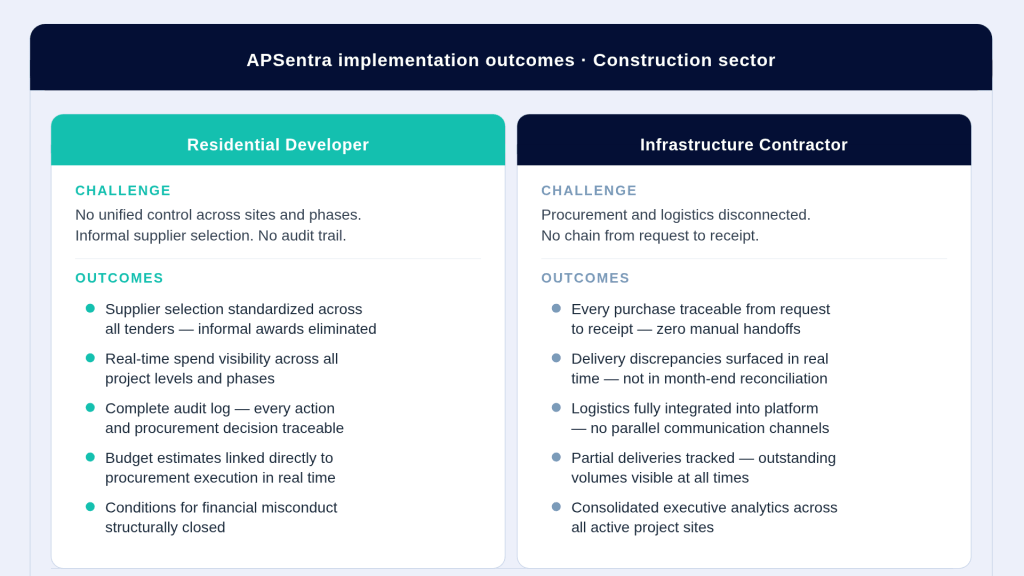
Case 1: Residential Developer — Closing the Conditions for Procurement Leakage
Construction | Construction & Engineering | Multiple Sites | Complex Structure
Challenge: Budget estimates were tracked separately from actual procurement activity, with no automated link between commitments and financial reporting. Supplier selection was driven by informal relationships rather than objective criteria. There was no audit trail for user actions.
APSentra Solution: Implemented end-to-end sourcing automation: electronic tenders, reverse auctions, and automated approval routing, configured to mirror the full depth of the client’s project hierarchy from headquarters through to individual construction sections.
Outcome: Supplier decisions are now governed by standardized, documented criteria applied consistently across all tenders. The gap between budget estimates and procurement execution, the gap through which financial leakage had previously operated, was structurally closed. Finance gained real-time visibility into committed spend across all project levels without relying on manual reporting.
“Automation is one of the most powerful tools against corruption. When the process is automated, transparent, and tied to objective KPIs, there is simply no space left for shadow activity.”
— Project Lead, APSentra
Case 2: Infrastructure Contractor — Building a Continuous Procurement-to-Receipt Chain
Construction | Construction & Engineering | Multiple Sites | 50+ users
Challenge: Procurement and logistics operated as disconnected functions, with no systematic link between purchase requests, supplier orders, delivery coordination, and warehouse receipts. Discrepancies between what was ordered and what was delivered accumulated undetected.
APSentra Solution: Deployed an integrated procurement and supply chain control solution built around six modules: Request, Tender, Contract, Order, Receipt, and Analytics. Every line item moves automatically through the full sequence, with data carried forward between stages without manual re-entry.
Outcome: every purchase is now traceable from request to receipt, with no manual handoffs and no unverified deliveries. Leadership has consolidated procurement and supply chain analytics across all active project sites, structured for executive review, not operational reporting. The audit and security function has the controls and data it needs to monitor compliance continuously.
“The goal was to build a control mechanism that covers the entire chain, from purchase request to goods receipt. That mechanism is now in place.”
— Project Lead, APSentra
The CFO’s Four-Question Diagnostic
Before a CFO can determine which governance changes are needed, they need an accurate picture of where their current procurement environment stands. The following four questions provide a rapid diagnosis. They require no technology, only honest answers from the people who run procurement and project finance.
- How much time passes between a procurement commitment being made and finance knowing about it?
- If the answer is measured in weeks or is genuinely unknown, the commitment ledger is not live. Financial reporting is lagging.
- Can your organization produce, within 24 hours, a complete list of all spend commitments currently outstanding across all active projects, by project, by trade, by approval status?
- If not, the visibility required for credible cash flow forecasting and drawdown planning doesn’t exist.
- What proportion of subcontract awards in the past 12 months were made through a competitive process with documented evaluation criteria?
- If the honest answer is below 50%, the organization is systematically paying a sourcing premium.
- How are change orders governed? Is there a defined workflow that requires finance authorization above a cost threshold before additional scope is instructed?
- If a change order governance is informal, budget protection is informal.
An organization that can answer all four questions confidently has procurement financial efficiency in place. An organization that cannot answer one or more of them has identifiable, addressable gaps, each of which has a documented financial consequence.
About APSentra
APSentra is an AI-driven source-to-pay platform designed to control, structure, and optimise company-wide spend. Trusted by leading organisations across telecom, logistics, agriculture, and financial services — including Kyivstar, Nova Post, Kernel, UkrLandFarming, Sense Bank, and Intesa Sanpaolo.