Procurement as a Finance Function: The CFO-CPO Alignment Imperative
Why the CFO and CPO Belong in the Same Conversation
In most organizations, procurement and finance operate on separate rhythms. Finance closes the books monthly and reports what was spent. Procurement negotiates contracts and issues purchase orders. The gap between these two functions, between commitment and reporting, is where financial risk accumulates silently.
This is not a new observation. But the urgency has sharpened. Compressed margins, persistent geopolitical volatility, and tariff-driven cost unpredictability define the global operating environment of 2025. In this context, the question is no longer whether procurement should be connected to financial governance. The question is how quickly that connection can be built. We examined the same question in a live session on Thoughts & Coffee with Let’s Talk Supply Chain.
“In every economic downturn I have observed, the organisations that emerge stronger are not those that cut the most, they are those that controlled the most. Procurement is not a support function during a recession. It is the financial architecture that determines whether a business protects its margins or loses them to decisions made without visibility.”
— Natalie Eksi, CEO at APSentra
Gartner’s 2025 CFO Leadership Vision research, drawn from interactions with nearly 5,000 finance leaders, identifies “forging stronger finance-business partnerships” as the leading priority for CFOs this year. Procurement is one of the most direct mechanisms for delivering that partnership, because it controls how external spend gets committed, authorized, and tracked against budgets.
The Data: What Research from Gartner, Deloitte, and McKinsey Shows
The research consensus on procurement-finance alignment has solidified significantly in the past 18 months. The findings are consistent across sources and point in one direction.
Gartner: CFOs Are Already Taking Ownership of Procurement
A Gartner survey of 251 CFOs, conducted in late 2024 and published in February 2025, found that procurement is among the enterprise functions CFOs are now expected to own or co-own, alongside enterprise risk, M&A, and data and analytics strategy. The expansion of the CFO’s remit into procurement is not a future scenario. It is already underway at leading organizations.
Gartner also found that profits lost due to financially unsound operating decisions are equivalent to 3% of EBITDA on average. Procurement decisions, supplier selection, contract terms, and order volumes are operating decisions with direct EBITDA consequences. The CFO’s expanding mandate makes procurement governance a finance-level accountability, not a purchasing-team accountability.
3% of EBITDA is the average profit lost to financially unsound operating decisions at the typical enterprise.
Deloitte: CPOs Are at an Inflection Point
Deloitte’s 2025 Global Chief Procurement Officer Survey identifies the procurement function as standing at a structural inflection point, driven by generative AI, agentic process automation, and the growing demand from finance leadership for real-time spend data.
The survey found that siloed ways of working are the leading barrier to value delivery, cited by 57% of surveyed CPOs. This silo is not primarily a technology problem. It is a governance and organizational design problem. When procurement operates separately from finance, budgets are managed separately from commitments. That separation is the root of forecast inaccuracy and spend leakage.
57% of CPOs cite siloed ways of working as the primary barrier preventing procurement from delivering value.
Source: Deloitte 2025 Global CPO Survey
McKinsey: The Structural Case for Strategic Procurement
McKinsey’s research on procurement transformation, published in late 2025, found that companies with advanced procurement operating models achieve EBITDA margins five percentage points higher than peers. Two-thirds of the 300-plus procurement leaders surveyed report directly to the CEO or CFO, reflecting how the function’s strategic positioning is changing at the top of the house.
McKinsey also found that companies now manage 50% more spend per employee than five years ago. The volume of procurement decisions has grown substantially. The organizational structures governing those decisions, in most cases, have not kept pace.
5 percentage points higher EBITDA — the advantage enjoyed by companies with advanced procurement operating models.
Source: McKinsey Global Procurement Excellence Benchmark, 2025
The Three Structural Gaps That Prevent CFO-CPO Alignment
Understanding what the research recommends is straightforward. Understanding why most organizations have not yet acted on it requires identifying the specific gaps that keep procurement and finance operating in parallel rather than in alignment.
Gap 1: Spend Commitments Are Not Visible Until After They Are Made
In most organizations, a procurement decision, selecting a supplier, agreeing on a price, issuing a purchase order, creates a financial commitment before finance knows it exists. The commitment surfaces later, in an invoice, in a bank reconciliation, or in a budget variance report. By then, the decision cannot be changed. It can only be explained.
The consequence is that financial forecasting operates on lagging data. FP&A models are built on what was spent, not on what has been committed. In stable conditions, this gap is manageable. In volatile conditions, when cash must be conserved, and spending decisions must be made quickly, lagging visibility is operationally dangerous.
Gap 2: Approval Structures Are Not Enforced — They Are Observed
Most organizations have approval policies. Few have enforcement mechanisms. A purchase request that requires the CFO’s sign-off for amounts above a defined threshold may, in practice, route through a department head who approves it informally, because the system does not prevent it. Informal approval chains are not exceptions. In manually managed procurement environments, they are the rule.
The financial consequence of uncontrolled approval chains is not primarily fraud, though that risk is real, as the construction sector cases below illustrate. The larger consequence is budget leakage: spending that falls within no individual’s scope of concern but accumulates across the organization into significant unplanned expenditure.
Gap 3: Procurement Is Involved in Budgeting After It Is Complete
Strategic procurement involvement in financial planning requires that procurement data, category costs, supplier pricing trends, and contract renewal schedules feed into the budget-building process. In most organizations, it does not. Finance builds the budget; procurement is informed of it and asked to deliver within it.
This sequence produces budgets that do not reflect procurement realities, and procurement activity that operates without genuine financial grounding. The two functions are aligned in name, because both are working from the same budget document, but not in substance.
What Procurement as a Finance Function Looks Like in Practice
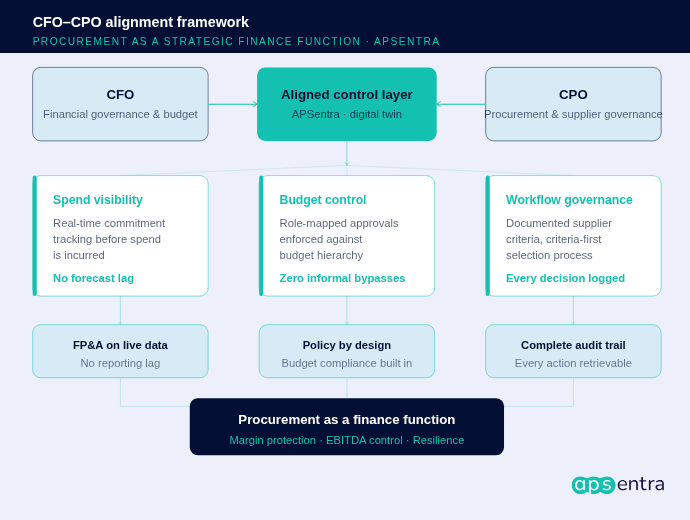
The operational model that closes these three gaps has four defining characteristics. These are not aspirational principles — they are observable system behaviors that either exist or do not in a given procurement environment.

Pre-commitment Spend Visibility
Enforced, Role-Mapped Approval Workflows

Supplier Selection Governed by Documented Criteria

Complete Audit Traceability
Real-World Evidence: Two APSentra Implementations
Every action taken in the procurement system, including who submitted a request, who approved it, what documentation was provided, which supplier was selected, and on what basis, is logged and retrievable. This is not primarily a compliance requirement. It is the foundation for credible financial reporting on procurement activity.
Case 1: Intesa Sanpaolo — Establishing a Fully Controlled Procurement Environment in Financial Services
Banking | Financial Services & Insurance | 250+ users | Complex Structure
Challenge: Key activities, request handling, tendering, contract management, and supplier coordination operated across disconnected systems. The result was persistent difficulty maintaining real-time budget alignment and providing consolidated oversight for management. In banking, where every procurement action carries compliance weight, fragmented traceability is not a process inconvenience. It is a governance liability.
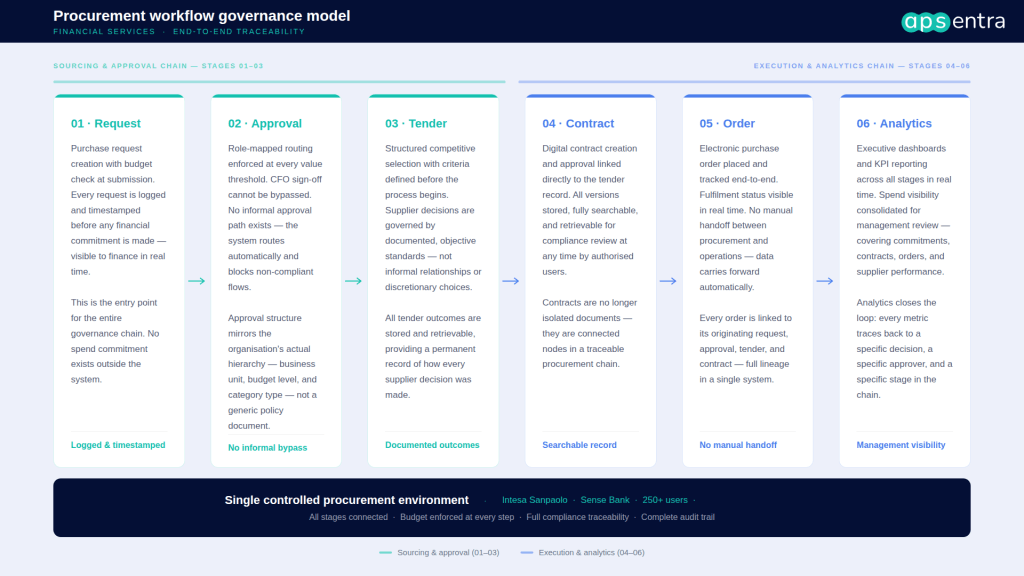
APSentra Solution: Implemented a centralized procurement environment covering all stages from request creation to contract management and reporting. It introduced structured, automated approval workflows for every transaction, full integration with internal budgeting and financial controls, and digital contract and document handling.
Outcome: all procurement activities are now managed within one system, approvals follow a defined path, documentation is fully traceable for compliance purposes, and management has access to clear, consolidated reporting. Procurement now fits naturally into how the organization operates, without requiring constant manual attention or additional reconciliation.
“By connecting our entire process from request to contract, we’ve created a reliable environment where 250+ users can operate with full transparency and budget alignment.”
— Business Unit Director, Intesa Sanpaolo
Case 2: Sense Bank — Closing the Approval Gap Across a Distributed Banking Network
Banking | Financial Services & Insurance | 150+ users | Major Network
Challenge: Work moved across teams without a shared operational logic. Approval paths were partially defined but heavily reliant on manual coordination requests, lost momentum between departments, status was invisible in real time, and inconsistent workflows meant that different teams interpreted the same approval steps differently.
APSentra Solution: Implemented a unified procurement workflow environment, connecting key process steps into a continuous digital flow. Approval paths were clarified and configured to route between departments without manual intervention. All documents and request histories were centralized in a single digital space, eliminating fragmented file management and the follow-up cycles that accompanied it.
Outcome: requests now move smoothly between teams with fewer delays and less manual intervention at each stage. More than 150 employees operate on a consistent, predictable daily rhythm. Approval steps are better defined, document access is centralized, and the bank now has an operational baseline that scales without adding coordination overhead.
“The goal was to make our internal flow easier to navigate, not harder to control. By connecting our key steps into one digital space, we’ve ensured that requests no longer lose momentum as they move between teams.”
— Head of Procurement, Sense Bank
The Role of Technology: What It Solves and What It Does Not
Technology platforms like APSentra enable CFO-CPO alignment. They do not create it. This distinction matters because it is the source of most failed procurement transformation efforts.
A procurement platform makes a well-designed governance structure faster, more visible, and more enforceable. It gives finance real-time access to spend data that would otherwise require manual extraction and reconciliation. It enforces approval workflows that would otherwise be observed informally. It generates the audit trail that manual processes cannot maintain reliably.
What a platform cannot do is substitute for the organizational decisions that must precede implementation:
- Who is accountable for procurement decisions by category, by value, by business unit?
- What is the approval structure, and how does it map to the budget hierarchy?
- What criteria govern supplier selection, and are they documented before the selection process begins?
- How does procurement data feed financial forecasting, and at what frequency?
Organizations that deploy a procurement platform without making these decisions first typically replicate their existing informal processes in digital form. The system is adopted; the governance is not.
The organizations that achieve the results described in the case studies above removed conditions for misconduct, real-time delivery verification, consolidated executive analytics, and made the governance decisions first. The technology then made those decisions enforceable at scale.