Procurement in Capital Projects: How Spend Governance Protects Investment Returns
Every capital investment decision rests on a model that assumes a price, a schedule, and a set of suppliers who perform as contracted. Procurement in capital projects is where that model meets reality, and where it is either upheld or quietly undone.
Between board approval and project completion, the return on a major investment is shaped far less by the original business case than by the discipline with which an organization governs supplier selection, committed spend, and the change orders that accumulate across a multi-year build.
Where Capital Investment Returns Are Won or Lost
Approval commands the attention as well as a capital project reaches the board with a business case, a return target, and a budget scrutinized line by line. Once it is approved, governance attention moves on, and the project enters an execution phase that can run for years across multiple sites, phases, and contractors.
Execution is also where the largest committed spend in most enterprises flows. Capital programs in construction, manufacturing capacity, and infrastructure commit money in large, irreversible blocks. Yet real-time control is typically weakest precisely where exposure is greatest. The result is a structural mismatch: the spend that most determines investment returns is governed with the least visibility.
Professor Sajjadul Mawla has spent close to fifteen years inside this problem, leading procurement and project delivery across construction and manufacturing. His observation holds across sectors: the discipline that protects an investment is not applied at the moment of approval, when scrutiny is highest. It is applied, or quietly abandoned, in the daily decisions of execution.
A capital project is approved once and governed every day thereafter. The gap between those two facts is where returns are lost.
— Sajjadul Mawla, PMP, CIPS
The Execution Gap: Why Approved Capital Spend Leaks Value
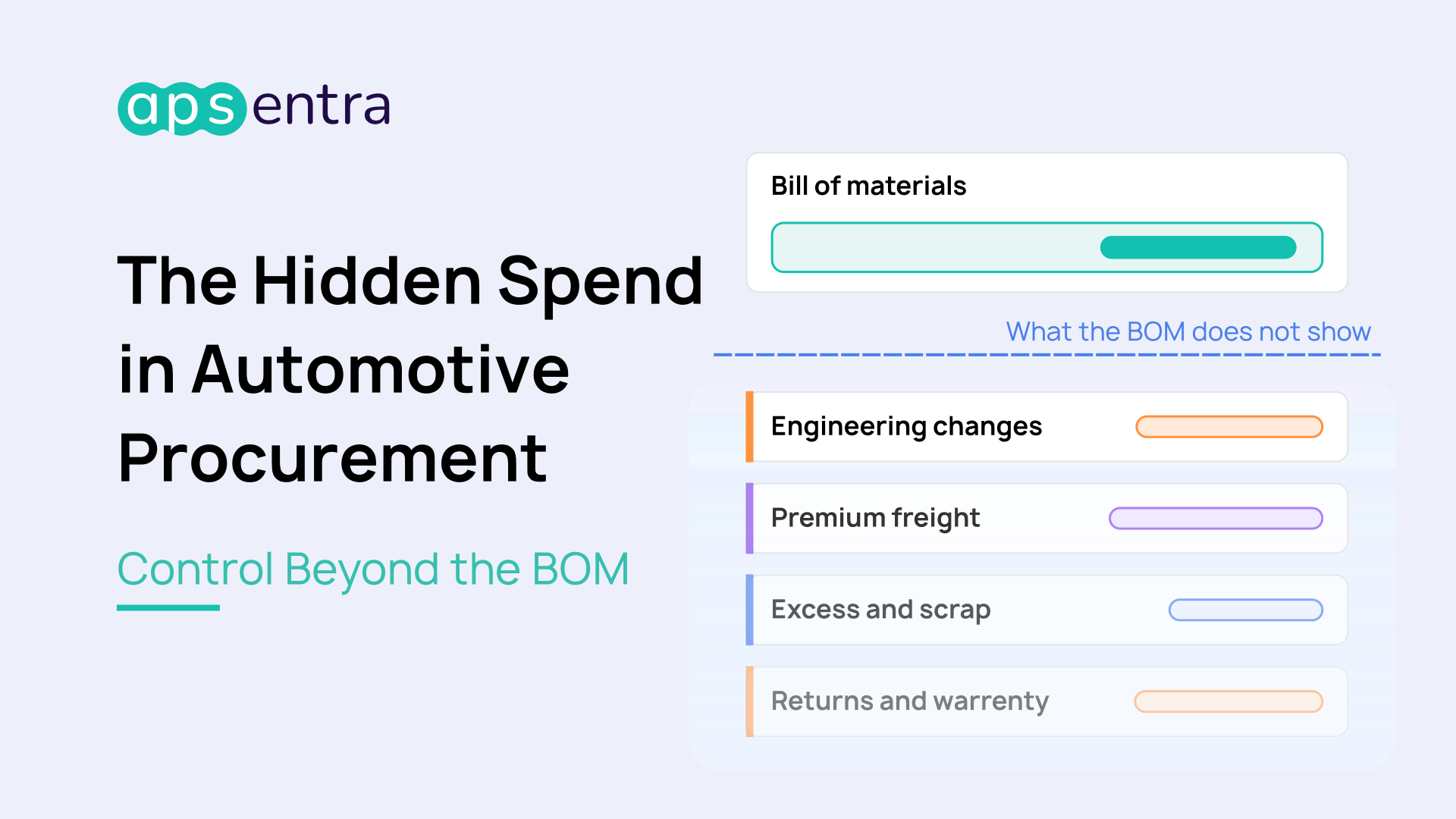
The execution gap is the distance between the moment a commitment is made and the moment finance can see it. On a capital project, that distance can stretch to weeks. A site team issues a change order, a contractor adjusts scope, a partial delivery arrives short of contract. Each event carries a financial consequence, and each one typically surfaces later, in a reconciliation report produced long after anyone could act on it.
Value leaks through a small set of recurring channels: scope and change orders that accumulate without a documented approval route; supplier underperformance that was foreseeable but never screened for; and committed spend that stays invisible until it has already hardened into a liability. None of these is exotic; they are the ordinary friction of a complex build, and in aggregate they are what separates a project that delivers its return from one that erodes it.
The point is not that capital projects are poorly managed. It is that the control surface is vast, the coordination is manual, and the financial signal arrives late. Closing the execution gap is a governance and workflow problem before it is a technology one.
What the 2025 Research Shows
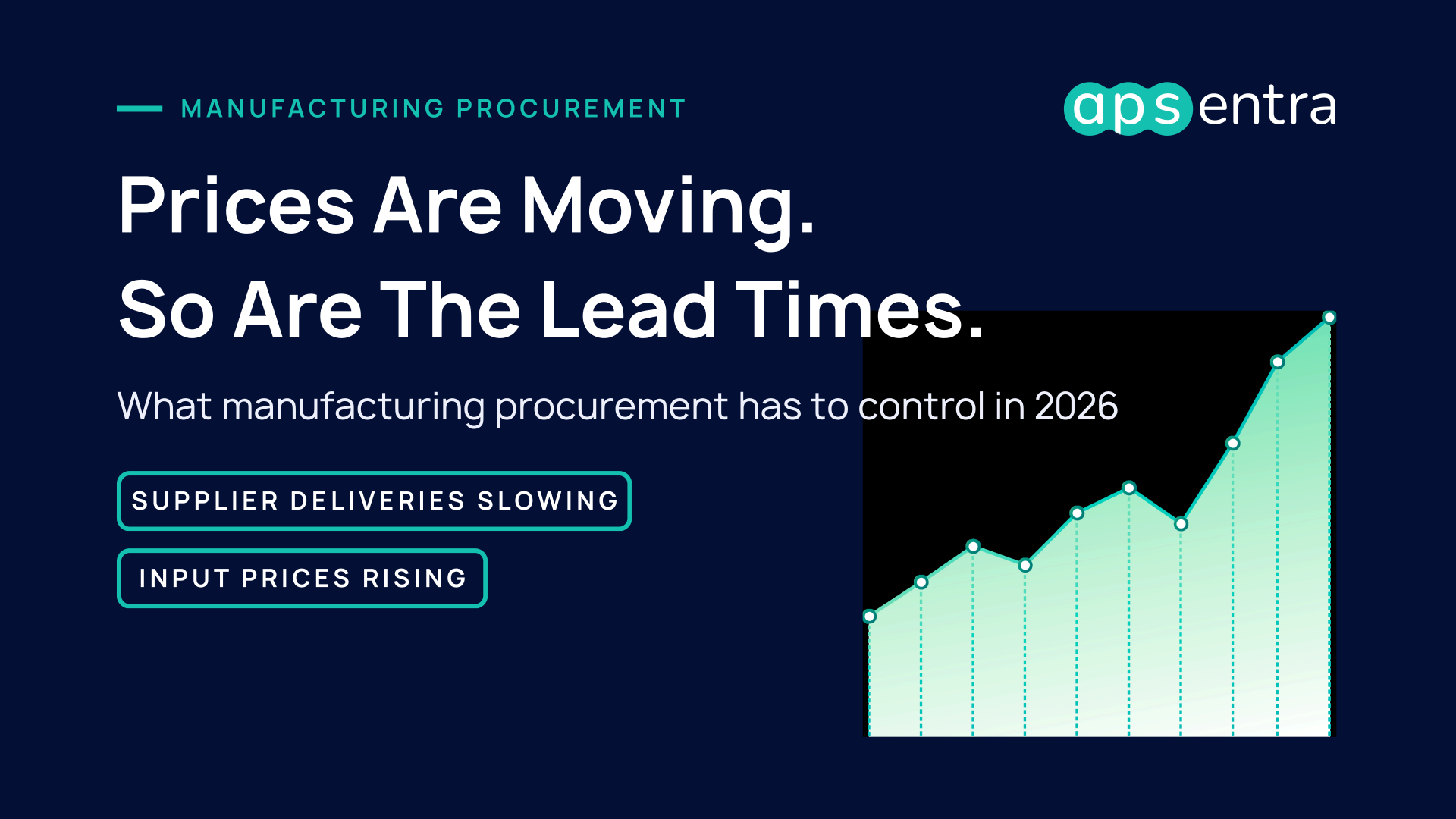
The scale of capital at risk is rising, and the evidence on where it leaks has grown consistent. In a July 2025 review of more than three hundred billion-dollar-plus megaprojects, McKinsey found average cost overruns of roughly 80 percent and schedule delays near 50 percent. The firm estimates that some 24 trillion dollars of capital is set for deployment over the next five years across heavy-industrial projects. The exposure is not marginal. It is the central financial risk of the coming investment cycle.
~80% average cost overrun across 300+ billion-dollar-plus megaprojects reviewed by McKinsey (2025), with schedule delays of roughly 50 percent.
Source: Don’t cancel or coddle at-risk capital projects—challenge them. McKinsey
Critically, the research points away from external shocks as the primary cause. A December 2025 analysis from Baker Tilly argues that supply chain disruption and resource scarcity, though real, are seldom the root cause of overruns. The recurring drivers are passive contractor oversight and the absence of early, frequent cost visibility. Its remedies are governance remedies: diversified suppliers, more agile procurement, and continuous cost monitoring in place of periodic review.
This converges with what finance leaders now expect of the procurement function. Deloitte’s 2025 Global Chief Procurement Officer Survey places procurement at a structural inflection point, driven in large part by finance’s demand for real-time spend data. In a capital-intensive organization, procurement is the function that holds that data first.
Four Controls That Protect Investment Returns
Closing the execution gap does not call for a new theory of project management. It calls for four controls, applied consistently from the first purchase request to the final receipt.

Commitment visibility before liabilities form.
Objective, documented supplier governance.

Change-order and delivery traceability.

Procurement data feeding financial oversight.
None of these is a feature – they are operating decisions. Technology makes them enforceable at scale, as a later section describes, but the decisions come first.
Procurement in Capital Projects in Practice: Two Implementations
Two APSentra implementations in capital-intensive environments show what these controls look like once they are built into the way an organization works.
Manufacturing & Industrial | Mining, Machinery, Logistics, Infrastructure | 60+ Users | Multi-Entity Group
Challenge: Requests, tenders, and supplier communication had evolved separately in each business unit. The fragmentation slowed group-wide decisions and left leadership without a consistent view of procurement activity, and any change had to operate alongside the existing ERP without adding friction.
APSentra Solution: Within a 24-week rollout, APSentra brought every key procurement activity into a single environment connected directly to the existing ERP: unified tendering logic, simplified and comparable supplier selection, and a centralized hub in place of localized, unit-specific approaches.
Outcome: Procurement now runs as one coordinated function across all units, with standardized tendering, transparent supplier selection, and group-level reporting. Sixty users operate on a shared logic, so how a decision is made no longer depends on which company makes the request, which strengthens both control and confidence in how capital is deployed across the group.
“Procurement has become far more transparent across the group. We now have a clear understanding of how decisions are made, regardless of the business unit, which significantly improves both control and confidence.”
— Procurement Manager, UMGI
An infrastructure contractor builds an unbroken request-to-receipt chain
Infrastructure & Civil Engineering | Road, Agribusiness, Quarry | 50+ Users | Multiple Active Sites
Challenge: Procurement and logistics ran as disconnected functions. Purchase requests, supplier orders, delivery coordination, and warehouse receipts each followed their own process, leaving gaps in which what was ordered and what was delivered could diverge unnoticed.
APSentra Solution: APSentra connected request, tender, contract, order, receipt, and analytics into a single digital flow with no manual handoffs. Received quantities are verified automatically against contracted volumes, and partial deliveries are tracked against the original order, with outstanding balances always visible.
Outcome: Every purchase is now traceable from request to receipt, with no unverified deliveries. Discrepancies surface in real time, before financial exposure accumulates, and leadership holds consolidated analytics across all project sites. The implementation reached production in under eight weeks.
“The goal was to build a control mechanism that covers the entire chain, from purchase request to goods receipt. That mechanism is now in place.”
— Project Lead, APSentra
The Role of Technology: What It Solves and What It Does Not
A procurement platform enables governance on capital projects. It does not create it. This distinction is the source of most failed procurement transformations, and it is worth stating plainly.
A platform makes a well-designed governance structure faster, more visible, and more enforceable. It gives finance real-time access to committed spend that would otherwise require manual extraction. It enforces approval routes that would otherwise be observed informally, and it generates the audit trail that manual processes cannot sustain.
APSentra builds a digital twin of the organization’s structure and workflow, so that controls map to how the business actually operates rather than to a generic template.
What a platform cannot do is substitute for the decisions that must precede it: who is accountable for procurement by category, value, and business unit; how the approval structure maps to the budget hierarchy; what criteria govern supplier selection; and how often procurement data feeds financial forecasting.
Organizations that deploy a platform without first making these decisions tend to reproduce their informal processes in digital form. The system is adopted; the governance is not.
“Procurement controls the majority of external spend on any capital program. Treat it as a financial control function, and the investment case holds. Treat it as paperwork, and you dicover, too late, that it never did“
— Natalie Eksi, CEO at APSentra
About APSentra
APSentra is an AI-driven source-to-pay platform designed to control, structure, and optimise company-wide spend. Trusted by leading organisations across telecom, logistics, agriculture, and financial services — including Kyivstar, Nova Post, Kernel, UkrLandFarming, Sense Bank, and Intesa Sanpaolo.