Best Tail Spend Management Companies in 2026
Why “tail spend management companies” isn’t a single category
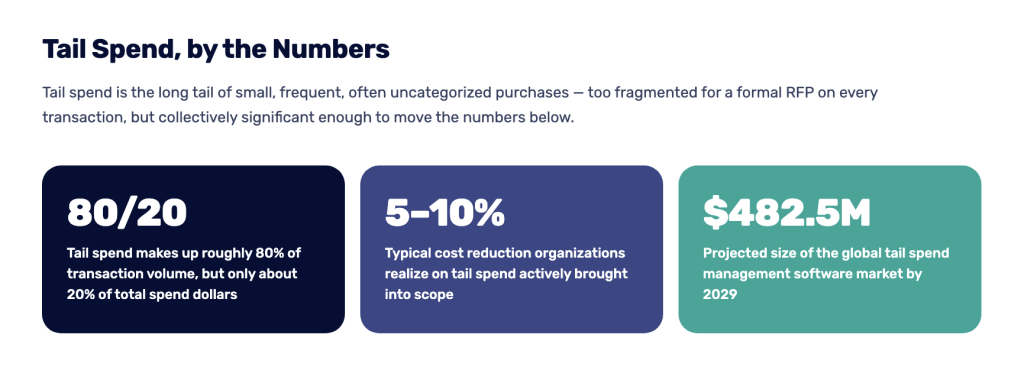
Tail spend is the long tail of small, frequent, often uncategorized purchases that make up roughly 80% of transaction volume but only about 20% of total spend dollars — the commonly cited 80/20 pattern across procurement research. It’s the category-strategy blind spot: too fragmented and low-dollar-per-transaction for a sourcing team to run a formal RFP on every purchase, but collectively large enough that organizations actively managing it typically realize 5–10% cost reduction on the spend brought into scope. The global market for dedicated tail spend management software alone is projected to reach $482.5 million by 2029.
Because the problem is structurally different from strategic sourcing, three genuinely different company types have emerged to solve it, and conflating them leads to picking the wrong partner:
- Automation platforms — software that uses AI/ML to generate RFQs, match suppliers, and negotiate small purchases at a speed and volume no human buyer could match.
- BPO buying desks — an outsourced team that manages all spend under a defined threshold on your behalf, so your internal buyers focus on strategic categories.
- Group purchasing organizations (GPOs) — a membership model that pools your tail spend with other member companies’ spend to negotiate pre-set contracts and volume pricing you couldn’t access alone.
Editorial methodology: how we evaluated these companies
This comparison draws on a different evidence base than our software-category comparisons, because the tail spend market spans software, outsourced services, and membership organizations that aren’t reviewed on a single platform like G2 the same way.
We built this article from each company’s public materials, funding and press coverage (including SEC filings for M&A activity), independent procurement-industry commentary.
We evaluated every company against:
- how tail spend is actually identified (manual threshold rule vs. automated classification),
- speed and mechanism of sourcing execution,
- whether tail spend visibility connects to the rest of your spend data or lives in a separate system,
- the underlying commercial model (software license, BPO fee, or GPO membership/rebate).
Signs your tail spend needs active management
- You can name your top 20 suppliers by spend, but have no idea how many total suppliers you actually have.
- A meaningful share of purchases never goes through any sourcing process at all — someone just orders from whoever’s fastest or most familiar.
- Your procurement team’s time is entirely consumed by large, strategic categories, with no bandwidth left for the long tail.
- The same commodity item is being purchased from different suppliers, at different prices, across departments or entities.
- Nobody can produce a clean list of every active supplier relationship for an audit or a risk review.
- You suspect real savings exist in the tail, but have never quantified how much.
Must-have capabilities, whichever model you choose
- Automated tail spend identification — classification based on spend thresholds, category, and transaction frequency, not a manually maintained list
- Fast sourcing execution — RFQ generation and supplier matching in hours, not the weeks a formal sourcing event takes for a strategic category
- Supplier consolidation insight — visibility into redundant suppliers serving the same category, so consolidation opportunities surface automatically
- Connection to your broader spend data — tail spend visibility that’s part of the same system as your strategic spend, not an isolated report
- A commercial model that fits your resourcing reality — software if you want to run it in-house, BPO if you want it fully outsourced, GPO if you want pooled buying leverage without giving up purchasing control
Best tail spend management companies in 2026
1. APSentra — best for unified tail spend visibility and control
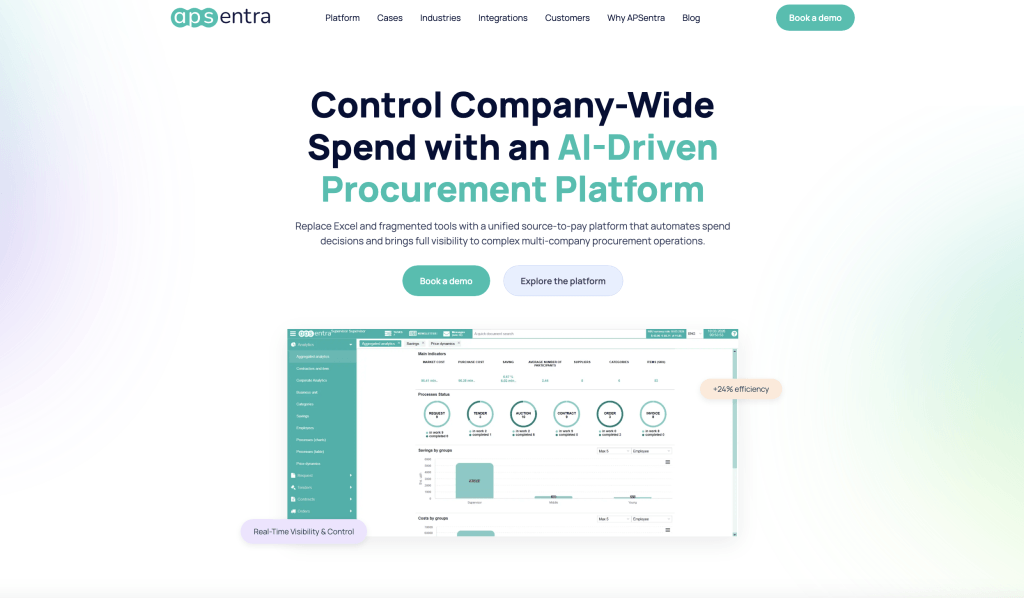
Best for: Mid-market companies that want tail spend identified and governed inside the same spend management system as the rest of procurement, rather than as a separate tool or outsourced project.
APSentra’s approach to tail spend runs through its broader spend management and Spend Under Management (SUM) optimization capability, rather than treating the tail as a disconnected category requiring a separate vendor relationship.
Automated cost classification and maverick spend detection identify low-visibility, off-contract, and fragmented purchases as part of the same real-time spend picture used for strategic categories — so tail spend isn’t managed in isolation from the rest of your spend data.
Top features:
- Automated cost classification into a structured taxonomy, surfacing tail spend patterns without a manually maintained threshold list
- Maverick spend and off-contract purchase detection, applied to the same transactions that make up the long tail
- Supplier concentration analysis, which surfaces redundant suppliers serving the same category — a common, high-value tail spend consolidation opportunity
- Real-time spend dashboards with category-level breakdowns, so tail spend visibility doesn’t require a separate reporting tool
- Spend Under Management (SUM) optimization tooling, directly relevant to bringing previously unmanaged tail spend into a governed process
- Native ERP and accounting integration, so tail spend data reconciles with the rest of company spend automatically
On stated outcomes: APSentra’s own materials describe up to 95% spend visibility coverage and a 30–50% reduction in maverick spend for customers implementing structured spend management — directly relevant to tail spend, since maverick and tail spend overlap heavily in practice.
These figures are vendor-reported and not yet cross-referenced against a large base of third-party reviews specific to tail spend outcomes.
Why it’s ranked first: the criterion we weighted most heavily — does tail spend visibility connect to the rest of your spend data, or live in an isolated tool — is where a unified spend management platform has a structural advantage over a point solution.
Where it’s not the right fit: if you specifically want an AI-native sourcing marketplace purpose-built only for tail spend transactions, or want the work fully outsourced, the companies below are worth evaluating directly.
Model 1: Automation platforms
Fairmarkit
Fairmarkit, headquartered in Boston, is the most frequently cited category specialist purpose-built specifically for tail spend: an AI-powered autonomous sourcing platform that generates RFQs, matches suppliers, and negotiates prices for small purchases, with the company reporting reductions in procurement cycle times from weeks to hours and savings in the 20–30% range on tail spend brought into scope.
The company has raised $78M in total funding (including a $35.6M Series C round backed by OMERS Growth Equity, GGV Capital, Insight Partners, and a strategic investment from ServiceNow), reports customers including Snowflake, BT, Cabot Corporation, and Emirates Flight Catering, and had roughly 148 employees as of mid-2026. In 2026, Fairmarkit launched “Total Agentic Sourcing,” extending its AI agents beyond tail spend to strategic spend within the same environment.
Best for: organizations that want a dedicated, AI-native sourcing engine specifically for tail spend transactions and are comfortable running it alongside their existing procurement suite rather than as part of a single unified platform.
Vroozi
Vroozi’s SpendTech platform combines spend management and AP automation with AI/ML-driven process orchestration, integrating with existing ERP systems for procurement and accounts payable teams. It’s positioned more broadly across procure-to-pay than as a tail-spend-only specialist, but its automation approach extends to the long tail of low-value transactions as part of its wider spend visibility scope.
Best for: teams that want tail spend addressed as part of a broader P2P and AP automation rollout rather than a standalone tail spend initiative.
Model 2: BPO buying desks
ProcureAbility
ProcureAbility offers outsourcing services through a BPO “buying desk” model specifically designed to manage all spend under a defined threshold, freeing internal procurement teams to focus on strategic categories. Rather than software you configure and run, this is delivery-as-a-service: ProcureAbility’s team executes tail spend sourcing on your behalf.
Best for: organizations with a lean internal procurement team that would rather pay for outsourced execution than build internal capacity — or bandwidth — to run tail spend sourcing themselves.
Model 3: Group purchasing organizations (GPOs)
Una
Una operates as a group purchasing organization, centralizing buying power across member companies to negotiate pre-set supplier contracts and volume pricing that an individual company couldn’t access alone. Una’s model uses spend analytics to identify high-risk or high-cost tail spend categories and route them into existing pooled contracts rather than running new sourcing events for each member.
Best for: companies that want tail spend savings through pooled purchasing leverage without giving up day-to-day purchasing control, and that fit well into pre-negotiated categories a GPO already covers.
Corcentric
Corcentric combines a spend management platform with GPO services specifically for indirect spend, reporting over 30 years in the category with a team of subject-matter experts across common indirect categories. Its GPO offer is structured with no upfront cost, no volume commitments, and no buying restrictions for members.
Best for: organizations that want a combined technology-plus-GPO offer from a single vendor, particularly for common indirect spend categories rather than highly specialized direct materials.
Comparing the three models
| Model | How it works | Speed to value | Ongoing effort required from you | Best fit |
|---|---|---|---|---|
| Unified spend platform (APSentra) | Tail spend identified and governed inside the same system as all other spend | Fast — visibility from existing spend data | Low — automated classification, not a new workflow | Companies that want one system of record for all spend, including the tail |
| Automation platform (Fairmarkit, Vroozi) | AI generates RFQs and sourcing events for individual tail transactions | Fast per-transaction, but runs alongside your existing procurement stack | Moderate — you still own the process, software accelerates it | Companies that want a dedicated engine for high-volume tail sourcing |
| BPO buying desk (ProcureAbility) | An outsourced team executes sourcing on your behalf below a spend threshold | Depends on onboarding and handoff | Low day-to-day, but requires clear scoping and governance upfront | Lean procurement teams without bandwidth to run tail spend themselves |
| GPO (Una, Corcentric) | You buy through pre-negotiated, pooled contracts alongside other member companies | Fast for categories already covered by the GPO’s existing contracts | Low — mostly a matter of routing purchases through the GPO’s contracts | Companies whose tail spend falls into common indirect categories already covered |
Tail spend management pricing
| Company | Model | Pricing approach (as publicly reported) |
|---|---|---|
| APSentra | Unified spend platform | Contact sales (scoped to entity count and modules) |
| Fairmarkit | Automation platform (SaaS) | Custom quote; typically scoped to transaction volume |
| Vroozi | Automation platform (SaaS) | Custom quote |
| ProcureAbility | BPO buying desk | Service fee structure, typically scoped to managed spend volume |
| Una | GPO | Membership-based; savings typically realized through pooled contract pricing rather than a subscription fee |
| Corcentric | GPO + platform | No upfront cost or volume commitment reported for GPO membership; platform pricing separately quoted |
People searching “tail spend management pricing” should expect meaningful variation by model: software platforms are typically subscription- or transaction-volume-based; BPO buying desks charge a service fee tied to managed spend; GPOs often have no membership fee at all, monetizing instead through supplier rebates built into the pooled contract pricing.
Common tail spend management mistakes
- Treating tail spend as “too small to matter.”
At roughly 80% of transaction volume, ignoring it means a purchasing process that only governs a fifth of actual purchasing activity. - Picking a model before diagnosing the actual constraint
If the real problem is a lack of internal bandwidth, a software platform alone won’t solve it — you need the BPO or GPO model. If the real problem is lack of visibility, outsourcing without first understanding your own tail spend data can mean paying for management of a category you haven’t sized correctly. - Letting tail spend visibility live in a system separate from strategic spend
This recreates exactly the fragmentation tail spend management is supposed to fix — you end up with two data sources that don’t reconcile. - Assuming a GPO’s pre-negotiated categories match your actual tail spend
GPO savings only materialize for categories the GPO already has contracts in; verify overlap with your real spend data before assuming savings. - No follow-through on supplier consolidation insights
Identifying that five departments buy the same commodity from five different suppliers is only valuable if someone acts on it — this needs an owner, whichever model you choose.
Tail spend trends for 2026
- AI agents are extending from tail spend into strategic spend, not staying confined to it. Fairmarkit’s 2026 “Total Agentic Sourcing” launch — deploying AI agents across both tail and strategic spend in the same environment — reflects a broader pattern of tail-spend-first AI tools expanding upward once proven on high-volume, low-complexity transactions.
- The market for dedicated tail spend software continues growing steadily, with the category projected to reach $482.5 million globally by 2029.
- Consolidation between spend visibility and sourcing execution is increasing — rather than a standalone tail spend point tool, buyers increasingly want tail spend identification and sourcing execution in the same system that manages the rest of procurement.
- GPOs are expanding their use of spend analytics to proactively identify high-risk or high-cost tail categories for members, rather than waiting for members to bring spend to them.
- Managed services (BPO) demand is rising alongside automation, not being replaced by it — for many organizations, the constraint isn’t the availability of AI tooling but internal bandwidth to run any tail spend process at all, which favors the BPO model regardless of how good the software gets.
Estimating the ROI of tail spend management
This is a simplified, illustrative framework — not a case study — meant to help you build your own estimate:
Using the commonly cited tail spend benchmark (roughly 20% of total spend dollars, with 5–10% cost reduction achievable on actively managed tail spend), a company with $50M in total annual spend would have an estimated $10M in tail spend, with $500,000–$1,000,000 in potential savings from bringing it under active management.
The achievable savings within that range depends heavily on which model you choose: automation platforms typically report savings concentrated in negotiated price reduction (Fairmarkit reports 20–30% specifically on the tail spend it sources), while GPO and BPO models realize savings through pooled pricing or dedicated sourcing execution respectively. Run this math against your own total spend to get a directional number, then validate it against your actual, uncategorized purchase data before committing to a specific vendor or model.
Tail spend management buyer’s checklist
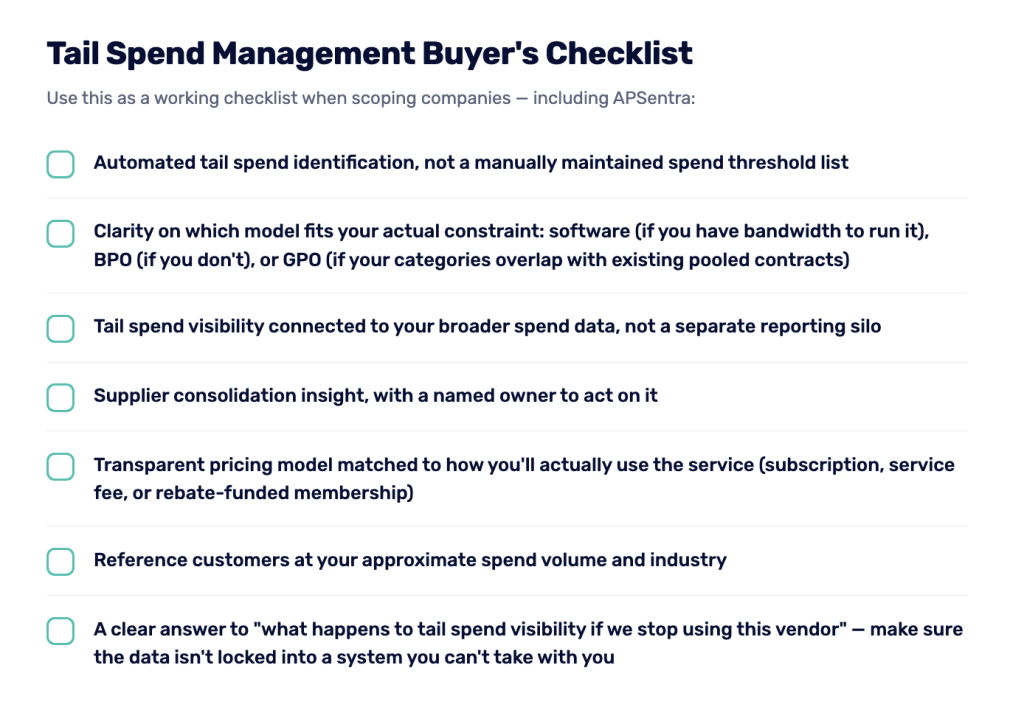
How to choose the right approach

Diagnose the actual constraint before picking a model

Check whether tail spend data will live with the rest of your spend data

Verify category overlap before committing to a GPO

Decide who owns acting on consolidation and savings insights
Sources and methodology transparency
Company data in this article is drawn from public company materials, funding and press coverage (including reporting on Fairmarkit’s funding rounds and 2026 product launch), and independent procurement-industry commentary on BPO and GPO models for tail spend (Una, Corcentric, ProcureAbility). Market-size and savings benchmark figures are drawn from independent tail spend research cited in our companion article on spend management software.
Editorial policy: Companies cannot pay for inclusion or ranking in this article. Companies are included because they meet our evaluation criteria for the tail spend management category, and every claim about a third-party company is tied to a citable public source rather than our own characterization.