Procurement as a Growth Driver: From Cost Center to Value Creation
What Does Procurement as a Growth Driver Mean?
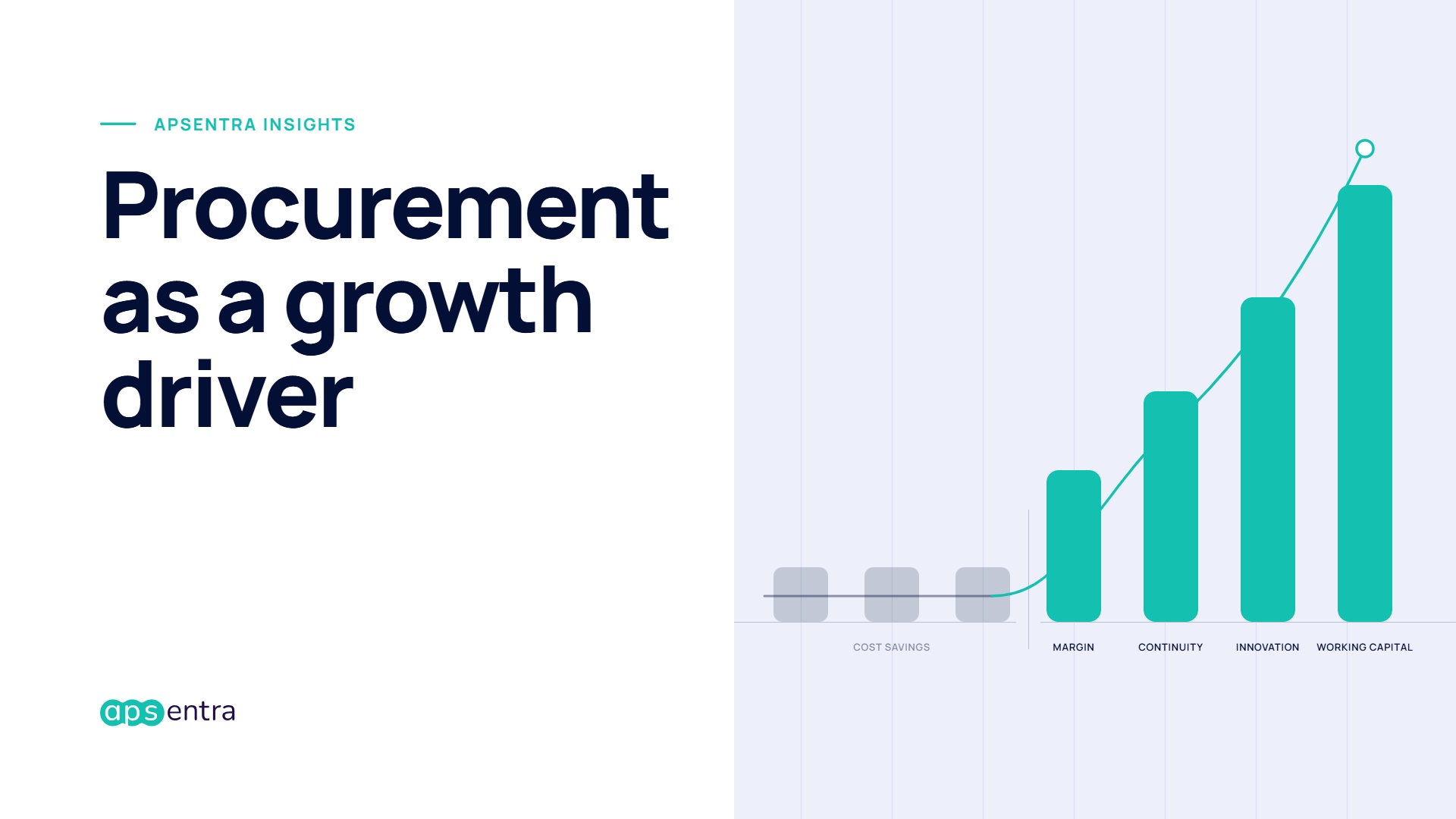
Procurement acts as a growth driver when it influences revenue-bearing decisions before they are committed: which suppliers gain access to the business, how much continuity risk the company carries into a demand peak, which categories fund innovation, and how much working capital stays available for growth.
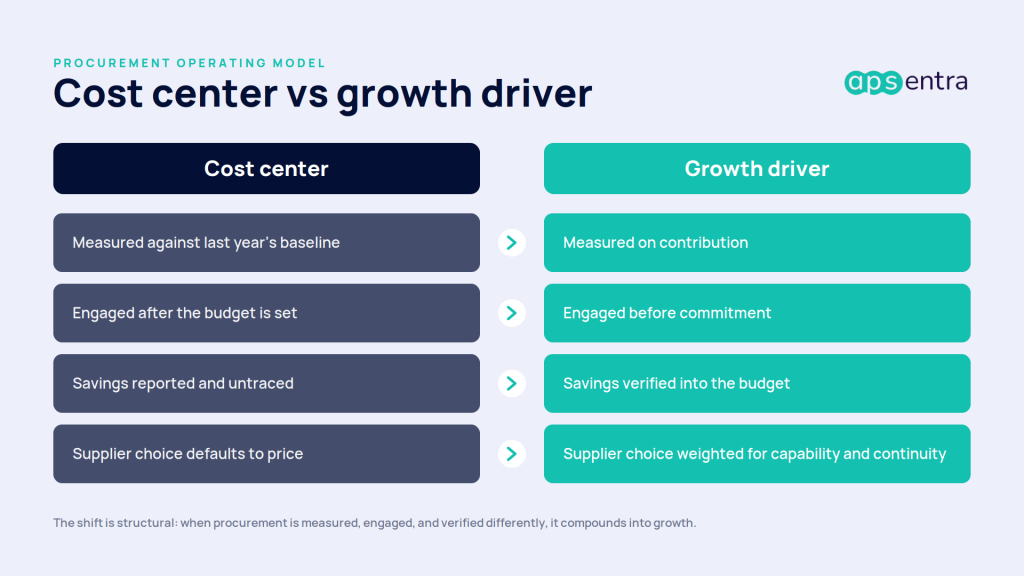
The cost center framing measures the function against last year’s baseline. Savings are counted, reported, and rarely traced further. The growth framing measures contribution: margin defended through execution, revenue protected through continuity, innovation sourced through supplier capability, and capital released through better terms and planning.
The difference is not semantic. It determines who sits in the room and when. A function measured on savings is called after the budget is set, because savings can be extracted from decisions already made. A function measured on contribution has to be present while the decisions are being made, which is a different operating model, not a different job title.
“We reconsidered our view of procurement entirely. Today, we believe that technology gives procurement not just a seat at the executive table, but it gives it the power to become a true value creator for the entire business.”
— CEO of the procurement entity, Food Manufacturing Holding
Why Is Procurement Still Treated as a Cost Center?
Because the reporting line and the timing both place procurement downstream of the decisions that create growth. Roughly half of procurement organizations sit outside the finance structure entirely, and a large minority still do not have most of their external spend under formal management.
Deloitte’s 2025 Global Chief Procurement Officer Survey, drawn from more than 250 CPOs across 40 countries, puts numbers on both. Across industries, 49 percent of procurement teams report through finance, and 81 percent have at least half of their spend under formal management. Read the second figure the other way: close to one organization in five cannot say that most of its external spend is formally managed at all.
49% of procurement teams report through finance across industries, and 81% have at least half of company spend under formal management.
A function reporting outside finance receives the budget rather than shaping it. It inherits assumptions about supplier pricing, availability, and terms that were set without procurement market knowledge, and it is then measured on how efficiently it executes those assumptions.
Spend that is not formally managed compounds the same problem from the other direction. Commitments made outside a governed route never enter the record in time to be influenced, so procurement is left reconstructing what happened rather than shaping what happens next. Both conditions produce the same organizational conclusion: procurement is where costs are processed, not where value is created.
What Does the 2025 Data Say About Procurement’s Growth Contribution?
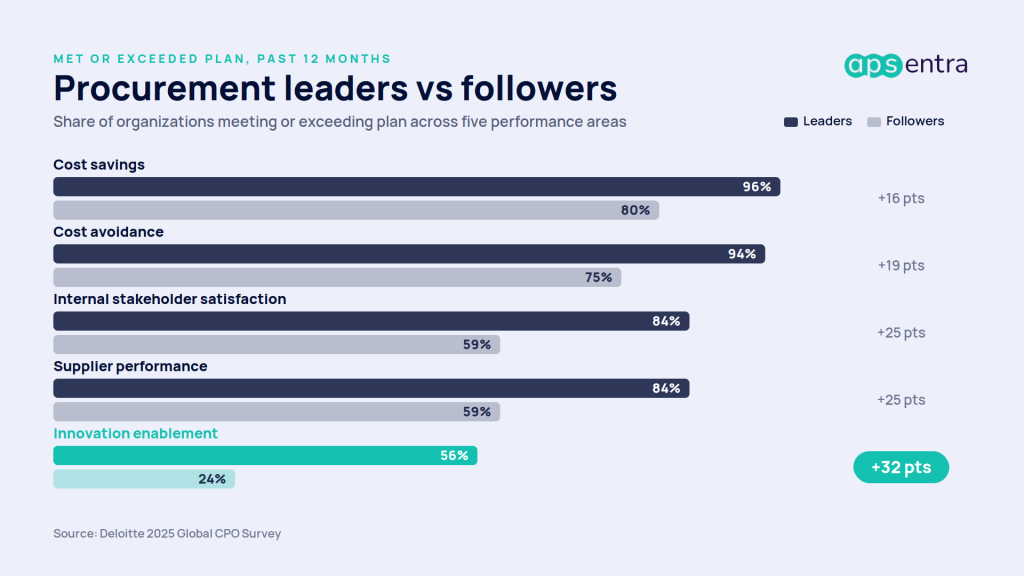
The gap between leading and following procurement organizations is widest exactly where growth lives. On cost metrics, leaders and followers are separated by a margin. On innovation enablement, they are separated by a factor.
Deloitte’s 2025 survey compared organizations investing decisively in digital capability and talent against the rest, measuring how each group performed against plan over the previous twelve months. The pattern across five performance areas is consistent, and the size of the gaps is the useful part.
| Performance area (met or exceeded plan) | Leaders | Followers | Gap |
|---|---|---|---|
| Cost savings | 96% | 80% | 16 pts |
| Cost avoidance | 94% | 75% | 19 pts |
| Internal stakeholder satisfaction | 84% | 59% | 25 pts |
| Supplier performance | 84% | 59% | 25 pts |
| Innovation enablement | 56% | 24% | 32 pts |
Cost savings is the metric most procurement functions already compete on, and the leaders are ahead by sixteen points. Innovation enablement, the clearest proxy for growth contribution, separates them by thirty-two points and more than double the rate. Cost discipline is table stakes. What distinguishes the leading group is the capacity to bring supplier capability into the business early enough to matter.
The same survey shows where the effort is going. Asked which risk strategies proved most effective, 74 percent of respondents named finding alternative supply sources, 64 percent prioritized greater visibility into the supply chain, and 61 percent focused on stronger supplier information sharing and collaboration. Each of those is a continuity measure, and continuity is a revenue condition before it is a supply condition.
Where Does Procurement Create Growth Beyond Savings?
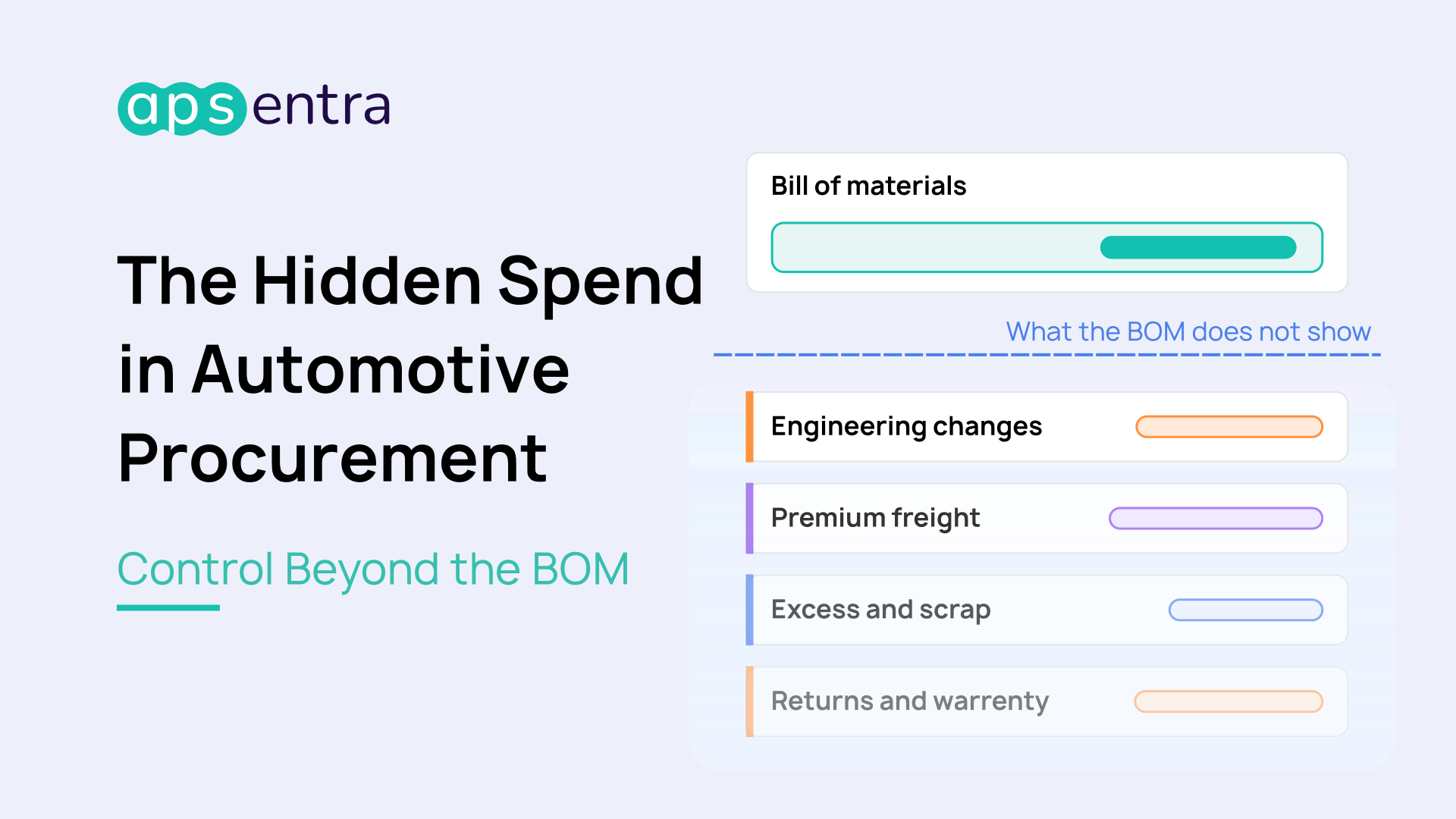
Procurement creates growth through four levers that a savings report does not capture: margin that survives execution, continuity that protects revenue, supplier capability that funds innovation, and working capital released through terms and planning.

Margin that survives execution

Continuity that protects revenue

Supplier capability that funds innovation

Working capital released through terms and planning
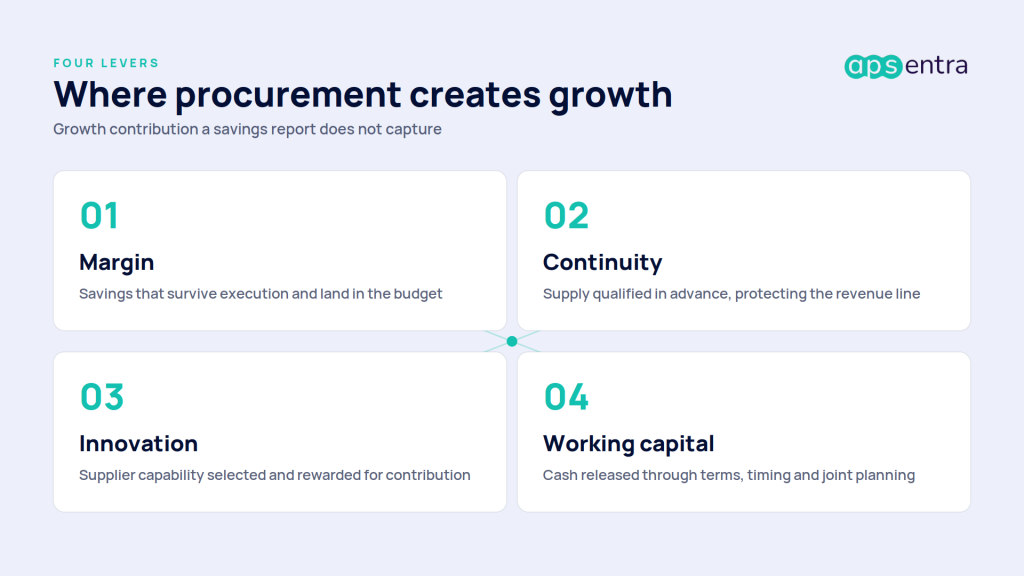
None of the four is available to a function that sees spend after it has been committed. All four require procurement to operate inside the decision, which is a structural question rather than a capability one.
How Does This Align with the Broader CPO Value-Creation Shift?
Independent research on the North American CPO agenda through 2031 reaches the same conclusion from another angle. Louis Ivezaj, CPO & Supply Chain Officer at ExiQ Consultancy, frames the shift as procurement moving from managing spend to creating, protecting, and accelerating enterprise value, with performance increasingly measured against EBITDA created and protected, cash released, risk reduced, and growth enabled.
The distinction ExiQ draws between negotiated value and realized value mirrors the execution gap already described above: a CPO may report a substantial saving at signing, but if implementation stalls, specifications are not converted, or suppliers underperform, the number that reaches the P&L can differ materially from the number that was negotiated.
“Negotiated value and realized value are not the same number. A CPO can report twenty million in savings, but until it survives implementation, demand changes, and supplier adoption, it is a forecast, not a result. The gap between the two is where most procurement credibility is lost.”
— Louis Ivezaj, CPO & Supply Chain Officer, ExiQ Consultancy
How Did a Food Manufacturing Holding Turn Procurement Into a Business?
By separating procurement from the production facilities and rebuilding it as a dedicated entity with its own commercial model. The function moved from decentralized support activity to a business process outsourcing unit that is becoming financially self-sustaining.
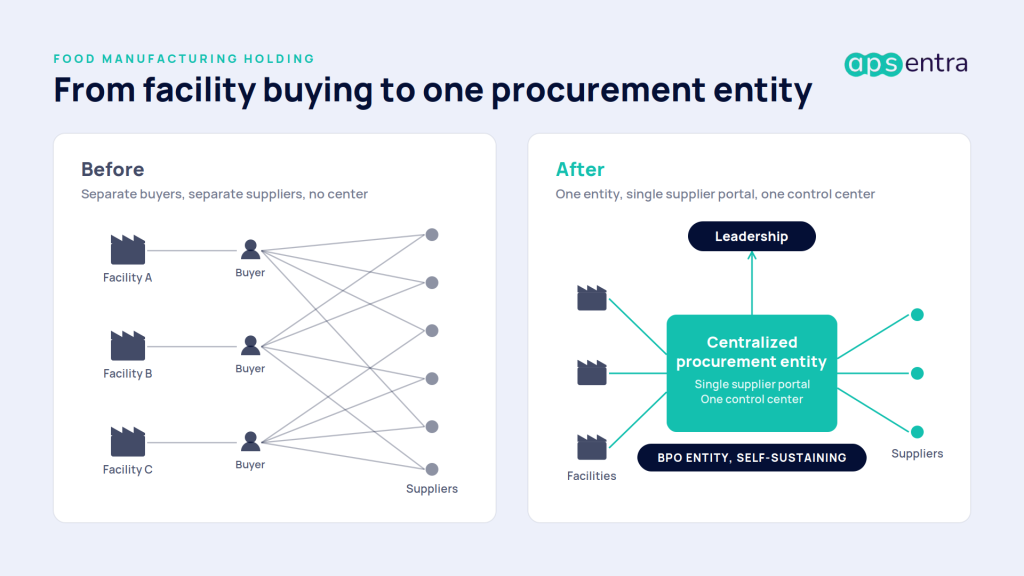
The holding unites several factories and production enterprises. Procurement had been treated as a support function for years: buyers worked on-site at individual facilities, each managing their own supplier relationships, with no shared structure and no oversight tools. The consequences were predictable and expensive, and none of them appeared as a line item.
Case 1: Food Production Holding
Multiple production facilities | Centralized procurement entity
Challenge: Fully decentralized procurement across facilities. No holding-level oversight, inconsistent supplier management, recurring supply disruptions due to uncoordinated planning, no tender transparency, and fragmented negotiating power across separate purchasing volumes.
APSentra Solution: After a full procurement audit of the group, the function was spun off into a standalone legal entity operating under a business process outsourcing model, deployed on APSentra: electronic tenders, auctions and reverse auctions, a unified supplier portal with online access to contracts, orders and shipments, electronic contract approval and signing, joint procurement planning that synchronizes facility needs with supplier capacity, commodity pricing tools including raw material futures and factoring, and full elimination of paper workflows.
Outcome: Leadership established a single procurement control center across all facilities, eliminating manual data collection. One procurement manager now represents all group entities to suppliers through a centralized platform. Consolidating the holding’s purchasing volumes into one structure materially strengthened its negotiating position, automated routing and approval reduced error and process abuse, and the entity operates on a commercial model in which buyers are compensated on service quality and outcomes.
The detail worth pausing on is the compensation model. Buyers are paid on service quality and outcomes, and a commission model for supplier tender participation supports the unit’s financial self-sufficiency. Procurement did not simply contribute to growth in this holding. It acquired its own revenue logic and became a business that other organizations can buy from.
“The future of our company’s procurement is no longer built on the dogma of ‘buy cheaper.’ It is built on a system of shared cost and risk management with our suppliers.”
— CEO of the procurement entity, Food Manufacturing Holding
The pattern is not confined to food manufacturing. A comparable shift from support function to value center runs through the wider APSentra client cases, across agriculture, retail, logistics and financial services.
What Has to Change Structurally Before Procurement Can Drive Growth?
Four decisions have to be settled before any technology is deployed: who is accountable for spend by category, value and business unit; how approval authority maps to the budget hierarchy; what criteria govern supplier selection; and how often procurement data reaches financial forecasting.
Organizations that skip these questions and deploy a platform anyway tend to digitize the fragmentation they already had. The system is adopted, the connection is not, and the function is measured on the same savings report as before, produced faster.
Where the decisions are settled, technology makes them enforceable at scale. APSentra builds a digital twin of an organization’s structure and procurement workflow: legal entities, territories, approval hierarchies, decision rights, contracts and supplier relationships, digitalized and connected, so that every request, approval and commitment belongs to a specific owner at a specific point in the process. Finance sees commitments as they are made rather than at reconciliation, which is the precondition for every one of the four growth levers.
Reported efficiency gains of up to 25 percent in cost and up to 80 percent in process speed follow the governance work rather than the software installation. The financial reasoning behind that sequence is developed further in Procurement as a Finance Function: The CFO-CPO Alignment Imperative
How Do You Start Moving Procurement From Cost Center to Growth Driver?
Start with four diagnostic questions. Each one tests whether procurement is positioned to influence a decision or only to record it.
- How much time passes between a committed purchase and the moment finance can see it?
- What share of external spend runs through a governed route, and who owns the remainder?
- Is supplier selection governed by documented criteria that weigh capability and continuity, or by price and individual discretion?
- When was procurement last consulted before a budget was approved rather than after?
Where the answers expose a gap, the constraint is structural rather than technical, and it is addressable in weeks rather than quarters. Governance decisions made before implementation have more effect on the outcome than any feature comparison.
About APSentra
APSentra is an AI-driven source-to-pay platform designed to control, structure, and optimise company-wide spend. Trusted by leading organisations across telecom, logistics, agriculture, and financial services — including Kyivstar, Nova Post, Kernel, UkrLandFarming, Sense Bank, and Intesa Sanpaolo.