Procurement Capability Assessment: How to Evaluate Your Team, Process, and Technology
This guide sets out what a capability assessment measures, the five dimensions to score, an 18-question scorecard you can run in-house, the gaps that show up most often, how those gaps turn into financial exposure, and how to convert the results into a plan that survives contact with a budget.
Capability Assessment vs Maturity Assessment: What Each Measures
A procurement capability assessment is a structured evaluation of whether a procurement function has the skills, process discipline, technology, data quality and governance needed to perform its role. Unlike a maturity assessment, which places the function on a stage scale, a capability assessment measures execution readiness and identifies the specific gaps that limit it.
The distinction matters in practice. A maturity assessment can rate a function Proactive because it has category owners and a central platform. A capability assessment might then find that the category owners have never run a competitive sourcing event, the platform’s approval rules are switched off, and the spend classification is 60 percent “other”. The stage is real; the capability to operate at it is not.
Use the maturity lens to decide where the function should be, and the capability lens to decide what has to change for it to get there. Our guides to the procurement maturity model and to running a procurement maturity assessment cover the stage side; this article covers execution.
The Five Capability Dimensions
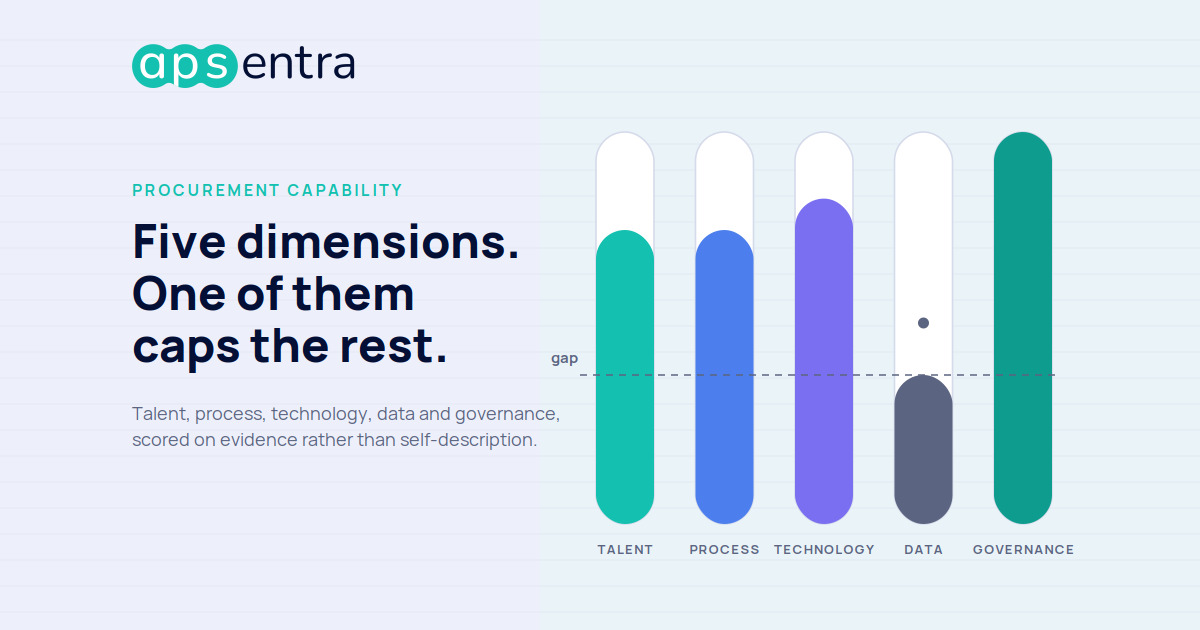
Most capability frameworks converge on five areas. What differs between good and poor assessments is whether each area is scored on evidence or on self-description.

Talent and skills

Process discipline

Technology stack

Data quality

Governance
Deloitte’s 2025 Global Chief Procurement Officer Survey, drawing on more than 250 CPOs across 40 countries, found that 57 percent cite siloed ways of working as their leading barrier to delivering value. Silos are a capability problem before they are a maturity problem: they mean the skills, data and governance exist in pockets rather than as a function.
How to Structure the Assessment: An 18-Question Scorecard
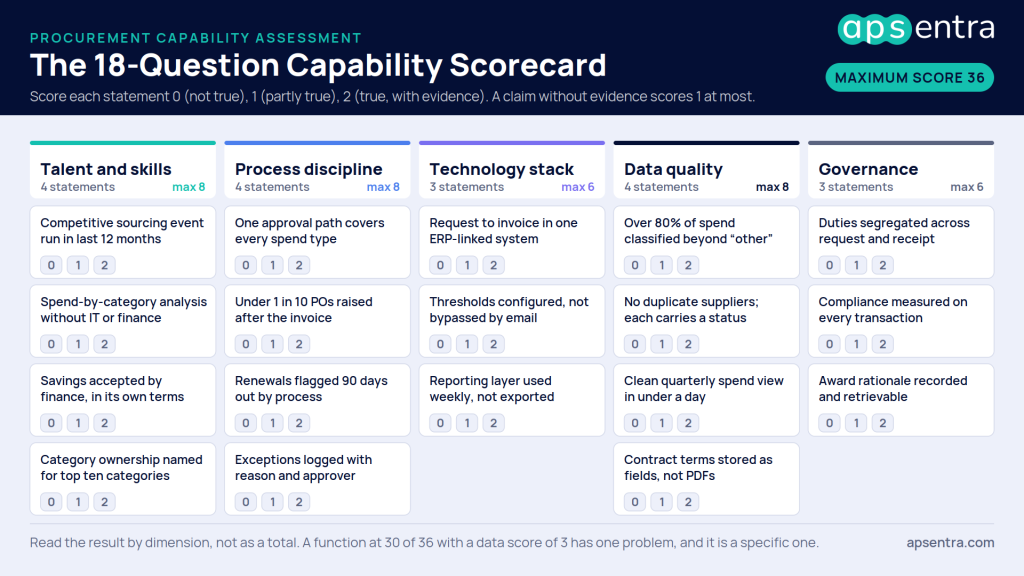
Score each statement 0 (not true), 1 (partly true) or 2 (true, and we can show the evidence). Eighteen statements, maximum 36. The scoring rule is the important part: a claim without evidence scores 1 at most.
Talent and skills (4 statements, max 8)
- At least one team member has run a competitive sourcing event with a weighted evaluation in the last twelve months.
- Someone on the team can produce a spend-by-category analysis without help from IT or finance.
- The team has presented savings to the CFO using finance’s definitions, and finance accepted the figure.
- Category ownership is assigned by name for the top ten categories.
Process discipline (4 statements, max 8)
- A single documented approval path exists and covers every spend type.
- Fewer than one in ten purchase orders is created after the invoice arrives.
- Contract renewals are flagged at least 90 days before expiry by a process, not a person.
- Exceptions to policy are recorded with a reason and an approver.
Technology stack (3 statements, max 6)
- Requests, approvals, orders, receipts and invoices run through one system integrated with the ERP.
- Approval thresholds are configured in the system and cannot be bypassed by email.
- The team uses the reporting layer weekly rather than exporting to spreadsheets.
Data quality (4 statements, max 8)
- More than 80 percent of spend is classified to a category other than “other” or “miscellaneous”.
- Supplier master records are deduplicated and carry a status (approved, conditional, blocked).
- A classified spend view for the last quarter can be produced in under a day.
- Contract terms and prices are stored as data fields, not only as attached PDFs.
Governance (3 statements, max 6)
- Segregation of duties is enforced: the person who raises a request cannot approve it or receive the goods.
- Approval compliance above threshold is measured on every transaction, not by sampling.
- Supplier selection rationale is recorded at award and retrievable without asking the buyer.
Read the result by dimension, not as a total. A function at 30 of 36 with a data score of 3 has one problem, and it is a specific one.
Common Capability Gaps in Mid-Market and Enterprise Teams
The same gaps recur across sizes; what changes is which one dominates.
| Gap | Where it shows up | Mid-market pattern | Enterprise pattern |
|---|---|---|---|
| Category expertise concentrated in one or two people | Talent | The one senior buyer is the function | Expertise exists but sits in one region or business unit |
| Approval policy documented, not enforced | Governance | Policy exists, system does not check it | Policy enforced in one ERP instance, not the others |
| Spend classified by GL code, not by category | Data | Nobody has time to reclassify | Multiple taxonomies across entities |
| Platform bought, features unused | Technology | Implemented for POs only | Modules licensed, workflows never configured |
| Retroactive purchase orders | Process | Common; POs raised to match invoices | Concentrated in tail spend and services |
| Finance and procurement count savings differently | Talent, governance | Rarely reconciled | Reconciled annually, disputed quarterly |
The enterprise pattern is worth a second look. Large functions usually score well on paper and poorly on consistency: a capability that exists in headquarters but not in a subsidiary is a capability the company does not have.
How Capability Gaps Become Financial Risk
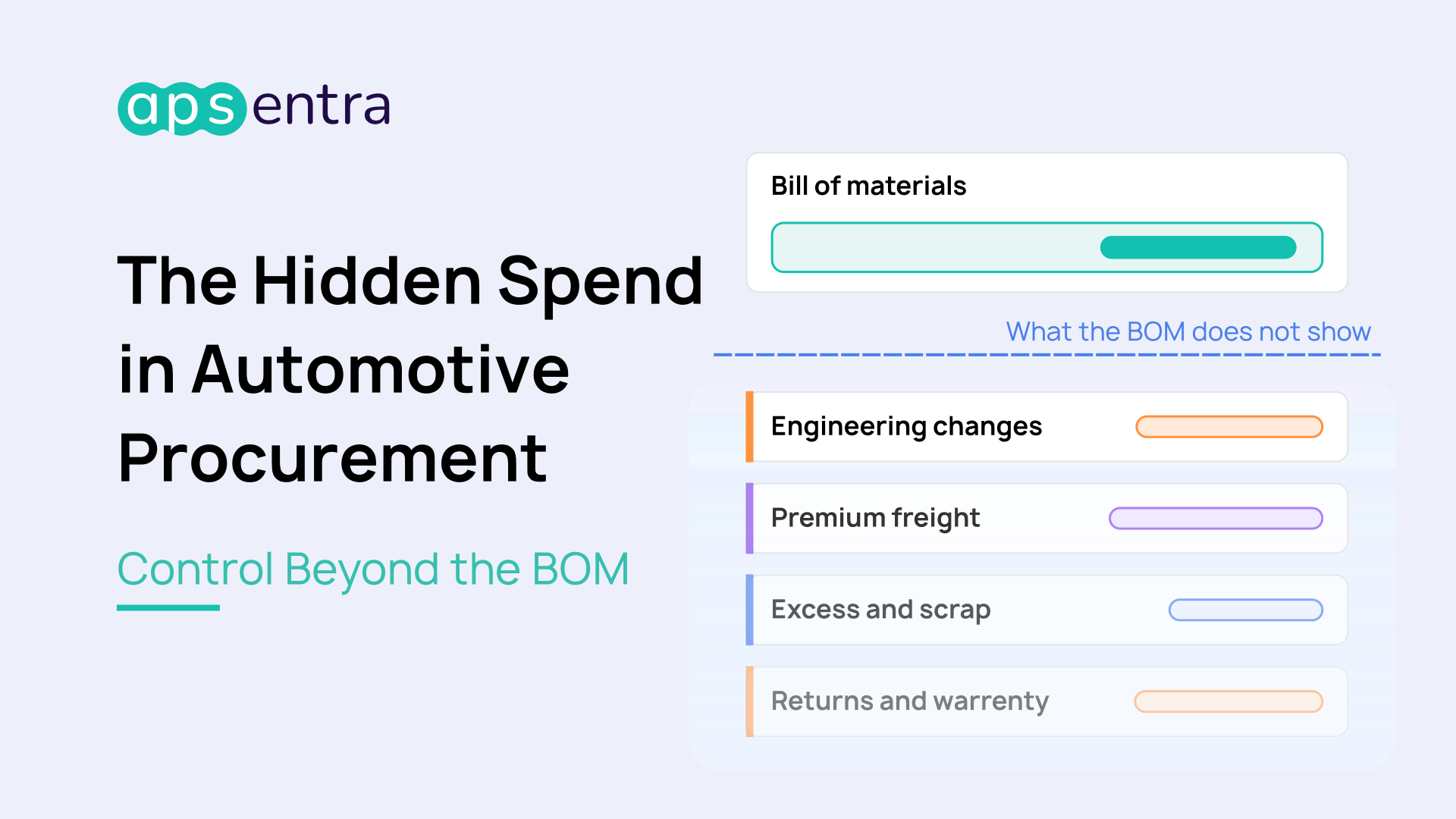
Each gap has a cost, and most of the costs are already in the P&L under a different name.

Leakage

Compliance exposure

Slow cycle times
Our analysis of why procurement ROI fails CFO scrutiny covers what happens when the savings figure cannot be traced; the capability gaps above are usually the reason it cannot.
“Map your process, align the teams, define the rules. Before you touch the keyboard.”
— Mauricio Dezen, VP Professional Services and Customer Success, APSentra, on the Behind Procurement LinkedIn Live
Turning Results Into a Prioritized Action Plan
An assessment produces a list of gaps. A plan needs an order. Three rules produce one.
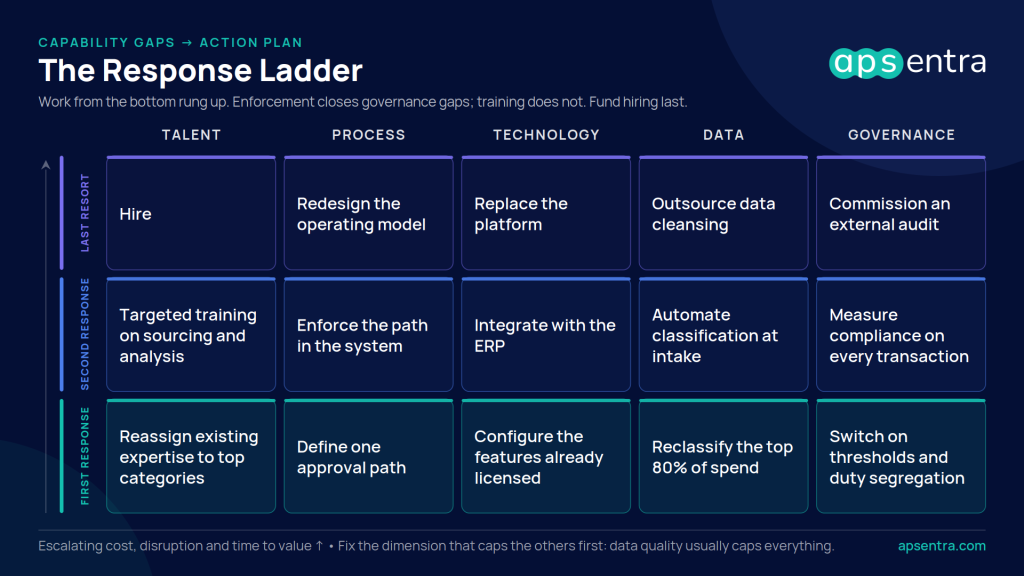
Fix the dimension that caps the others. Data quality usually caps everything: a team cannot demonstrate sourcing skill or governance compliance on data it cannot trust. If the data score is the lowest, it goes first regardless of what else is tempting.
Prefer enforcement over training. A governance gap can be closed by training people to follow a policy or by configuring the system to refuse a transaction that breaks it. The second is cheaper, faster and permanent. Training closes talent gaps; it does not close governance gaps.
Fund hiring last. Most talent gaps are narrower than they look once process and tooling gaps are closed, because the skilled people already in the team stop spending their time on reconciliation. Assess the talent gap again after the first two rules have been applied.
| Gap type | First response | Second response | Last resort |
|---|---|---|---|
| Talent | Reassign existing expertise to top categories | Targeted training on sourcing and analysis | Hire |
| Process | Define one approval path | Enforce it in the system | Redesign the operating model |
| Technology | Configure the features already licensed | Integrate with the ERP | Replace the platform |
| Data | Reclassify top 80 percent of spend | Automate classification at intake | Outsource data cleansing |
| Governance | Switch on thresholds and segregation of duties | Measure compliance on every transaction | External audit |
The plan itself belongs in a roadmap with costs, owners and dates; our guide to building a procurement transformation roadmap covers that format.
Making the Assessment Continuous, Not One-Time
A capability assessment run once is a snapshot. Run on a schedule from live data, it becomes a control.
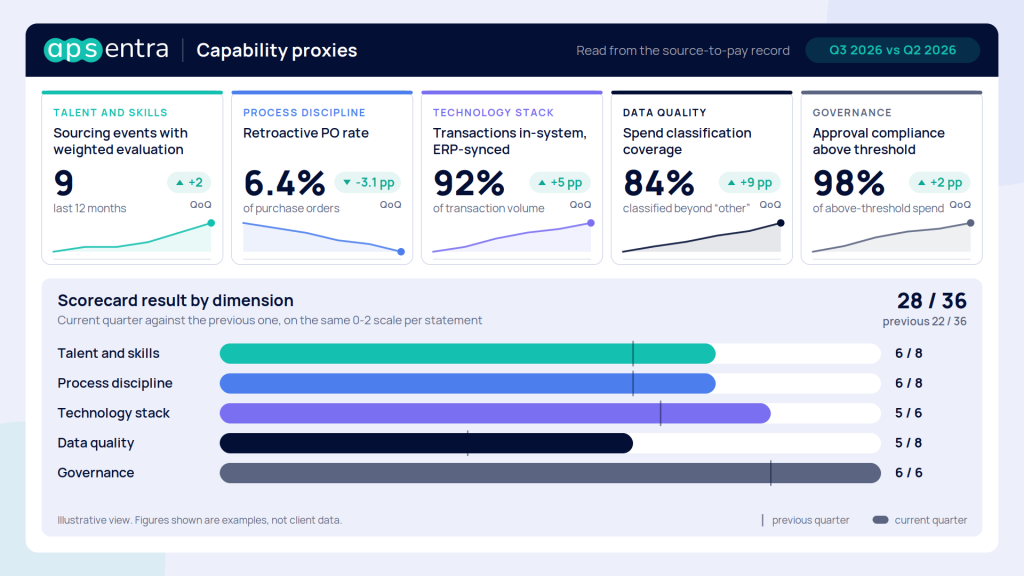
Most of the 18 statements have a system proxy. Retroactive PO rate, approval compliance above threshold, spend classification coverage, supplier master duplicates, time to a clean spend view and contract fields populated can all be read from a source-to-pay platform on demand. The talent statements still need judgement, but they can be evidenced from the sourcing event log and the savings finance has accepted.
The practical cadence is quarterly for the system proxies and annually for the full scorecard, with the annual result compared on the same scale to the previous one. The pattern across APSentra client cases is consistent: the second and third assessments are where the value lands, because they show which gap moved and which did not.
Where outside help still earns its fee is calibration for complex, multi-entity or regulated functions, and it can be bought as a short review rather than a full diagnostic. Our comparison of when a team needs a consultant and when it needs a better system sets out the trade-off.