Procurement Maturity Assessment: The Framework CFOs and CPOs Actually Use
A procurement maturity assessment fixes that. It turns a vague sense of progress into a stage, a score, and a short list of what to fix first, the kind of input a board can actually fund. This guide covers what the assessment measures, the five-stage model behind it, how to run one without paying a firm for six weeks of data collection, and a scorecard you can use today.
What Does a Procurement Maturity Assessment Measure?
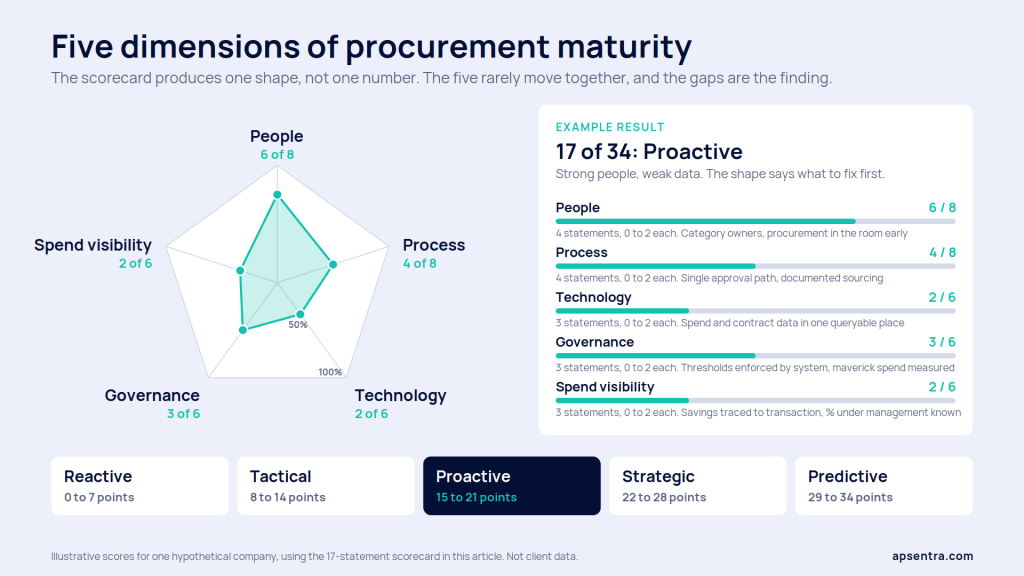
A procurement maturity assessment is a structured evaluation of how a company buys, covering five dimensions: people, process, technology, governance, and spend visibility. It produces a stage rating, from reactive to predictive, and a short list of the gaps holding the function back from the next stage.
- People. Who owns which category, and whether procurement is looped in before or after a decision has already been made.
- Process. Whether sourcing, approvals, and renewals follow a repeatable path, or depend on whoever remembers to chase them.
- Technology. Whether spend and contract data live in one place you can query, or across exports nobody fully trusts.
- Governance. Whether spending rules are enforced by a system, or by good intentions.
- Spend visibility. Whether the savings number reported to the board can be traced back to an actual transaction.
The five rarely move together. A company can have sharp people and a hopeless system, or a modern platform running on a policy nobody enforces. The assessment exists to catch that mismatch before a transformation budget gets spent fixing the wrong one.
The stakes for getting this right are rising. Ardent Partners’ 2026 survey of 311 CPOs, sponsored by GEP, found 79 percent expect the year ahead to be harder, while 75 percent expect their teams to perform better regardless. Closing that gap starts with knowing, precisely, where the function stands today, which is also covered from the finance side in our piece on CFO-CPO alignment.
The Procurement Maturity Model: Five Stages From Reactive to Predictive
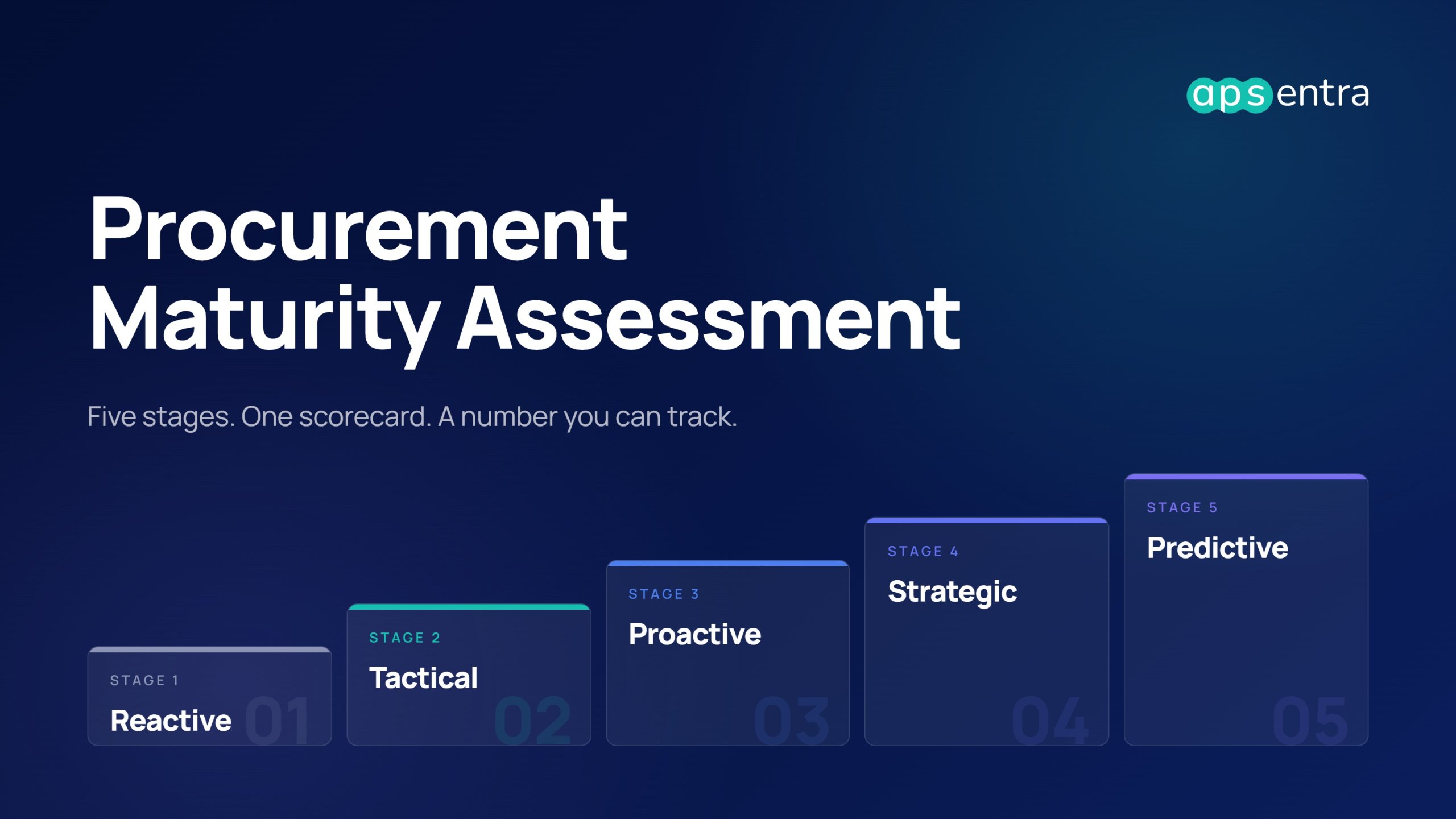
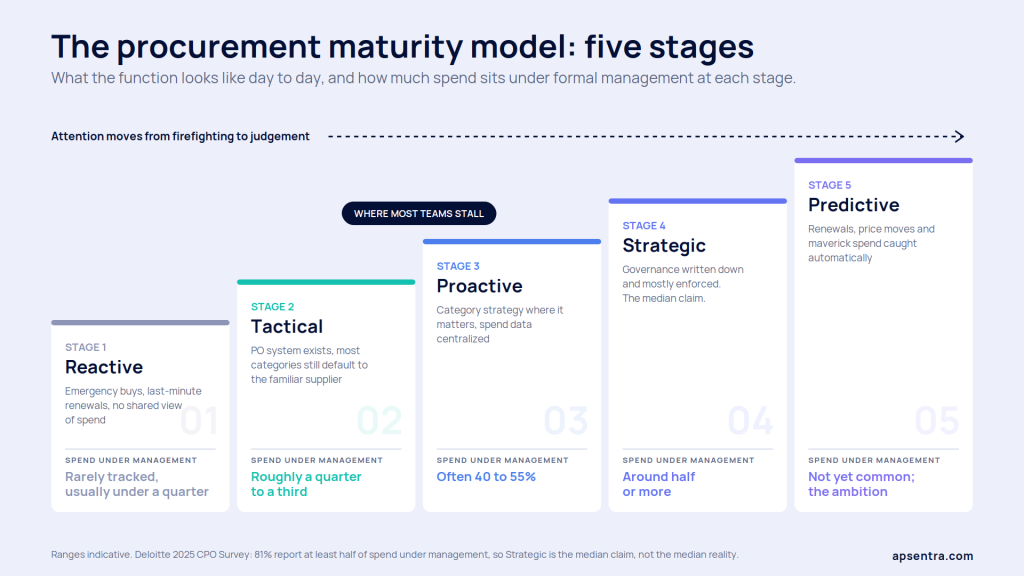
Most frameworks describe the same climb, even when the labels differ slightly from one consulting firm to the next: reactive, tactical, proactive, strategic, and predictive or autonomous at the top. What changes at each stage is not just capability, it’s where the function’s attention goes.
| Stage | What it looks like day to day | Spend under formal management |
|---|---|---|
| Reactive | Procurement responds to requests as they land: emergency purchases, last-minute renewals, one-off supplier calls. There is no shared view of spend, so nobody notices a pattern until finance asks a hard question. | Rarely tracked; usually well under a quarter |
| Tactical | Basic tools exist, a PO system, maybe a shared spreadsheet of contracts. Some categories are sourced properly; most still default to whichever supplier the requester already likes. Savings get reported project by project, inconsistently. | Roughly a quarter to a third |
| Proactive | Category strategy exists for the categories that matter. Procurement is invited in before a supplier is chosen, not after a verbal commitment is already made. Spend data is centralized, even if updating it still takes a person. | Often 40 to 55 percent |
| Strategic | Procurement sits with finance on decisions with P&L impact. Governance rules are written down and mostly followed. This is close to where the median CPO now claims to be. | Around half or more (see note below) |
| Predictive / Autonomous | The system flags risk and opportunity before someone goes looking for it. Renewals, price movements, and maverick spend get caught automatically, not discovered at reconciliation. The team’s time goes to judgment calls, not data assembly. | Not yet common; the ambition most Strategic-stage teams are building toward |
That Strategic-stage benchmark is worth a second look. Deloitte’s 2025 Global Chief Procurement Officer Survey, based on responses from more than 250 CPOs across 40 countries, found 81 percent of organizations now report at least half their spend under formal management. That makes Strategic the median claim. It does not make it the median reality, and the gap between what a function reports and what its own data actually shows is precisely what a maturity assessment is supposed to surface.
The jump from Tactical to Proactive is where most companies stall, because it is the first stage that requires investment before it shows a return: centralizing data, assigning category owners, standing up a single approval path. Everything after that compounds on whether the foundation underneath it can be trusted.
Self-Diagnosis Signals: How to Tell Which Stage You’re In
Before the formal scorecard, a faster gut check. If two or three of these sound familiar, that is probably your stage.
Reactive
- A supplier calls asking about a renewal you did not know was coming up.
- Nobody can say what you spent with your top ten suppliers last quarter without a research project.
- Sourcing means calling whoever you used last time.
Tactical
- There is a PO system, but half the team still emails vendors directly.
- Savings get reported after each project ends, never as a running total.
- Contracts exist, but nobody reviews them until something breaks.
Proactive
- Procurement is in the room before a supplier is chosen, most of the time.
- A spend report by category takes under a day to produce.
- A few categories have a real strategy behind them; most still do not.
Strategic
- Approval thresholds are enforced by the system, not by whoever remembers the policy.
- Finance trusts the savings number procurement reports, because they can trace it themselves.
- Supplier risk gets flagged before it becomes a supply disruption, not after.
Predictive / Autonomous
- A price increase shows up in the data before the invoice does.
- Routine renewals and low-risk sourcing run with minimal human review.
- The team’s time goes to negotiation and strategy, not to finding the data to support it.
Why This Was Traditionally a Consultant’s Job
A maturity assessment sounds like something a team could run on a Friday afternoon. In practice, three things made it a six-figure consulting engagement instead.
Data collection came first, and it was the slow part. Spend data lived in the ERP, contracts lived in a shared drive, and supplier performance lived in someone’s head. A firm would spend the first two or three weeks of a six-week diagnostic just assembling a dataset that should already have existed.
Benchmarking came next. Knowing your own numbers only tells you so much; you also need to know what “good” looks like elsewhere. Firms such as The Hackett Group built entire practices on proprietary benchmark data, drawing in Hackett’s case on more than 57,000 procurement metrics collected across thousands of client engagements, because no single company could assemble that comparison set on its own.
Calibration was the genuinely hard part, and it’s the one piece that has not gone away. Turning a set of scores into an honest stage rating takes judgment: has this company actually solved governance, or does the policy just look good on paper? That kind of pattern recognition is still worth paying for in complex cases, and it’s covered in our overview of what procurement consulting actually involves.
“It is dealt with as a back-office service. It is not in the forefront as part of a planning process or part of a strategy. And the leakage there can creep up on you, and it can increase really quick.”
— Richard Richardson, Founder and Chief Equity Officer, RicheRich LLC, on the Behind Procurement Podcast
Richardson was describing freight buying specifically, but the pattern is not industry-specific. Any function reviewed only when something breaks is, by definition, still reactive, whatever the org chart says.
What has changed is the first two problems, not the third. A platform that already centralizes spend and contract data removes the assembly step. A growing body of public benchmark data, from Hackett, from Ardent Partners, from a company’s own trend line over time, covers a fair share of the comparison work too.
That leaves calibration, which is a smaller and more specific problem than “assess our entire procurement function,” and it’s worth pricing accordingly. Our comparison of when a team needs a consultant versus when it needs a better system goes into that trade-off in more depth.
How to Run a Procurement Maturity Assessment Without Hiring a Consultant
- Get one honest view of spend first. Before scoring anything, pull a single, classified view of what the company actually spends, by supplier and category. If that takes more than a day, that fact alone tells you your stage.
- Score yourself against the five dimensions. Use the self-diagnosis signals above for a fast read, then the full scorecard below for a number worth tracking over time.
- Check the score against your data, not your memory. “We source competitively” is a claim. “62 percent of spend is under a competitively sourced contract” is a fact. Pull the number before trusting the claim.
- Write down the two or three gaps that actually block the next stage. Not everything, just the constraint. A team stuck at Tactical because of fragmented data does not need a governance overhaul yet.
- Re-run it on a schedule, or after a trigger. Annually is a reasonable default. A new CPO, an ERP migration, or an acquisition are all good reasons to run it again sooner.
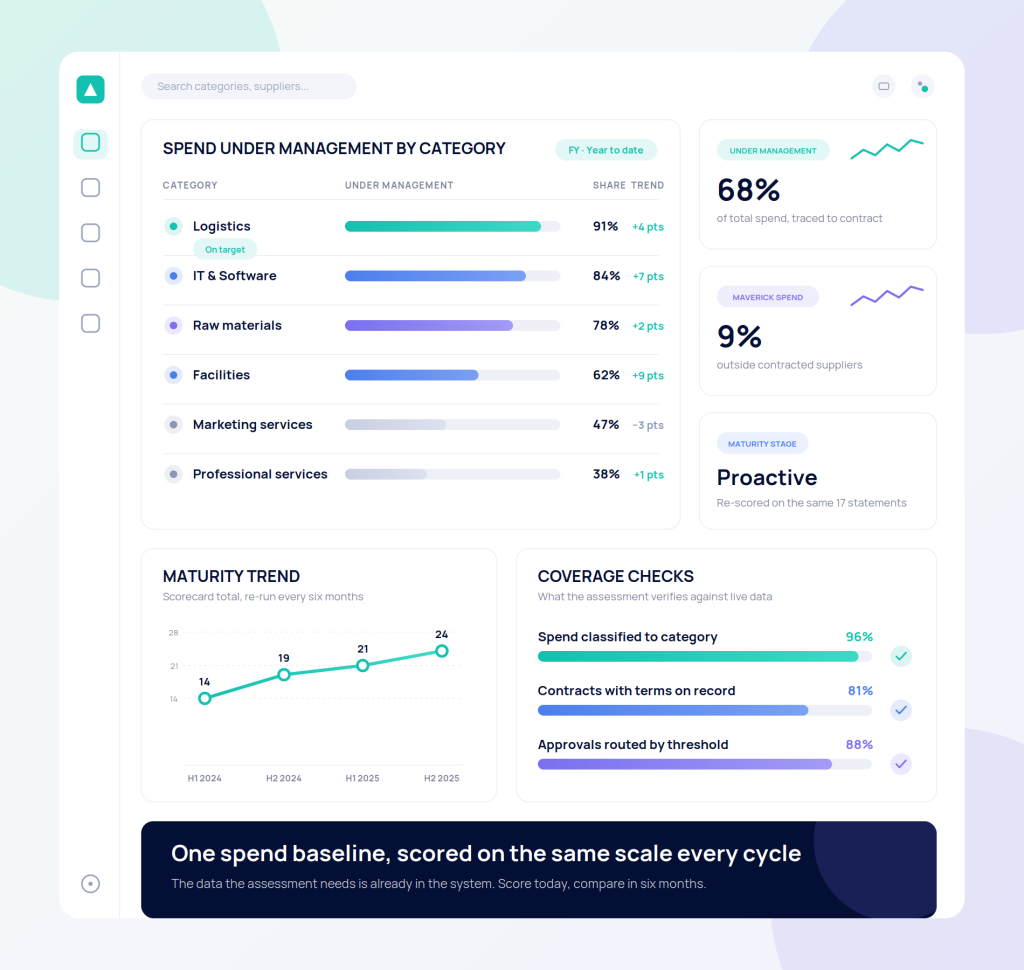
The honest constraint on doing this yourself has never been the five dimensions, that part is well documented across the industry. It’s step one: getting a spend view that’s actually trustworthy without three weeks of manual reconciliation. That’s the specific gap a spend analytics layer closes, and it’s why the assessment gets faster every time a company runs it on top of one instead of starting from a blank spreadsheet.
The Procurement Maturity Scorecard
Score each statement 0 (no), 1 (partially), 2 (yes), based on what’s actually true today, not what the policy document says. Think of it as a procurement maturity assessment template you can reuse every cycle: same questions, same scale, a new number each time.
People
| Self-check statement | Score (0–2) |
|---|---|
| Every category of spend has a named owner, not “whoever has time.” | |
| Procurement is looped in before a new supplier is chosen, not after the contract is signed. | |
| At least one person outside procurement (finance, legal, or ops) reviews high-value contracts before signature. | |
| Someone can describe the strategy for your top three spend categories without opening a slide deck. |
Process
| Self-check statement | Score (0–2) |
|---|---|
| There is a single approval path for a purchase request, not three different ones depending on who’s asking. | |
| Sourcing events follow a documented process, rather than being run from memory each time. | |
| Contract renewals are flagged before the expiry date, not discovered after auto-renewal has already triggered. | |
| A supplier onboarding checklist exists and is actually used, not filed away. |
Technology
| Self-check statement | Score (0–2) |
|---|---|
| Spend data lives in one system you can query directly, not scattered across ERP exports and spreadsheets. | |
| You can pull a current, accurate view of spend by supplier and category in under a day. | |
| Contract terms, pricing, renewal dates, and obligations are stored somewhere searchable, not only in PDF attachments in someone’s inbox. |
Governance
| Self-check statement | Score (0–2) |
|---|---|
| Spending thresholds, and who can approve them, are written down and enforced by the system, not by memory or trust. | |
| Maverick spend, purchases made outside contracted suppliers or approved process, is measured, not assumed to be low. | |
| Someone can name your top five suppliers by spend right now, without pulling a report first. |
Spend Visibility
| Self-check statement | Score (0–2) |
|---|---|
| Finance and procurement agree on the savings number reported to the board, and both can trace it to source data. | |
| You know what percentage of total spend is under formal management today, as an actual figure, not an estimate. | |
| A supplier price increase would show up in your data within a month, not at the next scheduled review. |
Add up the total across all seventeen statements and check it against the stage key below.
| Total score | Stage |
|---|---|
| 0–7 | Reactive |
| 8–14 | Tactical |
| 15–21 | Proactive |
| 22–28 | Strategic |
| 29–34 | Predictive / Autonomous |
What to Do With Your Result: A Roadmap by Stage
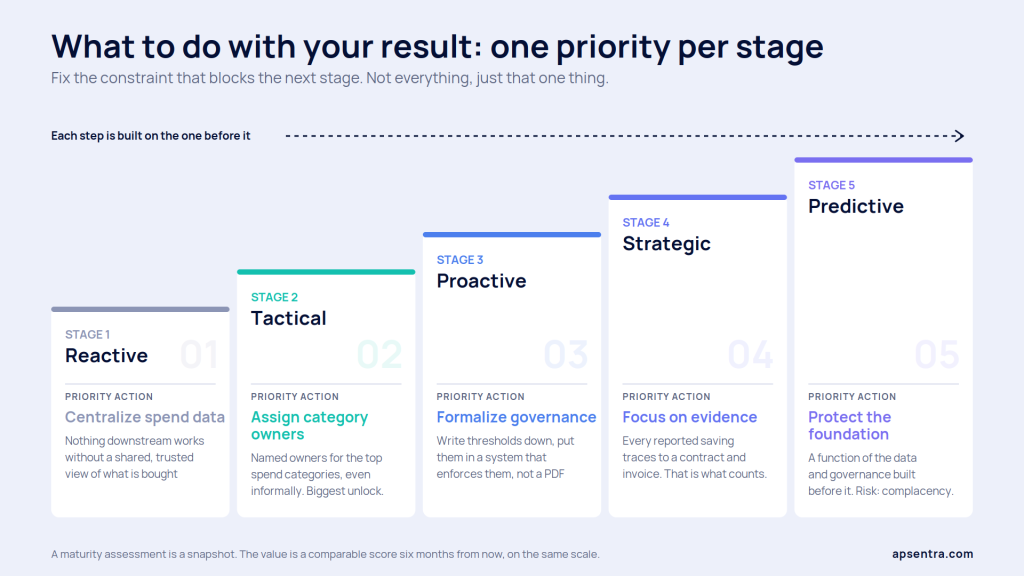
- Reactive. Centralize spend data before anything else. Nothing downstream works without a shared, trustworthy view of what’s actually being bought.
- Tactical. Assign named category owners for your top spend categories, even informally. Ownership is usually the single biggest unlock between this stage and the next.
- Proactive. Formalize governance. Write approval thresholds down and put them in a system that enforces them, not a policy PDF nobody reopens.
- Strategic. Focus on evidence. Every savings number procurement reports should trace back to a contract and an invoice, because that traceability is what determines whether finance treats the number as real. Our analysis of why procurement ROI fails CFO scrutiny covers this gap in detail.
- Predictive / Autonomous. Protect the foundation you built. This stage is a function of the data and governance work done at every stage before it, not a separate initiative, so the main risk here is complacency rather than capability.
“End-to-end efficient procurement and the digital twin of procurement is not a luxury anymore. It is a must-have for companies which want to scale, or even stay in the business.”
— Natalie Eksi, CEO, APSentra, on the Behind Procurement Podcast
A maturity assessment is a snapshot, and snapshots age. The value is not the score itself, it’s having a comparable score six months from now, on the same scale, without paying someone to run the exercise again from scratch. It’s a pattern that shows up consistently across APSentra client cases: the companies that keep climbing are the ones who kept measuring, not the ones who scored highest on their first attempt.