Tail Spend Management Services: Consultants, Outsourcing, and In-House Alternatives Compared
This guide separates them. It covers what consultants, service providers, outsourcers and consulting firms actually deliver, what each costs, where each fits, and why most of these engagements produce a one-time result for a recurring problem. It ends with a decision framework and the software-first alternative that increasingly replaces the recurring fee.
What Tail Spend Management Actually Means
Tail spend management is the practice of bringing the long tail of low-value, high-frequency purchases under control: the roughly 20 percent of spend spread across roughly 80 percent of suppliers and transactions. It combines policy, guided buying, supplier rationalization, and automation to reduce cost, manual effort, and compliance exposure in purchases too small to source individually.
The 80/20 shape is a rule of thumb rather than a law; some organizations find the tail at 10 percent of spend and 90 percent of suppliers. What is consistent is the mismatch between financial weight and administrative load. The Hackett Group’s 2025 Tail Spend Management Study found 48 percent of procurement leaders say tail spend has become a significantly higher priority, largely because the transaction volume drives processing cost and audit exposure out of proportion to the spend.
Setting your own threshold and building the internal plan is covered in our guide to a tail spend management strategy; this article is about whether, and from whom, to buy help.
Tail Spend Management Consultants: What They Do and What They Cost
A tail spend management consultant is usually an individual or boutique engaged for a defined project: analyse the tail, rationalize suppliers, design a buying policy, and hand over a plan.
Typical engagement. Four to twelve weeks. Spend data extract, classification of the tail, supplier consolidation analysis, threshold and policy recommendations, sometimes a first wave of supplier negotiations on the largest tail categories.
What you receive. A classified view of the tail, a shortlist of suppliers to consolidate to, a recommended threshold and approval policy, and a savings estimate.
Cost range. Day rates for independents and boutiques commonly run in the low to mid thousands of dollars; fixed-fee tail spend projects for a mid-market company typically land in the tens of thousands. Add internal time for data pulls and stakeholder interviews.
When it is worth it. When the company has never classified its tail and needs the first honest picture, or when a one-off supplier consolidation on a few categories is the goal. Less so when the tail is a recurring flow that will regrow the moment the consultant leaves.
Tail Spend Management Services: Project-Based vs Ongoing
“Services” is the broadest label, and it covers two different commercial models.
Project-based services resemble the consultant engagement above but delivered by a firm with a repeatable method and, often, its own analytics tooling. The output is the same: analysis, rationalization plan, policy. The difference is process maturity and price, which scales with firm size.
Ongoing managed services run part of the tail for you on a continuing basis: a buying desk that handles requests below threshold, negotiates spot purchases, onboards tail suppliers and reports monthly. Pricing is typically a monthly retainer, a per-transaction fee, or a share of savings.
The distinction matters because the two solve different problems. A project fixes the tail once. A managed service keeps managing it, which is closer to what the problem needs, at a cost that recurs for as long as the tail does.
Tail Spend Management Outsourcing: Full Transactional Handover
Tail spend management outsourcing, sometimes sold as tail spend BPO, hands the transactional handling of the tail to a provider entirely: request intake, supplier selection below threshold, ordering, invoice processing and reporting.
Pricing models. Per transaction, per purchase order, a percentage of managed spend, or a gain-share on documented savings. Per-transaction pricing is the most transparent; gain-share invites disputes over baselines.
What you gain. Processing cost per order falls sharply. Our comparison in the procurement outsourcing guide sets out the range: in-house processing of a purchase order commonly costs USD 50 to 150 fully loaded, against USD 8 to 25 for standardized outsourced processing, per Purvex Global’s 2026 analysis.
What you give up. The buying data now sits in the provider’s system, the supplier relationships in the tail become the provider’s, and the policy is enforced by the provider’s staff rather than by your workflow. When the contract ends, the tail comes back with a gap in its history. The control and data-ownership trade-offs are the same as for any procurement outsourcing decision, only concentrated in the highest-volume part of the function.
Tail Spend Management Consulting: Advisory vs Execution
Tail spend management consulting, as distinct from a consultant engagement, usually refers to the strategic layer: category rationalization, policy and threshold design, operating model for the tail, and the business case for whatever comes next. It is advisory work, often from the procurement practice of a larger firm, and it is frequently bundled with a broader procurement transformation.
The line to watch is between advice and execution. Advisory tells you what the tail policy should be. Execution services or software make it happen. Firms that sell both will naturally recommend both; the buyer’s question is whether the advisory output, a policy document and a category plan, is something the internal team could produce with a clean data set, which is often the case once a system provides it.
Our guide to procurement consulting covers how these advisory engagements are scoped and priced across the wider function.
Comparison: Consultant vs Service vs Outsourcing vs Software
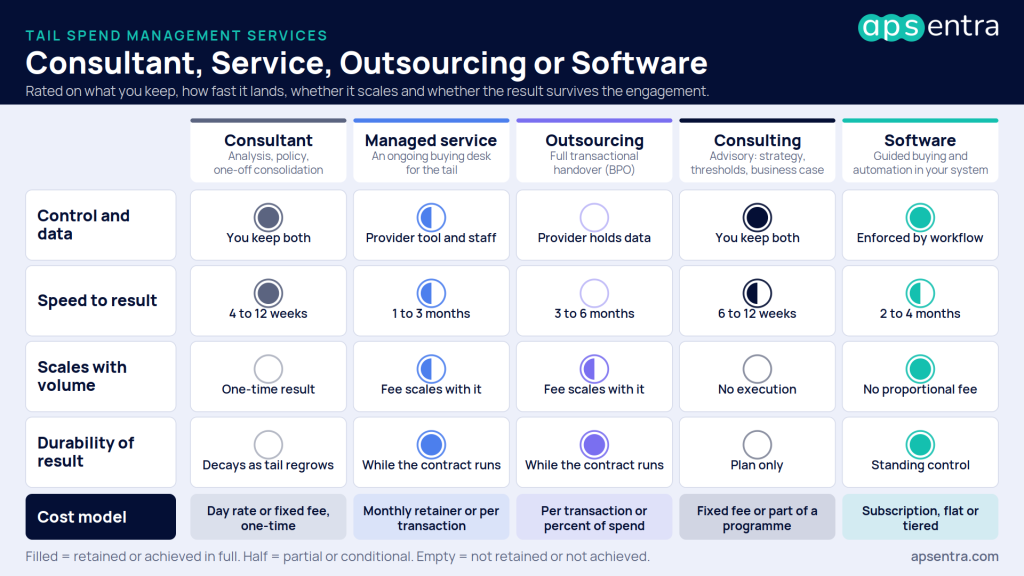
| Option | What you buy | Cost model | Control and data | Speed to result | Scales with volume? |
|---|---|---|---|---|---|
| Consultant | Analysis, policy, one-off consolidation | Day rate or fixed fee, one-time | You keep both; nothing enforced after handover | 4 to 12 weeks | No; result decays as tail regrows |
| Managed service | Ongoing buying desk for the tail | Monthly retainer or per transaction | Data often in provider tool; policy enforced by provider staff | 1 to 3 months to steady state | Yes, fee scales with it |
| Outsourcing / BPO | Full transactional handover | Per transaction or percent of spend | Provider holds data and supplier relationships | 3 to 6 months | Yes, fee scales with it |
| Consulting (advisory) | Strategy, thresholds, business case | Fixed fee or part of larger programme | You keep both; execution separate | 6 to 12 weeks | Not applicable; no execution |
| Software (guided buying + automation) | Catalogues, thresholds, automated approvals and PO in your system | Subscription, flat or tiered | You keep both; policy enforced by workflow | 2 to 4 months to live | Yes, without proportional fee growth |
Why Most Tail Spend Engagements Don’t Scale
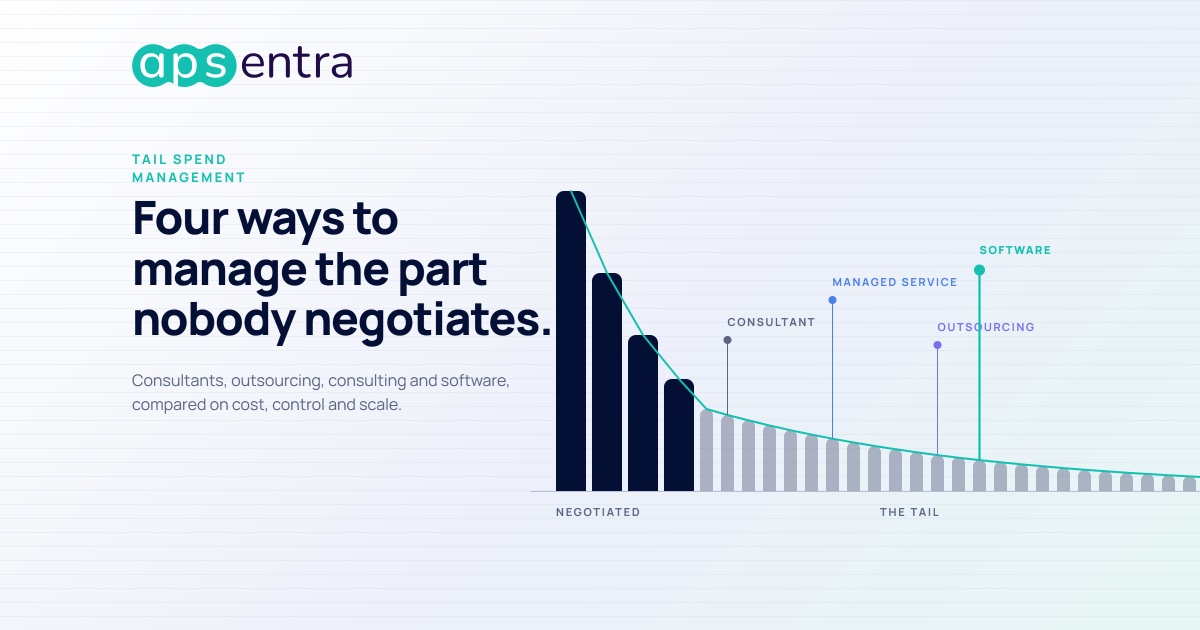
The tail is not a backlog. It is a flow. Every week new requests arrive below threshold, new suppliers get added because someone needed something on Tuesday, and consolidated suppliers drift back to many. Any intervention that treats the tail as a one-time clean-up produces a one-time result.
Consultants and advisory firms deliver a plan; the tail regrows around it. Managed services and outsourcers keep it managed, but the fee grows with the volume, so the cost of control rises with the problem it controls. The savings case that justified the engagement in year one is smaller in year three, and the provider now holds the data you would need to bring it back in-house.
Deloitte’s 2025 Global Chief Procurement Officer Survey found that 81 percent of organizations report at least half of their spend under formal management. The tail is, almost by definition, the part that is not, and a recurring fee to manage it externally is an admission that the internal process cannot.
“Map your process, align the teams, define the rules. Before you touch the keyboard.”
— Mauricio Dezen, VP Professional Services and Customer Success, APSentra, on the Behind Procurement LinkedIn Live
The advice applies in reverse to tail spend engagements: a provider who handles the tail for you has defined the rules for you, and they leave with the provider.
The Software-First Alternative
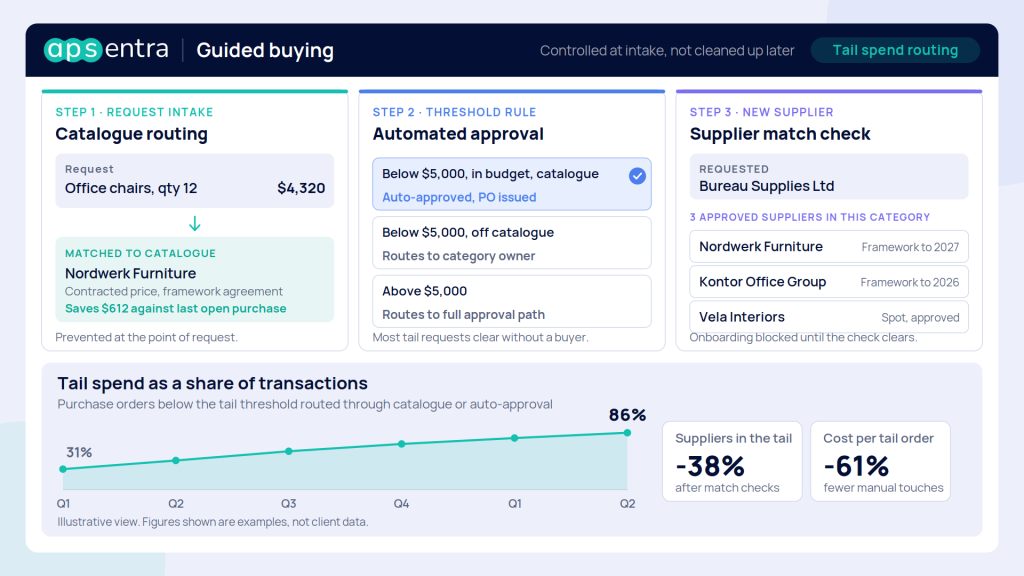
The alternative is to make the internal process able to handle the flow. Three mechanisms do most of the work.

Guided buying

Threshold-based automation

Supplier rationalization in the workflow
The result is that the tail is managed by the same system that manages the rest of spend, the data stays in-house, the policy is enforced by the workflow rather than by a provider’s staff, and the cost does not scale with transaction volume. The case for this over a service provider is strongest when the company already has, or is buying, a source-to-pay platform; our comparison of when a team needs a consultant and when it needs a better system covers the general version of the decision.
Decision Framework: Size, Volume, Complexity
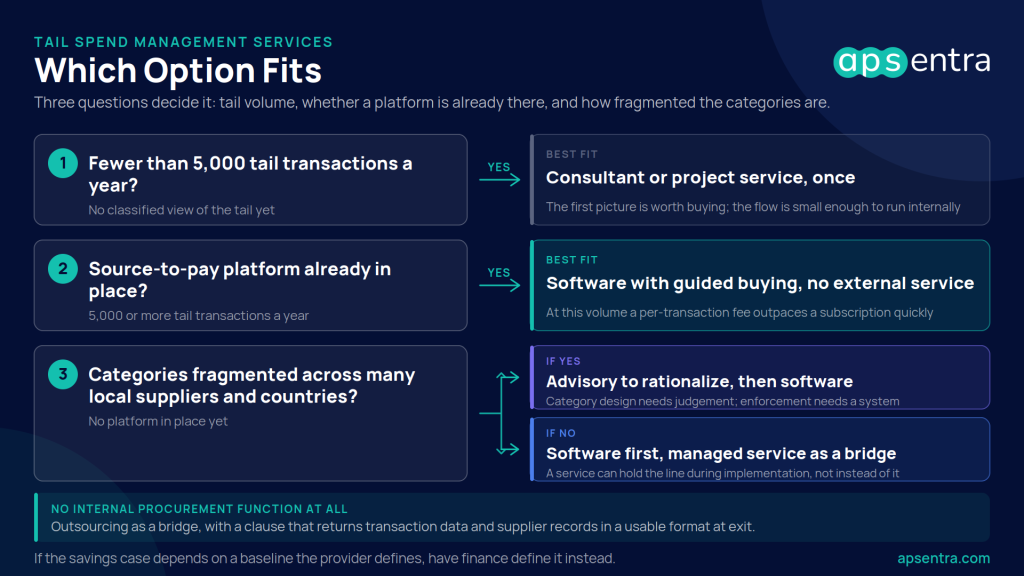
| Situation | Best fit | Why |
|---|---|---|
| No classified view of the tail yet, under 5,000 tail transactions a year | Consultant or project service, once | The first picture is worth buying; the flow is small enough to manage internally afterwards |
| 5,000 to 50,000 tail transactions a year, no source-to-pay platform | Software first, managed service as bridge if urgent | Volume justifies automation; a service can hold the line during implementation |
| Over 50,000 tail transactions a year, platform in place | Software with guided buying, no external service | The system handles the flow; a per-transaction fee at this volume outpaces a subscription quickly |
| Highly fragmented categories, many local suppliers, multi-country | Advisory for rationalization, then software | The category design needs judgement; the enforcement needs a system |
| No internal procurement function at all | Outsourcing as a bridge, with a data-return clause | Someone has to run it; the contract must return the data when the function is built |
Two rules cut across the table. Never sign a tail spend outsourcing or managed service contract without a clause that returns transaction data and supplier records in a usable format at exit. And if the engagement’s savings case depends on a baseline the provider defines, have finance define it instead.