


















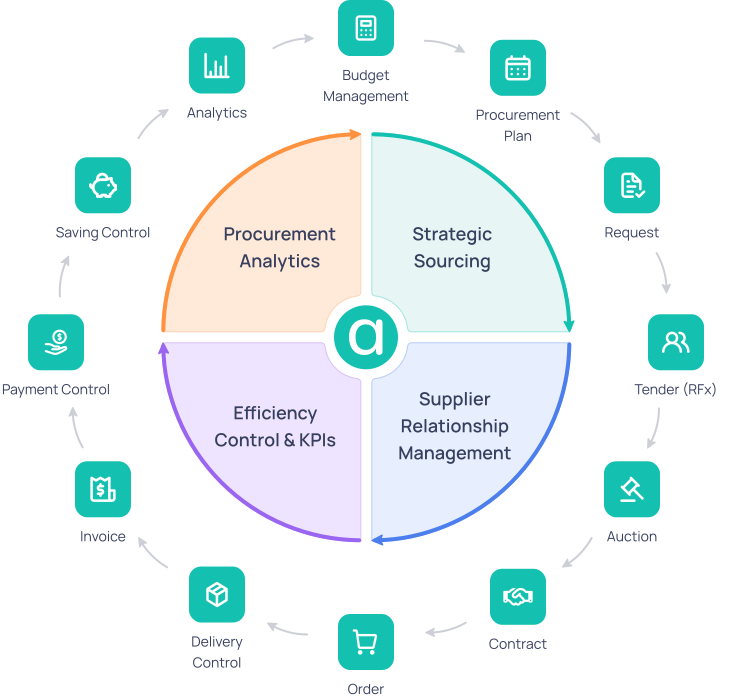
See the full source-to-pay cycle in about a minute
- 1One request moves from budget check to tender, contract, order, and receiving without leaving the platform.
- 2Every step follows your real structure: entities, budget owners, and approval routes.
- 3Procurement and finance work from one data model, so spend and savings are measured the same way.


Platform modules


A digital twin of your organization

Mirrors your structure

Tests changes before go-live

Enforces rules on every transaction


Built for every role in the procurement cycle

Finance

Procurement

Requesters

Legal

Operations

Security & compliance
High-speed implementation








Explore the platform through the problems it solves
ERP-agnostic integrations for full visibility & control
Seamless integration with your ERP, accounting, collaboration, analytics, and supplier networks.
Keep budgets, contracts, purchase orders, tenders and payments in sync across your enterprise systems.


Customers cases











See how APSentra runs your procurement cycle
Book a demo to see budgeting, sourcing, contracts, procure-to-pay, and supplier management configured for your own entities.
FAQs
What is a source-to-pay platform?
A source-to-pay (S2P) platform manages the full procurement lifecycle in one connected system: budgeting, sourcing, contracts, purchase requests, purchase orders, invoicing, and payment. APSentra adds a digital twin of your organization on top of that scope, so every entity runs the same governed process.
What is the difference between source-to-pay and procure-to-pay?
Source-to-pay covers the whole process, from supplier sourcing and contracting through to payment. Procure-to-pay is the transactional part, from purchase order to payment. APSentra runs both on one data model, so negotiated contract terms carry through into purchase orders and receiving.
How is APSentra different from point solutions?
Point solutions handle one stage well, but the handoffs between them are usually manual. APSentra keeps budgets, sourcing, contracts, and procure-to-pay in one data model, so those handoffs happen automatically. You can still start with a single module and add others later.
Can APSentra handle procurement across multiple entities and regions?
Yes. Each legal entity can run its own budgets, approval rules, and supplier relationships, while group-level teams get consolidated visibility across all of them.
Does APSentra integrate with our ERP and accounting systems?
Yes. APSentra is ERP-agnostic and integrates with SAP, SAP Business One, NetSuite, Dynamics 365 Business Central, Dynamics NAV, Odoo, and QuickBooks, plus Microsoft Power BI, Slack, single sign-on, and an open API for custom systems.
How does APSentra use AI?
AI supports day-to-day work across the platform: category codes suggested from the tender title, market analysis with price ranges and sources, and virtual assistants for buyers and suppliers. Decisions stay with people and their approval routes.
How long does implementation take?
Most clients go live within 8 weeks, covering consulting, configuration, and ERP integration. Timing depends on the number of entities, integrations, and modules activated at once.
Do we have to implement every module at once?
No. You can start with one module, such as budget control, sourcing, or supplier management, and add others as needs grow. Every module shares the same data model, so adding one later does not require re-implementing what is already live.