The Hidden Spend in Automotive Procurement: Control Beyond the Bill of Materials
It leaves through engineering revisions released late, launches declared ready too early, forecasts nobody trusts, air freight, scrap and parts that come back. None of these costs sits on the BOM. Most of them land in budgets procurement never sees, so a buyer can report a saving while the plant books a loss on the same part.
What is hidden spend in automotive procurement? Hidden spend in automotive procurement is the cost a part generates beyond its purchase price: engineering change waste, launch expedites, premium freight, excess and obsolete stock, scrap, supplier returns and warranty claims. It rarely appears as a price variance, so it escapes the controls built around the bill of materials.
The scale is material. McKinsey estimates that unfulfilled supplier obligations alone can leak roughly 2 percent of spend in large enterprises, or about $40 million a year on $2 billion of spend (McKinsey, 2025). That figure covers contracts and invoices only. Add the operational costs below, and the gap between the savings procurement reports and the margin finance sees grows wider.
This article walks through where that spend hides, from sourcing to returns, and what control looks like at each step.
Why the bill of materials hides the real cost of a part
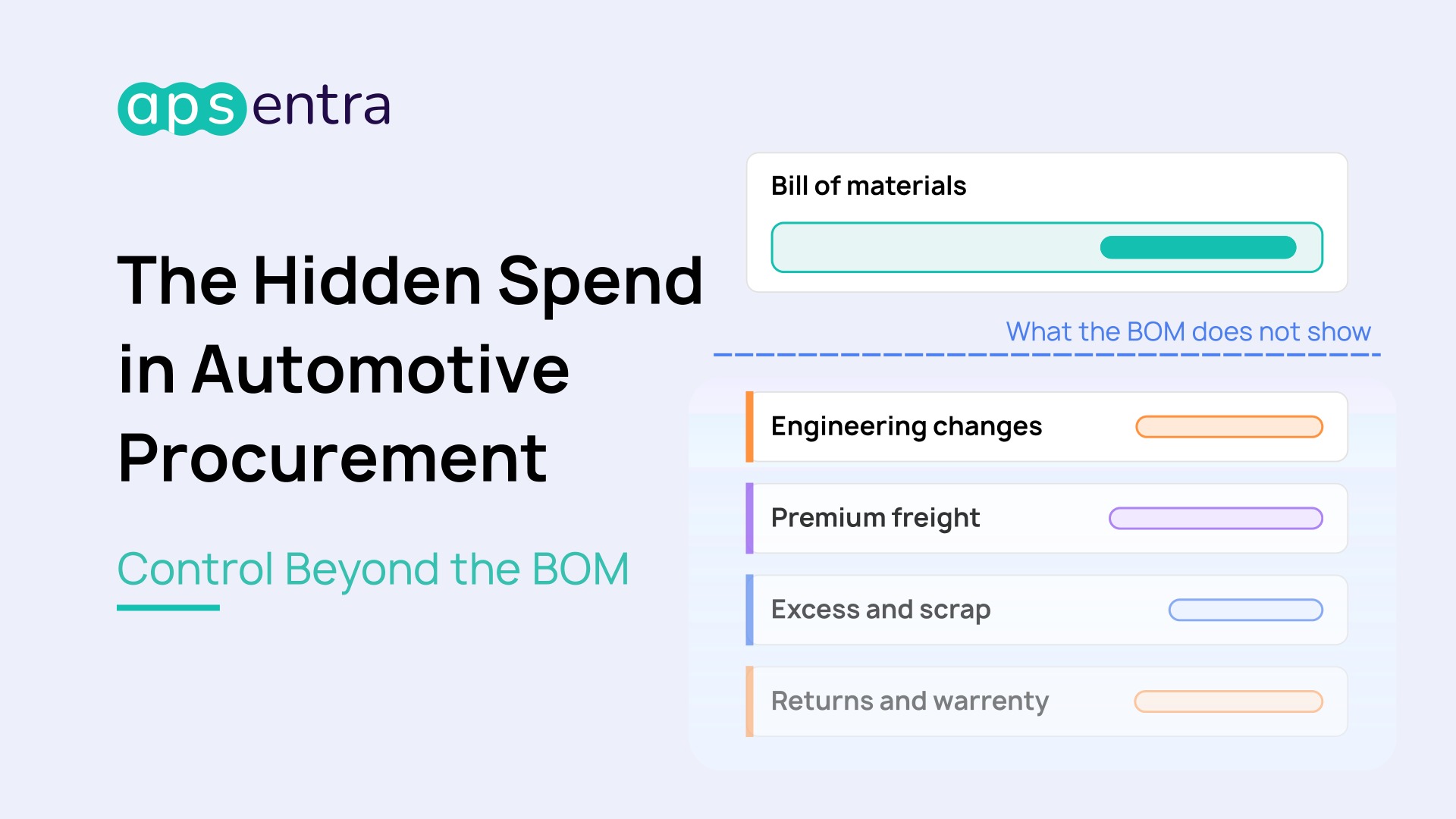
The bill of materials records what a part should cost. It says very little about what that part actually costs the business once it moves through engineering revisions, launch, planning, the plant floor and the field. Four cost lines account for most of the gap, and none of them shows up as a purchase price variance.
| Hidden cost line | What happens | Why the BOM misses it |
|---|---|---|
| Engineering changes | A revision releases late, and old-revision stock is still built and shipped | The part number stays the same, so the cost looks like routine production |
| Premium freight | Air freight and expedites cover forecast and schedule errors | Freight sits in logistics or plant budgets, not on the part |
| Excess and scrap | Inventory piles up, goes obsolete or is lost in process | Write-offs land in inventory accounts months after the buying decision |
| Returns and warranty | Parts and vehicles come back and cost money a second time | Quality and warranty costs are booked by other departments |
The pattern behind the table is simple. The decision that creates the cost sits with one function, while the cost itself lands with another. A buyer who awards a part on piece price rarely sees the air freight that follows a weak forecast, the scrap that follows a late revision or the warranty claim that arrives two years later. The same pattern runs through manufacturing procurement more broadly, where rising input prices have already shifted the conversation from discounts to what the business actually pays.
Warranty shows how large that second half can grow. McKinsey puts global automotive warranty costs at roughly $58 billion in 2024, about 2.2 percent of industry sales and above 4 percent of revenue for some OEMs (McKinsey, 2026). In the same survey, executives ranked weak supplier quality control among their most frequent pain points, which makes warranty a procurement problem as much as a quality one.
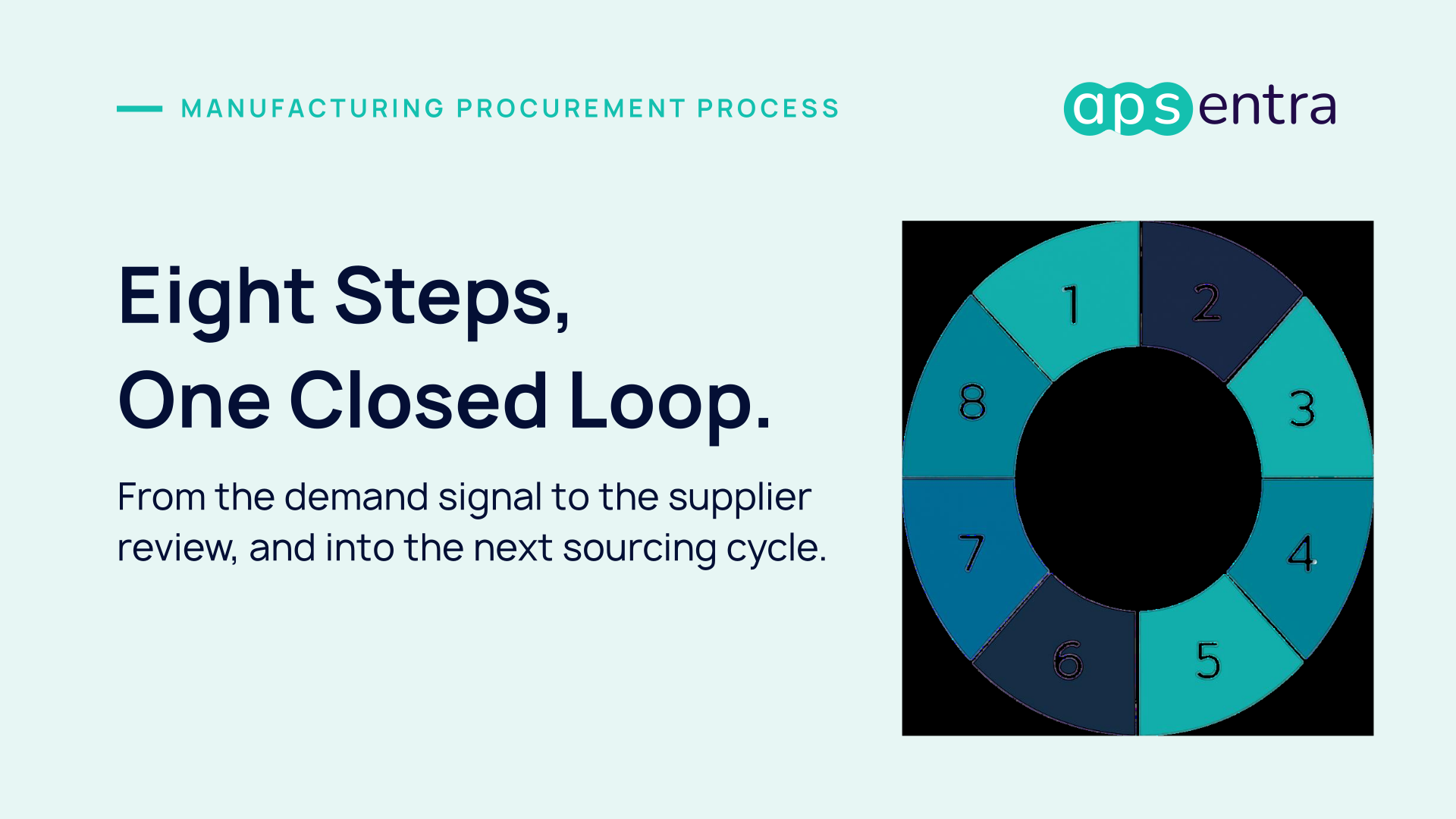
To see where these costs come from, follow a single part. Between the first RFQ and the last warranty claim it passes through six stages: sourcing, launch, planning, inbound, production, and shipping and returns. Automotive runs each of these stages well. Where it struggles is the handoffs between them, where ownership changes and cost quietly changes hands with it.
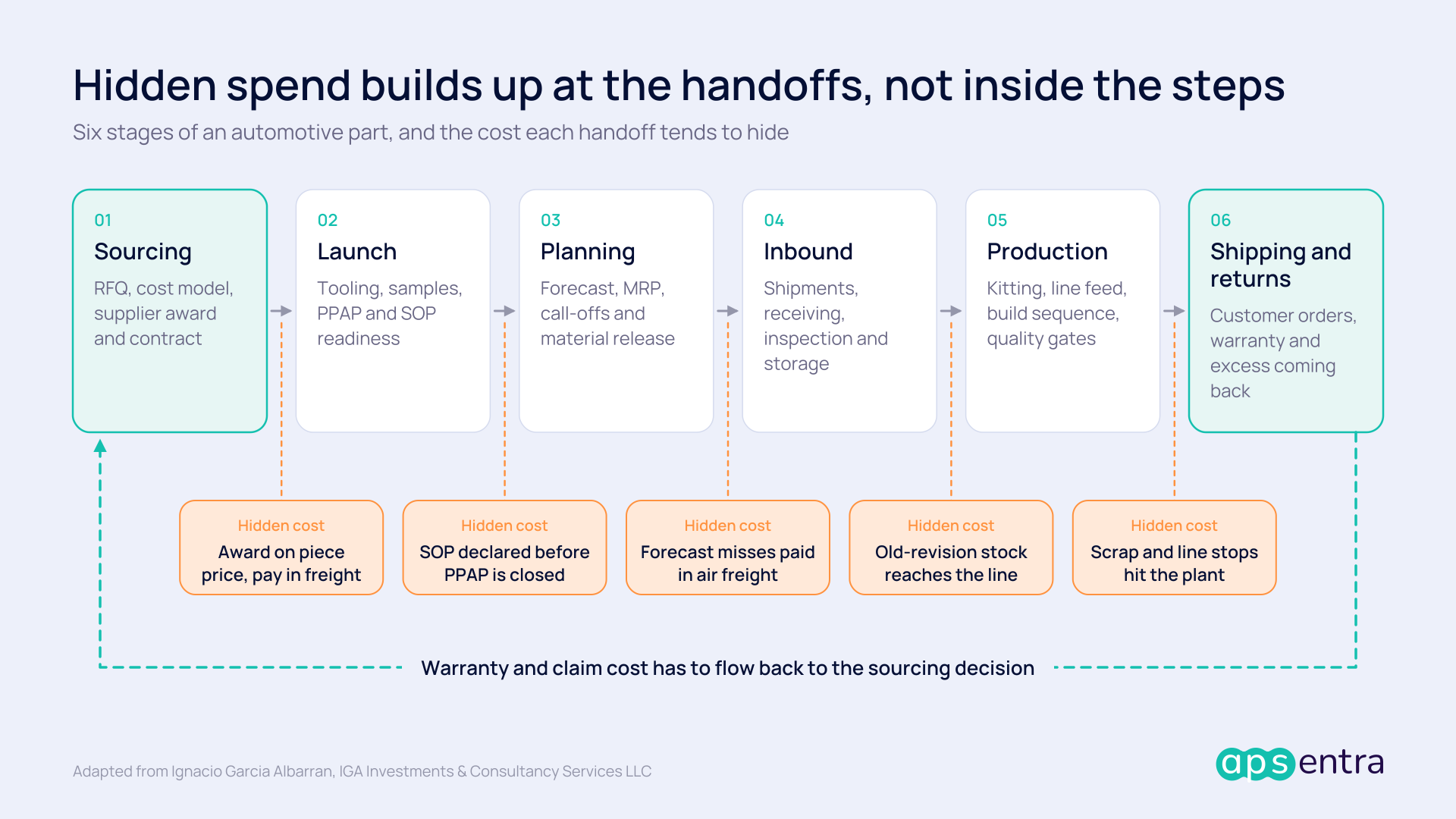
The industry’s weaknesses tend to sit right next to its strengths. Mature PPAP and APQP discipline governs launches, yet revision status still lives across PLM, ERP, email and paper. Buyers have long, technically deep relationships with suppliers, yet their scorecard stops at piece price. Quality and freight costs sit in other departments, and visibility rarely reaches below Tier 1.
The loop at the bottom of the diagram is the one most organizations never close. Warranty and claim costs surface at the very end of the chain, but they trace back to decisions made months earlier at sourcing or launch. Unless that cost flows back to the decision that created it, the same award logic repeats on the next program.
Hidden costs are decided before the part reaches the plant
The most expensive hidden costs are locked in early. By the time a part reaches the line, its revision discipline, launch readiness and cost structure are largely fixed, and the plant can only absorb the consequences. Three moments matter most: engineering changes, new part launches and the cost-down work that happens during development.
Revisions are the clearest example, because the part number is not the part. One number can carry several drawing revisions across plants and suppliers. An engineering change notice is released in PLM before ERP, the supplier and the warehouse catch up, so suppliers keep building the old revision until a purchase order or drawing is reissued, and old stock sometimes ships to the line.
“The part number is not the part.”
— Ignacio Garcia, Founder, IGA Investments & Consultancy Services LLC
Good control here is unglamorous. It means one revision status per part number, shared by engineering, purchasing, quality and planning, and effectivity by date or serial number rather than “when we get to it.” It also means supplier acknowledgement of every change with an effective date and stock disposition, followed by a physical cut-in audit before the new revision goes live. Procurement has to own the supplier side of this, because the supplier only changes what the purchase record tells it to change.
New part launches follow the same logic: launch cost is set at sourcing. In a disciplined manufacturing procurement process, suppliers pass quality gates before they ship a single part, and time pressure is exactly what compresses those gates. Late sourcing leads to single-source awards, samples approved from nonproduction tools and a start of production declared without a containment plan. Each shortcut returns later as expedites, rework or line stops, and none of it appears in the business case that justified the award.
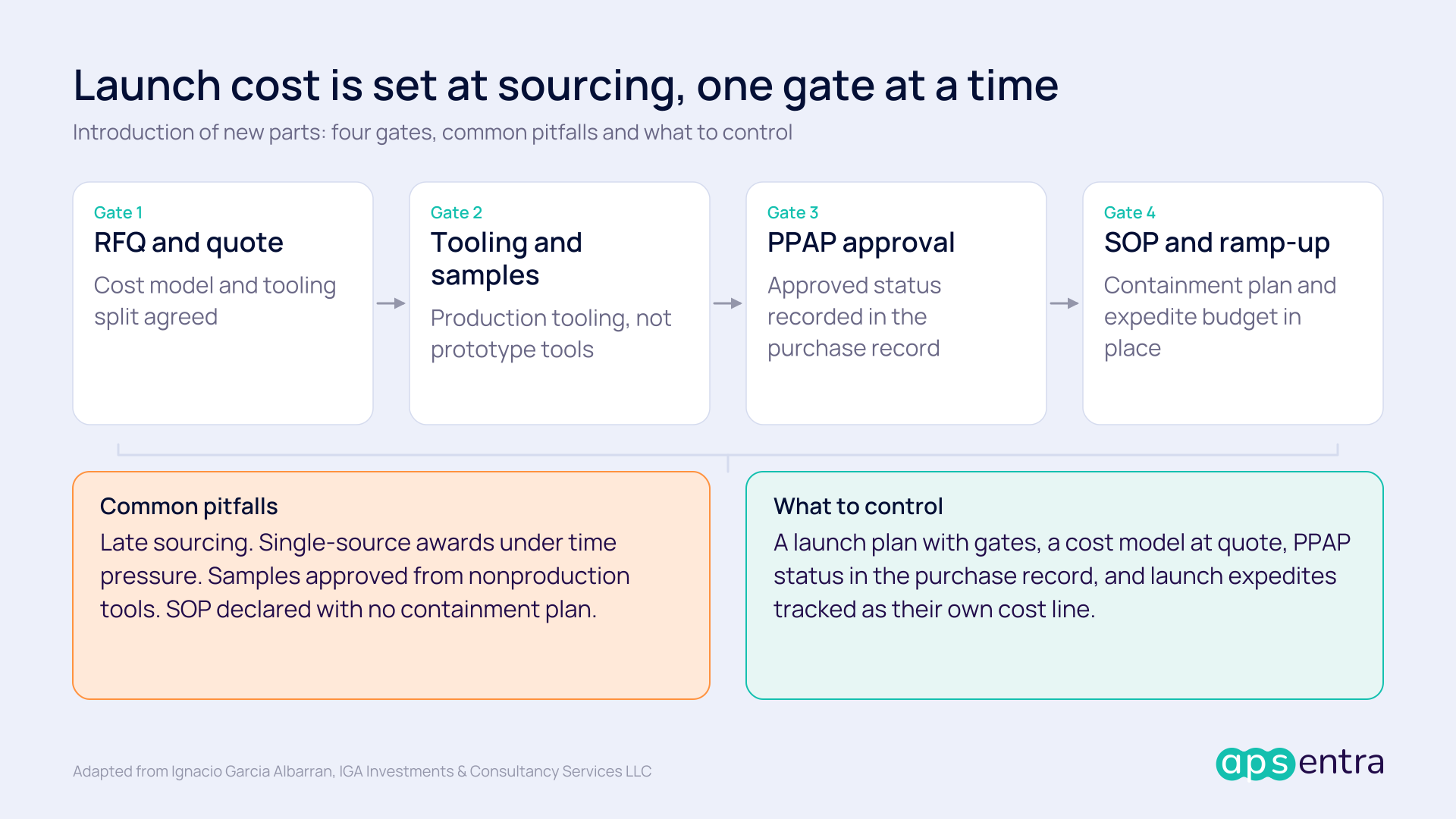
A gated launch keeps that cost in view, from a cost model and tooling split agreed at quote to PPAP status recorded in the purchase record and an expedite budget set aside before SOP. We recommend tracking launch expedites as a cost line of their own. If nobody tracks them, every launch looks on budget.
Cost reduction works on the same clock. Most cost is designed in, so the window for meaningful cost-down runs from concept through design freeze to tooling and closes at SOP. Target cost belongs before the design freezes, supplier co-design and should-cost belong before tooling, and agreed savings belong in the price agreement. After SOP, annual productivity is the only lever left, and it is far weaker.
The typical failure is a saving that exists on paper but never reaches the BOM, or a material change that forces a new PPAP and erases the gain. Engineering and purchasing often each assume the other owns the target. One owner per target, and a rule that a saving counts only once it shows on the BOM, removes most of that ambiguity.
Where the plant pays for decisions made elsewhere
Premium freight is the most visible symptom of hidden spend, but it rarely starts in logistics. It usually starts with a forecast nobody trusts. Accuracy tends to be weak beyond the frozen zone, so suppliers plan capacity on numbers they quietly discount, and every gap between plan and reality gets closed with overtime or air freight. As our look at the manufacturing supply chain in 2026 found, supply risk now reaches the margin well before it reaches the production line.
The remedy is to make forecast horizons contractual. Firm call-offs in the frozen zone cost money to change and need approval. Quantities in the firm horizon must be built within an agreed tolerance, while the forecast horizon serves only as a signal for capacity and raw material planning. Behind these horizons sit explicit supplier requirements: a material release schedule with exact dates and delivery windows, written capacity confirmation for each horizon, and one source of truth for schedule changes, with the cost of a change agreed up front.
Sequenced production raises the stakes further. When vehicles are built in the order the customer needs, every supplier has a dock slot and every truck is planned to a station, not just a day. One late truck can stop the line, yet the cost of a stopped minute is rarely shown to the buyer whose decision caused it.
Productivity targets can make all of this worse. Annual price productivity, kanban, freight lane consolidation and inventory reduction are legitimate levers, but each one, pushed without guardrails, shifts cost somewhere the buyer’s scorecard does not look.
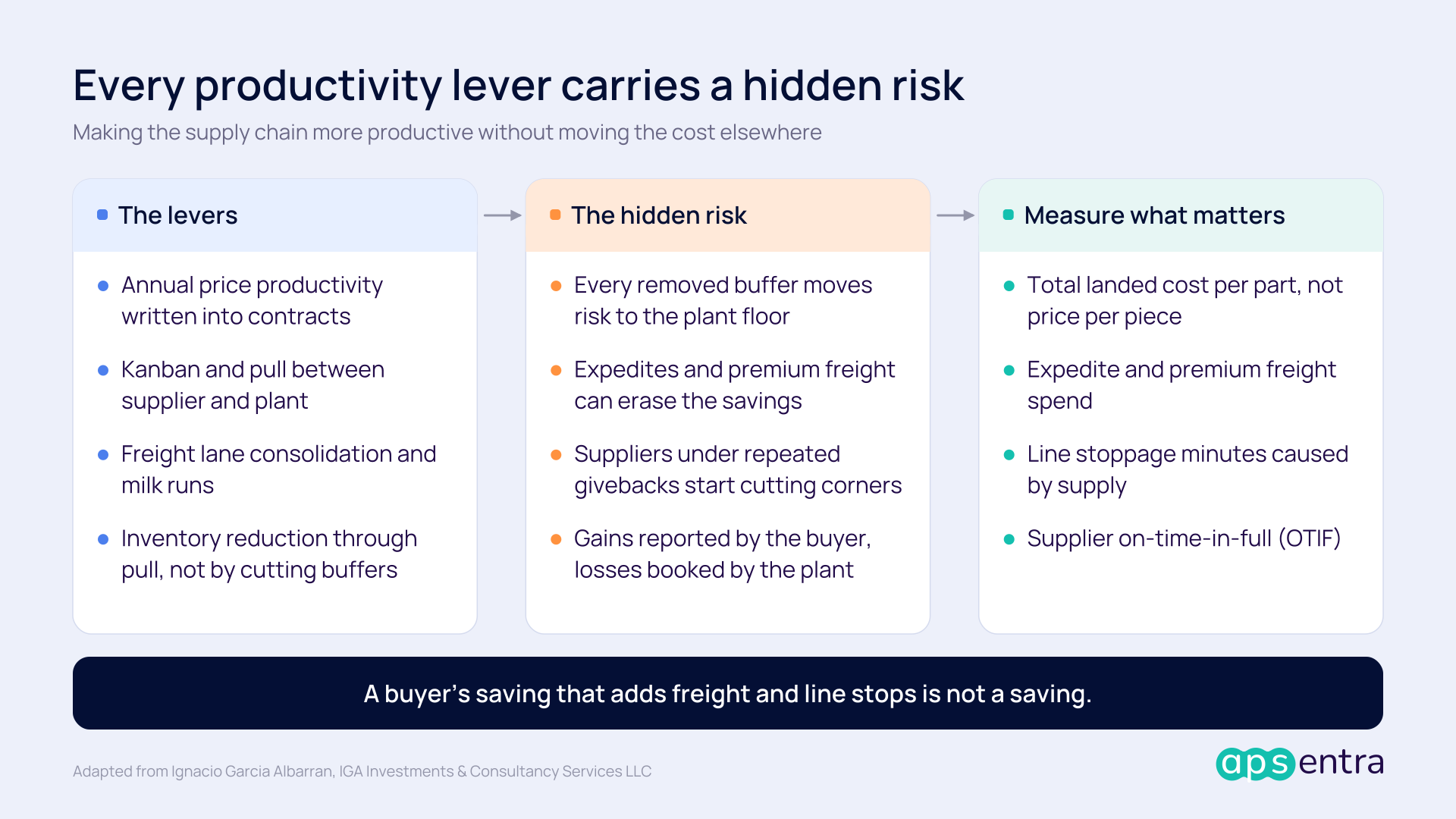
Every removed buffer moves risk to the plant floor. Suppliers under repeated givebacks start recovering margin through quality or service, and the savings reported by procurement are paid for by the plant. The answer is not to abandon the levers but to change what gets measured: total landed cost per part rather than price per piece, expedite and premium freight spend, line stoppage minutes caused by supply, and supplier on-time-in-full.
“Productivity should be measured on total cost. A buyer’s saving that adds freight and line stops is not a saving.”
— Ignacio Garcia, Founder, IGA Investments & Consultancy Services LLC
Delivery performance belongs on the same scorecard. A good delivery arrives on time, at the right dock, in the right quantity, at the right revision and with safety characteristics never traded for price. Reporting on-time delivery, PPM defect rates and safety-critical nonconformances by part and supplier every week, with the same definitions on both sides, turns these conditions from expectations into commitments.
The costs that surface months later
The last stretch of hidden spend sits in inventory and in parts that travel backwards. These costs appear months after the buying decision, which makes them the easiest to leave without an owner.
Excess, obsolete stock, and scrap each have a recognizable origin, and each has a control that procurement can write into the supplier relationship.
| Category | Where it comes from | How to control it |
|---|---|---|
| Excess | Forecast noise, minimum order quantities, safety stock nobody reviews | Monthly MRP parameter review; MOQs written into contracts |
| Obsolete | Old revisions, cancelled programs, engineering changes cut in too late | Obsolescence trigger at every engineering change; buy-back clauses agreed upfront |
| Scrap | Revision mismatches, handling damage, supplier escapes | Tracked by part, supplier and cause, and charged back to the source |
Most organizations cannot state their own baseline, so a useful first step is to measure each category as a share of material spend. The first honest number usually changes the conversation with finance. Those numbers, however, are only as reliable as material control on the floor, where stock disappears in predictable ways: parts moved without a transaction, bins not updated and old revisions left beside new ones at the line. The rule that prevents it is simple. No movement without a transaction, no transaction without a revision, and cycle counts tied to the physical location rather than the system alone.
Returns to suppliers are where paid-for value is most often left uncollected. Recovery follows five steps, from detecting and containing a nonconforming lot to filing the claim, shipping the return and closing the debit note.
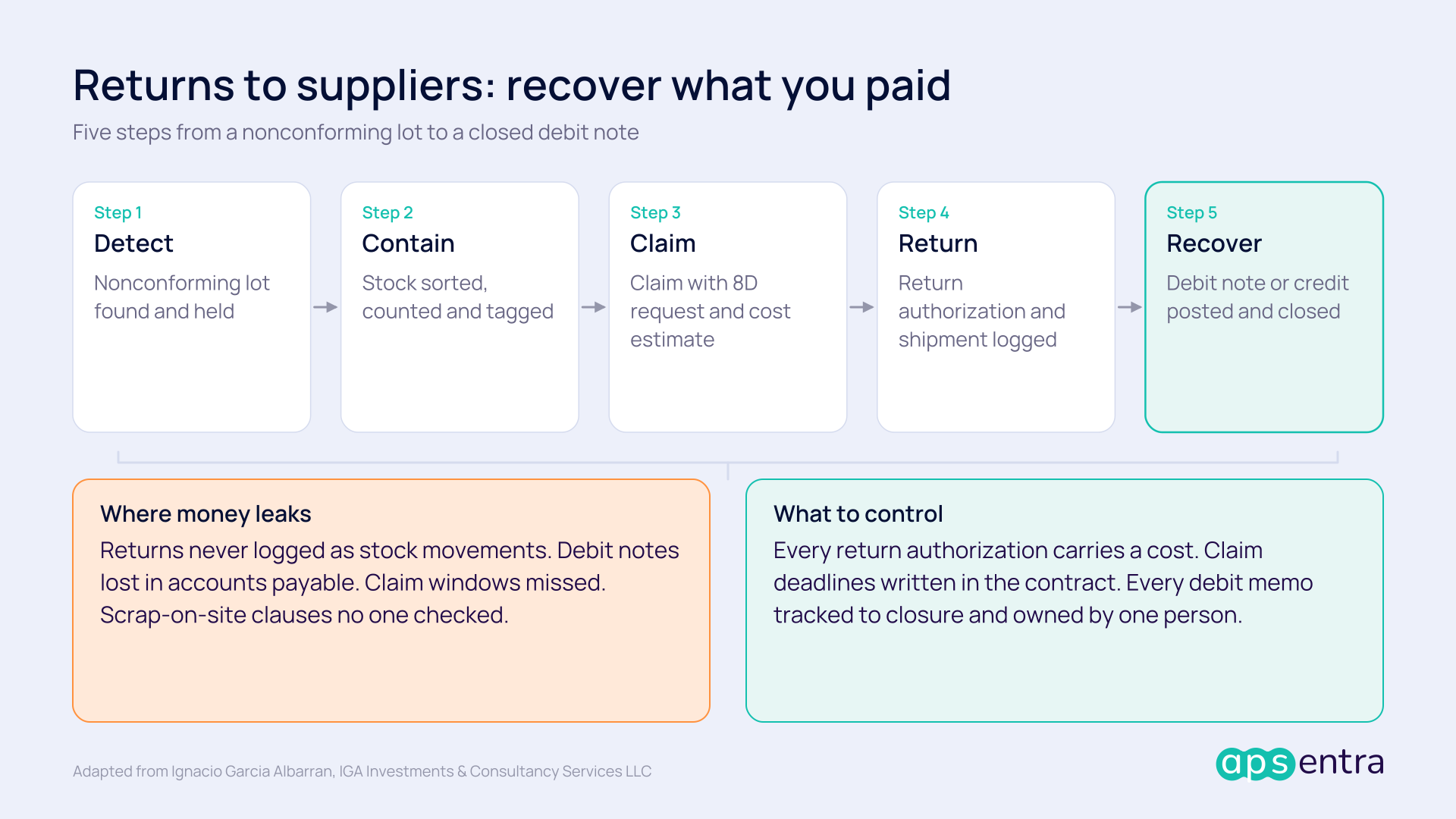
The money rarely leaks in the middle of that process. It leaks at the edges, where returns are never logged as stock movements, debit notes get lost in accounts payable and claim windows quietly expire. McKinsey’s research on procurement value leakage describes the same mechanism in commercial terms: negotiated terms that never reach the bottom line because nobody enforces them, and invoices paid without a line-by-line match against PO and contract (McKinsey, 2025). A lost debit memo is the same leak in a different form.
Customer returns close the loop. Excess parts coming back from dealers or OEMs should arrive only against an authorization number, at an agreed recovery rate and through a quality disposition before they re-enter stock. Warranty returns need an authorization per claim, a teardown with a root-cause code and no-fault-found tracked as a cost of its own.
The procurement link is the chargeback. Warranty cost has to tie to a part number, a revision and a supplier, and trend by part and supplier every month, or it stays in the warranty reserve and never reaches the supplier that caused it. McKinsey reports that only 15 percent of surveyed OEM executives have centralized all relevant quality data (McKinsey, 2026), which goes a long way toward explaining why so few chargebacks hold.
How to control automotive procurement beyond the bill of materials
Control beyond the BOM does not require a new strategy. It requires five operating rules, applied consistently from sourcing to returns.

Track total landed cost, not piece price, for every part.

Put one owner on each revision, launch gate and cost-down target.

Make forecast horizons contractual and the schedule visible daily.

Control every movement, return and scrap with a transaction and a cause.

Charge the cost of misses back to the decision that created them.
“Hidden spend stays hidden because every function sees only its own slice. Control starts when sourcing, engineering, the plant and finance work from one record of what a part really costs.”
— Natalie Eksi, CEO, APSentra
Every one of these rules depends on connected records. Revision status spread across four systems cannot support a cut-in audit, freight and quality costs held in other departments cannot feed a total landed cost view, and chargebacks without visibility below Tier 1 have no evidence behind them.
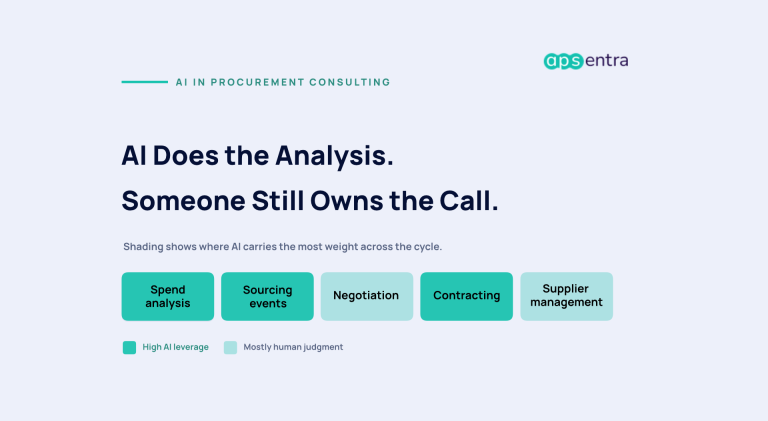
That is also why AI has been slow to help. In McKinsey’s warranty survey, 75 percent of OEMs were experimenting with AI-driven quality analytics, yet only 10 percent reported satisfactory results, with respondents pointing to data-sharing limits across functions and suppliers (McKinsey, 2026). The order of work matters: structured workflows and one source of truth first, analytics and AI on top, a point we explore further in AI in procurement processes.
This is the gap a procurement platform should close. When requests, approvals, purchase records, receipts and claims sit in one connected workflow that mirrors the organization, each cost line has an owner and a trail. See how this works in manufacturing and industrial production, or read our guide to automotive procurement consulting for the strategy side.