IT Procurement Consulting: What It Costs and What It Actually Covers
A laptop refresh is a straightforward, largely commoditized purchase. A Microsoft or Oracle license portfolio is a compliance exposure that can produce a seven-figure invoice with no warning. A cloud bill grows on its own, quietly, whether or not anyone approved the growth. Telecom contracts renew on autopilot and rarely get renegotiated at all. This guide covers what IT procurement consulting actually does across all four, what a 2026 engagement costs, and where the real risk concentrates.
What IT Procurement Consulting Covers
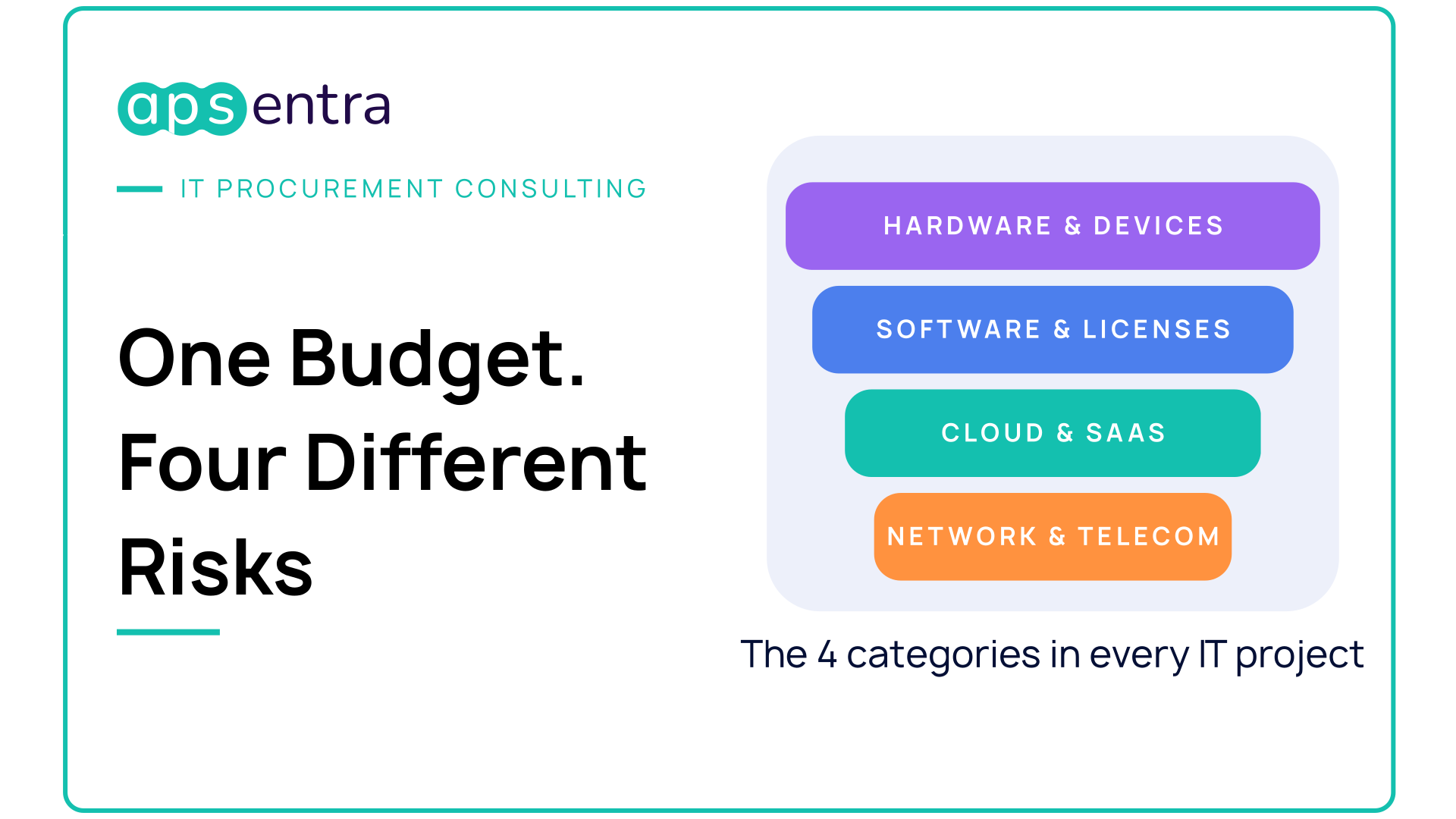
IT procurement consulting is the sourcing, negotiation, and lifecycle management of everything a company buys to run its technology: hardware and devices, software licenses, cloud and SaaS subscriptions, and network and telecom services. It differs from general procurement consulting in one important way: two of its four categories, software licensing and cloud consumption, carry compliance and cost risks that do not exist in most other spend categories.
That distinction matters more than the category list itself. A company that mismanages its office supplies spend loses some money. A company that mismanages its Oracle license position can receive an audit finding measured in millions of dollars, with contractual language that gives the vendor the upper hand in the dispute. IT procurement consulting exists because the stakes and the mechanics of the four categories are genuinely different from each other, not because “technology” is a natural category boundary.
- Hardware and devices. Laptops, servers, networking equipment, peripherals. The most commodity-like of the four, with the clearest unit pricing and the shortest negotiation cycles.
- Software and licenses. Perpetual licenses, subscriptions, enterprise agreements. Governed by contract terms most buyers never fully read, and enforced through audits most buyers do not expect.
- Cloud and SaaS. Infrastructure-as-a-service, platform-as-a-service, and the sprawling long tail of SaaS subscriptions individual teams sign up for. Consumption-based, which means the bill moves even when nobody makes a new purchasing decision.
- Network and telecom. Circuits, mobile plans, unified communications. Usually the most neglected category, because the contracts are long, the invoices are opaque, and almost nobody owns renegotiating them.
The organizing question is the same one that runs through general category management consulting: which of these four deserves a dedicated strategy and owner, and which can run on a lighter, standardized process. Very few IT functions have actually answered that question category by category.
Where the IT Dollar Actually Goes
Worldwide IT spending is forecast to reach $6.37 trillion in 2026, and the composition matters more than the total for a sourcing strategy: software and services together account for nearly half of it, while devices, the category most people picture first when they hear “IT procurement,” make up a comparatively small share.
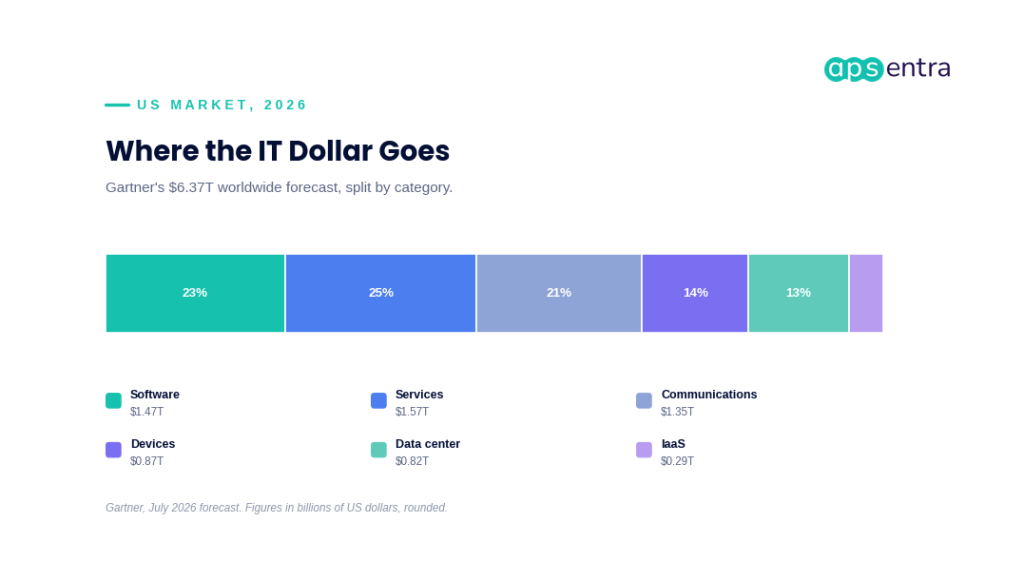
Gartner’s July 2026 forecast puts software growth at 15.5 percent and infrastructure-as-a-service growth at 29.3 percent for the year, both outpacing device spending’s 9.8 percent. Data center systems are the outlier, projected to grow 62.5 percent, driven almost entirely by AI infrastructure buildout rather than by anything a typical enterprise IT procurement function controls directly.
The practical implication is sequencing. A sourcing team that spends most of its attention on hardware refresh cycles, because that is the most visible and most easily benchmarked category, is managing the smallest and slowest-growing piece of the budget. Software and cloud are larger, growing faster, and carry the compliance and consumption risks the next two sections cover.
What IT Procurement Consulting Costs
Pricing follows the same logic as general sourcing engagements: scope drives cost more than category does.
| Engagement type | Typical cost | Typical duration |
|---|---|---|
| Single vendor negotiation (renewal or new deal) | $15K–$60K | 4–8 weeks |
| Software license compliance assessment | $25K–$100K | 6–10 weeks |
| Cloud cost optimization engagement | $30K–$120K | 8–12 weeks |
| Full IT category strategy (multi-category) | $150K–$450K | 4–9 months |
| Managed SAM / ongoing advisory | $8K–$25K / month | 12-month minimum, typical |
The variable that moves these numbers most is not company size. It is vendor concentration. A company with a single dominant enterprise agreement, most often Microsoft, Oracle, or SAP, faces a narrower but higher-stakes engagement than a company with a fragmented vendor base and no single contract worth renegotiating aggressively.
Gain-share pricing, where the firm takes a percentage of documented savings instead of a flat fee, is common in cloud optimization and software compliance work specifically, for the same reason it appears in strategic sourcing consulting: the savings are large, quantifiable, and easy to attribute to the engagement, which makes the commercial structure attractive to both sides.
Software License Compliance: The Risk Nobody Prices In
Software audits used to be an occasional inconvenience. They are now closer to an annual certainty.
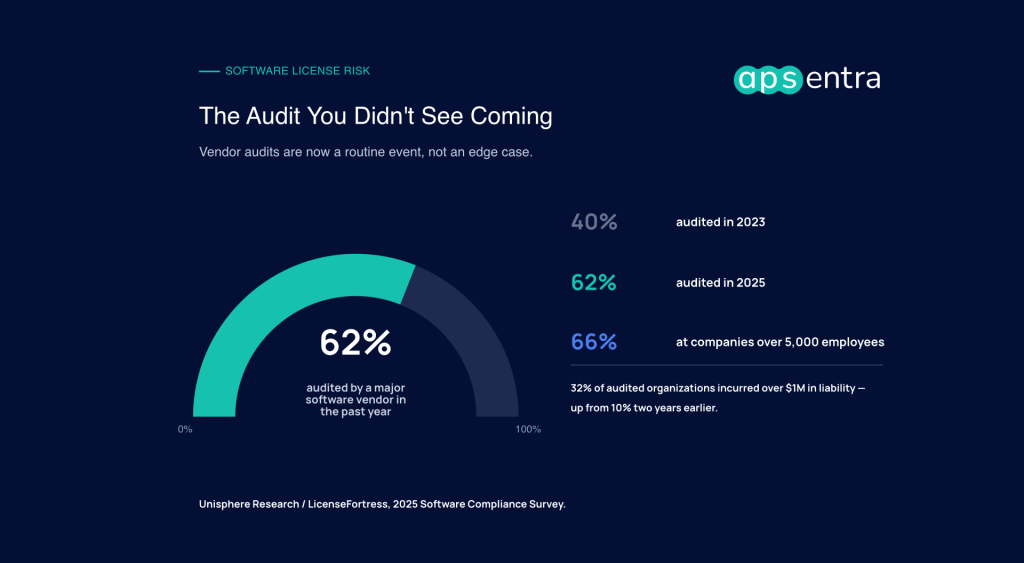
According to the Unisphere Research / LicenseFortress 2025 Software Compliance Survey, 62 percent of organizations were audited by a major software vendor in the past year, up sharply from 40 percent in 2023. Larger companies fare worse: audit frequency climbs to 66 percent at organizations with more than 5,000 employees. Nearly a third of audited organizations incurred financial liabilities exceeding $1 million, more than triple the share reporting the same two years earlier.
The mechanics explain why this keeps getting worse rather than better. Enterprise software vendors are under sustained pressure to grow revenue, and an audit is a reliable, contractually protected way to generate it: most large deployments are out of compliance in some way, usually unintentionally, and the vendor’s audit clause does not distinguish between a deliberate violation and an honest licensing mistake made three reorganizations ago.
What actually reduces exposure

Maintain a current Effective License Position
Negotiate audit terms at the point of purchase, not after

Treat Tier 1 vendors differently
This is the same enforcement argument made in our guide to the procurement operating model: a policy that exists in a document is a reference; a license position that is checked automatically against deployment data is a control. The gap between the two is exactly where audit exposure accumulates.
Cloud and SaaS: Where the Waste Hides
Cloud spend does not require a purchase order to grow. That single fact explains most of what goes wrong with it.
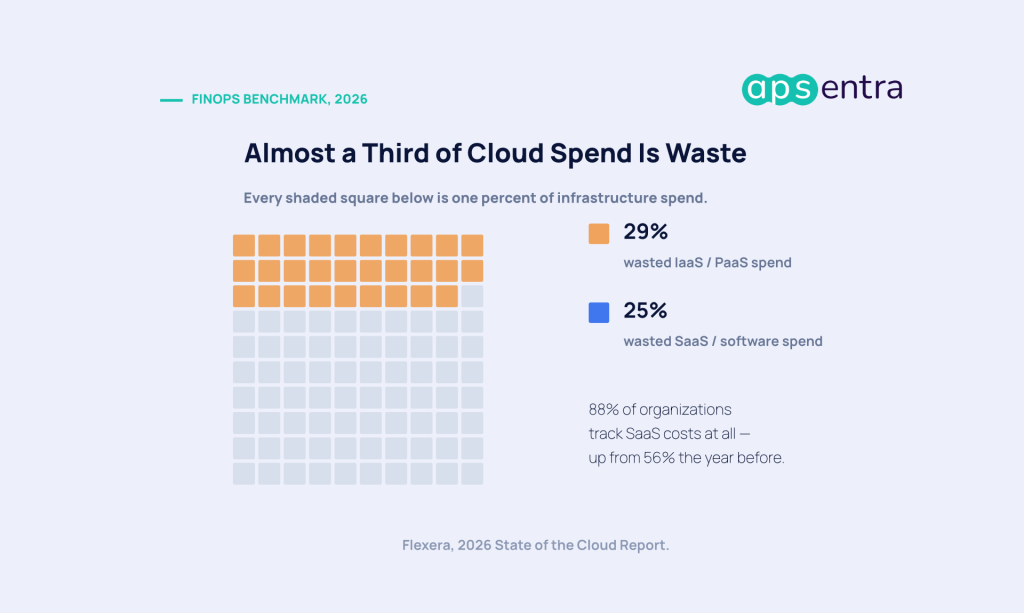
Flexera’s 2026 State of the Cloud Report found that an estimated 29 percent of infrastructure and platform cloud spend is wasted, the first increase in five years, alongside 25 percent waste in SaaS and software spend. The report attributes the reversal to AI workloads and new consumption-based pricing models outpacing the governance built to track them. Separately, 8 percent of organizations report not tracking SaaS costs at all, up from 5 percent the year before, at the exact moment SaaS sprawl is accelerating.
The waste concentrates in patterns that are well understood and stubbornly persistent: idle or overprovisioned compute that nobody has decommissioned, reserved-capacity discounts left unused because committing feels risky, and SaaS seats purchased for a project that ended a year ago. None of these require sophisticated tooling to fix. They require someone whose job is to look.
The underlying discipline is the same demand-management argument made in procurement cost reduction strategies: the cheapest unit of cloud consumption is the one nobody is still paying for. A FinOps function that only tracks spend after the fact is measuring the problem, not preventing it.
Hardware and Device Procurement: The Smaller, Simpler Piece
Hardware deserves proportionate attention, which in most IT budgets is less than it currently receives.
- Standardize the catalog. A limited set of approved configurations, refreshed on a fixed cycle, beats ad hoc purchasing on both price and support cost, and it is the easiest category-level win in the whole IT portfolio.
- Buy on a cycle, not on demand. Consolidated purchasing windows create the volume leverage that scattered, as-needed orders never will.
- Plan for memory and component price volatility. Rising memory costs are currently compressing device replacement cycles industry-wide; a hardware strategy that assumes flat component pricing will be wrong within a budget cycle.
- Track the asset lifecycle, not just the purchase. Disposal, data destruction, and residual value recovery are part of the total cost of a device, not an afterthought handled by whichever team happens to notice the equipment is obsolete.
Hardware is also the category where a platform, rather than a consultant, earns its keep fastest: catalog management, standardized approvals, and refresh scheduling are exactly the kind of repeatable, rules-based work that a system should own outright.
Build vs. Consultant vs. Platform
The right answer is different for each of the four categories, and the deciding factor is not company size. It is how often the work repeats.
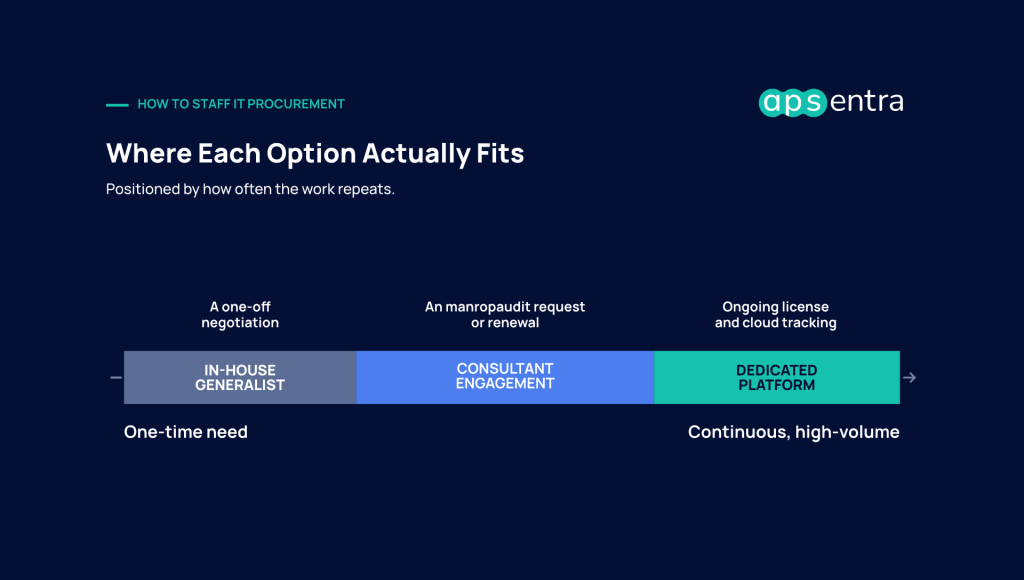
A one-off vendor negotiation or a single audit response is squarely consultant territory: specialized, infrequent, and not worth building permanent internal capability for. Ongoing license tracking, renewal calendars, and ongoing cloud cost governance belong on a platform, because the value is in the consistency of the tracking, not in any single decision.
The middle of that spectrum, where most companies actually sit, is exactly the question addressed in when your team needs a consultant and when it needs a better system. IT spend makes that decision unusually legible, because the four categories sit at genuinely different points on the same spectrum rather than all needing the same answer.
A practical hybrid, common among IT functions that have thought this through deliberately, brings in a consultant for the Tier 1 vendor negotiations and the periodic compliance assessments, while running catalog management, SaaS tracking, and hardware refresh cycles on a platform that never stops watching.