Procurement as a Strategic Finance Function During Recession
“In every economic downturn I have observed, the organisations that emerge stronger are not those that cut the most — they are those that controlled the most. Procurement is not a support function during a recession. It is the financial architecture that determines whether a business protects its margins or loses them to decisions made without visibility.”
— Natalie Eksi, CEO at APSentra | Global Supply Chain & Procurement Expert
The global economy no longer follows predictable cycles. Volatility has become structural — driven by persistent inflation, supply chain fragility, tighter monetary policy, and deepening geopolitical instability. The signals are consistent across leading research institutions:
Deloitte’s CFO Agenda reports sustained volatility as a defining challenge for finance leaders; McKinsey’s Procurement 2024 report identifies economic volatility (spend management recession) as one of six transformative forces reshaping business; and the Hackett Group’s 2025 Working Capital Survey identifies a $1.7 trillion liquidity opportunity locked inside suboptimal procurement and working capital practices.
In this environment, financial resilience is not a by-product of good management. It must be engineered — and the function best positioned to deliver it is procurement.
Strategic vs. Transactional Procurement: What the Difference Means for Your P&L
For most of the past two decades, procurement was treated as a transactional function: receive a purchase request, find a supplier, issue a purchase order, process the invoice. The goal was efficiency — completing each transaction with minimum friction. Cost reduction, when it happened, was a by-product of periodic negotiation cycles rather than embedded financial control.
Strategic procurement operates on a fundamentally different logic. Rather than processing transactions, it governs the conditions under which all financial commitments are made. It connects operational decisions to financial outcomes in real time — aligning every purchase, contract, and supplier relationship with the organisation’s budget, risk profile, and strategic priorities.
| Transactional Procurement | Strategic Finance-Aligned Procurement |
|---|---|
| Processes purchase orders | Controls financial commitments before they are made |
| Reports spend monthly or quarterly | Provides real-time budget visibility across all categories |
| Negotiates prices when contracts expire | Continuously manages total cost of ownership (TCO) |
| Operates separately from finance | Embedded in financial planning and FP&A cycles |
| Measures savings vs. prior year | Measures EBITDA impact, working capital, and forecast accuracy |
| Reacts to supply disruptions | Proactively monitors supplier financial health and risk signals |
According to Spend Matters, the gap between transactional and strategic procurement is most visible in budgeting: when procurement is not involved in financial planning, cost data arrives too late to influence decisions. The result is a forecasting cycle permanently running behind reality.
CFO CPO alignment: From Parallel to Unified Functions
The relationship between the Chief Financial Officer and the Chief Procurement Officer is undergoing a structural shift. According to Clearsulting’s analysis of procurement-finance integration, the CPO’s decisions directly shape the office of the CFO — yet historically, the two functions operated with different priorities, different data, and different definitions of success.
CFOs focus on cash flow, Days Payable Outstanding (DPO), forecast accuracy, and risk mitigation. CPOs focus on supply chain continuity, supplier relationships, and savings creation. Without a shared framework, these objectives can actively work against each other: a CFO extending DPO to preserve liquidity can damage the supplier relationships a CPO has built to ensure price stability and supply continuity.
The Hackett Group’s research found that finance teams’ workloads are projected to increase while headcount and budgets decrease — creating a productivity gap that only CFO-CPO alignment can close. The solution is not more people. It is a shared system.
When procurement and finance converge on a unified platform — with shared KPIs, integrated spend data, and aligned budgeting processes — organisations gain something that neither function can achieve alone: real-time financial control over the cost base.
Recession Realities: The Specific Pressures Procurement Must Absorb
A recession creates a specific set of financial pressures that expose the weaknesses of unprepared procurement operations. Understanding each pressure — and its procurement-specific response — is essential for CFOs building resilience into operations.
Liquidity Pressure and Working Capital
McKinsey’s working capital optimisation research identifies the procure-to-pay cycle as one of the highest-leverage areas for rapid cash flow improvement. Three specific actions consistently deliver results: reviewing and clearing invoices ahead of payment to catch discrepancies; renegotiating early-payment discounts against the cost of capital; and standardising payment terms across supplier categories to reduce uncertainty in cash outflows.
For organisations with fragmented procurement — where different business units negotiate different terms with the same supplier categories — the working capital leakage can be significant. Centralising these decisions under a unified system immediately improves DPO management and forecast accuracy.
Inflation and Input Cost Volatility
McKinsey’s full-potential procurement analysis notes that inflation has joined supply chain disruption as one of the most significant perceived risks to profitability — surpassing COVID-19 as a concern for the first time in recent years. The organisations that managed this best did not react to price increases. They had forward visibility into commodity exposure, supplier-level risk, and cost structures before inflation hit their P&L.
This is only possible when procurement operates as an intelligence function — monitoring input cost signals, sharing market insights with finance and sales, and maintaining negotiation leverage before contracts come up for renewal.
Supply Chain Disruption and Supplier Risk
The 2008 financial crisis provides an instructive precedent. As documented by Supply Chain 24/7’s analysis of the financial crisis impact, industries such as machinery and transportation equipment saw customer orders drop by up to 42 percent within a single year — and the organisations that survived were those that had mapped supplier criticality, monitored supplier financial health in advance, and maintained relationships strong enough to receive priority allocation when supply tightened.
The same dynamic applies today: in a downturn, suppliers tighten terms, extend lead times, and prioritise the customers they trust. Procurement organisations with visible, governed supplier relationships maintain access. Those without them compete on price alone — precisely when price leverage is weakest.
The Three Dimensions of Procurement-as-Finance Control
Effective procurement-as-finance control operates across three non-negotiable dimensions simultaneously:
1. Budget Discipline
Every financial commitment must be visible, approved, and aligned with strategic priorities before it is made — not reconciled afterward. Budget discipline means moving from periodic reporting to continuous control: knowing, in real time, what has been committed versus what has been approved, and flagging deviations before they compound.
This requires procurement to be embedded in budgeting cycles — not informed of them after the fact. When procurement data feeds into FP&A in real time, forecast accuracy improves measurably, and the gap between planned and actual spend narrows.
2. Operational Velocity
In a recession, speed of execution is a competitive asset. Manual approval chains, duplicated workflows, and fragmented data entry do not just cost money — they slow decision-making at the moment when agility matters most.
According to EY’s 2025 Global CPO Survey, 80 percent of CPOs globally plan to deploy generative AI within three years, with near-term focus on spend analytics and contract management — precisely because these are the workflow bottlenecks that create the most operational drag.
3. Supplier Relationship Integrity
Suppliers tighten terms during downturns. Pricing becomes negotiable only for organisations that have built consistent, trustworthy relationships. Organisations that treat procurement transactionally — switching suppliers based on short-term price alone — lose access to favourable terms precisely when they need them most.
Long-term supplier relationships also create the conditions for innovation collaboration: cost-reduction initiatives, product redesign, and joint problem-solving that generate value beyond what negotiation alone can achieve.
Beyond Cost-Cutting: How Procurement Creates Value During a Downturn
Indiscriminate cost reduction destroys long-term value. The organisations that sustain performance through recessions do not simply cut — they selectively protect the relationships and capabilities that will determine their competitive position when conditions improve. As Fractory’s analysis of CFO-procurement alignment notes, companies like Siemens and Rolls-Royce have transformed procurement into a strategic function by embedding it in product design, supplier co-development, and category management — generating value that goes far beyond negotiated savings.
During downturns specifically, procurement creates value across three dimensions that cost-cutting cannot:
- Supply continuity assurance: ensuring that critical inputs remain available even as other suppliers face financial pressure — protecting revenue rather than just reducing cost.
- Demand signal management: sharing procurement intelligence with sales and operations to support realistic revenue forecasting and capacity planning.
- Innovation pipeline protection: maintaining the supplier relationships that enable R&D collaboration and product improvement — which will be the source of competitive advantage in the recovery.
Fragmentation Is the Hidden Risk Factor
The traditional procurement model — multiple tools, siloed data, decentralised decisions — was not designed for today’s complexity. When procurement runs across disconnected systems, there is no single version of truth. Finance, procurement, and business units operate on different assumptions, different timelines, and different definitions of ‘approved’.
The financial consequences are direct and compounding. Tail spend grows unnoticed. Off-contract buying increases as business units default to convenience. Invoice mismatches create leakage. Auditability becomes reactive — triggered by audits rather than embedded in daily operations.
McKinsey’s procurement trends research notes that despite typically accounting for 50 to 80 percent of a company’s total cost base, external spend often receives less strategic attention than sales or productivity improvement efforts. This is the core of the problem: the largest controllable cost lever in most businesses is the least governed.
“We moved from a system where every region had its own way of working to one shared logic. With 700+ users now on one platform, our decisions are easier to trust and our teams spend far less time on manual coordination.”
— Senior Manager, Kernel
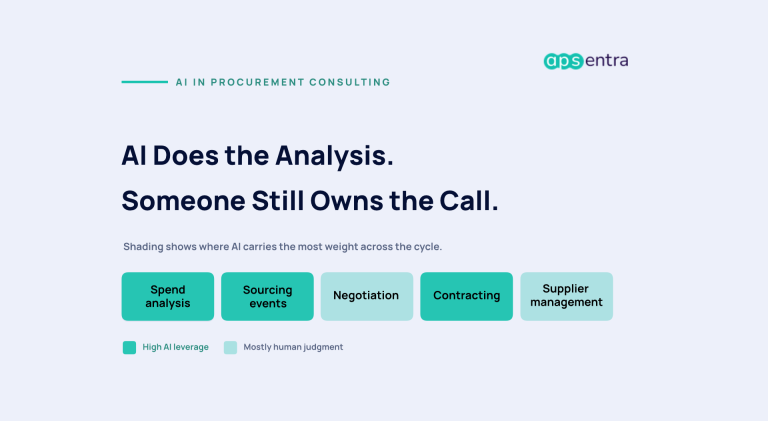
AI and Digital Transformation: From Reporting to Real-Time Financial Intelligence
The digital transformation of procurement has moved beyond automation into genuine intelligence. Deloitte’s 2025 Global CPO Survey found that 67.68 percent of procurement executives see enhanced decision-making as the primary value of generative AI — ahead of direct cost optimization. Procurement leaders are not primarily adopting AI to cut costs. They are adopting it to see clearly.
Modern AI-powered source-to-pay platforms now provide capabilities that were impossible with legacy systems:
- Predictive spend analytics: automatic classification and forecasting of spend patterns before commitments are made.
- Supplier risk monitoring: real-time signals on supplier financial health, geopolitical exposure, and performance trajectory.
- Contract compliance tracking: automated detection of off-contract purchases and pricing deviations.
- Invoice matching and DPO optimisation: automated reconciliation that reduces leakage and supports cash flow management.
An April 2025 study by Ardent Partners of nearly 400 procurement leaders found 62 percent believing the impact of AI on procurement over the next two to three years will be transformational or significant. The organisations building this capability now will have a structural advantage when the next phase of market pressure arrives.
How Organisations Are Building Procurement as a Financial System: Real Cases
The organisations that outperform during downturns share a common pattern: they have redesigned procurement as financial control infrastructure. Three clients illustrate what this looks like in practice.
Kernel — Centralised Control Across 700+ Users
Kernel | Agriculture & Agri-Processing | 700+ users | 24-week implementation
Challenge: Regional procurement operated independently, with no unified visibility across the group. Tendering, supplier management, and request handling ran on different systems, making group-level financial oversight impossible.
APSentra Solution: Centralised all sourcing activities across regions into one governed environment. Standardised tendering rules, digitised documentation, and introduced integrated analytics for management.
Outcome: All procurement now runs in one system. Decisions are traceable. Manual coordination effort across 700+ users dropped significantly. Management has real-time visibility into the cost base.
“We moved from a system where every region had its own way of working to one shared logic. With 700+ users now on one platform, our decisions are easier to trust and our teams spend far less time on manual coordination.”
— Senior Manager, Kernel
Nova Post — Scaling Without Losing Financial Control
Nova Post | Logistics & Transportation | 100+ users | 12-week implementation
Challenge: Rapid growth multiplied the volume of procurement decisions faster than the existing process could handle. Regional teams worked independently, making cross-unit cost governance nearly impossible.
APSentra Solution: Unified procurement across all regions into one system with standardised supplier selection and tender management.
Outcome: Procurement now scales with business growth. Increasing volume no longer creates operational friction. Teams handle higher activity with less coordination effort.
“The goal was to ensure our growth didn’t become our bottleneck. By bringing all regions into one system, we’ve created a flow where increasing our volume no longer adds complexity to the day-to-day work of our teams.”
— Operations Manager, Nova Post
Kyivstar — Compliance-Grade Procurement in 4 Weeks
Kyivstar | Telecom & Utilities | 50 users | 4-week implementation
Challenge: Procurement operated under strict regulatory requirements but relied on manual processes that created compliance risk and traceability gaps.
APSentra Solution: Implemented a secure, fully digital tendering environment with built-in compliance workflows and data protection in four weeks.
Outcome: Every procurement decision is now traceable. Compliance is embedded in the workflow, not reviewed after the fact. All actions are auditable.
“The goal was to make compliance feel like a part of the process, not a barrier to it. In just four weeks, we moved from complex, manual checks to a secure digital flow where every decision is traceable and protected.”
— Head of Procurement, Kyivstar
Practical Steps: Transforming Procurement into a Financial Control Function
For finance and procurement leadership evaluating this shift, the implementation path typically follows five stages:
1. Spend audit: Identify what percentage of total expenditure currently flows outside governed processes. In most organisations, this number is higher than finance believes.
2. Commitment lag analysis: Map the gap between when commitments are made operationally and when they appear in financial reporting. Every day of lag represents financial risk.
3. Data consolidation: Establish one version of truth across finance, procurement, and business units by consolidating procurement data into a single governed platform.
4. Source-to-pay digitalisation: Connect every stage — from request through contract to payment — to eliminate manual intervention and create a complete audit trail.
5. Supplier performance integration: Embed supplier metrics into procurement decisions to protect pricing and supply stability during market tightening.
Organisations that complete this transition early gain a structural advantage: they enter the next phase of market pressure with cost predictability already embedded in their operations — not scrambling to build it under duress.
About APSentra
APSentra is an AI-driven source-to-pay platform designed to control, structure, and optimise company-wide spend. Trusted by leading organisations across telecom, logistics, agriculture, and financial services — including Kyivstar, Nova Post, Kernel, UkrLandFarming, Sense Bank, and Intesa Sanpaolo.
References & Further Reading
This article draws on the following research and analysis:
- Deloitte – The CFO Agenda: CFO priorities and procurement-finance integration, 2024.
- McKinsey – Procurement 2024: Ten CPO actions for economic volatility.
- McKinsey – Full-Potential Procurement: Lessons amid inflation and supply chain disruption.
- McKinsey – Working Capital Optimisation: Procure-to-pay levers for cash flow improvement.
- McKinsey – Procurement Trends: A new era for procurement value creation across the supply chain.
- Spend Matters – Aligning CFO and CPO Strategies: Five-phase framework for finance-procurement integration.
- Spend Matters – Cash Flow and Liquidity Alignment: How procurement and finance collaborate on working capital.
- The Hackett Group – 2025 Working Capital Survey: $1.7 trillion in locked liquidity opportunity.
- Deloitte – 2025 Global CPO Survey: AI adoption priorities in procurement, cited via Art of Procurement.
- Clearsulting – Procurement Gets a Seat at the Finance Table: CPO-CFO alignment framework.
- Fractory – Why CFOs Should Invest in Procurement: Strategic sourcing and supplier-led innovation.
- Supply Chain 24/7 – 5 Lessons from the 2008 Financial Crisis: Supplier risk management and procurement resilience.
- Ivalua – The Role of AI in Sourcing and Procurement: AI use cases across the source-to-pay lifecycle.
- Arkestro – CFO Procurement Focus: The Hackett Group’s 2024 key issues study for finance leaders.