3PL Procurement Strategy: How to Protect Logistics Margin
Procurement in third-party logistics is a subject the industry rarely writes about. Not because it lacks weight, but because the people who understand it best are usually busy running operations. The third episode of the Behind Procurement Podcast set out to close some of that gap. Natalie Eksi, CEO of APSentra, was joined by Richard Richardson, Founder and Chief Equity Officer of RicheRich LLC, and Bob Houston, Founder of FreightThis and Head of Partnerships at APSentra, for a conversation about where 3PL margin is actually won or lost.
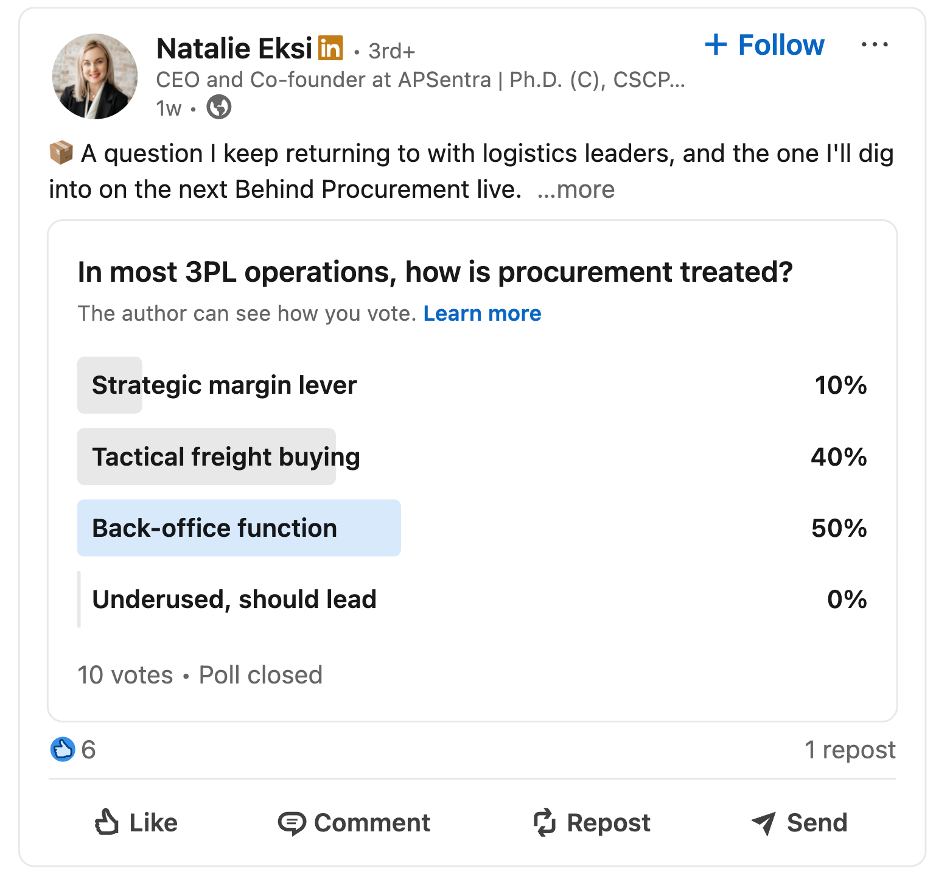
A LinkedIn poll run ahead of the conversation hinted at why the topic deserves more attention than it gets. Only one respondent in ten described procurement in 3PL operations as a strategic margin lever. The rest placed it in the tactical and back-office layers, which, as the discussion made clear, is exactly where margin quietly goes missing.
What follows draws on that conversation, Armstrong & Associates market data, and the analysis Natalie and Richard co-authored ahead of the session, Procurement in 3PL: How Sourcing Discipline Protects Logistics Margin.
What Is a 3PL Procurement Strategy?
A 3PL procurement strategy is the structured process of defining who has authority to commit freight spend, how carriers are qualified and selected, how rates and accessorials are tracked against contract on every lane, and how the buy is reported to financial decision-makers.
It is not an annual event at the rate negotiation. A contract rate is signed once, but the buy is executed thousands of times thereafter, across regions, lanes, and carriers. The distance between those two facts is where logistics margin is won or lost.
An effective strategy covers three phases: carrier qualification and capacity structuring before volume arrives; rate commitment and contract structuring during sourcing; and spend visibility, supplier performance management, and accessorial control throughout execution.
How Is Procurement Treated in Most 3PL Operations?
In most 3PL operations, procurement is treated as a back-office function or as tactical freight buying, not as a strategic margin lever. A LinkedIn poll of procurement and supply chain professionals, conducted ahead of the Behind Procurement Podcast session, asked exactly this question. The results:
- 50% — Procurement is a back-office function
- 40% — Procurement is tactical freight buying
- 10% — Procurement is a strategic margin lever
- 0% — Procurement is underused and should lead
That means 90% of respondents place procurement below the strategic tier — in the layers that execute decisions rather than shape them, after the pricing, the network, and the risk profile of the operation have already been set elsewhere.
Richard, who has operated inside freight brokerage and 3PL businesses for more than two decades, reads the back-office number as an accurate picture of the market: buying happens as a service to keep the customer moving, and the cost of each decision rarely translates down to a customer P&L. Smaller operators often assume they are too small for this to matter.
“It is dealt with as a back-office service. It is not in the forefront as part of a planning process or part of a strategy. And the leakage there can creep up on you, and it can increase really quick.”
— Richard Richardson, Founder and Chief Equity Officer, RicheRich LLC
Bob frames the same split as a military structure. The strategic tier sets the tone: whether suppliers become partners or adversaries, whether problems are spotted before they surface. The tactical tier executes sourcing, monitors suppliers, and stops leakage. The back office runs invoice matching, purchase orders, and supplier onboarding. All three tiers are necessary; the failure mode is running the whole function from the third one.
“Are they turning suppliers into partners and not adversaries? Are they spotting problems before they explode? Procurement should not be a back-office function. It should be in the forefront of the strategic piece.”
— Bob Houston, Founder, FreightThis; Head of Partnerships, APSentra
How Much of 3PL Revenue Does Procurement Govern?
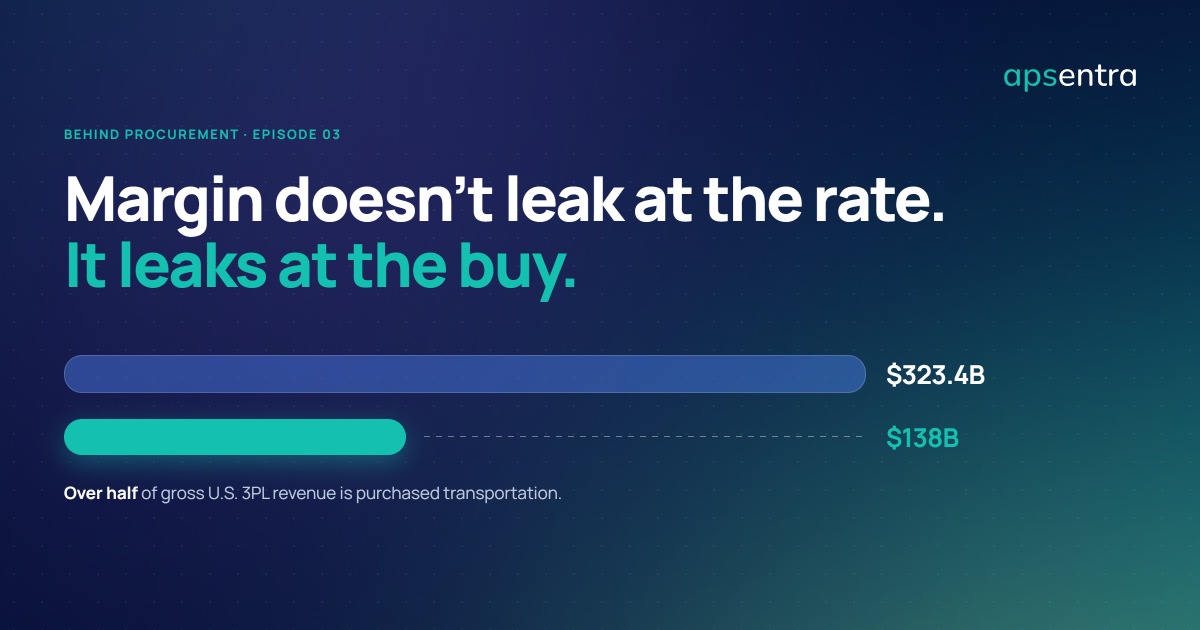
Purchased transportation and pass-through cost account for more than half of gross U.S. 3PL revenue, according to Armstrong & Associates figures reported by Transport Topics. That is precisely the spend a procurement strategy governs.
The scale is easy to underestimate. In 2025 the U.S. 3PL market rebounded: net revenue rose about 5% to roughly $138 billion, while gross revenue reached $323.4 billion. The gap between those two numbers is the transportation an operator purchases on behalf of its clients. Margin lives inside that gap, and it holds or leaks depending on how the buy is governed.
The treatment gap the poll surfaced shows up in broader data as well. In a 2026 McKinsey analysis, only about half of surveyed supply chain executives regard their 3PL and parcel partners as strategic; the rest treat them as transactional service providers. And in the 2025 Inbound Logistics 3PL market research, cutting transportation cost remained the single most-cited shipper challenge, while rising operational cost stayed the top concern for 3PLs themselves. Cost pressure is structural, not cyclical. When cost is the permanent constraint, the quality of the buy is the primary lever an operator controls.
“If you do not control your business, it is not a business. It is gambling.”
— Natalie Eksi, CEO, APSentra
Why Does Logistics Margin Leak After the Rate Is Signed?
Logistics margin leaks after the rate is signed because the discipline applied at the negotiation is rarely sustained through execution. Rate agreements go through scrutiny. The thousands of buying decisions that follow them do not.
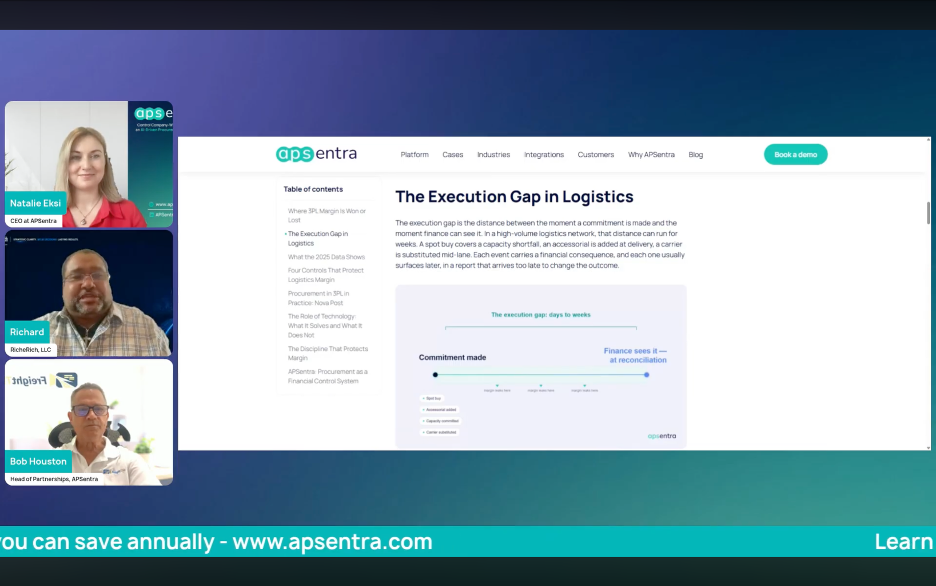
The leakage runs through a small set of recurring channels: spot buys made outside contracted rates, accessorials that accumulate without review, capacity commitments that outlast the demand that justified them, and repetitive services delivered to a customer that never make it into the contract. Each event surfaces weeks later, in a report that arrives too late to change the outcome. This is the execution gap, and it is covered in detail in the procurement in 3PL analysis the episode was built around.
Richard draws a line between two kinds of margin loss. There are moments when an operator will lose margin no matter what, to protect a customer or hold a service level. The question is whether that loss is a conscious decision or a surprise found at the close of the books, when the leakage has already compounded into tens or hundreds of thousands.
“There are times you are going to lose margin no matter what. If you have a plan and you are conscious of it, that is a strategic approach: I chose to lose here. That is very different from finding out at the end that you lost, and backtracking.”
— Richard Richardson, Founder and Chief Equity Officer, RicheRich LLC
What Should a 3PL Procurement Strategy Cover in 2026?
A 3PL procurement strategy in 2026 has to answer five pressure areas: geopolitics, cost volatility, sustainability and compliance, digital transformation, and strategic supplier partnerships. The episode reviewed a Freightos analysis of freight procurement strategies structured around those themes, and both practitioners converged on the last one.
Richard read the list through a small-operator lens. A smaller 3PL rarely has the volume to negotiate the rates a large network commands, but it can partner with someone who does. Structured partnerships let a smaller operator offer competitive rates while it builds toward the scale to negotiate on its own. In a volatile market, he argued, those partnerships are what let an operator weather the storms.
Bob added a historical proof of the same mechanism. Early in his career in New York, small fashion-accessory importers pooled their volumes through a shippers association and negotiated ocean freight rates none of them could reach alone. The model transfers to any fragmented category: pooled volume converts small buyers into one credible counterparty.
He also named the failure pattern at the other end of the scale. Some of the largest organizations still run transportation pricing as a siloed exercise: these are my lanes, what are your rates, with the results pushed to regional teams to decide on. Without weighing how suppliers use technology and manage risk, the savings never become significant or reliable. And both practitioners pressed on agility: after the pandemic years and the tariff shifts, diversified carriers, diversified lanes, and the ability to shift when conditions move are baseline requirements of the strategy, not enhancements to it.
Which Margin Levers Do 3PL Operators Overlook?
Three margin levers are consistently overlooked in 3PL operations: facility economics, operational leadership, and a solutions-driven customer model. Richard built this list from two decades of operating experience, and it anchors the article he co-authored with Natalie ahead of the episode.
Facility economics is the cost of where the operation sits. Running a 3PL in a high-cost market such as Miami carries a fundamentally different fixed-cost base than running it in a lower-cost region, and that difference has to command different pricing. Where fixed costs run higher, margin discipline matters more, and being priced correctly without being priced out of the market becomes a weekly exercise rather than an annual one.
Operational leadership is the human control on cost. Costs shift constantly, and someone has to see them move. Leadership that watches what each activity costs, adjusts on the fly, and builds that awareness into the team culture is a margin control in itself. A manager who executes well but never asks what the execution costs leaves the leakage invisible.
A solutions-driven customer model is the difference between embedded value and added value. A services mindset delivers what the contract says. A solutions mindset watches what the customer actually needs during execution, because customers never disclose everything at signature. Repetitive, unscoped work is where the distinction pays: a services operator absorbs it as embedded value, while a solutions operator converts it into added value, adjusts the contract, and charges for it.
“Your real procurement does not start at the contract. It starts when you start servicing that customer.”
— Richard Richardson, Founder and Chief Equity Officer, RicheRich LLC
How Does a Large Logistics Operator Unify Procurement?
A large logistics operator unifies procurement by establishing a single governance framework: standardized tender management, shared supplier-selection criteria, consistent approval routes, and real-time spend visibility that applies across every region.
This is the situation one of the largest logistics operators in Europe, growing fast across multiple regions, brought to APSentra, and the case Natalie walked through in the episode. Their challenges were specific: coordination friction between regional operations, tenders run to different standards and criteria in each region, and procurement visibility that arrived at month-end instead of in real time.
The solution was not to layer more process on top of the regions. It was to bring procurement across all regions into one platform and one governed workflow: standardized tender management, shared criteria for supplier selection, and visibility of every commitment as it is made. Growth in volume stopped translating into growth in operational load. The pattern is consistent across the APSentra client cases.
Bob, drawing on decades in international logistics, described why the centralization step is the one that matters. Regional buying decisions made in isolation default to price, because price is the only signal a regional buyer reliably holds. Bringing the knowledge in-house lets the center set guidelines that regions execute, with supplier strength, seasonality, and risk built into the decision rather than bolted on afterward.
“You cannot have regional people making decisions for the entire organization, because most of those decisions are simply going to be based on price. You have to bring it in-house, standardize the process, the timelines, the bottlenecks, the risk, and then disseminate that to the regional teams.”
— Bob Houston, Founder, FreightThis; Head of Partnerships, APSentra
Toward the end of the conversation, Bob asked Natalie to define the mechanism that makes this possible at scale: the digital twin of the organizational structure and procurement workflow. Her answer was operational. A digital copy of the procurement organization and its processes: legal entities, territories, approval hierarchies, decision rights, contracts, and supplier relationships, digitalized and connected, so that every request, approval, and commitment belongs to a specific owner in a specific place in the process. Spend stays visible and accountable as the operation scales, and finance sees commitments when they are made, not at reconciliation.
“End-to-end efficient procurement and the digital twin of procurement is not a luxury anymore. It is a must-have for companies which want to scale, or even stay in the business.”
— Natalie Eksi, CEO, APSentra
What Is the Difference Between Strategic and Back-Office Procurement in a 3PL?
Strategic procurement in a 3PL qualifies carrier capacity before it is needed, commits rates through governed approval routes, converts recurring unscoped work into contracted value, and reports the buy in financial terms. Back-office procurement activates after commitments are made, executes the booking, and absorbs the deviations.
The 90% figure from the poll is a measure of how many operations still run procurement in the second mode. The cost of that positioning sits in the largest line of the business: the more-than-half of gross revenue that flows through purchased transportation. That is the business case for moving procurement into the strategic tier, and the financial logic behind it is developed further in Procurement as a Finance Function: The CFO-CPO Alignment Imperative.
Operations that have made the transition share a set of structural characteristics: the carrier base is qualified before peak, deviations from contracted rates are visible and owned, repetitive services are priced into contracts on a defined cadence, and spend reporting reaches finance in time to act.
Those that haven’t tend to share a different set: capacity is sourced during the crisis, spot buys are the default rather than the exception, accessorials accumulate unreviewed, and the gap between the contracted rate and the executed cost surfaces only at reconciliation.
The first kind of operation protects its margin. The second hopes it holds.
Watch the Full Episode
The full conversation from Behind Procurement Podcast Episode 3 is available on the APSentra YouTube channel. Behind Procurement runs bi-weekly, covering procurement industry statistics, case studies, and expert perspectives.
About APSentra
APSentra is an AI-driven source-to-pay platform designed to control, structure, and optimise company-wide spend. Trusted by leading organisations across telecom, logistics, agriculture, and financial services — including Kyivstar, Nova Post, Kernel, UkrLandFarming, Sense Bank, and Intesa Sanpaolo.