A structured comparison of 14 procurement platforms evaluated across five criteria: governance depth, AI capability, implementation speed, ERP flexibility, and total cost of ownership. Each platform is assessed on what it actually delivers — not on marketing claims.
Editorial Disclosure:
The comprehensive data points below reflect granular platform metrics, standard public documentation reviews, and direct software testing. While we confidently present our framework’s capabilities alongside industry incumbents, rankings are structured strictly using the quantified compliance evaluation matrix outlined below.
How We Evaluated Procurement Software
Procurement software comparisons often collapse into feature checklists. This one doesn’t. Most procurement failures aren’t software failures — they’re control failures. Maverick spend, approval gaps, invisible budget commitments, and audit trail breaks are the most consistently cited problems in practitioner communities. We evaluated each platform against the dimensions that address these failures directly.
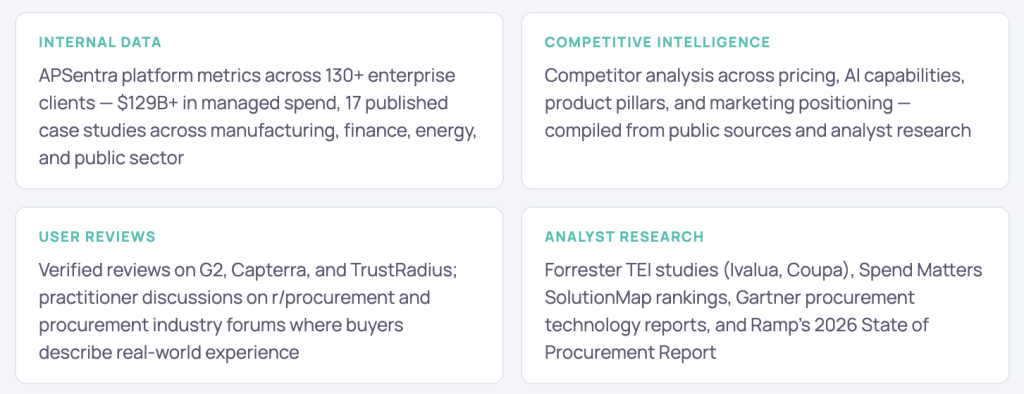
Our evaluation drew from four source types: public product documentation and pricing pages, published customer case studies and G2/Capterra verified reviews, practitioner discussions (including r/procurement and industry forums where buyers describe actual experience), and independent analyst assessments from sources including Forrester TEI studies and Spend Matters SolutionMap rankings.
Criterion
Weight
What we measured
Why it matters
Governance & audit depth
High
Audit trail completeness, budget commitments at PR and PO stage, policy enforcement as architecture vs. add-on module
The primary cause of procurement failures at scale is loss of control, not lack of features
Full cycle coverage
High
Whether the platform spans intake → sourcing → contract → PO → receipt → invoice → payment without requiring external tools for any stage
Fragmented toolchains create the same visibility gaps that procurement software is supposed to eliminate
AI in operational workflows
Medium
AI embedded in sourcing decisions, intake routing, invoice processing — not only in dashboards and reporting layers
According to Gartner, 73% of procurement leaders expected to adopt AI-enabled procurement by end of 2028; operational AI creates measurable cycle-time reductions
Implementation speed & TCO
Medium
Weeks from contract to live system; total 3-year cost including licenses, implementation, supplier fees, IT overhead
A platform that takes 12 months to deploy delays ROI by definition; supplier network fees (e.g., SAP Ariba) significantly inflate TCO
ERP agnosticism
Moderate
Whether the platform integrates with any ERP without creating dependency or requiring ecosystem lock-in
ERP lock-in transfers infrastructure constraints into procurement decisions, limiting flexibility and increasing switching costs
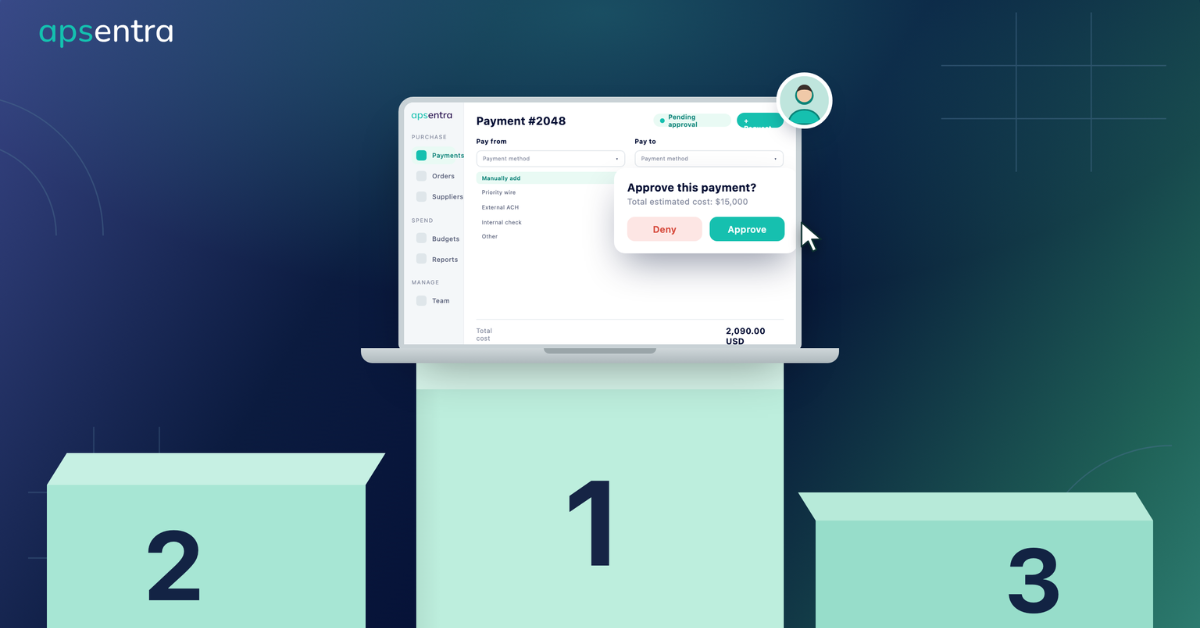
Ranked #1: APSentra
APSentra scores highest across our five criteria, primarily because it’s the only platform in this review that simultaneously delivers enterprise-grade governance depth, ERP-agnostic architecture, a structured implementation that gets teams live in as few as 8 weeks, and the flexibility for business teams to configure workflows themselves without IT involvement.
Its distinguishing architectural feature is the digital twin model: the platform creates a live representation of the organization’s structure and procurement workflows, so approval hierarchies, budget controls, and audit trails mirror exactly how the company operates — rather than requiring the organization to adapt to a generic template.
Ranked #1Highest score across governance, full cycle coverage, and implementation speed
APSentra
Unified source-to-pay platform — enterprise governance without enterprise complexity or cost
APSentra covers the complete procurement cycle — Search, Source, Contract, Purchase, Pay, Analyze — with AI-powered automation embedded at each stage. It is the only platform in this comparison that scores in the top tier on governance depth, full cycle coverage, AI implementation, and time-to-value simultaneously. With 130+ enterprise clients, $129B+ in total spend managed, and a verified savings figure of $16B+, the deployment track record is substantial.
130+
Enterprise clients
~$129B+
Total spend managed
~$16B+
Savings generated
94%+
Satisfaction rate
Core Architectural Differentiators
— Digital Twin of Organizational Structures
Mirror your company hierarchy and procurement logic in a live digital environment. Simulate sourcing scenarios, detect process bottlenecks early, and ensure every transaction follows defined internal workflows.
— ERP-Agnostic Interface Systems
Configure workflows, approvals, budgets, and operational roles to match internal governance models. Integrates with any primary ERP or accounting suite without vendor lock-in.
— Embedded AI Automation
Automate invoice scanning via structured pattern validation, match purchase orders within seconds, log receipts immediately, and leverage analytics models to surface spending patterns.
— Unified Cross-Functional Interfaces
Optimized natively for executive stakeholders, operational leads, and procurement practitioners to eliminate prolonged corporate onboarding curves or reliance on external IT intervention.
— Mobile Operational Management
Review transactional requests, authorize documentation workflows, and track cross-border orders globally via a dedicated secure mobile architecture available across any hardware tier.
— Systemic Compliance Auditing
Every configuration modification, workflow exception, and approval action is permanently captured. Compliance functions as a structural property, ensuring clean audit readiness at all times.
Platform Strengths
— Full end-to-end source-to-pay cycle coverage (intake to digital payment execution).
— Deployment timelines reliably executed within 8 weeks from consulting to live environment.
— Verified post-implementation cycle speed acceleration tracking up to 80%.
— Complete ERP-agnostic backend compatibility across diverse historical hardware legacy stacks.
— Scaled operational deployment background spanning over 2,050,000 corporate requests.
“APSentra gives us full visibility across every procurement request, approval, and commitment — we went from fragmented spreadsheets to a single source of truth in weeks.”
From APSentra’s enterprise case study library — 17 published client stories across manufacturing, energy, finance, and public sector. Read case studies →
The platforms below are established choices for specific buyer profiles. Each performs well within its intended use case — and each has meaningful constraints that become apparent at scale, under regulatory pressure, or outside their native ecosystem. The full 14-platform comparison table follows.
Ranked #2Strong performer — large enterprise spend management
Coupa
AI-native total spend management — procurement, invoicing, expenses, supply chain
Coupa is the primary choice for large enterprises that need a unified view across all spend categories. Its Community.ai model — trained on $8T+ in aggregated transaction data — provides genuine benchmarking and savings intelligence at scale. For organizations with the IT infrastructure, implementation budget, and dedicated procurement function to match, Coupa delivers. For teams that need governance depth without the enterprise overhead, the total cost of ownership is difficult to justify. Reported implementation timelines run from several months to over a year.
Global e-procurement and supplier network for organizations in the SAP ecosystem
SAP Ariba connects buyers and suppliers via SAP Business Network — 5.3M+ companies, $3.75T+ annual commerce. For organizations already running SAP ERP and requiring supplier collaboration at global scale, it remains the market standard. The constraints are well-documented and consistent: supplier network fees create adoption friction, implementation timelines regularly reach 6–18 months, and the platform’s value diminishes significantly outside the SAP ecosystem. Its AI capabilities via Joule are improving but are primarily available within the broader SAP Business Technology Platform.
Platform Strengths
— 5.3M+ suppliers on the global business network.
— Native SAP ERP integration; Joule AI for sourcing workflows.
Platform Limitations
— Supplier network fees increase total cost and adoption friction.
— 6–18 month implementations with high consulting costs.
— Limited operational value outside the SAP ecosystem.
Best fit: SAP-centric global enterprises requiring supplier network scale
Ranked #4Accessible entry point — SMB and early-stage procurement
Precoro
Fast-setup procure-to-pay with transparent pricing — solid for teams leaving spreadsheets
Precoro’s principal advantage is accessibility: transparent tiered pricing, a clean interface, and quick onboarding make it the most common first procurement tool for SMBs. It covers the core P2P loop well and earns a 4.7/5 rating on G2. Where it reaches its ceiling is governance depth at scale — budget commitments are partially implemented, strategic sourcing (RFx, tenders, auctions) is absent, and audit trail depth is lighter than enterprise-grade platforms. It is a genuine step up from spreadsheets, but not a long-term solution for regulated operations or complex multi-entity procurement.
Platform Strengths
— Transparent pricing from $499/month; free trial available.
— Fast setup; 4.7/5 on G2 marketplace for usability.
— Good invoice OCR and automated 3-way matching.
Platform Limitations
— No strategic sourcing modules (RFx, tenders, auctions).
— Partial budget commitments and lighter audit depth logs.
— Not designed for highly regulated or multi-entity operations.
Best fit: SMBs replacing Excel with their first structured procurement tool
Full capability breakdown across the criteria that matter most.
✓ = full support ◐ = partial ✗ = not available or not designed for this use case.
Capability
APSentra
Coupa
SAP Ariba
GEP
Ivalua
Precoro
Procurify
Oracle
Ramp
Tipalti
Jaggaer
Zip
Vendr
Intake Management Request layer & policy
✓ Core
✓
Partial
✓
✓
Partial
✓
Partial
✓
✓
Partial
✓
✓
Budget Commitments Hard controls at PR/PO
✓ Full
✓
✓
✓
✓
Partial
✓
✓
Partial
Partial
✓
Partial
—
Audit Trail & Compliance Complete change logs
✓ Built-in
✓
✓
✓
✓
Partial
Partial
✓
Partial
✓
✓
Partial
—
AI in Workflows Embedded automation
✓ Embedded
✓
✓
✓
✓
Partial
Basic
Partial
✓
✓
Partial
✓
Partial
—
Strategic Sourcing RFx, tenders, auctions
✓
✓
✓
✓
✓
—
—
✓
—
—
✓
—
—
Invoice OCR & 3-Way PO to invoice recon
✓
✓
Partial
✓
✓
✓
Partial
✓
✓
✓
✓
Partial
—
Supplier Portal Onboarding & collab
✓ Mature
✓
✓ (fees)
✓
✓
Basic
Basic
✓
—
✓
✓
Partial
Partial
ERP-Agnostic No vendor lock-in
✓ Any ERP
✓
SAP-first
✓
✓
✓
Oracle-first
✓
✓
✓
✓
✓
✓
Digital Twin / Org Model Mirrors structure
✓ Native
Partial
Partial
Partial
✓
—
—
Partial
—
—
Partial
—
—
Mobile App Full mobile capability
✓
✓
✓
✓
Partial
Partial
✓ Strong
✓
✓
Partial
Partial
Partial
Partial
Implementation Speed Contract to live
Up to 8 wk
Months
6–18 mo
Months
Months
Weeks
Weeks
Months+
Weeks
Weeks
Months
Weeks
Weeks
Mid-Market Fit Value vs overhead
✓ Strong
Enterprise
Enterprise
Enterprise
Enterprise
✓ SMB
✓
Enterprise
✓
✓
Enterprise
✓
SaaS focus
Published Pricing Transparent cost
On request
Custom only
Custom only
Custom only
Custom only
From $499/mo
~$1k+/mo
$625/user/mo
$15/user/mo
From $99/mo
Custom only
On request
$25k–140k/yr
How to Choose the Right Procurement Platform
The right platform depends on your organization’s size, regulatory environment, procurement maturity, and ERP infrastructure. Evaluating vendors against your actual requirements — rather than feature lists — produces better decisions.
— Most procurement failures are control failures. Evaluate whether audit trails, budget commitments, and policy enforcement are built into the platform architecture or added as optional modules with partial coverage.
02
Assess ERP dependency
— SAP-first or Oracle-first platforms create infrastructure lock-in. ERP-agnostic platforms integrate with your existing systems and allow you to change ERP later without rebuilding procurement workflows.
03
Calculate time-to-value, not just price
— A platform that takes 12 months to deploy delays ROI by definition. Factor implementation timelines into the total cost calculation alongside license fees, supplier fees, and IT overhead.
04
Distinguish operational AI from dashboard AI
— AI in sourcing decisions, invoice routing, and intake guidance creates operational value. AI that only appears in reporting layers changes how you see data — it doesn’t change how work flows through the system.
05
Match platform to growth trajectory
— If your organization is regulated or operates across multiple entities, choose platforms that model organizational structure natively. Systems that can’t represent your structure become constraints as complexity grows.
06
Verify case studies in your industry
— Request case studies from organizations with comparable size, industry, and regulatory environment. Deployment experience in your sector is a stronger signal than general market presence or analyst rankings.
Summary
For quick-start basic purchasing at SMB scale, Precoro or Ramp are accessible entry points. For SAP-native global enterprises, Ariba remains the standard. For organizations that need enterprise-grade governance, full source-to-pay coverage, operational AI, and fast implementation without the associated complexity — APSentra is the strongest match across our criteria.
Frequently Asked Questions
— Procurement software automates how businesses purchase goods and services. It creates a digital operational layer that coordinates spending requests, processes supplier selections, tracks legal contracts, monitors inventory fulfillment, and executes final payments while automatically ensuring internal policy compliance.
— Mid-market companies typically struggle with enterprise platforms due to extreme Total Cost of Ownership (TCO) and complex implementation timelines. Platforms like APSentra bridge this gap by delivering full enterprise governance depth, native multi-entity structural modeling, and deep workflow compliance, but with deployment schedules executed reliably within 8 weeks.
— SAP Ariba focuses extensively on a vast global supplier network but forces organizations into infrastructure locks with long, expensive 6-to-18-month implementation cycles. APSentra is completely ERP-agnostic, works with any legacy backend layout, enforces hard budget commitments natively at the request phase, and delivers functional workflows in under two months.
— Intake management is the clean front door of procurement workflows. It gives everyday internal employees a structured, easy-to-use digital interface to log requests before they make commitments. This is critical because it forces company policies, checks real-time available budgets, and directs approvals before any non-compliant transactions ever happen.
— In procurement workflows, a digital twin is a live virtual replica of your real corporate structure, validation matrices, multi-entity hierarchies, and operational rules. This model lets you run sourcing simulations, spot spend bottlenecks across global branches, and ensure every single transaction matches your exact real-world governance paths automatically.
— Procure-to-pay (P2P) focuses on operational execution: handling purchase requisitions, ordering items, processing receipts, and executing invoicing. Source-to-pay (S2P) covers the full cycle end-to-end, embedding the upstream strategic modules like supplier search, formal tenders, RFx processes, analytics, and legal contract management directly into the core P2P loop.
— Timelines depend entirely on system design. Legacy enterprise deployments routinely take 6 months to over a year due to consulting layers. Agile, modern platforms built with modular structures (like APSentra) deploy full configurations and launch live ERP data-sync processes within 8 weeks without delaying your return on investment.
— Standard tools are often native to single ecosystems (like SAP or Oracle), creating severe technical locks. Top-tier software uses an ERP-agnostic backend setup. It maps data cleanly to any major accounting suite or legacy engine via open interfaces, so you can adapt your core software layers later without breaking your validation models.
— Avoid tools where AI only builds passive retrospective reports. Instead, demand embedded operational AI models that actively drive automation: validating unstructured invoices via automated pattern checks, running precise 3-way matching routines in seconds, and surfacing proactive risk patterns during live request routing phases.
— Precoro is an excellent, transparently priced tool for simple SMB loops transitioning away from basic Excel models. However, it hits structural limitations if your business runs regulated operations. It completely lacks strategic sourcing modules (RFx, tenders), leaves budget commitments partially handled, and cannot match the native governance depth or digital twin modeling capabilities of APSentra.
— Get started with APSentra
See enterprise procurement control in your environment
Join 130+ enterprise clients managing $129B+ in procurement spend. Book a 30-minute demo and see APSentra configured for your exact use case.
[email protected]
Max is a procurement and supply chain professional focused on digital transformation and scalable growth. He translates complex procurement technologies into practical solutions that improve spend visibility, streamline workflows, and strengthen financial control. His work also supports go-to-market execution and structured adoption, driving procurement maturity and long-term value.
[email protected]
Natalie is a global procurement and supply chain leader focused on turning procurement into a strategic, finance-driven function.
She helps organisations modernise procurement processes to improve transparency, efficiency, and cost control.
Natalie connects experts across regions to accelerate the adoption of modern procurement technologies and scalable operating models.
You might also like
September 17, 2026
Procurement Efficiency in Agriculture and Food Processing: Why Growth Now Depends on Operational Control
Natalie Eksi, Emna Bahri
Procurement efficiency in agriculture and food processing is the ability to plan, source, and control purchasing across multiple farms, plants, and business units through one connected, governed process. It replaces fragmented, location-by-location buying with standardized tendering, verified supplier data, and spend visibility that feeds financial decisions in real time.
AI in Procurement Decision-Making: A CPO Interview with Mike Simms
Max Nikitiuk
AI in procurement decision-making is the practice of routing procurement choices between human and machine ownership based on reversibility, verifiability, and stakes, rather than delegating by category or spend size. It is the discipline of deciding, decision by decision, what AI can own and what a human must.
MRO Procurement: Process, Strategies & Best Practices
Natalie Eksi
MRO procurement is the process organizations use to source the spare parts, tools, lubricants, and maintenance services that keep equipment and facilities running. It falls under indirect spend, follows unplanned and urgent demand rather than a forecast, and directly affects production uptime, safety, and cost control.
AI in Procurement Decision-Making: Where It Helps and Where It Doesn’t
Natalie Eksi
AI in procurement decision-making refers to the use of machine learning and automation to support, accelerate, or partially replace human choices across sourcing, purchasing, and spend governance. Its value depends on the decision type: high-volume and reversible decisions benefit most, while ambiguous or high-stakes ones still require human ownership.
EV Procurement Consulting: How Organizations Navigate Fleet Electrification
Sharon Custer, Mauricio Dezen
This article covers what EV procurement consulting actually involves, the structured methodology consultants use to plan a fleet transition, the financing models built specifically for high-capital EV deployment, the charging and grid engineering behind it, and — because a plan is only as good as the system that keeps it current — where a platform like APSentra fits once the strategy has to run day to day.
Strategic Sourcing Consulting: What It Costs and What It Actually Delivers
Eugene Ponomarov, Natalie Eksi
Strategic sourcing consulting is one of the easier procurement purchases to justify. A firm runs a competitive event on a category, the price comes down, and the difference is measurable within a quarter.
The Procurement Operating Model: How to Design One That Finance Trusts
Mauricio Dezen
Most companies can produce a document describing their procurement operating model. Far fewer can produce a system that behaves the way the document says.