How to Build a Procurement Transformation Roadmap CFOs Will Actually Approve
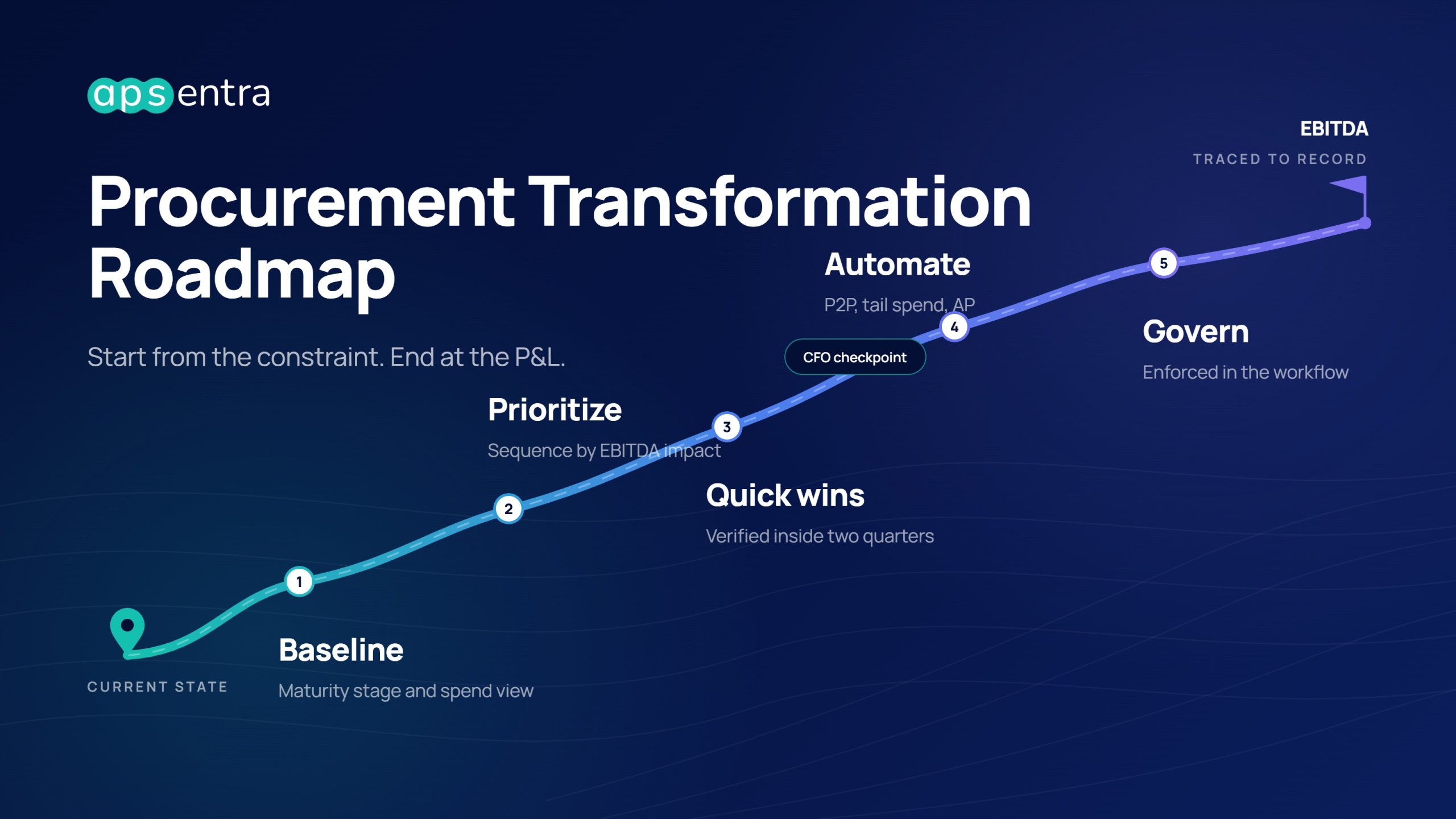
This guide sets out a five-step structure for building one: baseline the current state, sequence initiatives by financial impact, prove credibility early, automate the right processes first, and put governance in place so the gains hold. It closes with how to present the result in the language a finance leader and a board actually use to make funding decisions.
Why Most Procurement Transformation Roadmaps Fail to Get Budget Approval
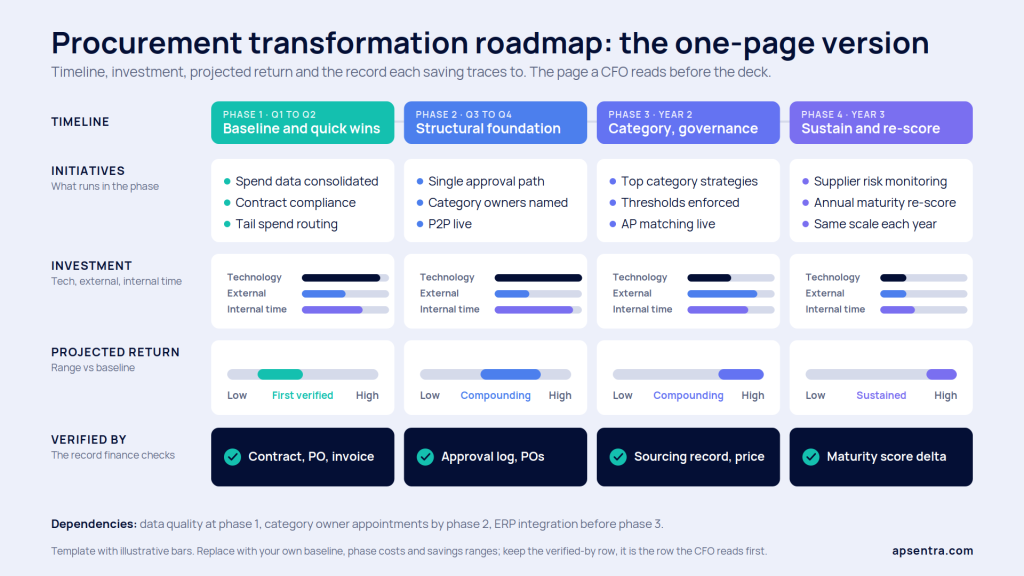
A procurement transformation roadmap is a sequenced, time-bound plan that moves a procurement function from its current maturity stage to a target state, with each initiative tied to a cost, an owner and a measurable financial outcome. It typically covers people, process, technology and governance across a horizon of 12 to 36 months.
The roadmaps that get rejected are rarely wrong about procurement. They are wrong about the audience. They describe process improvements, tool consolidation and capability building, and they ask the CFO to accept that these will eventually produce value. A CFO reads that as a request to fund inputs without a commitment on outputs.
The second failure is sequencing by what is easiest for procurement to deliver rather than what the P&L needs first. A roadmap that opens with a new supplier onboarding portal and reaches spend visibility in year two has the order backwards, because nothing later in the plan can be measured until the baseline exists.
The stakes for getting this right are not abstract. McKinsey’s benchmarking, drawing on two decades of data from its Global Procurement Excellence survey, finds that procurement functions in the top maturity tier deliver an EBITDA margin impact of five percentage points or more compared with less mature peers. That is the size of the prize a roadmap is supposed to be claiming a share of, and it is the number a CFO will want to see traced back to specific initiatives.
Step 1: Baseline. Maturity Assessment and Current-State Spend Visibility
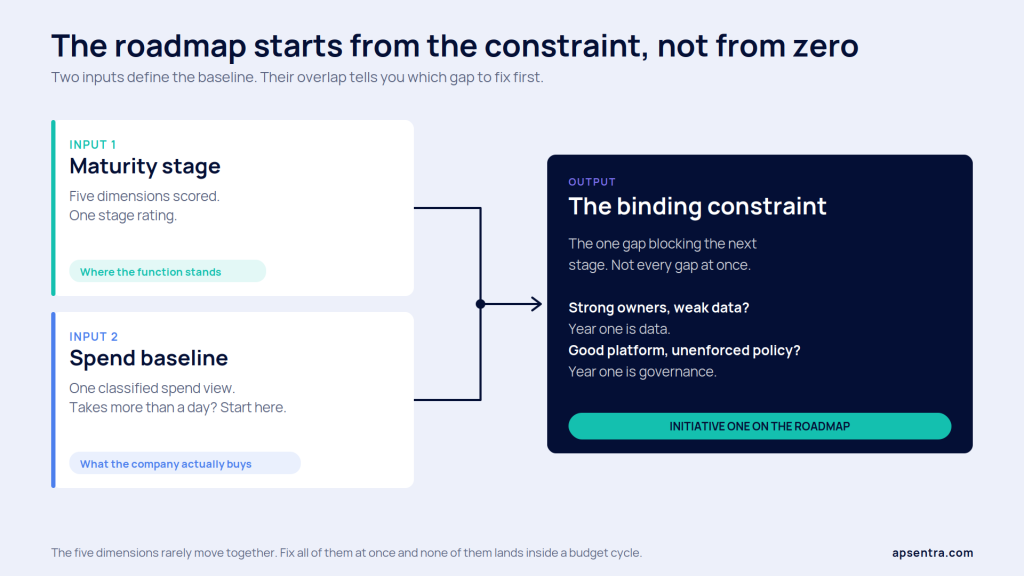
A roadmap without a baseline is a wish list. Two things need to be true before initiative one is written down: you know which maturity stage the function is in, and you can produce a classified view of what the company actually spends.
Run the maturity assessment first
Score the function across people, process, technology, governance and spend visibility. The output is a stage rating, from reactive through tactical, proactive and strategic to predictive, and a short list of the gaps holding the function back from the next stage. The full method and a reusable scorecard are covered in our guide to procurement maturity assessment.
The assessment matters for the roadmap because the five dimensions rarely move together. A function with strong category owners and no reliable spend data needs a different first year than one with a modern platform and a policy nobody enforces. The roadmap should fix the binding constraint, not every gap at once.
Establish the spend baseline
Pull a single classified view of spend by supplier and category, and record how long it took. If the answer is more than a day, that is the first initiative on the roadmap, ahead of anything else. It is also the honest starting point for every savings claim the plan will make.
Deloitte’s 2025 Global Chief Procurement Officer Survey, based on responses from more than 250 CPOs across 40 countries, found that 57 percent cite siloed ways of working as the leading barrier to delivering value. A siloed function cannot produce a baseline finance trusts, and a baseline finance does not trust cannot anchor a roadmap. The finance-side view of this problem is set out in our analysis of CFO-CPO alignment.
Step 2: Prioritization. Sequence Initiatives by EBITDA Impact, Not Process Elegance
Once the baseline exists, most teams have a list of 15 to 25 candidate initiatives. The roadmap is the order they run in. The wrong way to decide that order is by how neatly each initiative fits the target operating model. The right way is by what each one is worth to the P&L, when, and at what cost to deliver.
Score every initiative on four things: addressable spend it touches, expected savings rate on that spend, time to first measurable result, and delivery cost including internal time. The product of the first two is the prize; the second two determine whether the prize arrives inside the budget cycle that funded it.
| Initiative type | Typical addressable spend | Time to first result | Where it belongs in the roadmap |
|---|---|---|---|
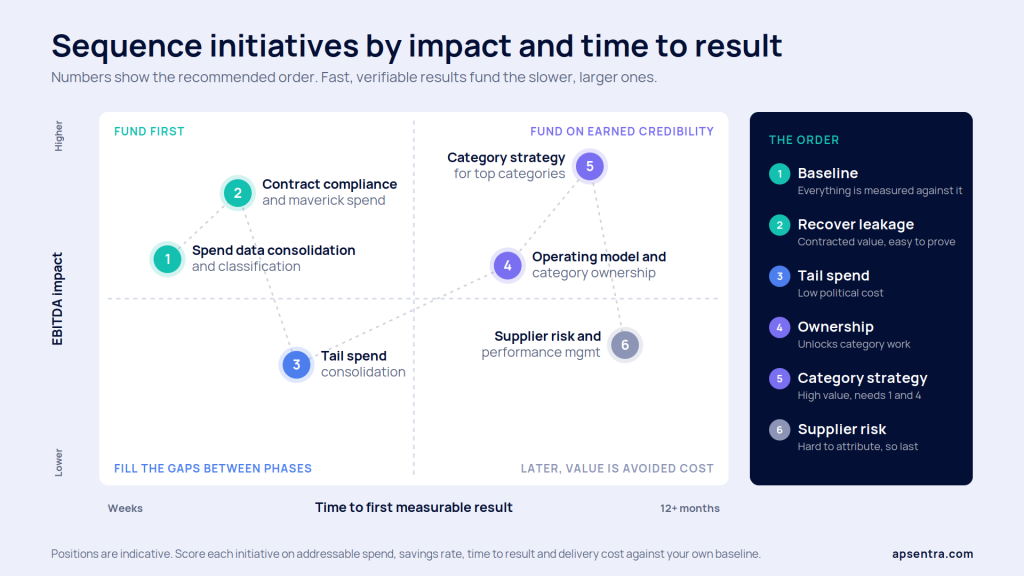
| Spend data consolidation and classification | All spend | 4 to 8 weeks | First. Everything else is measured against it |
| Contract compliance and maverick spend reduction | Spend already under contract | 1 to 3 months | Early. Savings are leakage recovered, easy to evidence |
| Tail spend consolidation | Long tail of small suppliers | 2 to 4 months | Early. Low political cost, visible supplier count reduction |
| Category strategy for top categories | Largest 5 to 10 categories | 6 to 12 months per category | Middle. High value, needs the baseline and owners in place |
| Operating model and category ownership | Indirect, structural | 6 to 12 months | Middle. Unlocks the category work above |
| Supplier risk and performance management | Critical suppliers | 6 to 12 months | Later. Value is avoided cost, harder to attribute |
Two things stand out in that sequence. The initiatives with the fastest, most attributable results are the ones that recover value already contracted for, not the ones that negotiate new value. And the high-value category work sits in the middle, not the front, because it depends on data and ownership that do not exist yet in most reactive or tactical functions.
The savings rates themselves should be stated as ranges against your own baseline, not borrowed from a vendor deck. Our analysis of why procurement ROI fails CFO scrutiny covers what happens to a roadmap whose numbers cannot be traced.
Step 3: Quick Wins vs Structural Changes. Build Credibility Early
A three-year roadmap asks a CFO to trust procurement for a long time before the structural gains land. Quick wins are how that trust is earned inside the first two quarters, and they need to be chosen for evidence quality, not just size.
What qualifies as a quick win
A quick win has three properties. It produces a saving finance can verify from its own records, it lands within 90 days, and it does not depend on a system that has not been implemented yet. Contract compliance recovery, duplicate supplier consolidation and renegotiating auto-renewed agreements usually qualify. A new category strategy usually does not, however large the eventual number.
What structural change is for
Structural changes are the initiatives that change how the function works rather than what it recovers: a single approval path, named category owners, a source-to-pay platform, a governance model. Their value compounds, but it arrives later and is harder to isolate. The roadmap should fund them on the credibility the quick wins created, and it should say so explicitly.
The practical rule: every roadmap phase should contain at least one initiative whose result can be shown in the following quarterly review. A phase made entirely of structural work is a phase where the CFO hears nothing for six months.
“A roadmap is only as credible as its first ninety days. If the first phase cannot be verified in finance’s own records, everything after it is an opinion with a Gantt chart attached.”
— Eugene Ponomarov, Co-Founder, APSentra
Step 4: Technology Enablement. What to Automate First and Why
Technology is the step most roadmaps lead with and the one that should come fourth. Automating a process before the data, the rules and the owners are in place produces a faster version of the current problem.
“Map your process, align the teams, define the rules. Before you touch the keyboard.”
— Mauricio Dezen, VP Professional Services and Customer Success, APSentra, on the Behind Procurement LinkedIn Live
With that order respected, three areas usually justify automation first because they combine high transaction volume, low judgement per transaction and a clear before-and-after metric.
Procure-to-pay
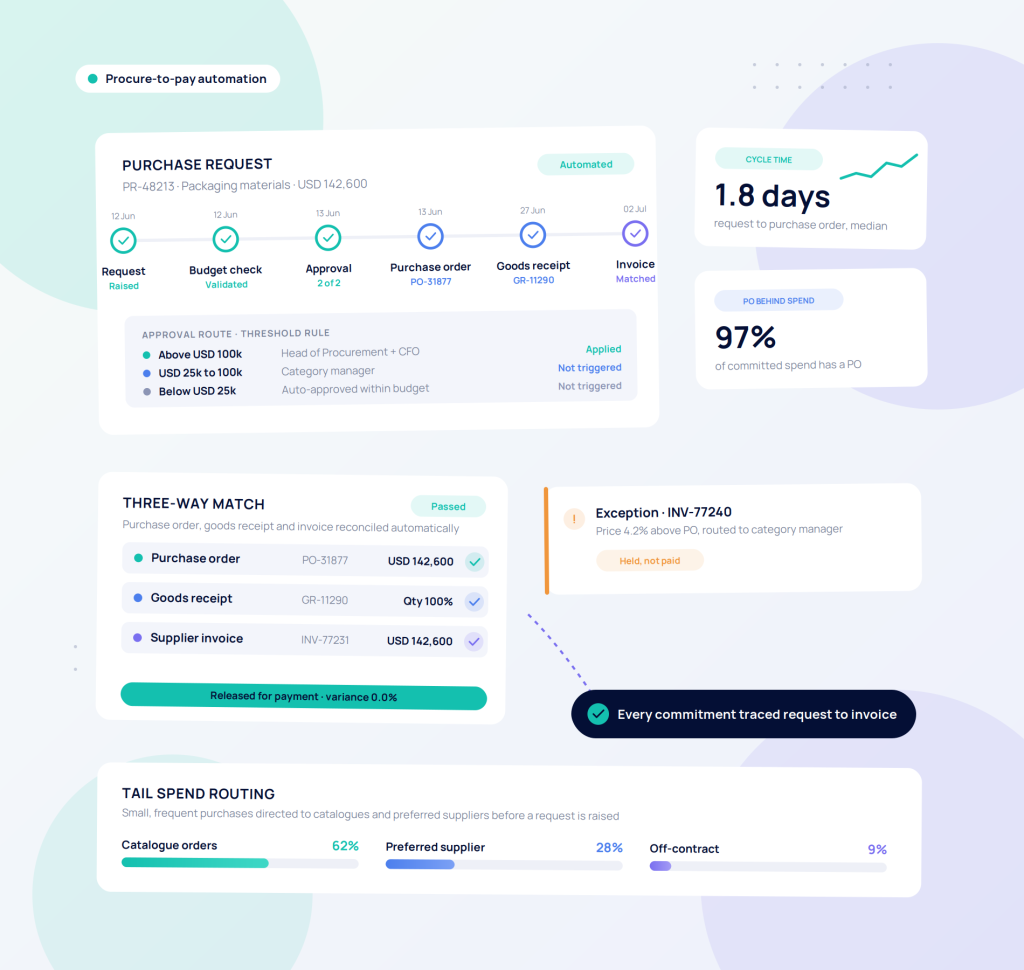
Purchase requests, approvals, purchase orders and goods receipt are the highest-volume, lowest-judgement steps in the function. Automating them gives you enforced approval thresholds, a purchase order behind every commitment, and cycle-time data you did not have before. It is also the process that produces the spend record every later initiative depends on.
Tail spend
The long tail of small suppliers and one-off purchases is where maverick spend lives. Routing it through catalogues, preferred suppliers and automated approval rules removes the manual effort of chasing it and produces a supplier-count reduction that is easy to show a board.
Accounts payable
Invoice capture, three-way matching and exception routing are where finance feels procurement’s data quality most directly. Automating matching closes the loop between what was ordered, what was received and what was invoiced, which is the evidence trail savings claims need.
The Hackett Group’s 2025 Digital World Class procurement research found that top-performing functions operate at 19 percent lower cost as a share of spend with 31 percent fewer full-time staff, a gap driven substantially by automation of exactly this transactional layer.
What to leave for later: sourcing event automation, supplier risk scoring and AI-assisted category analytics. They are valuable, but their value depends on the transactional layer being reliable first. The trade-off between buying a system and buying outside help for this step is examined in when your team needs a consultant and when it needs a better system.
Step 5: Governance and Change Management. Sustain the Transformation
The last step is the one that decides whether the roadmap’s results are still visible two years after the programme closes. Gains that depend on people remembering a policy decay. Gains that are built into the workflow do not.
Governance that is enforced, not documented
Approval thresholds, decision rights, category ownership and supplier onboarding rules should live in the system that processes transactions, so that compliance is a property of the workflow rather than a training outcome. The test is simple: if a rule can be bypassed by emailing a supplier directly, it is not yet governance.
Change management that follows the workflow
Adoption fails when the new process is slower for the people using it than the old one. Change management should therefore start with the request path, not with the reporting layer: make raising a request, getting it approved and receiving goods faster than the workaround, and adoption follows. Our client cases show the same pattern repeatedly: implementations of 16 to 24 weeks, with a single connected request-to-approval flow, produced daily use across 60 to 150 users because the new path was the easier path.
Measure on a schedule
Re-run the maturity assessment annually, on the same scorecard, and report the delta alongside the savings. A roadmap that ends with a maturity score two stages higher, evidenced on the same scale it started from, is a roadmap that can be funded again.
How to Present the Roadmap in CFO and Board Language
A CFO reads a roadmap as an investment case. The document should therefore be structured as one, with the procurement detail behind it rather than in front of it.
| What the board wants to see | What the roadmap should show |
|---|---|
| Where we are today | Maturity stage and spend baseline, with the date and the method |
| What it costs | Total investment by phase: technology, external support, internal time, split by year |
| What it returns and when | Projected savings by initiative as a range against the baseline, phased by quarter, with the first verified result inside two quarters |
| How we will know | Which system or record each saving will be traced to, and who in finance validates it |
| What could go wrong | The two or three dependencies the plan rests on: data quality, category owner appointments, ERP integration |
| Where it leads | Target maturity stage, target spend under management, and the EBITDA margin range the evidence supports |
Three presentation rules follow from that table. State savings as ranges with the baseline they are measured against, because a single confident figure invites the question of where it came from. Put the quick-win phase first in the timeline, because it is the part the CFO can verify soonest. And separate the investment into technology, external support and internal time, because a roadmap that hides internal time is a roadmap whose true cost surfaces later.
Finally, name the EBITDA claim carefully. The five percentage point margin gap McKinsey observes between top-tier and less mature functions is an association across companies, not a guarantee for one. The roadmap’s own projection should be built bottom-up from the initiatives, and the benchmark used only to show that the ambition is within the range mature functions actually achieve.