How to Build a Tail Spend Management Strategy Your CFO Will Approve
It covers the components, how to set the threshold that defines the tail for your organization, the business case in finance’s terms, a phased rollout, long-term ownership, the technology that sustains it, and a document outline you can adapt.
Why Tail Spend Needs a Strategy, Not a Clean-Up
A tail spend management strategy is a formal, ongoing plan for controlling low-value, high-frequency purchases below the sourcing threshold. It defines what counts as tail, how tail purchases are routed and approved, which suppliers are preferred, who owns the policy, and how success is measured, so that the tail is managed continuously rather than cleaned up periodically.
The clean-up model fails for a structural reason. Tail spend is generated by ordinary operations: a site needs a repair, a team needs a subscription, a project needs a contractor for a week. Each purchase is rational; the aggregate is uncontrolled. Consolidating suppliers once does nothing to change how the next purchase is made.
The Hackett Group’s 2025 Tail Spend Management Study found 48 percent of procurement leaders now rate tail spend a significantly higher priority than before, driven less by the spend itself than by transaction volume: processing cost, supplier onboarding effort and audit exposure all scale with the number of purchases, not their value.
A strategy, unlike a clean-up, changes the intake. That is the whole difference.
The Components of a Tail Spend Management Strategy
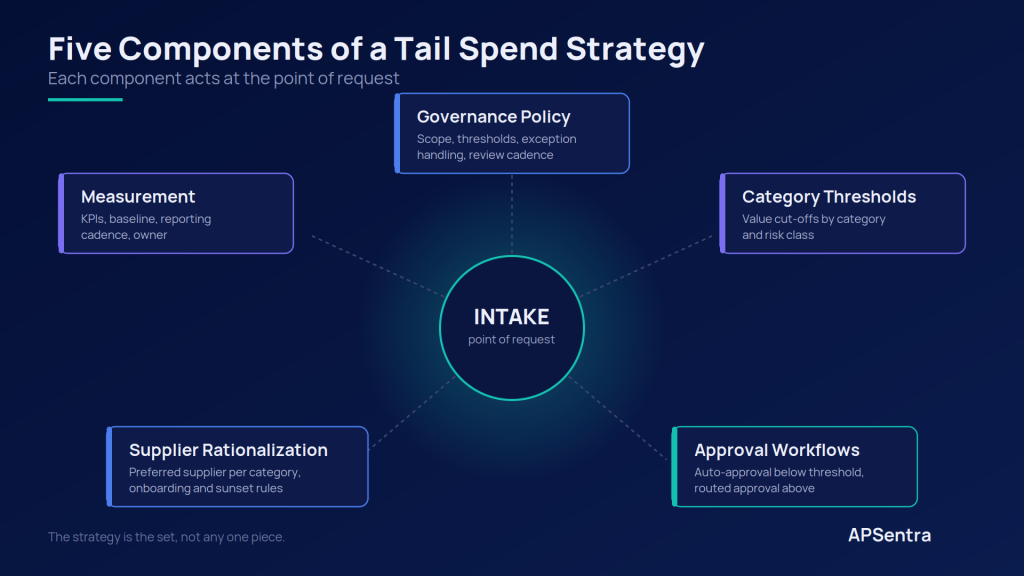
Five components, each answering a question the CFO will ask.
| Component | Question it answers | What it specifies |
|---|---|---|
| Governance policy | What are the rules, and who set them? | Scope, thresholds, preferred channels, exception handling, review cadence |
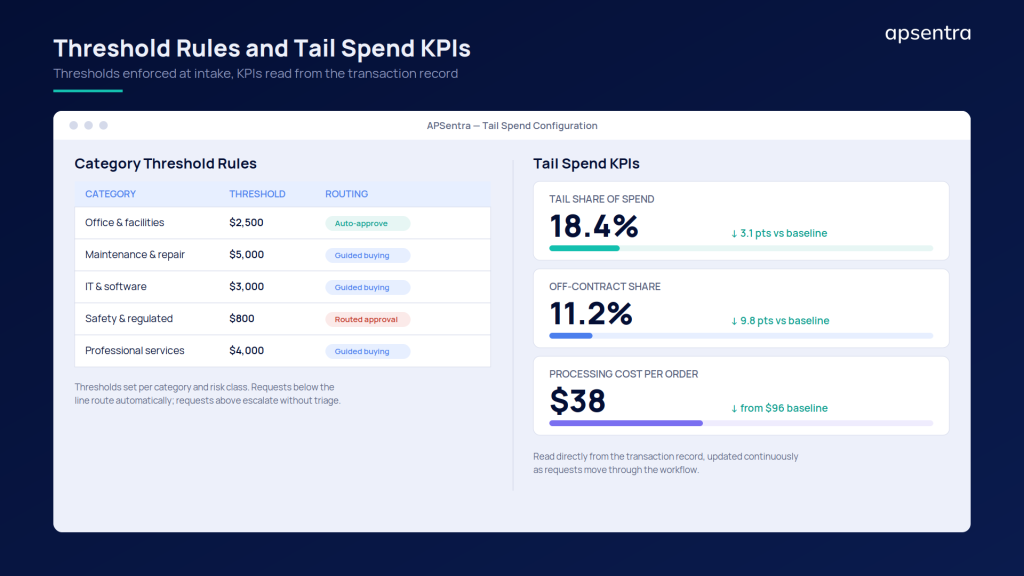
| Category thresholds | What counts as tail, and does it differ by category? | Value cut-offs by category and risk class; what falls below and how it is handled |
| Approval workflows | Who approves what, and how fast? | Auto-approval within budget below threshold; routed approval above; escalation for exceptions |
| Supplier rationalization | Who should we buy from, and how many? | Preferred supplier per tail category; onboarding rules for new suppliers; sunset plan for duplicates |
| Measurement | How will we know it is working? | KPIs, baseline, reporting cadence, owner |
The components are interdependent. A threshold without an approval workflow behind it is a number in a document. A preferred supplier list without guided buying at intake is a list nobody consults. The strategy is the set, not any one piece.
Setting Thresholds: What Counts as Tail for Your Organization
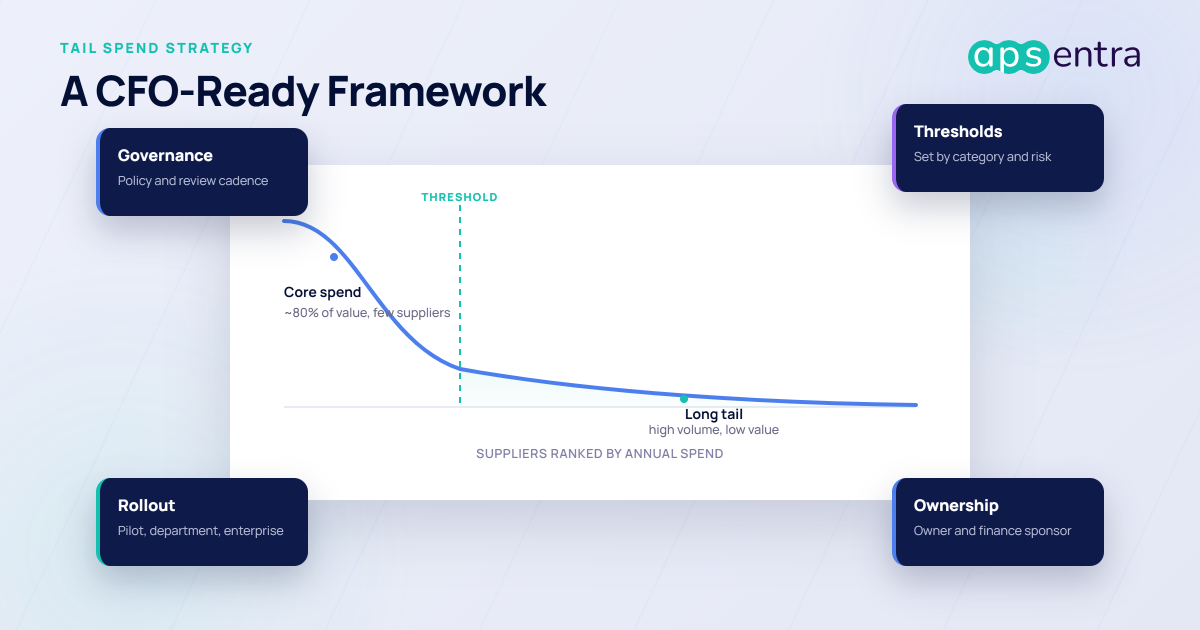
The 80/20 rule is where most strategies start and where many stop. It is a description of the shape of spend, not a threshold. The threshold is the value below which a purchase is handled by the tail process rather than by sourcing, and it should be set on your own data.

Start from the spend distribution

Adjust by category risk

Adjust by processing cost

Common landing points
| Threshold band | Handling | Typical control |
|---|---|---|
| Below micro-purchase value | Auto-approved within budget, catalogue or card | Budget check, catalogue routing, monthly review |
| Micro-purchase value to tail threshold | Guided buying, preferred supplier, single approval | Supplier match, one approver, PO issued automatically |
| Tail threshold to sourcing threshold | Three quotes or framework call-off, routed approval | Quote record, category owner approval |
| Above sourcing threshold | Competitive sourcing | Out of scope for the tail strategy |
Write the thresholds down with the date and the data they were set on, and re-run the distribution annually. Thresholds set in a growth year are usually wrong two years later.
Building the Business Case
A CFO does not fund tail spend management because the tail is untidy. The case has to be stated in the three currencies finance recognizes.

Processing cost

Price and leakage

Risk and compliance
Our analysis of why procurement ROI fails CFO scrutiny covers the evidence standard finance applies; the tail strategy business case should meet it before it is presented, not after. For the wider framing of procurement as a margin lever, see our guide to CFO-CPO alignment.
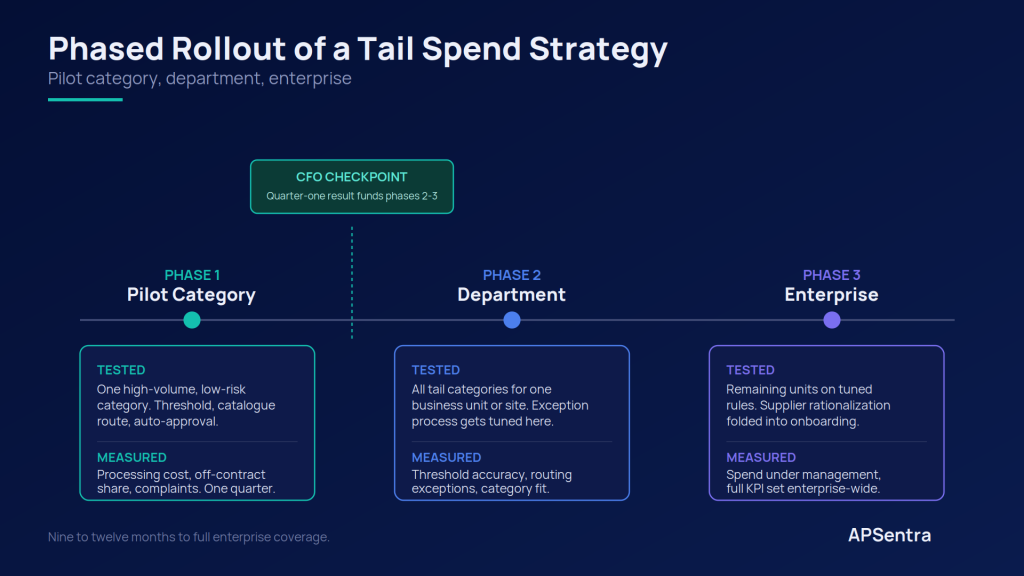
Phased Rollout: Pilot Category, Department, Enterprise
Rolling out the whole strategy at once produces exceptions faster than anyone can process them. Three phases keep it manageable and produce evidence at each step.
Phase 1: pilot category. Choose one high-volume, low-risk category with a small preferred supplier set, office supplies or maintenance consumables are typical. Implement the threshold, the catalogue or preferred-supplier route and the auto-approval rule for that category only. Run for one quarter. Measure processing cost, off-contract share and user complaints.
Phase 2: department. Extend to all tail categories for one business unit or site. This is where the exception process gets tested, because a department has purchases the pilot category did not anticipate. Tune thresholds and routing here; this is the last cheap place to do it.
Phase 3: enterprise. Roll out to remaining units with the tuned rules. Where units have their own suppliers, run the supplier rationalization as part of onboarding to the process rather than as a separate project.
The phased model has a second benefit: the pilot produces a measured result within a quarter, which is the evidence the CFO needs to fund phases two and three. The same logic governs any procurement transformation roadmap; the tail is often the best first phase because the volume makes results visible quickly.
Governance and Ownership: Who Owns the Strategy Long-Term
The most common reason a tail strategy decays is that nobody owns it after the project team disbands. Ownership needs three layers.
Policy owner. A named procurement leader owns the policy document, the thresholds and the annual review. This is a role, not a committee.
Category owners. Each tail category has a named owner responsible for the preferred supplier list and for approving exceptions in that category. In smaller functions one person owns several categories; the point is that every category has a name against it.
Finance sponsor. A finance leader co-owns the KPIs and the savings definition, so that results are recognized in finance’s terms. Deloitte’s 2025 Global Chief Procurement Officer Survey found 57 percent of CPOs cite siloed ways of working as their leading barrier to value; a tail strategy without a finance sponsor is a silo by design.
“Every override is a liability. All the company’s money flows through procurement.”
— Mauricio Dezen, VP Professional Services and Customer Success, APSentra, on the Behind Procurement LinkedIn Live
Governance also needs a review cadence: monthly KPI review by the policy owner, quarterly review with the finance sponsor, annual threshold reset on fresh data.
Technology’s Role in Sustaining the Strategy
Every component of the strategy has a point where it either lives in a system or lives in people’s memory, and the second decays.
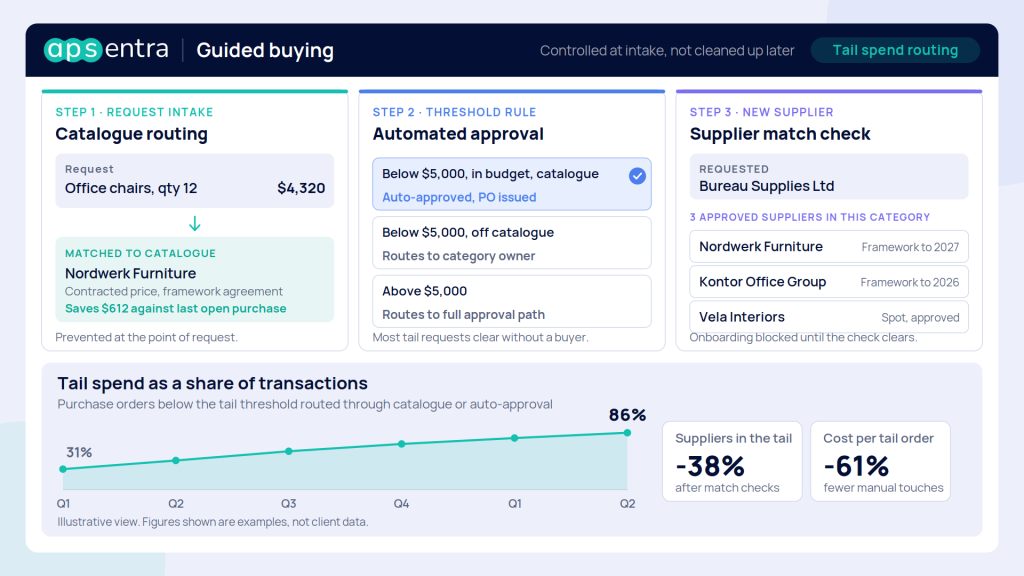
Thresholds live in the approval rules of a source-to-pay platform, where a request below the line is auto-approved within budget and a request above it is routed, without a buyer checking. Preferred suppliers live in guided buying at intake, where the requester is steered to the catalogue or the approved supplier before a maverick purchase happens.
Supplier rationalization lives in the onboarding workflow, where a new supplier request is matched against existing approved suppliers in the same category. Measurement lives in the reporting layer, where tail share, off-contract share and processing cost per order are read from the transaction record rather than assembled by hand.
The question of whether to buy that capability, build it, or hire a service provider to run the tail for you is covered in our comparison of tail spend management services. The short version: services can hold the line during implementation; only the system changes the intake.
Strategy Document Template
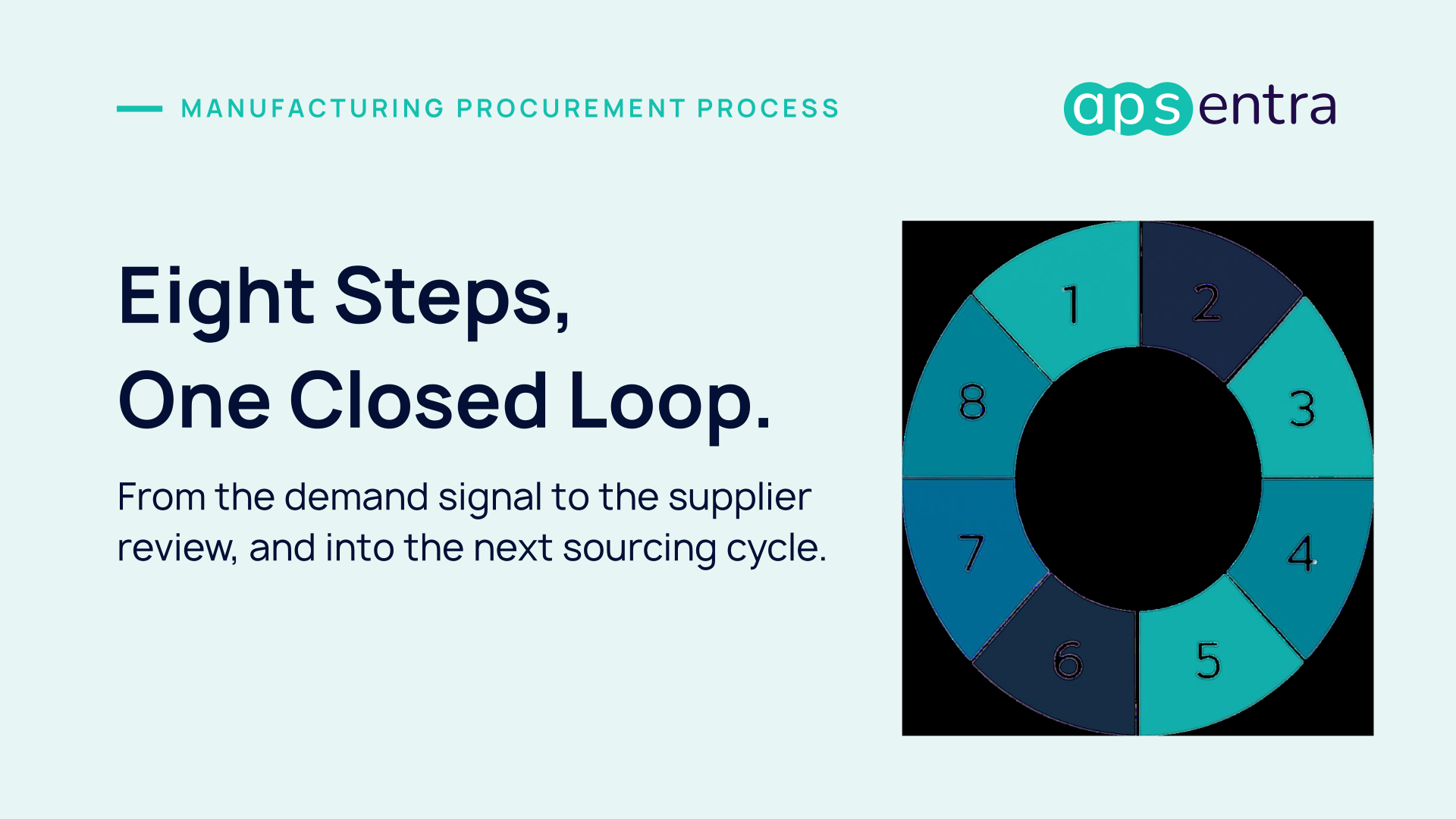
The document leadership approves should be short enough to read in one sitting and specific enough to be audited against. Eight sections.
- Purpose and scope. What tail spend means here, which categories and entities are in scope, and what is explicitly excluded.
- Baseline. Tail spend value, transaction count, supplier count, off-contract share and processing cost per order, with the date and the data source.
- Thresholds. The value bands by category and risk class, how they were derived, and the review date.
- Channels and routing. Catalogue, preferred supplier, purchasing card and exception path, with the rule for each band.
- Approval workflow. Who approves what, auto-approval conditions, escalation and exception recording.
- Supplier policy. Preferred suppliers by category, onboarding requirements, duplicate sunset plan.
- Ownership and governance. Policy owner, category owners, finance sponsor, review cadence.
- KPIs and targets. Tail share of spend, off-contract share, supplier count, processing cost per order, approval compliance, with quarterly targets for the first year.
Attach the business case as an appendix in finance’s format, and the phased rollout plan with dates. That is the whole document; anything longer is a project plan wearing a strategy’s title.