AI Procurement Workflows That Improve Decision Quality
Most organizations implementing AI in procurement expect the same thing: faster decisions, less manual work, and sharper spend control. Many get the speed. Fewer get the decisions.
The gap is not a technology failure. It is a design failure. AI amplifies whatever logic it operates within. When that logic is ambiguous, inconsistent, or disconnected from financial reality, the output reflects those same weaknesses at higher volume.
This article examines why AI procurement workflows frequently increase output without improving decision quality, and what it takes to design a workflow that actually changes outcomes rather than just accelerating the existing process.
1. The Speed Trap: When AI Delivers Volume Without Clarity
AI adoption in procurement is accelerating. According to the 2025 Annual ProcureCon CPO Report, 80% of CPOs consider AI investment a priority over the next 12 months. A separate 2025 survey of Chief Procurement Officers found that 68% identified enhanced analytics and decision-making as the top value driver of AI, ranking it above productivity gains.
The intent is clear. The results are more complicated.
A 2025 study by MIT found that 95% of enterprise AI pilots deliver no measurable business impact. S&P Global Market Intelligence reported that 42% of businesses scrapped most of their AI initiatives in the same year. These figures do not indicate that AI lacks value in procurement. They indicate that organizations are implementing AI before establishing the conditions that allow it to function.
Speed is the most visible output of AI. When a workflow that previously took three days is compressed into three hours, the improvement is immediate and easy to report. What is harder to measure and often overlooked entirely is whether the decisions produced by that compressed workflow are better, worse, or simply faster versions of what was happening before.
An AI system that routes a reorder recommendation in seconds, based on flawed demand assumptions, produces a faster version of the same poor decision. The velocity is new. The error is not.
“AI surfaces insights and recommendations, but accountability, validation, and exception management stay firmly with procurement professionals.”
— Supply Chain Management Review, 2026
2. Why Unclear Decision Logic Produces Inconsistent Outputs
Every AI procurement workflow encodes assumptions about how decisions should be made. The problem is that in most organizations, those assumptions are never made explicit. They exist informally, distributed across team members, category managers, and approval chains, and understood differently by different people.
When AI is deployed on top of that ambiguity, it does not resolve it. It scales it.
Consider a reorder recommendation. The AI system calculates a trigger based on inventory levels, lead time, and historical usage. The output looks precise. But if the underlying logic does not account for current cash constraints, supplier payment terms, or a pending contract renegotiation, the recommendation may be technically correct and operationally inappropriate at the same time.
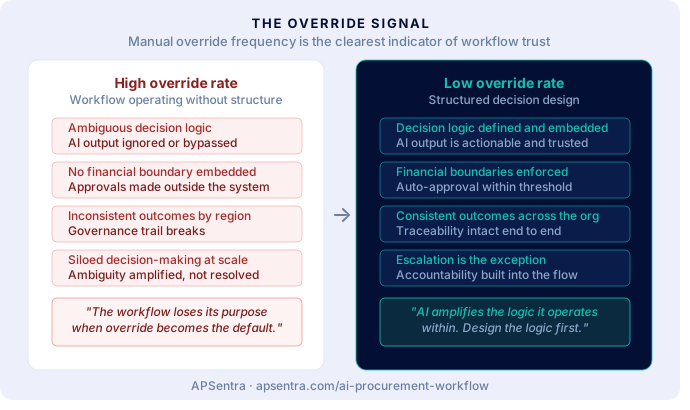
Procurement teams in this position face a choice between trusting the output and overriding it. When the logic is opaque, override becomes the default. When override becomes the default, the workflow loses its purpose.
The Consistency Problem at Scale
Inconsistency is not just a quality issue. It is a governance issue. When different team members apply different judgment to the same AI output, approving in one region, rejecting in another, escalating in a third, the organization loses the traceability that justifies workflow investment in the first place.
Deloitte’s 2025 Global CPO Survey identified siloed working as the top barrier to value delivery for AI in procurement, cited by 57% of CPOs. Siloed working is, in part, a symptom of decision logic that has never been standardized across functions. AI does not fix that silo. It inherits it.
APSentra structures procurement workflows around your organizational logic, approvals, thresholds, and financial rules built in, not bolted on. Schedule a demo to see it in operation.
3. The Override Problem: When Teams Bypass the Workflow
One of the clearest signals that an AI procurement workflow is not functioning is the frequency of manual override. When teams consistently bypass AI outputs at critical decision points, it is not because the technology is underperforming. It is because the workflow was not designed in a way that makes the AI output trustworthy enough to act on.
This pattern is well-documented. Research published in The AI Journal in 2026 found that AI procurement systems designed without meaningful involvement from the people who interact with underlying processes daily are “consistently ignored, worked around, or actively undermined.”
The report notes that an AI recommendation that does not align with how teams understand their own workflows will be overridden regardless of its analytical validity.
Override is a form of feedback. It signals that the gap between what the AI recommends and what the team actually needs is wide enough that the manual path feels safer than the automated one.
Three Common Override Triggers
- The AI recommendation conflicts with a financial constraint that was not encoded into the workflow
- The output is based on data that the team knows to be incomplete, outdated, or context-blind
- There is no documented accountability for what happens when the AI recommendation turns out to be wrong
None of these are technology problems. Each one is a design problem that existed before the AI was deployed, and the AI, without a proper foundation, cannot self-correct.
4. Financial Constraints Are Not Optional Inputs
Procurement decisions do not exist in isolation from financial reality. Every sourcing commitment, every purchase order, every supplier agreement carries cash implications that extend well beyond the moment of approval. Working capital, payment timing, cash flow cycles, and budget allocation are not upstream considerations that finance handles separately. They are part of the decision itself.
This is where many AI procurement workflows fail most consequentially. When financial boundaries are not embedded in the workflow logic, and the AI operates on procurement data without direct integration with cash position, budget state, or commitment exposure, the outputs are structurally incomplete.
“Procurement and finance often evaluate the same decision from different layers. Procurement focuses on cost and efficiency. Finance focuses on cash timing and working capital. This gap creates a silent misalignment in how decisions are approved, executed, and evaluated.”
— Sharon Custer, Founder, Inventory Optimization Pro
A reorder suggestion that the AI flags as optimal may be financially premature. A contract renewal that the workflow approves on compliance grounds may conflict with a cash constraint that finance is managing in real time.
Without structural connectivity between procurement logic and the financial state, AI operates on a partial picture and produces recommendations that finance must then correct manually after the fact.
This is not a failure of AI capability. It is a failure of integration design. The workflow was built to optimize a procurement variable without incorporating the financial variables that determine whether the output is actually viable.
What Financial Integration in Workflow Design Requires
- Defined thresholds for purchase commitment relative to available budget and cash position
- Visibility into payment term implications before approval, not after
- Escalation logic that routes decisions to finance when commitment depth exceeds defined risk parameters
- Audit trails that connect each procurement decision to the financial rationale that governed it
5. Speed Without Structure Compounds Rework
There is a reasonable assumption that faster procurement cycles reduce cost. In many cases, that is true. But speed without structural discipline does not eliminate rework. It accelerates the production of work that has to be corrected.
When an AI workflow routes a recommendation that teams do not trust, the result is not a faster decision. The result is a decision that gets escalated, reversed, or manually reconstructed outside the workflow. The AI produced an output. The organization incurred the cost of that output and then incurred additional costs to address it.
The Hackett Group has estimated that AI in procurement has the potential to reduce SG&A costs by up to 40%. That figure describes what is possible when AI is operating within a disciplined, well-structured workflow.
It does not describe what happens when AI is layered over an undisciplined process. In that scenario, the AI may reduce time-to-output while increasing total cycle cost through elevated error rates, exception volume, and manual correction load.
Rework Patterns in Underdeveloped AI Workflows
- Finance rejections of AI-approved commitments due to missing budget context
- Compliance exceptions were generated when policy logic was not fully encoded at implementation
- Supplier conflicts arising from automated reorders placed without coordinating existing contract terms
- Cross-functional misalignment when AI routes approvals without clarity on decision authority
Each of these patterns is recoverable. Each one also represents a cost that the organization would not have incurred if the workflow had been designed with structure from the start.
6. Decision Design: The Foundation AI Cannot Supply Itself
The core issue in underperforming AI procurement workflows is not that the AI is insufficient. It is that decision design, the explicit definition of what a good decision looks like, under what conditions, and with what accountability was never completed before the AI was deployed.
AI executes logic. It does not create it. If the organization cannot clearly articulate the rules that govern a procurement decision, the thresholds, the escalation paths, the financial boundaries, and the approval authorities, then deploying AI will not supply that clarity. It will execute whatever partial logic exists and produce outputs that reflect that incompleteness.
McKinsey’s 2025 State of AI report found that only 22% of organizations have a company-wide AI scaling strategy in place, even as 65% of senior leaders expect AI to improve operating margins within two years. That gap between expectation and governance readiness is not a gap in technology. It is a gap in the organizational work that technology cannot substitute for.
Decision Design Involves Four Disciplines
These are not implementation tasks. They are strategic tasks that must be completed before implementation begins. Organizations that complete them build AI workflows that perform as expected. Organizations that skip them build workflows that are fast but structurally unreliable.

Decision mapping
Boundary definition

Accountability assignment

Exception governance
7. What a Well-Designed AI Procurement Workflow Actually Looks Like
A well-designed AI procurement workflow does not attempt to eliminate human judgment. It removes friction from structured decisions so that judgment can be applied where it matters most.
The distinction matters. AI governance frameworks for procurement, including those recommended by Gartner and applied by mature procurement organizations, emphasize explainable decision logic, clear ownership of AI outputs, and human-in-the-loop review for high-stakes decisions.
The goal is not full autonomy. The goal is structured collaboration between AI capability and human accountability.
Structural Characteristics of High-Performing AI Workflows
- Intake design that captures financial and operational context at the point of request, before the decision reaches an approver
- Policy logic that is embedded in the workflow, not referenced informally. Rules govern routing automatically; exceptions surface for human review rather than bypassing the system entirely
- Financial integration that connects procurement decisions to the live budget state, cash position, and commitment exposure, rather than operating on static data
- Authority mapping that routes decisions to the right approver based on commitment depth, risk level, and category, consistently, across geographies and functions
- Audit trails that document why each decision was made, what inputs governed it, and who authorized it
These characteristics are not advanced features. They are baseline requirements for a workflow that is designed to improve decision quality rather than just accelerate decision volume.
The Role of the Digital Organizational Model
One of the more consequential design choices in enterprise AI workflows is whether the system reflects the actual structure of the organization, its reporting lines, approval authorities, financial ownership, and cross-functional dependencies, or operates on a simplified abstraction that does not match operational reality.
Workflows built on an accurate organizational model route decisions correctly, surface exceptions to the right stakeholders, and maintain accountability alignment as the organization evolves. Workflows built on an abstraction produce routing errors, approval gaps, and accountability confusion that compound over time.
APSentra is built around a digital twin of the organizational structure and procurement workflow, the precise connectivity between authority, process, and financial context that allows AI to operate within defined decision boundaries rather than beyond them.
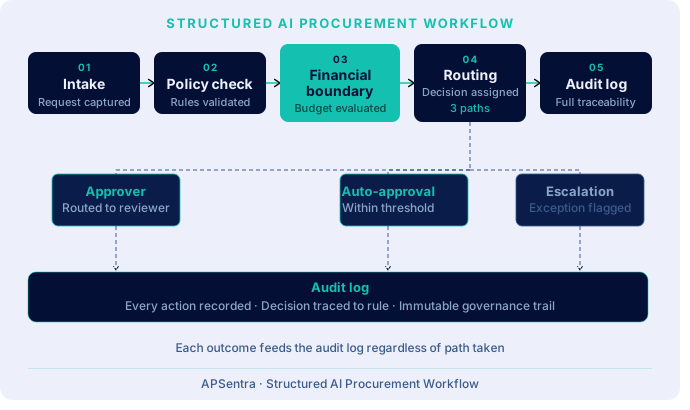
APSentra gives procurement and finance teams a shared operational foundation, structured workflows, embedded financial controls, and full decision traceability across the enterprise. Schedule a demo to see how it works in your environment.