Pharma Procurement Without Friction: Spend Control Stakeholders Follow
The instinctive fix is more process. In practice, procurement structures that add steps without making buying easier push stakeholders around the system rather than through it. Between us, we have seen this problem from both sides: from inside a global pharma procurement function and across the procurement teams APSentra works with. In this article, we look at where control actually slips and what a structure that stakeholders follow looks like in day-to-day operations.
What is pharma procurement governance? Pharma procurement governance is the set of policies, approval workflows, and systems that control how a pharmaceutical company selects suppliers, commits budget, and pays for external goods and services, including R&D, clinical, and commercial categories, so finance sees spend at the point of commitment rather than at invoice.
Why external spend escapes control in pharma procurement
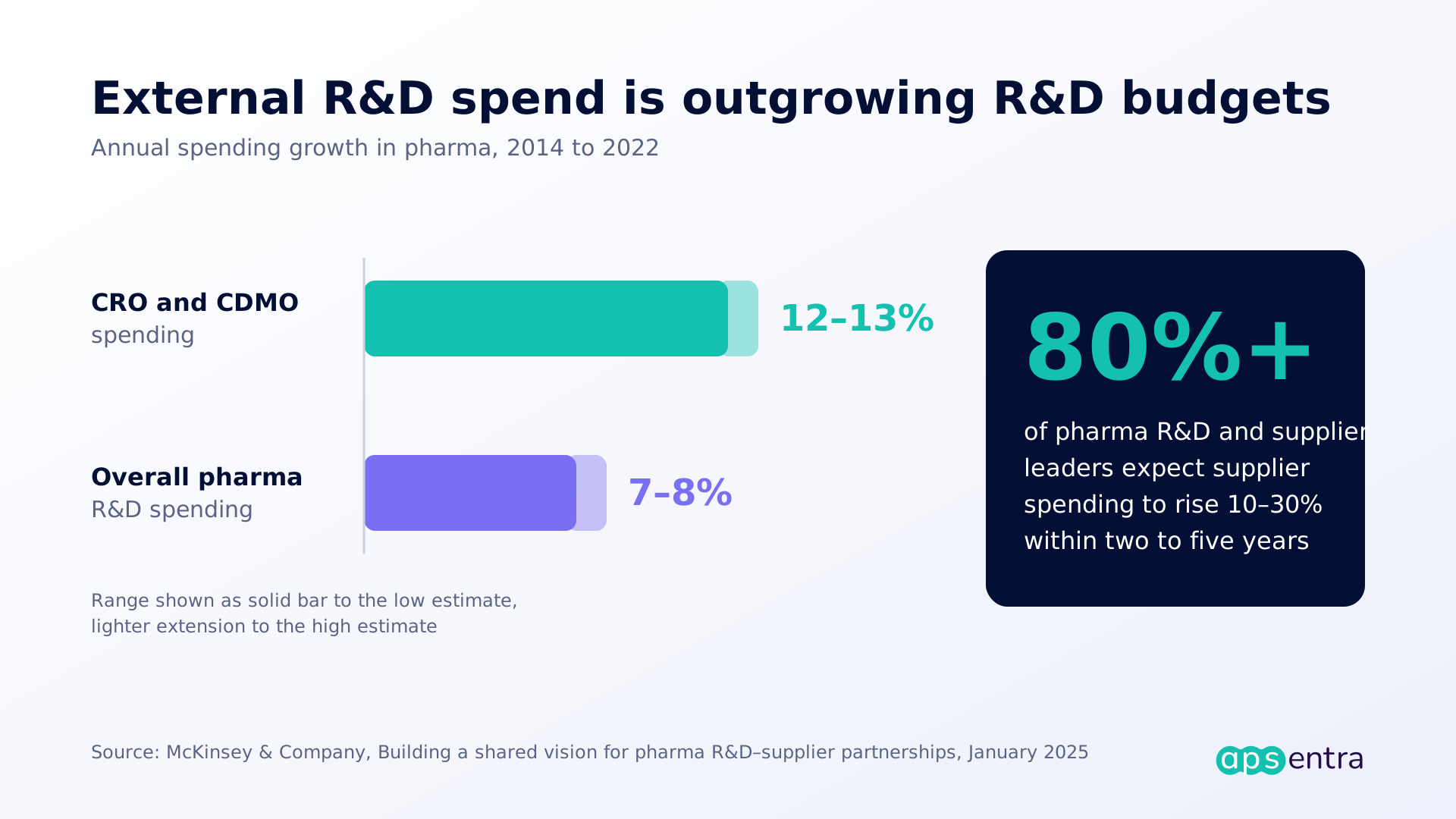
The pharmaceutical industry now buys a large part of its innovation. According to McKinsey’s 2025 analysis of pharma R&D–supplier partnerships, spending on contract research and contract development and manufacturing organizations grew 12 to 13 percent a year between 2014 and 2022, roughly twice the pace of overall R&D spending. More than 80 percent of the R&D and supplier leaders McKinsey surveyed expect supplier spending to rise by another 10 to 30 percent within two to five years.
The same pattern runs through commercial and corporate categories. Marketing agencies, market research, medical communications, and consulting all depend on external partners, and each category has its own buyers, budgets, and preferred vendors. The result is a supplier base that grows faster than the controls around it.
At APSentra, we see the same pattern well beyond pharma. Our clients in agriculture and food processing face the same fragmentation, and the core problems look remarkably similar, regardless of the industry.
McKinsey’s research points to the gap directly. Many pharma–supplier relationships still lack transparent governance and joint accountability, and the firm lists a strong procurement and contracting function, with systems to monitor supplier performance, compliance, and risk, as the first enabler of a mature partnership. In other words, the value of external spend depends on the structure that surrounds it.
Three conditions make this structure harder to build in pharma than in most industries:

Expert-led demand

Fluid scope

Regulated suppliers
Committed spend visibility: why PO coverage matters to finance
A purchase order is more than paperwork. It records a financial commitment at the moment the business makes it, which is why PO coverage, the share of spend that has an approved PO before the invoice arrives, is one of the most telling governance metrics in pharmaceutical procurement.
When coverage is low, finance manages by surprise. Commitments happen in emails, statements of work, and verbal agreements with long-standing vendors, and the budget impact surfaces weeks later in accounts payable.
One of us (Alan) saw this firsthand. In one European business unit, PO coverage sat at around 40 percent on hundreds of millions of dollars of annual spend. Without a view of what had already been committed, the business was simply waiting for invoices to arrive and finding out at month-end what it had spent.
Raising PO coverage changes the relationship between procurement and finance. Committed spend becomes visible as it happens, budget owners can see what remains available, and finance can forecast against approved commitments rather than against last month’s invoices. At APSentra, we call this budget control at the point of commitment: every request is validated against the available budget before approval, so overruns surface before they happen.
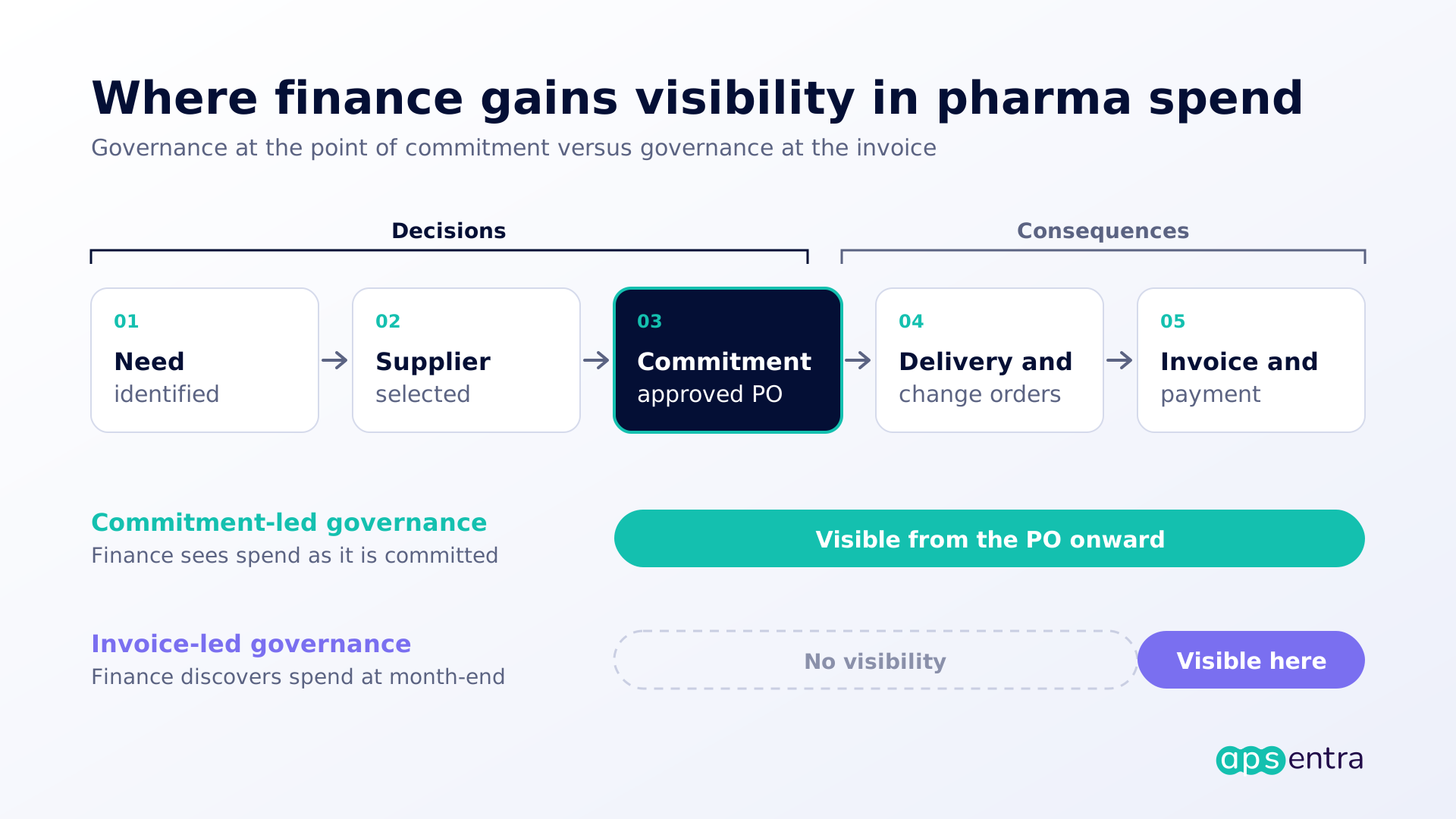
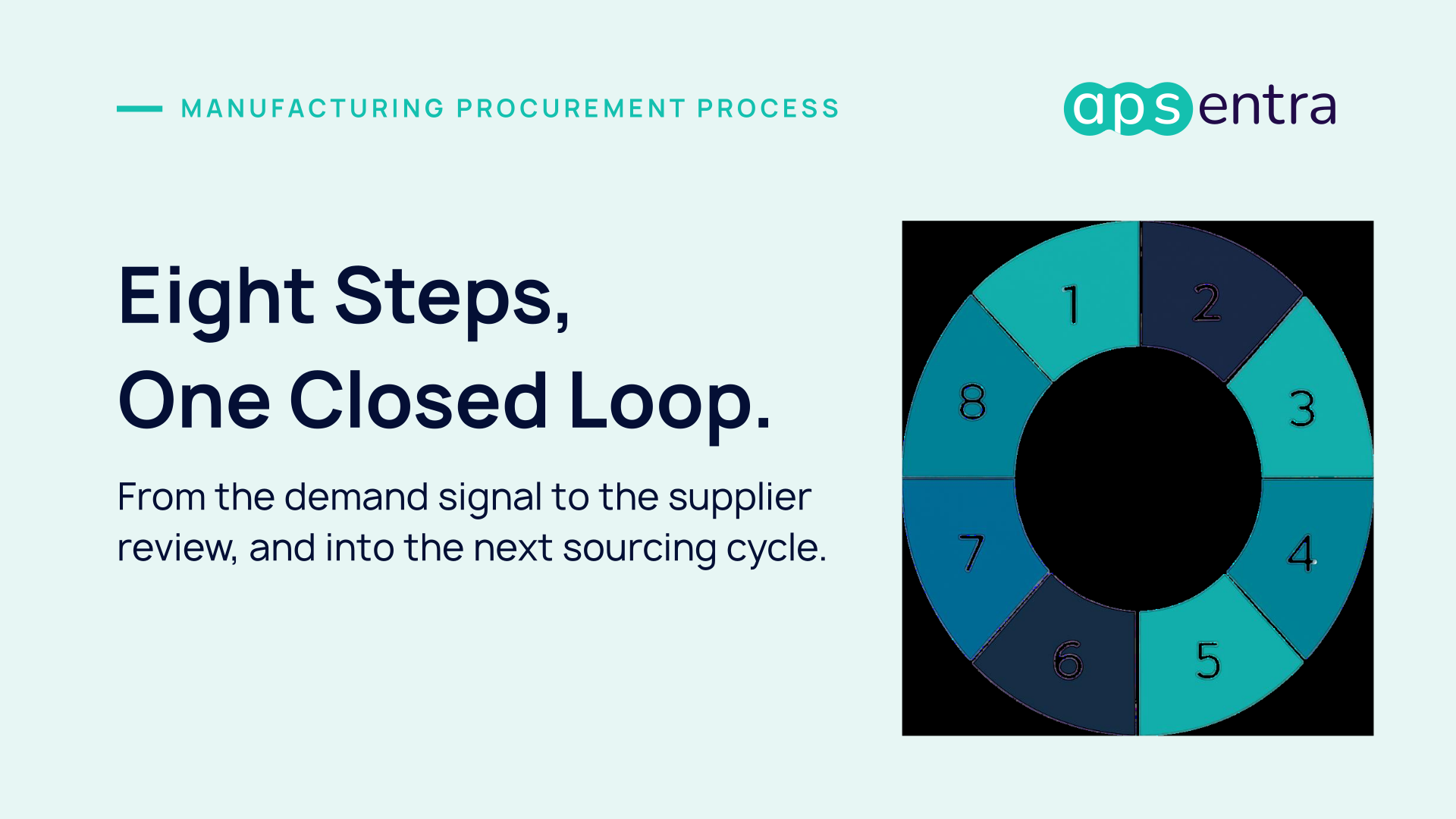
The lifecycle above shows why the PO is the pivot point. The approved PO closes the decision phase, and everything after it is a consequence of choices already made. Governance that starts at the invoice can only report on them.
Who really selects suppliers for R&D and external services
In most pharma organizations, the honest answer is the budget owner. A clinical lead chooses the CRO they trust, a brand team keeps working with its agency, and procurement joins at the contract stage to formalize a decision that has already been made. That is not a failure of discipline. It reflects where the expertise sits.
The question is how procurement adds value without taking the decision away from the experts. McKinsey’s answer is alignment rather than control: cross-functional teams, joint planning, and supplier strategies informed by business goals, combined with leadership that reviews spend analysis regularly.
One of us (Alan) saw what that alignment looks like while managing agency spend in global pharma. Instead of routing every request through a sourcing event, his team defined scope and complexity levels in advance, consolidated what many teams were buying from many suppliers, and gave stakeholders a pre-negotiated path to buy. The model eventually covered around $800 million in spend and later extended into market research and R&D categories.
“We managed it strategically from procurement, and then we built the tactical piece so stakeholders could go and buy what they needed. Every six months we went back into the data: here’s where we’re trending, here’s what’s changing, here’s what we need to adjust. You’re managing the spend instead of reacting to the spend that’s coming at you.”
— Alan Salter, Founder, Caravel International Partners
The pattern is worth noting. Procurement owns the framework, the commercial terms, and the analysis. Stakeholders own the day-to-day choice within that framework. Neither side has to slow the other down.
Structured RFPs and decision quality
Supplier selection is where subjective judgment most often overrides evidence. Large RFPs in pharma involve dozens of evaluators, long questionnaires, and suppliers who know how to present themselves well. Without structure, the final discussion drifts toward reputation and anecdote.
“When it comes to making a choice, the conversation becomes very subjective. Someone says, ‘I heard this about them.’ And I’ll say, that’s fine, but you scored them fours across the board. Why, if that was in the back of your mind? I always used the scoring to back the decision up.”
— Alan Salter, Founder, Caravel International Partners
Scale makes the case even stronger. When Alan refreshed a preferred supplier list for market research, the process started with 100 to 120 suppliers and narrowed to 50 or 60. One RFP he designed contained 112 questions; the evaluation team chose to score it by section, with small groups discussing each set of answers before agreeing on a grade. Both are workable in a system and close to unmanageable in spreadsheets.
| Dimension | Spreadsheet-based RFP | System-based RFP |
|---|---|---|
| Supplier responses | Suppliers can edit the template and answer in their own format | Fixed questions, required fields, and response limits |
| Deadlines | Tracked manually by email | Enforced for every participant |
| Scoring | Individual files consolidated by hand | Weighted scoring by question or section, visible to the panel |
| Audit trail | Scattered across inboxes | Complete record of invitations, responses, and scores |
| Scale | Practical for a handful of suppliers | Workable for 100+ invited suppliers |
The benefit reaches all three parties. Stakeholders evaluate in one place, procurement runs the process without chasing files, and suppliers know exactly what is expected of them. For a regulated industry, the audit trail matters as much as the efficiency: the organization can show how and why a supplier was chosen.
Supplier qualification and the realistic role of AI
In pharmaceutical procurement, a supplier is not qualified because the price is right. Quality certifications, regulatory documentation, insurance, data protection terms, and audit history all have to be collected, checked, and kept current. In most organizations this work is still manual, and it slows sourcing events long before commercial negotiation starts.
This is one of the clearest places for AI to help, provided expectations stay grounded. At APSentra, we are building AI-assisted document analysis for a client in food production, where safety certifications create a similar burden. The same logic applies in pharma, where the stakes are higher. AI can read submitted documents, verify that required certificates are present and valid, flag expired or inconsistent information, and route exceptions to a qualified reviewer.
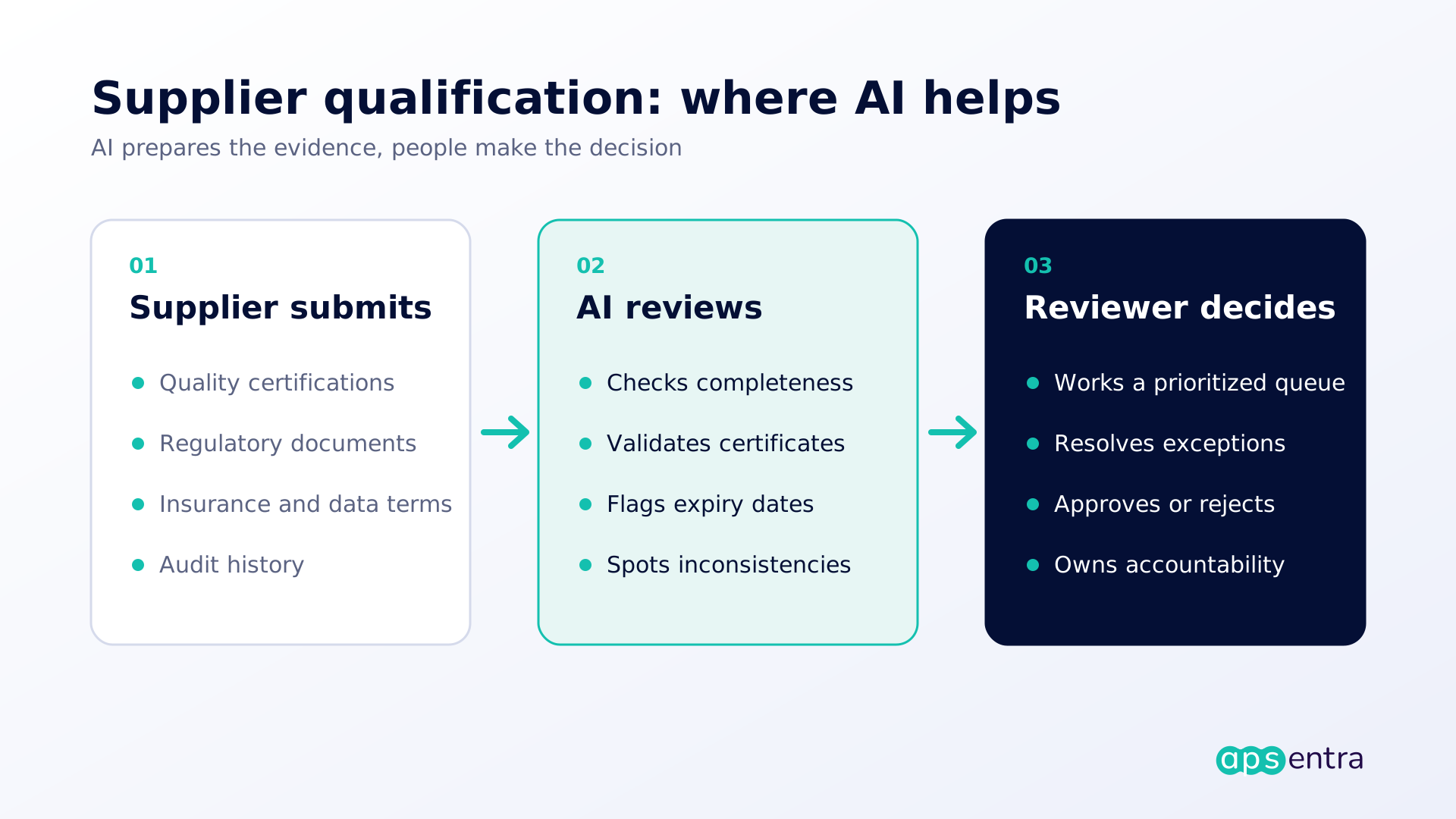
What AI should not do is make the qualification decision. Regulatory accountability stays with people, and the value of automation lies in giving reviewers a clean, prioritized queue instead of a folder of attachments. McKinsey frames AI the same way, as a tool that helps leaders analyze supplier spend and scrutinize contracts, and reports that generative AI accelerated this work by up to 80 percent in its client engagements.
In our experience, including Alan’s years managing large agency and research portfolios, the challenge is volume rather than judgment. Procurement teams are flooded with information, and centralizing it in one place is what makes analysis possible at all. AI earns its role when it works on top of structured procurement data, not in place of it.
Structure without friction: four design principles
The common thread across committed spend, supplier selection, RFPs, and qualification is the same trade-off. Pharma procurement needs enough structure to control spend and prove compliance, but not so much that stakeholders route around it.
“I can build a beautiful system with a thousand steps, and it doesn’t help the stakeholder. We need to make it easy for them, while we still control the spend with them.”
— Alan Salter, Founder, Caravel International Partners
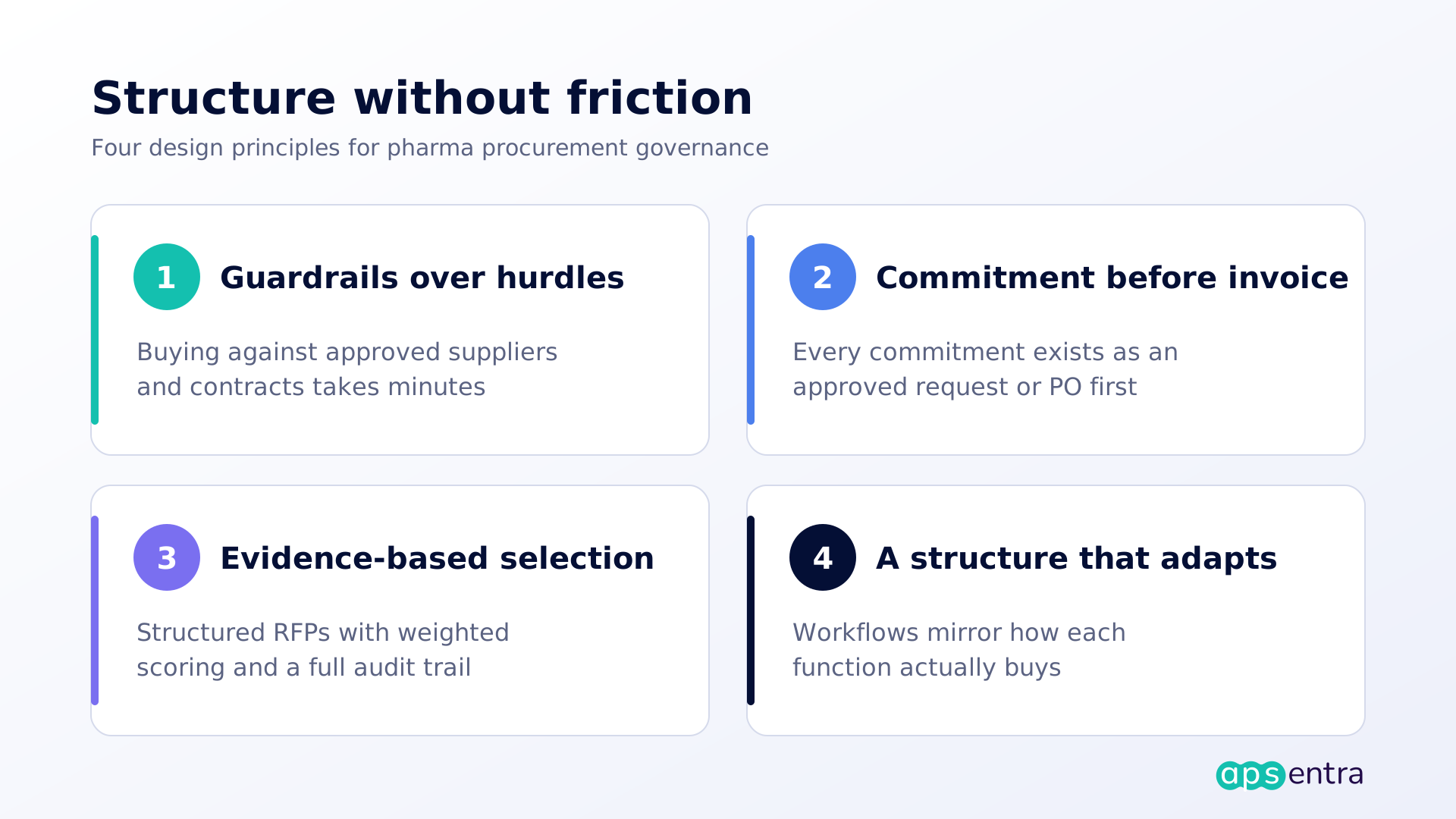

Guardrails over hurdles

Commitment before invoice

Evidence-based selection

A structure that adapts
These principles are not specific to one platform or one company size. They apply equally to a mid-sized specialty pharma business and to a global enterprise, and we see them at work in APSentra’s projects, including with a pharmaceutical distributor, where high-volume, multi-category purchasing moved onto a single structured workflow.