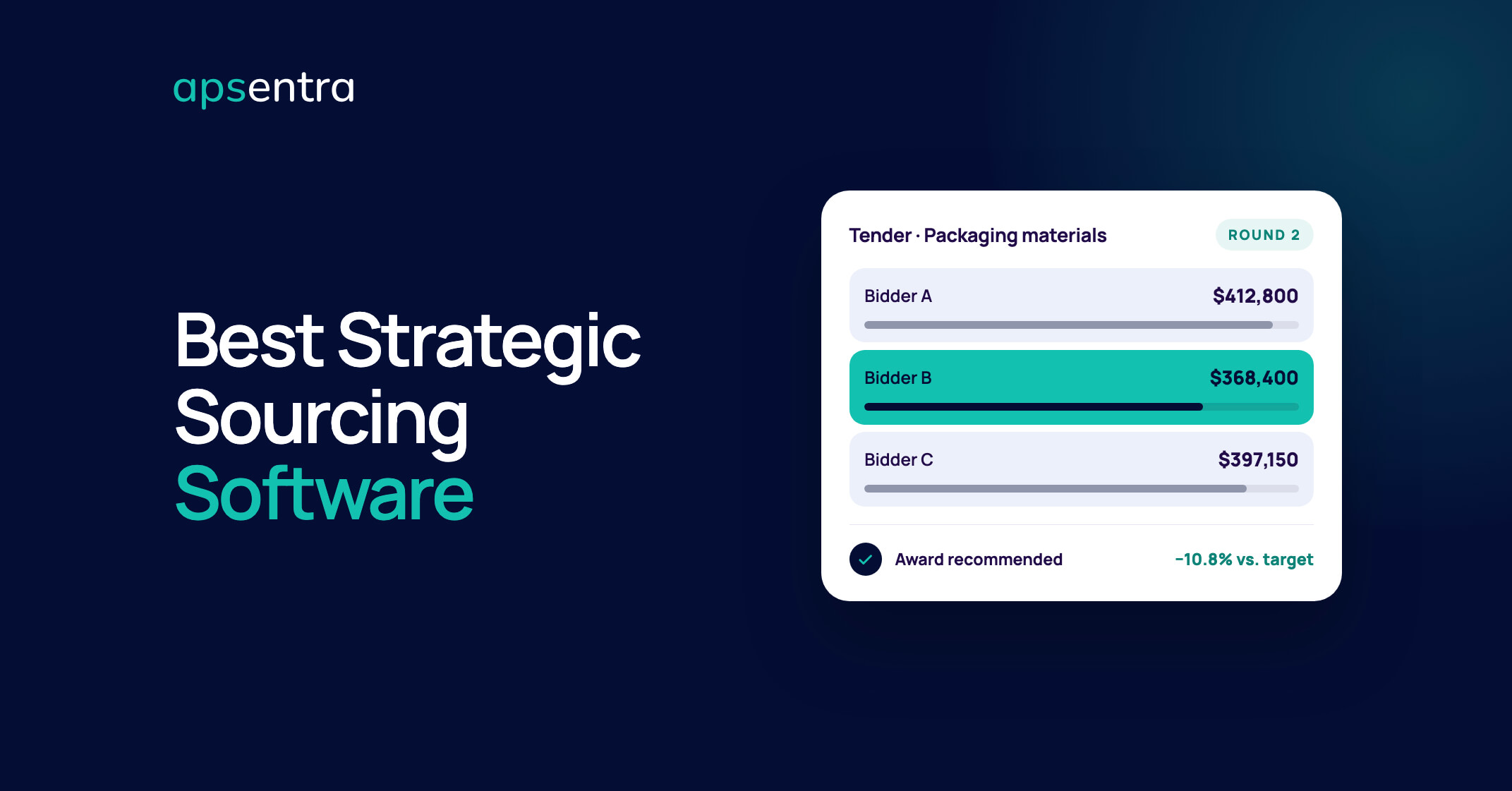
Best Strategic Sourcing Software
Quick answer:
The best strategic sourcing software in 2026 depends on what you source and where the results need to go. APSentra is our top pick for multi-entity and multinational organizations that want RFQs, RFPs and reverse auctions connected to supplier data, contracts and purchase orders in one system, configured around their own processes and live in few weeks.
Coupa and SAP Ariba are the default choices inside their own suites. GEP SMART and Jaggaer are strongest for complex and direct-materials sourcing. Ivalua and Zycus suit enterprises that want deep configuration or agentic negotiation. Full profiles, a comparison table and a buyer’s checklist follow.
What is strategic sourcing software?
Strategic sourcing software digitizes how a procurement team decides which suppliers to buy from and on what terms. It replaces emailed RFPs and bid-comparison spreadsheets with a structured workflow: spend and category analysis, supplier discovery and qualification, RFI/RFQ/RFP events, reverse auctions, bid evaluation and scoring, award decisions, and the hand-off into a contract.
The “strategic” part matters. A good platform doesn’t just collect quotes. It helps you decide what to source, how (a tender, an auction, direct negotiation or dual sourcing), and how to weigh price against total cost, supplier risk and continuity. It also keeps a record of why each supplier won, which is what auditors and CFOs eventually ask for.
Strategic sourcing vs. e-sourcing vs. a full procurement suite
These terms overlap, and vendors use them loosely. The distinction affects what you buy.
- E-sourcing tools run the event itself: RFx templates, supplier invitations, bid collection, auctions. Useful, but focused on the transaction.
- Strategic sourcing software adds the layer around the event: category strategy, spend analysis, supplier qualification and risk, multi-criteria scoring, savings tracking and decision records.
- Source-to-pay suites include sourcing as one module next to contracts, purchasing, invoicing and analytics. The advantage is that awarded prices flow straight into purchase orders. The risk is that the sourcing module is weaker than a specialist’s.
The practical question: after you award a tender, does the negotiated price automatically govern what people buy? If sourcing results live in one tool and purchasing in another, savings leak between them. That gap is why many teams now evaluate sourcing as part of a connected source-to-pay platform rather than as a standalone tool.
Signs your sourcing process has outgrown email and spreadsheets
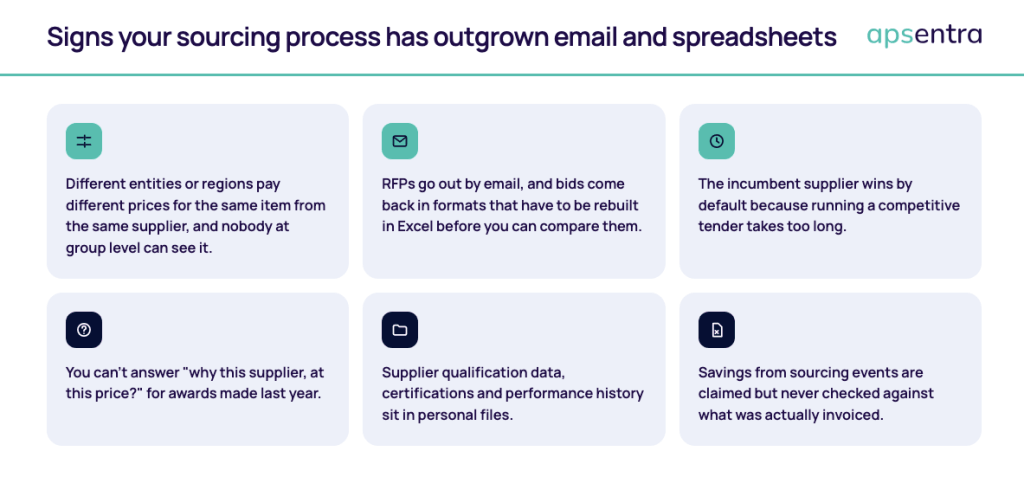
- Different entities or regions pay different prices for the same item from the same supplier, and nobody at group level can see it.
- RFPs go out by email, and bids come back in formats that have to be rebuilt in Excel before you can compare them.
- The incumbent supplier wins by default because running a competitive tender takes too long.
- You can’t answer “why this supplier, at this price?” for awards made last year.
- Supplier qualification data, certifications and performance history sit in personal files.
- Savings from sourcing events are claimed but never checked against what was actually invoiced.
If three or more of these sound familiar, the cost isn’t the software. It’s the price you’re paying without a competitive benchmark.
How we evaluated the platforms
We compared each platform on six criteria that matter to CPOs and category managers:
| Criterion | What we looked for |
|---|---|
| Sourcing event depth | RFI/RFQ/RFP, reverse and other auction types, multi-round events, lots, weighted scoring |
| Decision support and AI | Bid normalization, scenario analysis, AI-assisted supplier recommendations, autonomous sourcing for routine events |
| Supplier data and risk | Central supplier records, qualification, risk flags that feed scoring |
| Connection to execution | Whether awards flow into contracts and purchase orders without re-keying |
| Multi-entity fit | Running one tender across several legal entities, consolidating volume, local awards |
| Time to value | How long until the first live sourcing event, and how much configuration effort it takes |
Sources include vendor documentation and announcements, analyst positions as reported by vendors (the 2026 Gartner Magic Quadrant for Source-to-Pay Suites, the 2026 Gartner Market Guide for Sourcing Applications and the 2026 IDC MarketScape for AI-enabled direct spend), and G2 ratings in the strategic sourcing category as of October 2026.
We did not have access to the full analyst reports. APSentra figures are vendor-reported.
The 9 best strategic sourcing software platforms in 2026
1. APSentra — best overall for multi-entity sourcing connected to execution
Best for: multinational groups, holdings and multi-entity enterprises that want competitive sourcing to run the same way in every entity, with awarded prices enforced downstream.
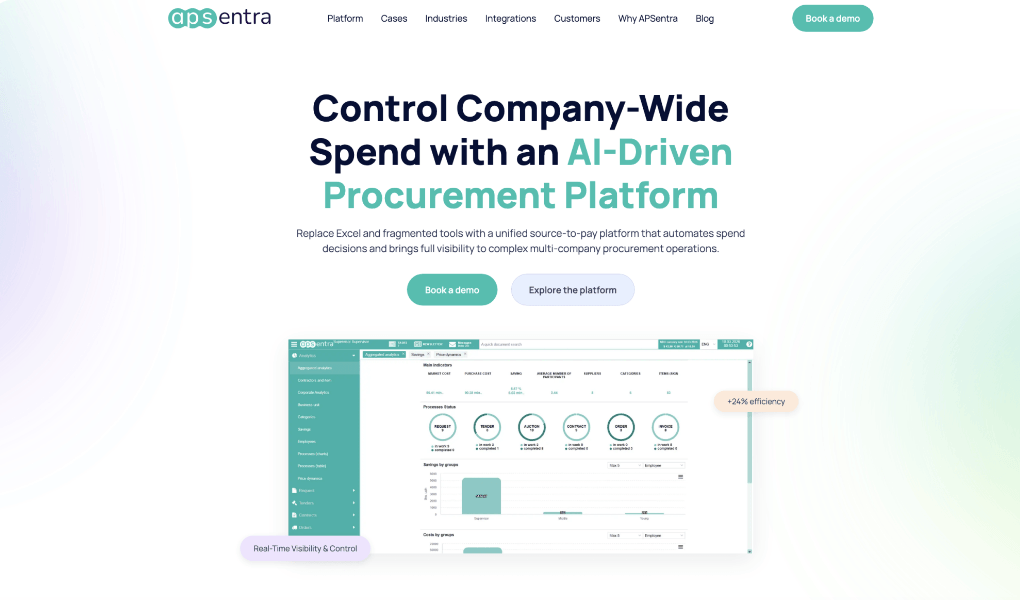
APSentra is a source-to-pay platform built on a live model of each organization: its entities, approval hierarchies, budgets and roles. Its sourcing module runs RFQs, RFPs and reverse auctions in one place, with configurable event types, weighted evaluation criteria and a side-by-side view that makes every supplier response directly comparable. The difference from the large suites isn’t company size. It’s how quickly and cheaply the platform can be shaped to the sourcing process you already run, instead of making your team adapt to a template.
Key sourcing capabilities:
- Competitive tendering: RFQ, RFP and reverse auctions, from simple price enquiries to multi-criteria tenders, with structured RFP creation, supplier invitations, digital bid submission and timeline control.
- Bid comparison and scoring: automated comparison, price normalization, scoring frameworks, multi-criteria evaluation and scenario analysis, including total cost of ownership views.
- AI-assisted sourcing: AI-powered bid analysis, historical performance weighting and risk-based supplier ranking that recommend a selection, with a person making the final call.
- Multi-entity tenders: run one category tender across several entities, consolidate volume automatically, let local teams add their own requirements, and push group pricing into local purchase orders.
- Supplier data and risk: one record per supplier with qualification, certifications and performance history, a self-service supplier portal, and financial, compliance and geographic risk flags that feed into evaluation scoring.
- Audit-ready decisions: every event’s criteria, responses, scores and selection rationale are logged automatically.
- Connected to the rest of source-to-pay: awarded terms flow into contract management, purchasing, invoice matching and spend analytics, so a negotiated rate is what actually gets paid.
Proof point (vendor-reported): at Bunge, one of the world’s largest agribusinesses, more than 200 users run strategic sourcing on APSentra. Competitive tendering delivered an average 25% cost reduction compared with direct award to the incumbent supplier. APSentra reports 130+ enterprise clients and $16B+ in savings generated across its portfolio, and a typical eight weeks to activate the sourcing module and run the first competitive tender.
Read how fragmented sourcing becomes one competitive process.
Named leadership:
- Eugene Ponomarov, Co-Founder, Procurement Strategy & Enterprise Transformation with 15+ years and 100+ transformation initiatives redesigning procurement operating models, financial governance, and spend control
- Natalie Eksi, CEO, Business Transformation & Executive Advisory — advises executive teams on turning procurement into a strategic function, bridging finance, procurement, and operations through governance and enterprise-wide transformation
- Mauricio Dezen, VP Professional Services & Customer Success, Procurement Operations Consultant — leads implementation, process optimization, change management, and adoption after the diagnostic, so the target model actually gets run as designed
- Bob Houston, Head of Partnerships, Supply Chain & Logistics Consulting — brings decades in logistics, freight, and global supply chain, with a focus on supplier collaboration and supply-chain performance beyond the purchase order itself
2. Coupa — best for sourcing inside a broad spend management suite
Best for: large enterprises already standardizing on Coupa for total spend management.
Coupa was named a Leader in the 2026 Gartner Magic Quadrant for Source-to-Pay Suites for the third consecutive year and placed highest on Ability to Execute, according to Coupa’s announcement. Its sourcing tools include RFx, auctions and sourcing optimization, and its AI draws on more than $8 trillion of anonymized spend data from its customer community.
Strengths: breadth of the suite, community benchmarks, strong analyst recognition.
G2 (strategic sourcing): 4.2/5 from 556 reviews.
Limitations: rollouts typically take several months to a year or more, and heavy customization can slow the system down. Practitioners on r/procurement describe implementations that ended up used for little more than invoicing when the underlying process wasn’t fixed first.
See how APSentra compares with Coupa.
3. SAP Ariba Sourcing — best for SAP-centric enterprises
Best for: companies running SAP S/4HANA that want sourcing on the same backbone and access to the SAP Business Network.
SAP was named a Leader in the 2026 Gartner Magic Quadrant. Next-generation Ariba has been generally available since March 2026, with Joule AI agents across intake and contracts. Ariba Sourcing supports RFx, auctions and sourcing projects, and the Business Network gives buyers a very large pool of connected suppliers.
Strengths: scale of the supplier network, native SAP integration.
G2 (strategic sourcing): 4.1/5 from 750 reviews, the largest review base in the category.
Limitations: implementations commonly run 6–18 months. User experience and supplier-side fees are recurring complaints, and some practitioners report suppliers declining to respond to RFPs sent through the network.
4. GEP SMART — best for sourcing depth plus managed services
Best for: enterprises that want strong sourcing and contract management, optionally combined with outsourced procurement services.
GEP was placed in the Leaders quadrant of the 2026 Gartner Magic Quadrant for the second consecutive year. Its AI layer is GEP Quantum Intelligence. GEP describes its platform as best suited to large organizations with complex procurement requirements.
Strengths: sourcing and contract depth on one platform, plus the option to outsource category work to GEP’s services arm.
Limitations: review analyses rate ease of use below the market average, and licensing is quote-based and sits at the enterprise end of the range.
5. Jaggaer — best for direct materials and complex sourcing
Best for: manufacturers, higher education and public-sector buyers with complex, specification-heavy sourcing.
Jaggaer was named a Leader in the IDC MarketScape: Worldwide AI-Enabled Direct Spend 2026 Vendor Assessment. It’s strong in direct-materials sourcing, supplier risk and audit trail.
Strengths: depth for direct spend and regulated sectors.
G2 (strategic sourcing): 4.1/5 from 85 reviews.
Limitations: buyers with mostly indirect spend tend to find it heavy, and its autonomous sourcing capabilities are still being developed with customers.
6. Ivalua — best for highly configurable enterprise sourcing
Best for: enterprises with IT or integrator capacity that want to configure sourcing deeply on a single data model.
Ivalua was again named a Leader in the 2026 Gartner Magic Quadrant and serves more than 500 organizations. Its no-code and low-code tools cover sourcing, supplier management and the rest of source-to-pay.
Strengths: configurability and a unified data model.
G2 (strategic sourcing): 4.4/5 from 111 reviews.
Limitations: that configurability usually needs a skilled admin or integrator, which adds time and cost compared with platforms that business admins configure directly.
7. Zycus — best for agentic negotiation and tail-spend automation
Best for: enterprises that want AI agents to run routine sourcing and negotiation.
Zycus was named a Leader in the 2026 Gartner Magic Quadrant. Its Merlin agentic AI and Merlin Intake sit at the core of its positioning, including autonomous negotiation for lower-value events.
Strengths: early and visible investment in agentic sourcing.
Limitations: practitioner reports on implementation are mixed, ranging from “a disaster to implement” to “easy to set up.” Ask for references in your industry and size band.
8. Keelvar — best for sourcing optimization and autonomous sourcing bots
Best for: sourcing teams running large, complex tenders (logistics, packaging, raw materials) and high volumes of repeat events.
Keelvar was named in the 2026 Gartner Market Guide for Sourcing Applications in two categories, Advanced Sourcing Optimization and Autonomous Sourcing. Its optimization engine handles expressive and combinatorial bidding, and its sourcing bots run routine events end to end. Customers it names include Coca-Cola, Maersk and Mars.
Strengths: optimization depth for complex award scenarios.
G2 (strategic sourcing): 4.7/5 from 45 reviews.
Limitations: it’s a sourcing specialist, not a full suite, so contracts, purchasing and invoicing live in another system that awards must be pushed into.
9. Fairmarkit — best for tail-spend sourcing
Best for: enterprises that want to bring competitive bidding to the long tail of low-value purchases.
Fairmarkit describes itself as an autonomous sourcing platform, with AI agents for intake, supplier discovery, RFx execution and bid evaluation. It reports that teams manage 10x more events per buyer and that automation rules cut tail-spend cycle time by 60%. It syncs with ERP and P2P systems, including SAP Ariba and SAP S/4HANA.
Strengths: fast, low-touch competitive bidding where most suites aren’t economical to run a full event.
Limitations: focused on tactical and tail spend, so strategic category sourcing and supplier lifecycle management sit elsewhere. For a broader view of the tail, see the guide to tail spend management software.
Other sourcing specialists worth knowing
- Archlet — bid analysis and sourcing analytics for complex tenders (G2: 4.7/5, 48 reviews).
- Arkestro — predictive procurement that uses models to recommend target prices and awards before and during sourcing events.
- Scanmarket — straightforward e-sourcing and auctions for teams that want a lighter tool (G2: 4.2/5, 26 reviews).
These are strong point solutions. They make the most sense when you already have a suite and need more depth in one sourcing step.
Feature comparison table
| Capability | APSentra | Coupa | SAP Ariba | GEP SMART | Jaggaer | Ivalua | Zycus | Keelvar | Fairmarkit |
|---|---|---|---|---|---|---|---|---|---|
| RFQ / RFP events | ✓ | ✓ | ✓ | ✓ | ✓ | ✓ | ✓ | ✓ | ✓ |
| Reverse auctions | ✓ | ✓ | ✓ | ✓ | ✓ | ✓ | ✓ | ✓ | Partial |
| Advanced bid optimization | ✓ | ✓ | Partial | ✓ | ✓ | Partial | Partial | ✓ | — |
| AI supplier recommendations | ✓ | ✓ | ✓ | ✓ | ✓ | ✓ | ✓ | ✓ | ✓ |
| Autonomous sourcing for routine events | ✓ | ✓ | Partial | Partial | In development | Partial | ✓ | ✓ | ✓ |
| Multi-entity tenders with local awards | ✓ | ✓ | ✓ | ✓ | ✓ | ✓ | Partial | Partial | — |
| Awards flow into contracts and POs natively | ✓ | ✓ | ✓ | ✓ | ✓ | ✓ | ✓ | Via integration | Via integration |
| ERP-agnostic | ✓ | ✓ | SAP-first | ✓ | ✓ | ✓ | ✓ | ✓ | ✓ |
| Typical time to first live event | Weeks (~8) | Months | 6-18 months | Months | Months | Months | Months | Weeks–months | Weeks |
| Published pricing | No | No | No | No | No | No | No | No | No |
Ratings reflect vendor documentation and public materials as of October 2026. “Partial” means the capability exists but is limited in scope or requires add-ons. Confirm specifics in a demo.
What strategic sourcing software costs
None of the platforms above publishes list pricing. Expect quote-based pricing driven by the number of users, modules, entities and sourcing events, plus a separate implementation fee.
Three cost drivers matter more than the license line:
- Implementation time
A 12-month program costs more in internal hours than many licenses do. Ask for the date of your first live tender, not the “go-live” of the whole suite. - Supplier-side fees
Some networks charge suppliers to participate, which reduces response rates and can push costs back into your prices. - Integration
If awards must be re-keyed into a separate contract or P2P tool, budget for integration work or accept the savings leakage.
The useful benchmark is payback, not price. If competitive tendering lowers category cost by even a few percent against direct award, the platform usually pays for itself on the first few categories.
AI in sourcing: what’s real in 2026
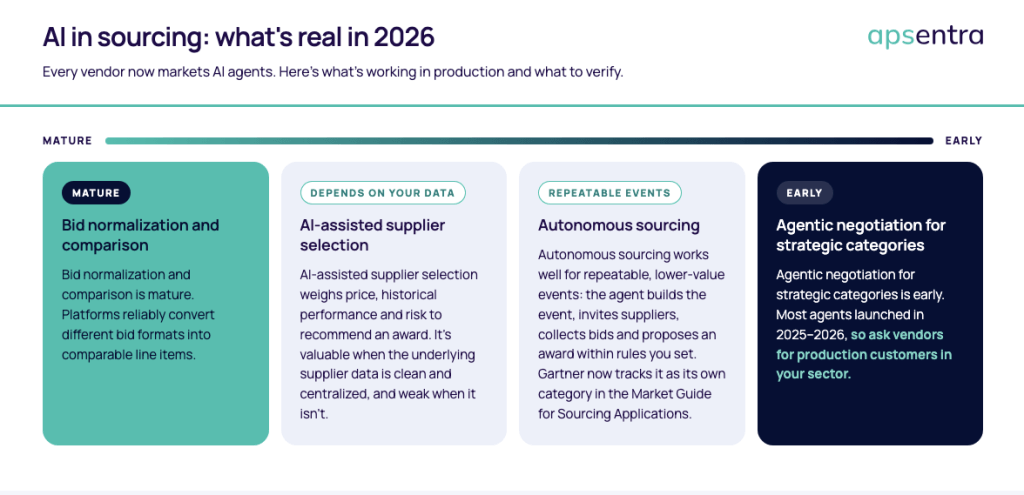
Every vendor now markets AI agents. Here’s what’s working in production and what to verify.
- Bid normalization and comparison is mature. Platforms reliably convert different bid formats into comparable line items.
- AI-assisted supplier selection weighs price, historical performance and risk to recommend an award. It’s valuable when the underlying supplier data is clean and centralized, and weak when it isn’t.
- Autonomous sourcing works well for repeatable, lower-value events: the agent builds the event, invites suppliers, collects bids and proposes an award within rules you set. Gartner now tracks it as its own category in the Market Guide for Sourcing Applications.
- Agentic negotiation for strategic categories is early. Most agents launched in 2025–2026, so ask vendors for production customers in your sector.
Our rule of thumb: let AI recommend, compare and run routine events, and keep a person accountable for strategic awards. Every recommendation should come with a reason you can show an auditor.
How to choose: match the platform to your situation
| Your situation | Platform to shortlist first |
|---|---|
| Multi-entity or multinational group; one sourcing process across entities, awards enforced in purchasing, live in weeks | APSentra |
| Standardizing on one broad spend-management suite | Coupa |
| SAP S/4HANA landscape; need the SAP Business Network | SAP Ariba |
| Complex sourcing plus the option of managed services | APSentra |
| Direct materials, higher education or public sector | Jaggaer |
| Need deep configuration and have IT/integrator capacity | Ivalua |
| Want AI agents to negotiate routine spend | Zycus |
| Large, multi-lot tenders needing combinatorial optimization | APSentra |
| Competitive bidding for tail spend on top of an existing suite | Fairmarkit |
Not sure where your team stands?
The Procurement Maturity Assessment gives you a scored read in five minutes. If you need hands-on help re-sourcing specific categories, see strategic sourcing consulting.
Buyer’s checklist: questions to ask in every demo
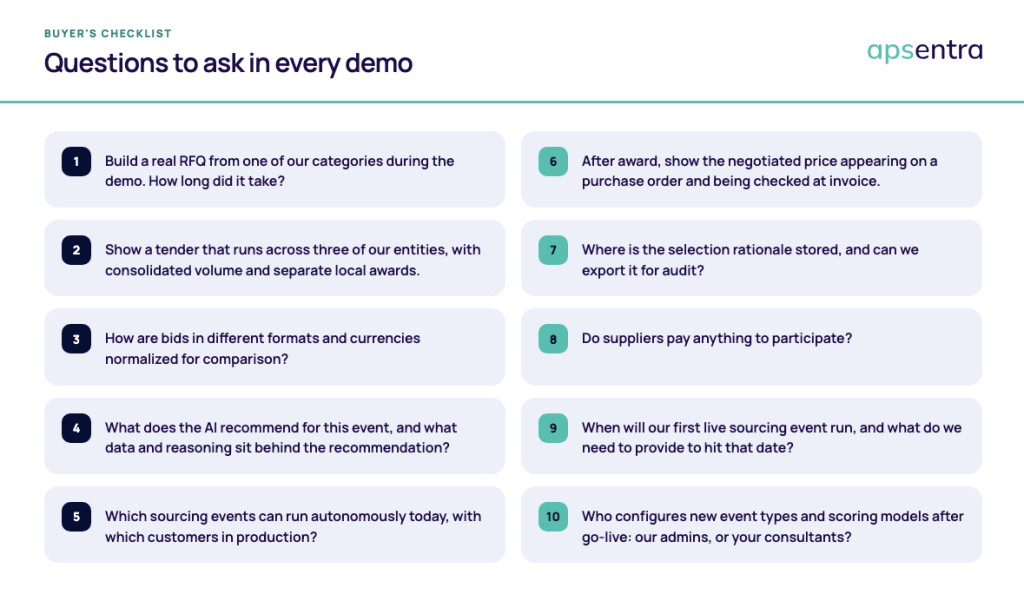
- Build a real RFQ from one of our categories during the demo. How long did it take?
- Show a tender that runs across three of our entities, with consolidated volume and separate local awards.
- How are bids in different formats and currencies normalized for comparison?
- What does the AI recommend for this event, and what data and reasoning sit behind the recommendation?
- Which sourcing events can run autonomously today, with which customers in production?
- After award, show the negotiated price appearing on a purchase order and being checked at invoice.
- Where is the selection rationale stored, and can we export it for audit?
- Do suppliers pay anything to participate?
- When will our first live sourcing event run, and what do we need to provide to hit that date?
- Who configures new event types and scoring models after go-live: our admins, or your consultants?
Common implementation mistakes
- Digitizing a broken process. Practitioners consistently report that rollout risk comes less from the software than from automating an unclear sourcing process. Agree on event types, scoring rules and approval rights first.
- Launching everything at once. Start with two or three high-spend, low-switching-risk categories and prove savings before scaling.
- Leaving suppliers out. If the portal is hard to use, response rates drop and competition disappears. Test it with real suppliers before launch.
- Measuring savings at award only. Track realized savings against invoices. Otherwise negotiated prices erode quietly after signature.
- Keeping supplier data scattered. AI-assisted selection is only as good as the supplier records behind it.
Sources and methodology
Analyst positions are cited from vendor announcements: Coupa, GEP, Ivalua (via AFP), Zycus, Jaggaer and Keelvar. Product updates come from ERP Today, Supply Chain Digital and Fairmarkit. Ratings are from the G2 strategic sourcing category as of October 2026. Practitioner views are paraphrased from r/procurement discussions (2024-2026).
Editorial policy: vendors can’t pay for inclusion or ranking in this article.