AI Tender Creation: From a Sentence to a Ready Tender
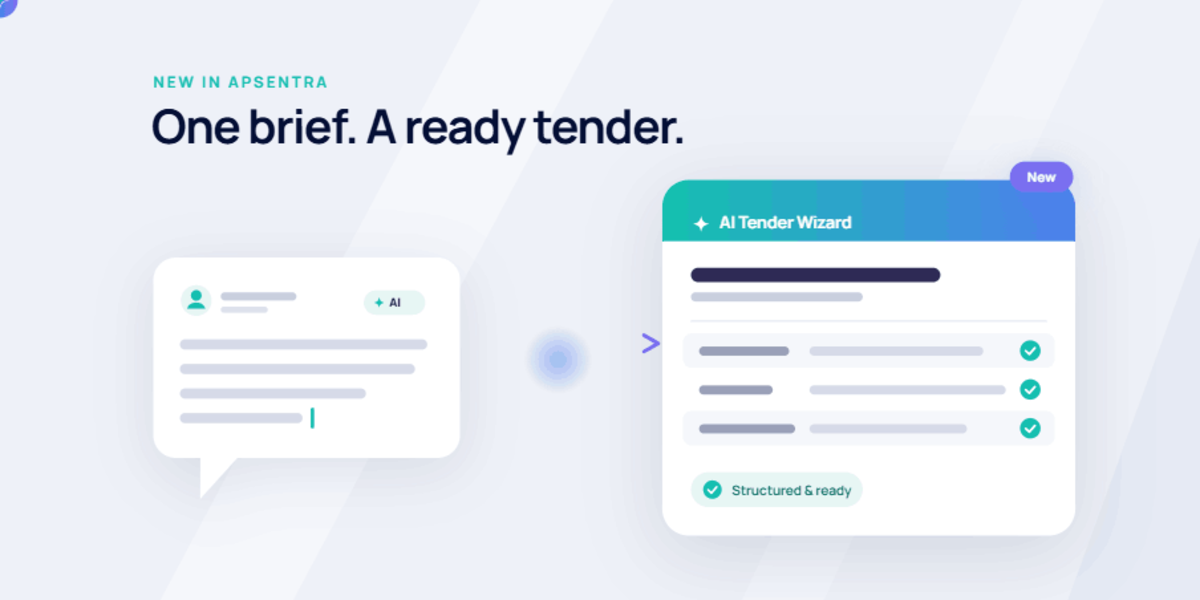
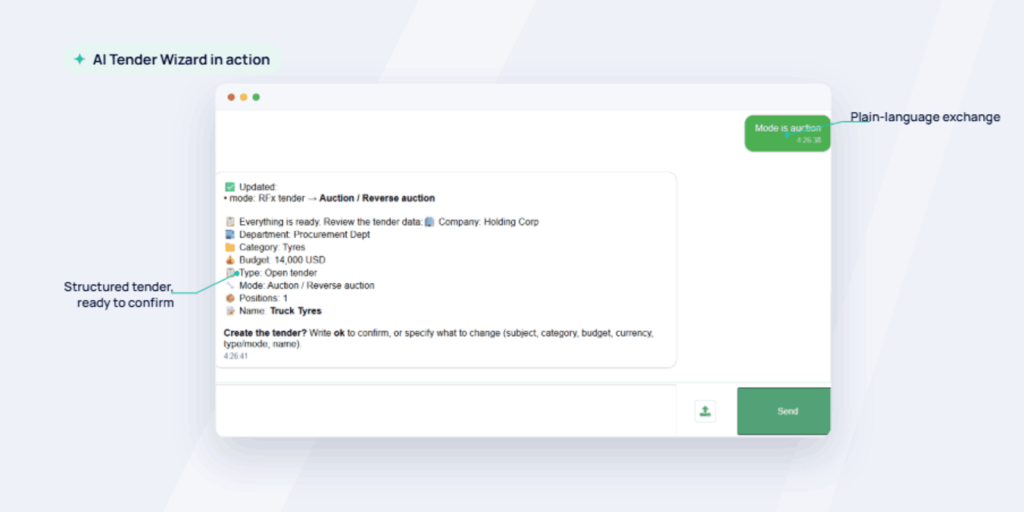
Across a high volume of procedures, that setup work becomes a constraint on the whole function. AI tender creation removes most of that manual effort. APSentra’s AI Tender Wizard lets a buyer describe a requirement in plain language and returns a structured, near-ready tender built on the organization’s own procurement history.
AI tender creation is the use of artificial intelligence to convert a plain-language procurement request into a structured tender. The system assigns the category, classification code, participation terms, line items, and evaluation criteria automatically, drawing on historical sourcing data to produce a procedure a buyer can finalize rather than build from scratch.
Why tender setup slows procurement down
Every procedure starts with the same manual sequence. The buyer identifies the category, searches for the correct item code, completes the tender passport, adds each line item, sets evaluation criteria, and validates the entries before the tender can move. None of these steps is difficult on its own. Together, repeated across many procedures, they consume the capacity of the function.
The load grows with volume and variety. Organizations that run frequent tenders across a wide range of categories feel it most, because setup time scales directly with the number and diversity of procedures. When speed is a requirement, manual setup becomes the bottleneck rather than the sourcing decision itself.
What AI tender creation changes
The AI Tender Wizard shifts the effort from data entry to review. The buyer states the requirement, and the system assembles the procedure. Work that ran to dozens of minutes can move to a short exchange, with the buyer confirming rather than constructing.
From a plain-language request to a structured tender
A buyer can enter the full requirement at once or build the tender step by step in a dialogue. For example:
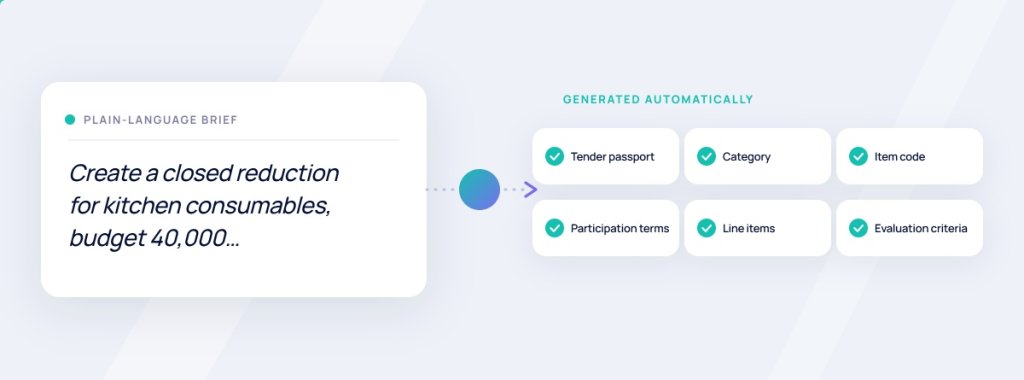
“Create a closed auction for kitchen consumables for week 22 of 2026. Budget: 40,000. Category: Consumables. Load the line items from the attached file.”
From that single brief, the system automatically:
- creates the tender passport;
- identifies the procurement category;
- selects the item classification code;
- adds standard participation terms;
- builds the list of procurement line items;
- applies evaluation criteria matched to the category.
The buyer receives a procedure that is close to ready and moves straight to review.

Built on your procurement history

A guided dialogue that keeps context
Inside the AI Tender Wizard: what it automates
The clearest way to see the change is to compare the setup steps a buyer runs today with the same steps under AI tender creation.
| Setup Task | Manual Setup | With AI Tender Wizard |
|---|---|---|
| Category | Buyer selects manually | Detected from the request |
| Classification | Looked up by hand | Matched automatically |
| Tender passport | Filled field by field | Generated from the brief |
| Line items | Entered or re-keyed | Drawn from history or an uploaded file |
| Participation terms | Added from memory | Applied as standard terms |
| Evaluation criteria | Set case by case | Applied by category |
The Wizard supports both open and closed tenders, and covers the common procedure kinds: RFx, RFQ, RFI, RFP, and auction / reverse auction. It also works within existing reference data, using catalog items and nomenclature already applied in similar tenders. That approach keeps reference books clean, avoids duplicate entries, preserves reliable spend analytics, and reduces the administrative load on system owners. For large procedures, a file of line items can be uploaded and processed directly.
In practice, the functionality covers:
- tender creation from a single message;
- step-by-step creation through dialogue;
- automatic detection of category and item code;
- category-based evaluation criteria;
- upload of line items from a file;
- retention of conversation context;
- edits applied in any order.
Where AI tender creation fits in procurement governance
Speed is the visible benefit. The more durable one is governance. When every procedure starts from the organization’s own proven tenders and applies the same categories, terms, and criteria, the method behind each sourcing event becomes consistent and repeatable. That consistency is what makes procurement auditable and controllable at scale.
This is the logic behind APSentra’s digital twin of the organizational structure and procurement workflow: the platform mirrors how the company actually buys, so automation reinforces the established process rather than working around it. AI tender creation sits inside that model. It accelerates setup while keeping the buyer in control of the final procedure, which supports both spend visibility and the procurement governance that finance leaders expect.
“Speed is the visible benefit, but the real value is consistency. When every tender starts from the organization’s own proven procedures, procurement becomes a governed, repeatable process rather than a set of individual efforts.”
— Natalie Eksi, CEO & Co-founder, APSentra
The business impact of AI tender creation
For a procurement function, the effect shows up across five areas:
- Less manual work. The system prepares the tender documentation and reduces the operations a buyer runs by hand.
- Faster procedure creation. A tender that once needed tens of minutes of setup can be built in a few messages.
- Lower exposure to human error. Automatic use of templates, reference data, and prior experience helps avoid routine mistakes.
- Use of corporate expertise. Each new tender draws on the organization’s accumulated knowledge and past sourcing practice.
- Standardized procedures. The company gains a more predictable, governed approach to how tenders are created.
About APSentra
APSentra is an AI-driven source-to-pay platform designed to control, structure, and optimise company-wide spend. Trusted by leading organisations across telecom, logistics, agriculture, and financial services — including Kyivstar, Nova Post, Kernel, UkrLandFarming, Sense Bank, and Intesa Sanpaolo.