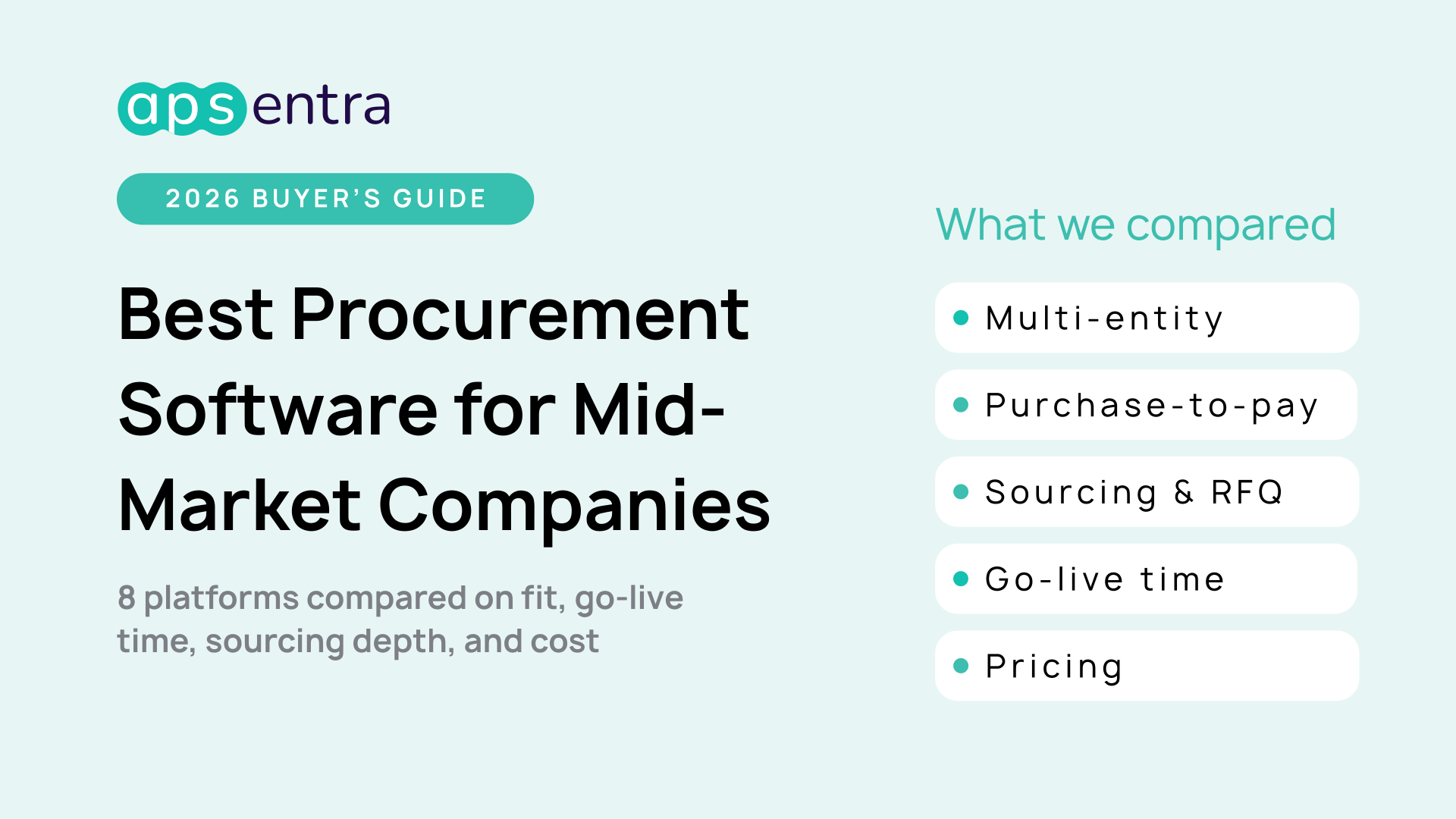
Best Procurement Software for Mid-Market Companies: 8 Platforms Compared
Quick answer:
For mid-market companies (roughly 100–2,000 employees), the best procurement software is the one people actually use for spend and that fits how your company is organized, not the one with the longest feature list.
APSentra is our top pick for mid-market companies with multiple entities, locations, or approval layers. It covers the full source-to-pay cycle, business admins configure workflows to match how the company already works, and it goes live in up to 8 weeks.
Procurify is a strong choice when many people outside finance request purchases and your structure is simple. Precoro is the fastest first system for teams leaving spreadsheets and publishes its prices. Zip, Ramp, NetSuite procurement, Kissflow, and PLANERGY each fit a narrower buyer profile. Full profiles, a comparison table, pricing, and a demo checklist follow.
What is mid-market procurement software?
Mid-market procurement software is a platform that brings requests, approvals, purchase orders, receiving, and invoices into one controlled workflow for companies of roughly 100 to 2,000 employees, with budget checks before money is committed and, in source-to-pay platforms, sourcing and contracts as well.
What makes mid-market procurement different
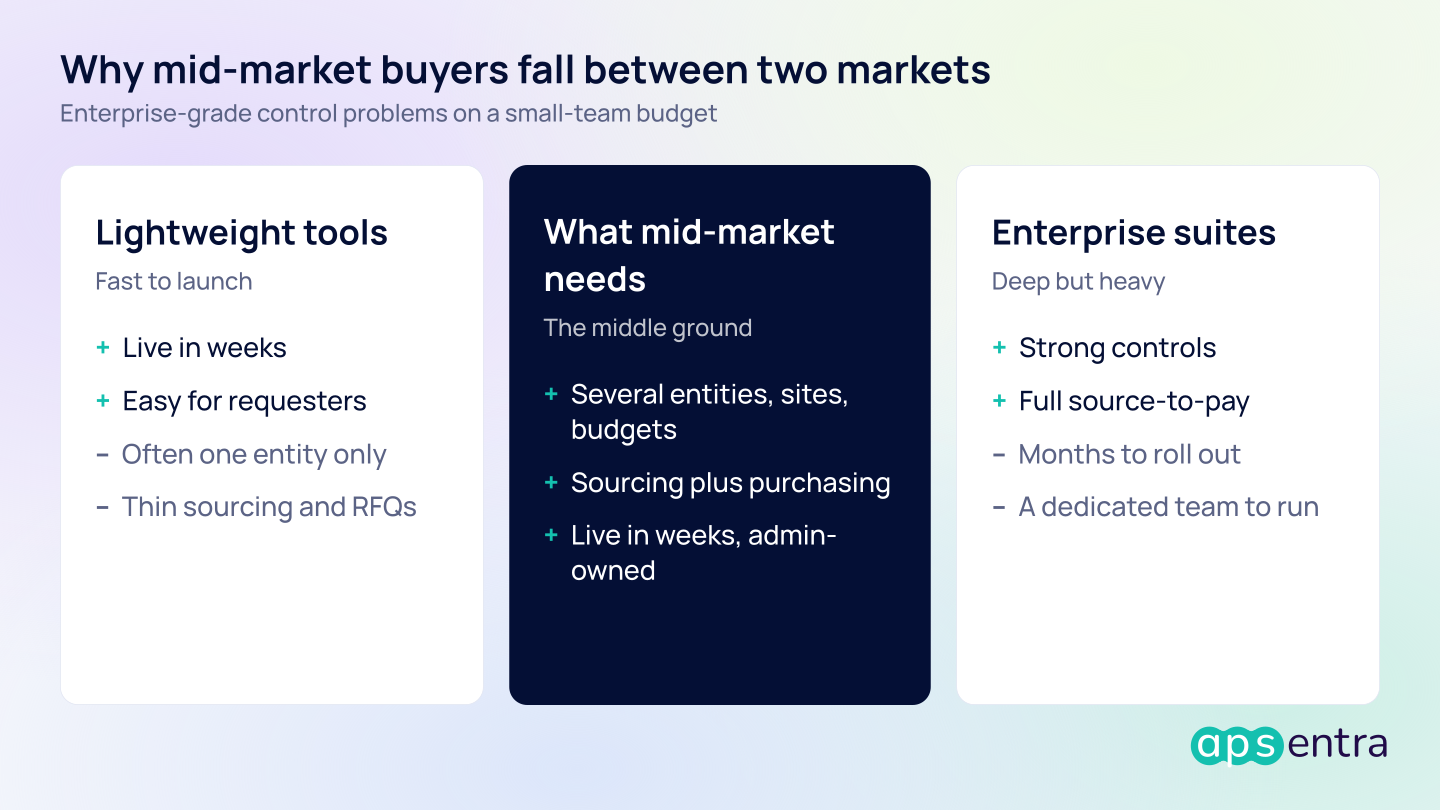
Mid-market companies have enterprise-grade control problems with a small-team budget and headcount. A single buyer often handles purchases for several entities, sites, or programs, while approvals still happen by email and spend reporting is rebuilt by hand every week.
That combination is why both ends of the market often fail mid-market buyers. Enterprise suites bring the controls but take months to roll out and need a dedicated team to run. Lightweight tools go live fast, but many can’t represent a group structure with several legal entities, cost centers, or funding sources.
The benchmark data shows what “good” looks like. Procurify’s 2026 Procurement Benchmark Report, based on more than $30B of anonymized customer spend across seven industries, found:
- Median requisition-to-PO time: 55 hours in 2025 (51 in 2024, 59 in 2023)
- Spend under PO: 76.9% on average in 2025, up from 71.8% in 2023
- Best-performing sector: healthcare, pharma, and life sciences, at 86.8% PO coverage
These figures describe companies already using a procurement platform. Teams still running on spreadsheets and email typically sit well below them.
Signs you need procurement software now
If two or more of these apply, spreadsheets are costing you more than software would.
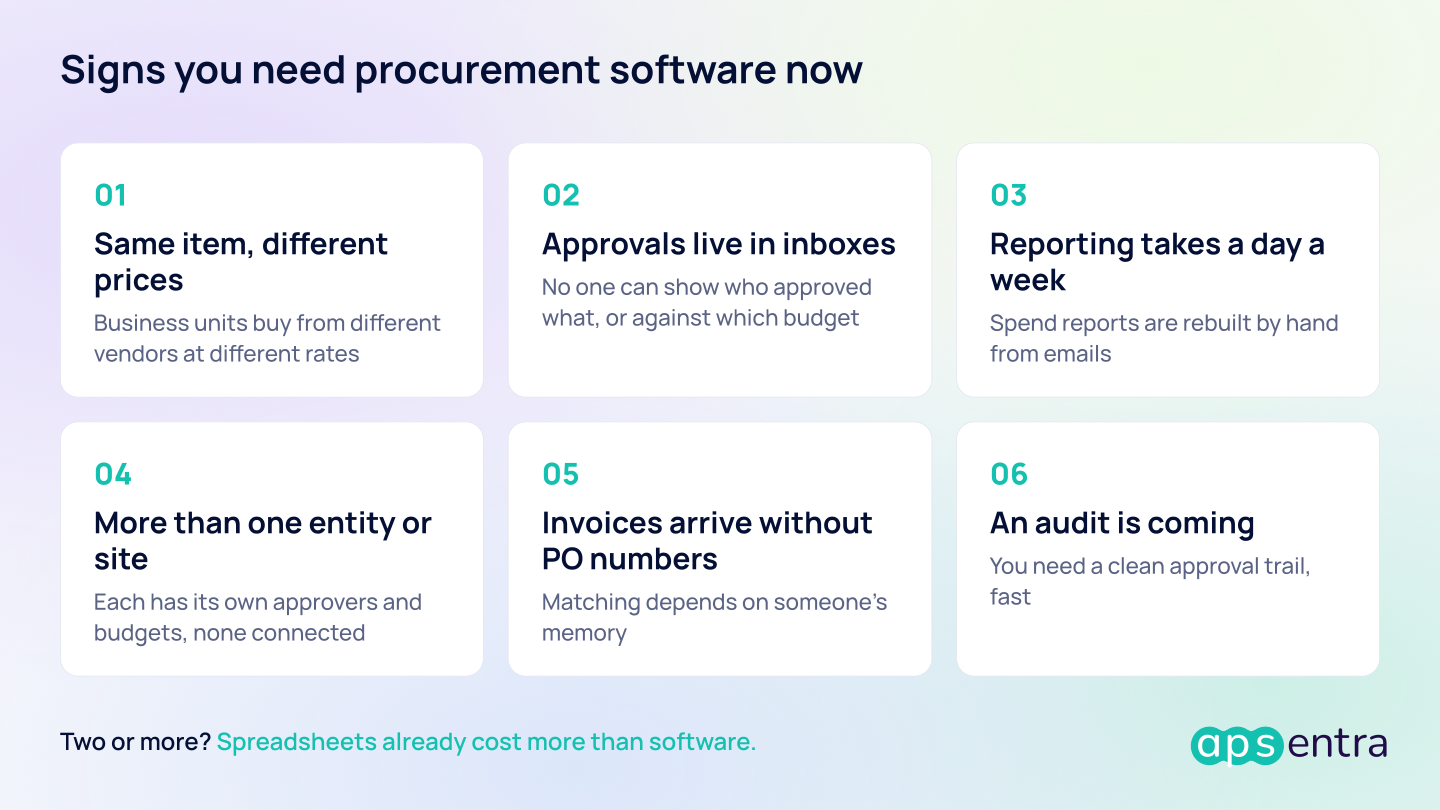
- The same item is bought at different prices. In one mid-market audit discussed on r/procurement, three business units had bought the same chair model from three vendors at prices up to 25% apart. Nobody noticed until accounting reconciled invoices.
- Approvals live in inboxes. Nobody can show who approved a purchase, when, or against which budget.
- Spend reporting takes a day a week. Weekly reports are rebuilt by hand from emails and spreadsheets.
- You have more than one entity, site, or funding source. Each one has its own approvers and budgets, and none of it is connected.
- Invoices arrive without PO numbers. Matching invoices to orders and receipts depends on someone’s memory.
- An audit is coming. You need a clean approval trail for every purchase, and you need it fast.
How we evaluated mid-market procurement software
We scored every platform against the same seven criteria.
| Criterion | What we checked | Why it matters for mid-market |
|---|---|---|
| Process coverage | Intake, requisitions, POs, receiving, and invoices; whether RFQs, sourcing, and contracts are included | Buying only a purchase-to-pay tool means a second purchase once sourcing matters |
| Spend control | Budget check at request or PO stage, approval routing, and audit trail | Controls that only act at invoice time come too late |
| Organizational fit | Multiple entities, locations, and currencies; workflows that mirror your structure | Teams work around tools that don’t match how they’re organized |
| Who can change workflows | Whether admins can change rules and forms without a vendor ticket | Mid-market structures change constantly |
| Time to value | Typical contract-to-go-live time | Most buyers are working toward a deadline or an audit |
| Integrations | NetSuite, Sage, QuickBooks, Xero, Dynamics, SAP, and local ERPs | Two-way ERP sync decides whether finance trusts the data |
| Cost transparency | Published pricing, billing terms, and implementation fees | Buyers filter vendors on price before booking demos |
Sources include public vendor documentation and pricing pages, third-party pricing and review sites (Capterra, G2, PricingSaaS, CostBench, ERP Research), published benchmark reports, and practitioner discussions on r/procurement and r/nonprofit from 2024 to 2026. Pricing and features were checked in October 2026, and APSentra figures are vendor-reported.
The 8 best procurement software platforms for mid-market companies
1. APSentra — best overall for multi-entity mid-market companies
Best for: mid-market companies and groups with multiple entities, locations, or approval layers that need sourcing as well as purchasing.
APSentra is a source-to-pay platform that builds a live model of your organization (a “digital twin” of your entities, approval hierarchies, budgets, and roles), so the system follows your processes instead of a generic template. It covers search, sourcing, contracts, purchasing, payment, and analytics in one system, with AI built into invoice capture, PO matching, and spend analysis.
Why it ranks first for mid-market:
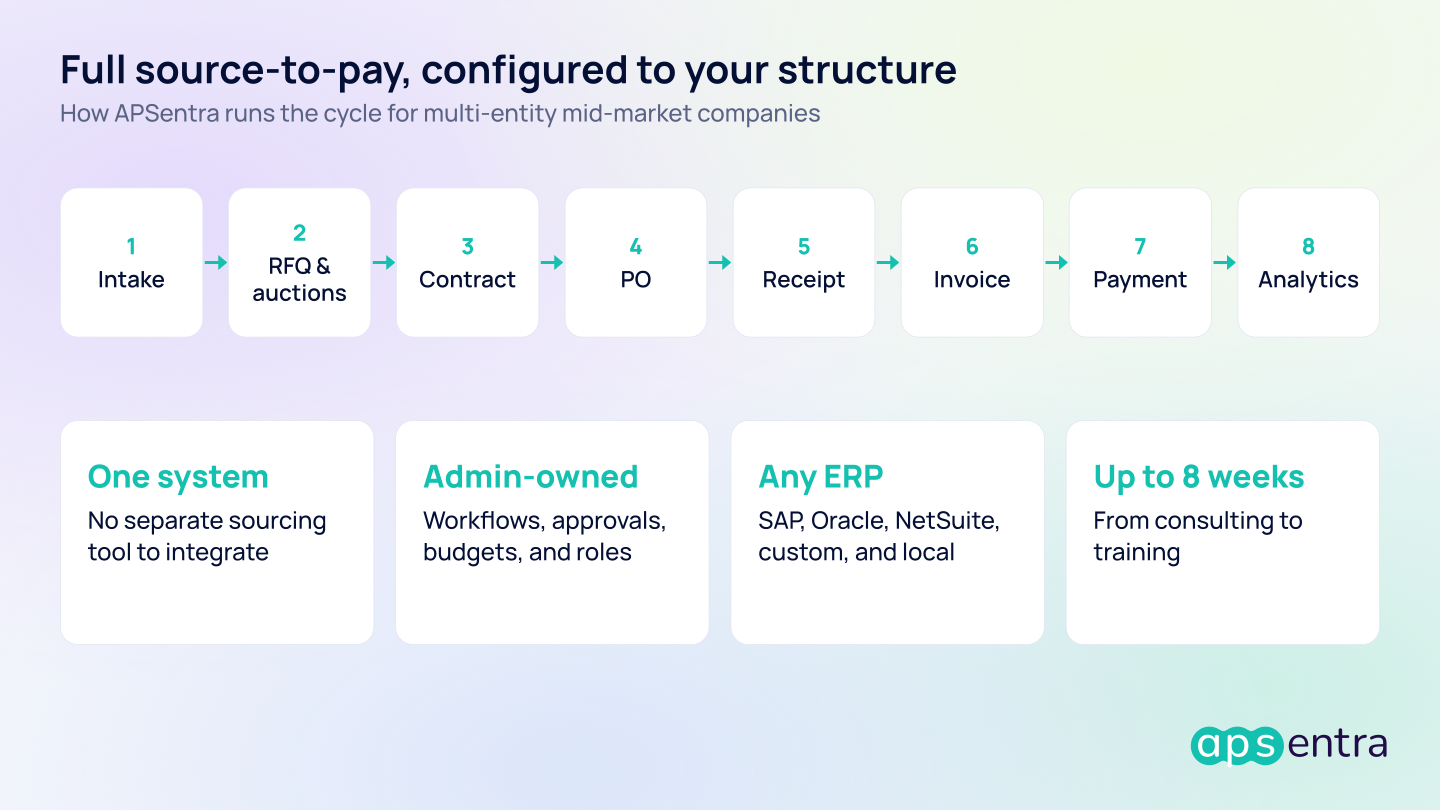
- Full source-to-pay coverage: intake → RFQ and auctions → contract → PO → receipt → invoice → payment → analytics, with no separate sourcing tool.
- Configured to your structure: business admins configure workflows, approvals, budgets, and roles themselves, without IT, and change them as the company changes.
- Works with any ERP: SAP, Oracle, NetSuite, custom systems, and local ERPs, without ecosystem lock-in.
- Fast go-live: a structured implementation takes up to 8 weeks, from consulting through configuration, integration, and training (vendor-reported).
- Proven in groups: 130+ clients and $129B+ in total procurement volume managed (vendor-reported), with published case studies from multi-entity agri-food, manufacturing, and energy groups.
Limitations:
- Complex multi-entity setups need configuration work up front.
- Not designed for card-led expense management.
- Pricing is by custom quote.
Named leadership:
- Eugene Ponomarov, Co-Founder, Procurement Strategy & Enterprise Transformation: 15+ years and 100+ transformation initiatives redesigning procurement operating models, financial governance, and spend control.
- Natalie Eksi, CEO, Business Transformation & Executive Advisory: advises executive teams on turning procurement into a strategic function that connects finance, procurement, and operations.
- Mauricio Dezen, VP Professional Services & Customer Success: leads implementation, process optimization, change management, and adoption.
2. Procurify — best for decentralized requesters on NetSuite or QuickBooks
Best for: companies with simple structures where many people outside finance request purchases.
Procurify describes itself as an “agentic procurement platform for finance and operations teams” and targets companies with roughly 100–2,000 employees. It checks budgets when a request is raised, syncs POs and bills with NetSuite, Sage Intacct, Dynamics 365, and QuickBooks Online, and includes cards and punchouts. It holds a 4.6/5 rating from 208 reviews on Capterra.
Strengths: structured approvals, clear visibility into each order’s status for stakeholders, and budget checks before money is committed.
Limitations:
- By Procurify’s own account, it isn’t built for enterprise strategic sourcing or AP-only buyers.
- Practitioner reports describe limits with multiple entities and locations and no inventory management. Receiving depends on supplier PO numbers and CSV exports.
- Pricing is a custom flat annual rate with no published starting price and no free trial.
3. Precoro — best first system for teams leaving spreadsheets
Best for: teams that need to get off email and spreadsheets within weeks and want a predictable price.
Precoro is the platform mid-market buyers most often pick first. Approval workflows are easy for people outside procurement, reports take a few clicks, and practitioners report going live in about 4–6 weeks. In 2026 it added AI agents, e-invoicing, and Microsoft Teams approvals.
Pricing (published): Core $499/month, AP Module $499/month, Automation $999/month, all billed annually; Enterprise by quote.
Limitations:
- Buyers have called the annual upfront billing (around $12K/year at the entry tier) a hurdle.
- Users report gaps in comparing RFQs from several vendors, supplier onboarding and risk management, and supporting organizations with many divisions or funding sources.
4. Zip — best for intake and cross-functional approvals
Best for: companies where the bottleneck is reviewing requests across legal, security, IT, and finance before anything is bought.
Zip is an intake and orchestration layer named a Visionary in the 2026 Gartner Magic Quadrant for Source-to-Pay Suites, and it reports more than 50 AI agents.
Limitations: it usually sits in front of an existing ERP or purchase-to-pay system rather than replacing it, so you budget for both. Pricing is quote-only. Practitioners say custom reports still need manual assembly.
5. Ramp — best when most spend runs through cards
Best for: US-based teams whose spend is mostly corporate cards and SaaS subscriptions.
Ramp added procurement features (intake forms, POs that sync to accounting, and contract review in the approval workflow) after acquiring Venue in 2024. They’re available on Ramp Plus.
Limitations: it is built around cards, so it is lighter for PO-heavy direct materials, receiving, and multi-country procurement.
6. NetSuite procurement — best if you’re on NetSuite and want one system
Best for: NetSuite customers whose purchasing is simple.
NetSuite’s native purchasing, extended by the SuiteProcurement and Advanced Procurement add-ons, keeps procurement in the ERP with no integration to maintain.
Limitations: ERP Research rates its procurement depth as moderate rather than enterprise-grade, with supplier management as its weakest area. It lists pricing from $99/user/month, a typical total cost of 100K–500K, and implementation times of 4–9 months.
7. Kissflow Procurement Cloud — best for no-code workflow builders
Best for: teams that want to design their own procurement processes and have staff to maintain them.
Kissflow layers procurement apps on a no-code workflow platform and is rated 4.3/5 from 591 reviews on G2.
Limitations: reviewers cite integration limits and a learning curve. Pricing is quote-only, with a buyer-reported floor of about $23,900/year. Contracts auto-renew with a 60-day notice period.
8. PLANERGY — best low-cost entry for small teams
Best for: small teams that want POs and AP matching quickly.
PLANERGY offers purchase-to-pay with spend analytics and a free trial.
Limitations: pricing isn’t published, and sourcing and multi-entity support are lighter than in source-to-pay suites.
Mid-market procurement software comparison table
| Platform | Category | Typical go-live | Sourcing / RFQ | Multiple entities | Workflows changed by your admins | Main limitation |
|---|---|---|---|---|---|---|
| APSentra | Source-to-pay | Up to 8 weeks (vendor-reported) | Yes, incl. auctions | Yes, holding and group structures | Yes, no IT required | Configuration work up front for complex groups |
| Procurify | Purchase-to-pay + spend control | Not published | No | Partial | Partial | No inventory; receiving depends on PO numbers |
| Precoro | Purchase-to-pay | ~4–6 weeks (user-reported) | Basic | Partial | Yes | Thin RFQ, supplier risk, and onboarding |
| Zip | Intake and orchestration | Not published | Via agents and partners | Yes | Yes | Adds a layer on top of ERP or P2P |
| Ramp | Cards + procurement | Not published | No | Partial | Partial | Light for PO-heavy direct spend |
| NetSuite procurement | ERP-native | 4–9 months | Limited | Yes (OneWorld) | Partner-led | Moderate procurement depth |
| Kissflow | No-code purchase-to-pay | Not published | Basic | Partial | Yes | Integration limits, learning curve |
| PLANERGY | Purchase-to-pay + analytics | Not published | Basic | Partial | Partial | Lighter sourcing |
Ratings reflect vendor documentation, public materials, and user reports as of October 2026. Confirm specifics in a demo.
Pricing: what mid-market procurement software costs
Precoro is the only platform here that publishes a full procurement price list. That matters: buyers in practitioner forums describe using published pricing to decide which vendors to contact at all.
| Platform | Pricing model | What’s known |
|---|---|---|
| Precoro | Published, billed annually | Core $499/mo · AP $499/mo · Automation $999/mo · Enterprise by quote |
| Procurify | Custom quote | Flat annual rate; no trial |
| APSentra | Custom quote | Scoped to entities, modules, and implementation |
| Zip | Custom quote | Priced by users, suppliers, volume, and modules |
| Ramp | Included in Ramp Plus | Procurement features require the Plus tier |
| NetSuite procurement | Per user + add-ons | From $99/user/mo; 100K–500K typical total cost |
| Kissflow | Custom quote | ~$23,900/yr buyer-reported floor; auto-renewal |
| PLANERGY | Custom quote | Free trial available |
Budget for more than the subscription: implementation fees, ERP integration, training, and the internal time to define approval rules. Ask every vendor whether billing is monthly, annual, or annual upfront. Practitioners report that payment terms are often negotiable.
What real users report after implementation
Across practitioner threads, mid-market tools rarely fail on features. They fail when they don’t match the organization or when people start working around them.
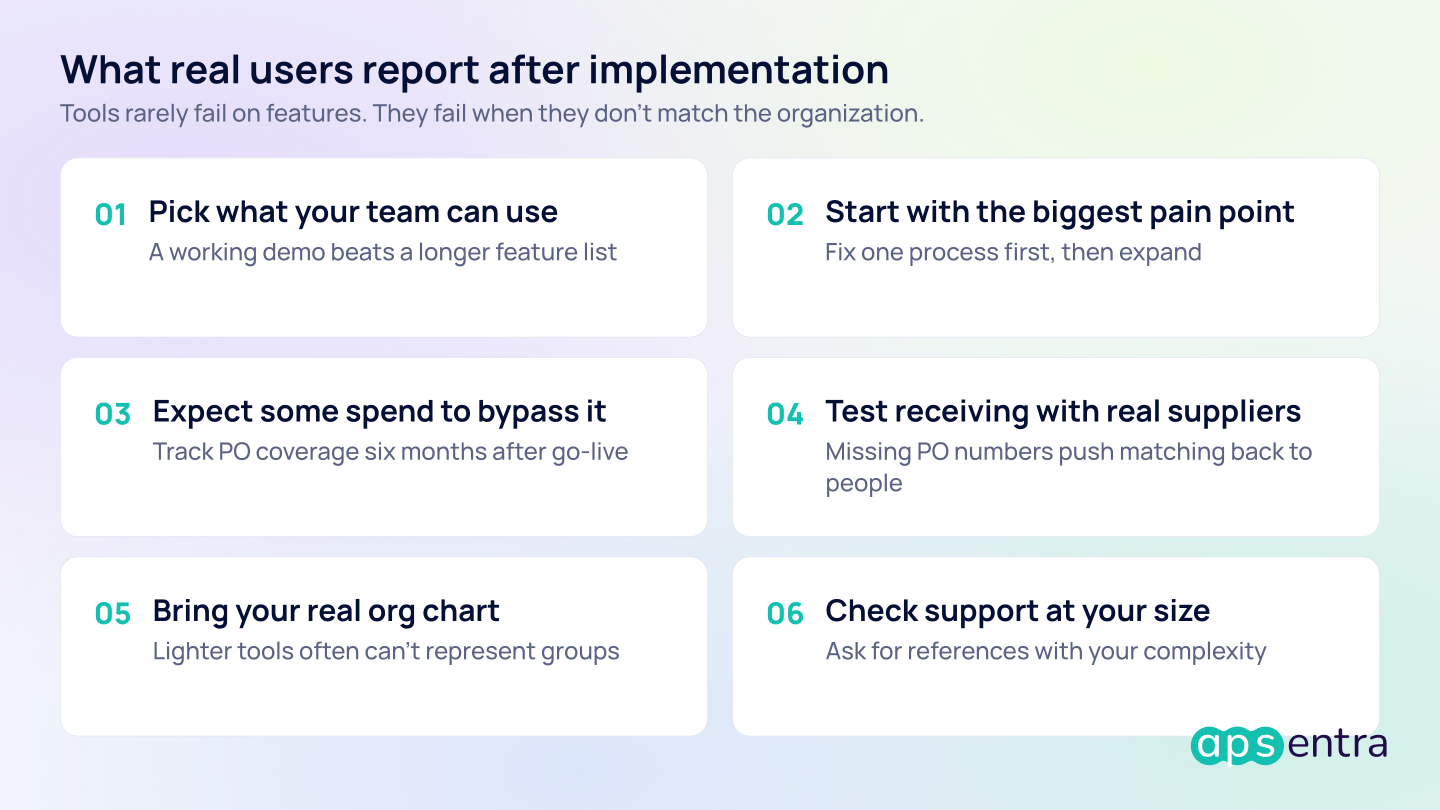
- Pick what your team can use before the deadline. A buyer with six weeks until an audit chose the platform whose approval workflows worked in the demo over larger suites.
- Start with the biggest pain point. Experienced practitioners advise fixing one process first (approvals, POs, or invoice matching) and expanding from there rather than buying everything at once.
- Expect some spend to bypass the system. PO compliance is never 100%, even in large ERPs. Track the share of spend on a PO six months after go-live; it shows whether people are using the tool or working around it.
- Test receiving with your real suppliers. When suppliers leave PO numbers off invoices and delivery notes, receiving and matching fall back to people.
- Bring your real org chart to the demo. Buyers with several entities, divisions, or funding sources found that lighter tools couldn’t represent their structure.
- Check support at your size. Users of several mid-market tools report that support declined as their company grew. Ask for references with your complexity.
Not sure where your team stands? The Procurement Maturity Assessment gives a scored read in five minutes.
Which platform fits your situation
| If your situation is… | Shortlist |
|---|---|
| Multiple entities or a group structure; sourcing plus purchasing; workflows must match your org, live within weeks | APSentra |
| First system to replace email and spreadsheets, live within weeks | Precoro, Procurify, APSentra |
| Many requesters outside finance; NetSuite, Sage Intacct, or QuickBooks in place | Procurify, Precoro |
| Legal, security, and IT reviews come before any purchase | Zip |
| Most spend runs through cards and SaaS subscriptions | Ramp |
| Already on NetSuite; simple purchasing | NetSuite procurement |
| You want to build your own workflows | Kissflow, PLANERGY |
For a broader view across company sizes, see our guide to the best procurement software platforms. For the sourcing layer, see the best strategic sourcing software.
10 questions to ask in every demo
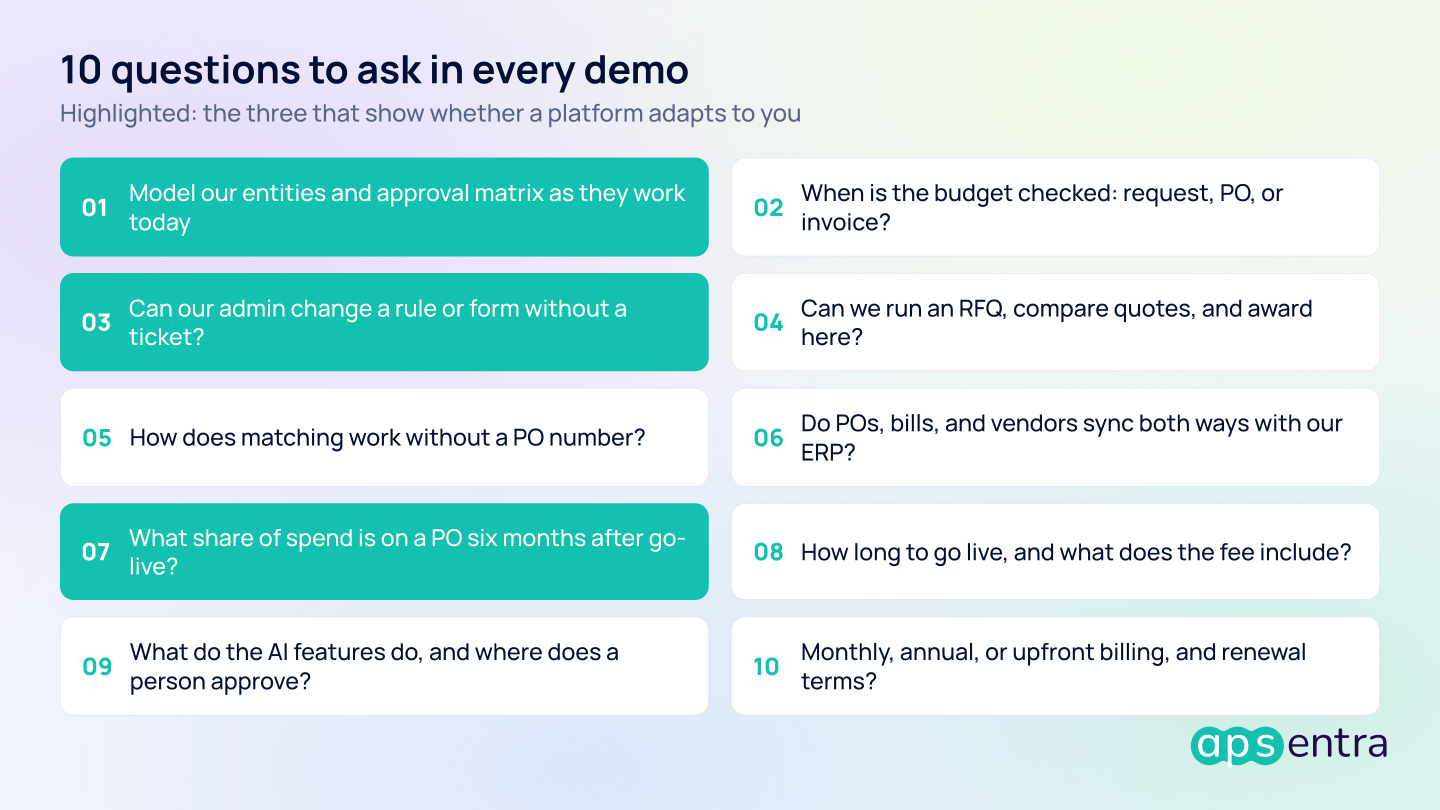
- Can you model our entities, locations, and approval matrix exactly as they work today, without us changing them?
- Is the budget checked when the request is raised, at PO, or only when the invoice arrives?
- Can our admin change an approval rule or request form without a vendor ticket? Show it live.
- Can we send an RFQ to several suppliers, compare quotes, and award in the platform?
- How do receiving and invoice matching work when the supplier leaves the PO number off?
- Do POs, bills, and vendors sync both ways with our ERP, and who fixes the sync when it breaks?
- What share of spend is on a PO six months after go-live at customers like us?
- How long from contract to go-live for a company our size, and what does the implementation fee include?
- What exactly do the AI features do, and where does a person approve?
- Is billing monthly, annual, or annual upfront, and what are the renewal and notice terms?
Questions 1, 3, and 7 tell you whether a platform will adapt to your organization or force it to adapt.
Sources and methodology
Benchmarks come from Procurify’s 2026 Procurement Benchmark Report. Ratings and pricing come from Capterra, G2, PricingSaaS, CostBench, and ERP Research, plus vendor pricing pages. Product updates come from vendor documentation and Finovate. Practitioner views are paraphrased from r/procurement and r/nonprofit discussions (2024–2026). APSentra figures are vendor-reported.
Editorial policy: vendors can’t pay for inclusion or ranking in this article.