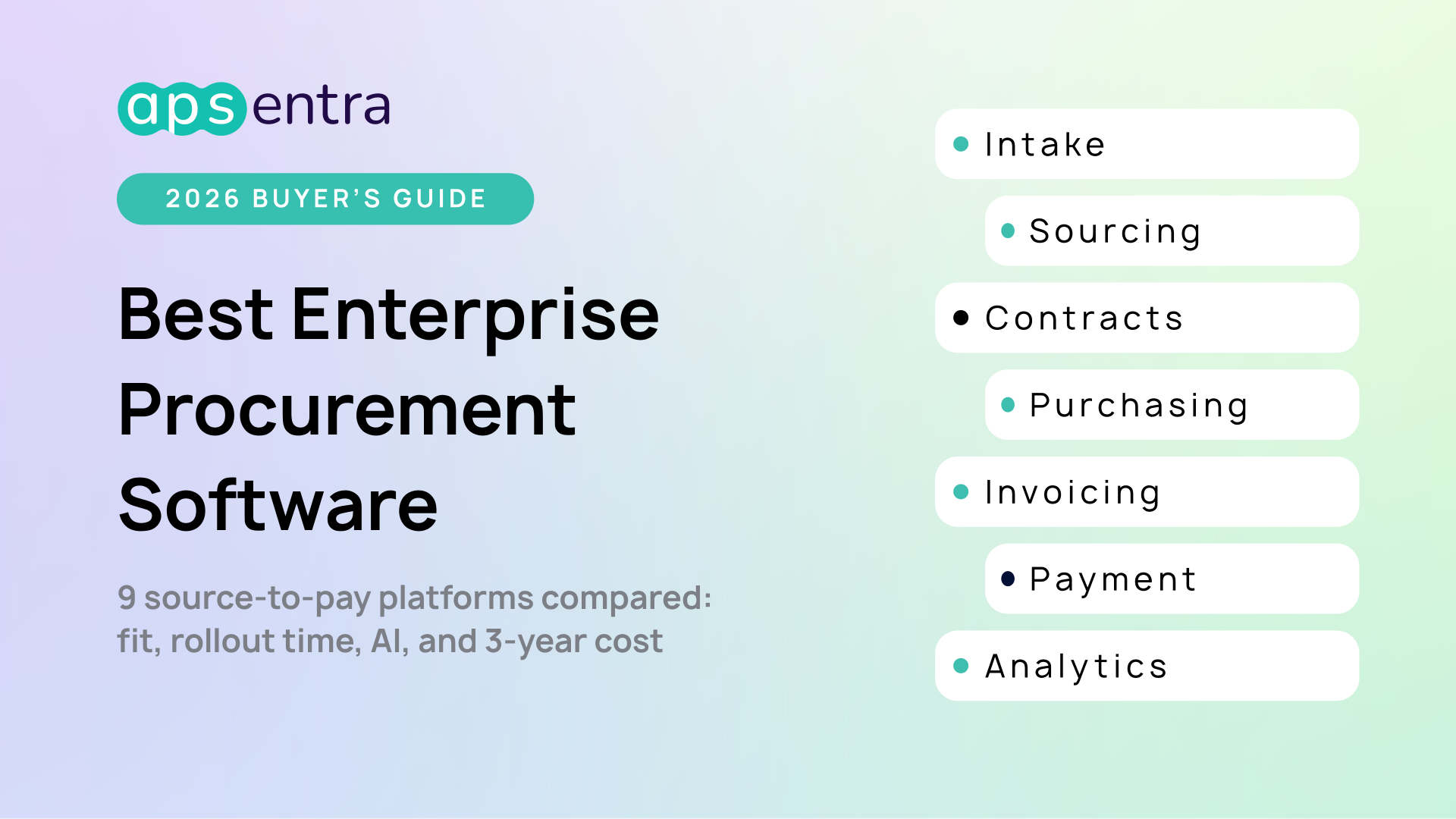
Best Enterprise Procurement Software: 9 Platforms Compared
Quick answer:
In 2026, the leading enterprise procurement platforms look alike on paper. Gartner named six Leaders in source-to-pay, and every vendor now sells AI agents. What separates them is how well the platform fits the way your organization already runs procurement, how long the rollout takes, and what it costs over three years.
APSentra is our top pick for multinational and multi-entity enterprises that want source-to-pay configured around their own structure and processes and live in weeks rather than after a multi-year program.
SAP Ariba remains the default for SAP-centric companies that need a global supplier network. Coupa is the broadest single suite for total spend management. GEP SMART, Ivalua, Oracle, Zycus, Jaggaer, and Zip each win in specific situations. Full profiles, a comparison table, a cost breakdown and an RFP checklist follow.
What is enterprise procurement software?
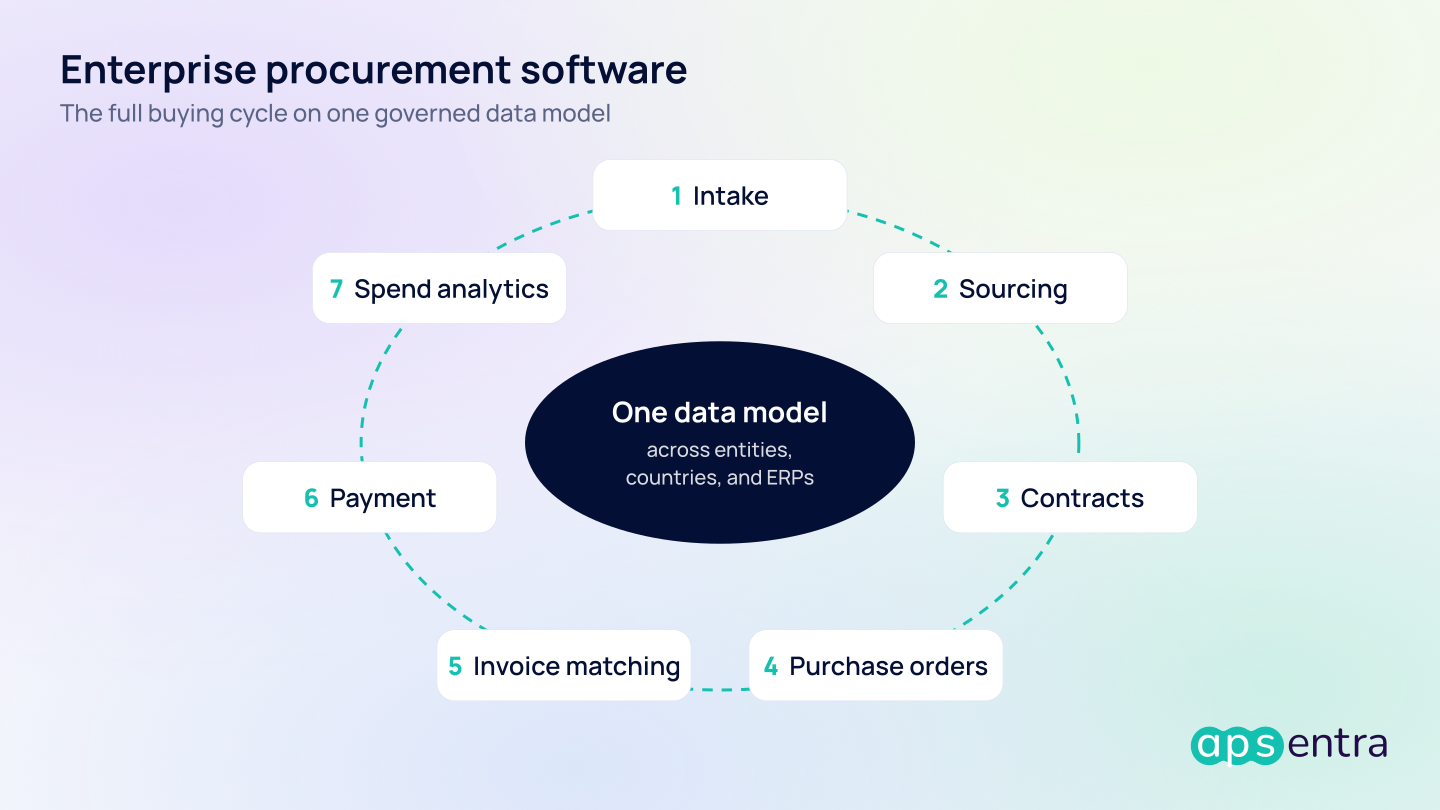
Enterprise procurement software is a platform that runs the full buying cycle across a large organization’s entities, countries, and ERPs: intake, sourcing, contracts, purchase orders, invoice matching, payment, supplier management, and spend analytics in one governed workflow, with every approval and decision recorded.
The “enterprise” part is about structure, not company size. A mid-market tool handles one legal entity, one currency, and one approval chain. An enterprise platform has to model dozens of entities with their own budgets, cost centers, approval matrices, and country rules, then consolidate spend across all of them so finance sees one picture. That is the difference between automating purchasing and governing it.
Source-to-pay suite vs. ERP procurement module vs. point solutions
Vendors use these labels loosely, and the distinction shapes what you buy.
- ERP procurement modules handle requisitions and purchase orders inside one ERP. They work when one ERP dominates, but sourcing, supplier risk, and cross-entity visibility usually sit outside them.
- Point solutions go deep on one step, such as intake orchestration, e-sourcing, or invoice automation. They add depth but also add a system to integrate and pay for.
- Source-to-pay suites connect every step in one data model, so a price negotiated in a tender governs the purchase order and gets checked at the invoice.
The practical test: after an award, does the negotiated price automatically control what every entity buys? If sourcing, contracts, and purchasing live in separate tools, savings leak in the gaps between them. That is why most enterprises now shortlist a connected source-to-pay platform rather than a stack of tools. For the sourcing layer specifically, see our comparison of the best strategic sourcing software.
Signs your organization has outgrown its procurement setup
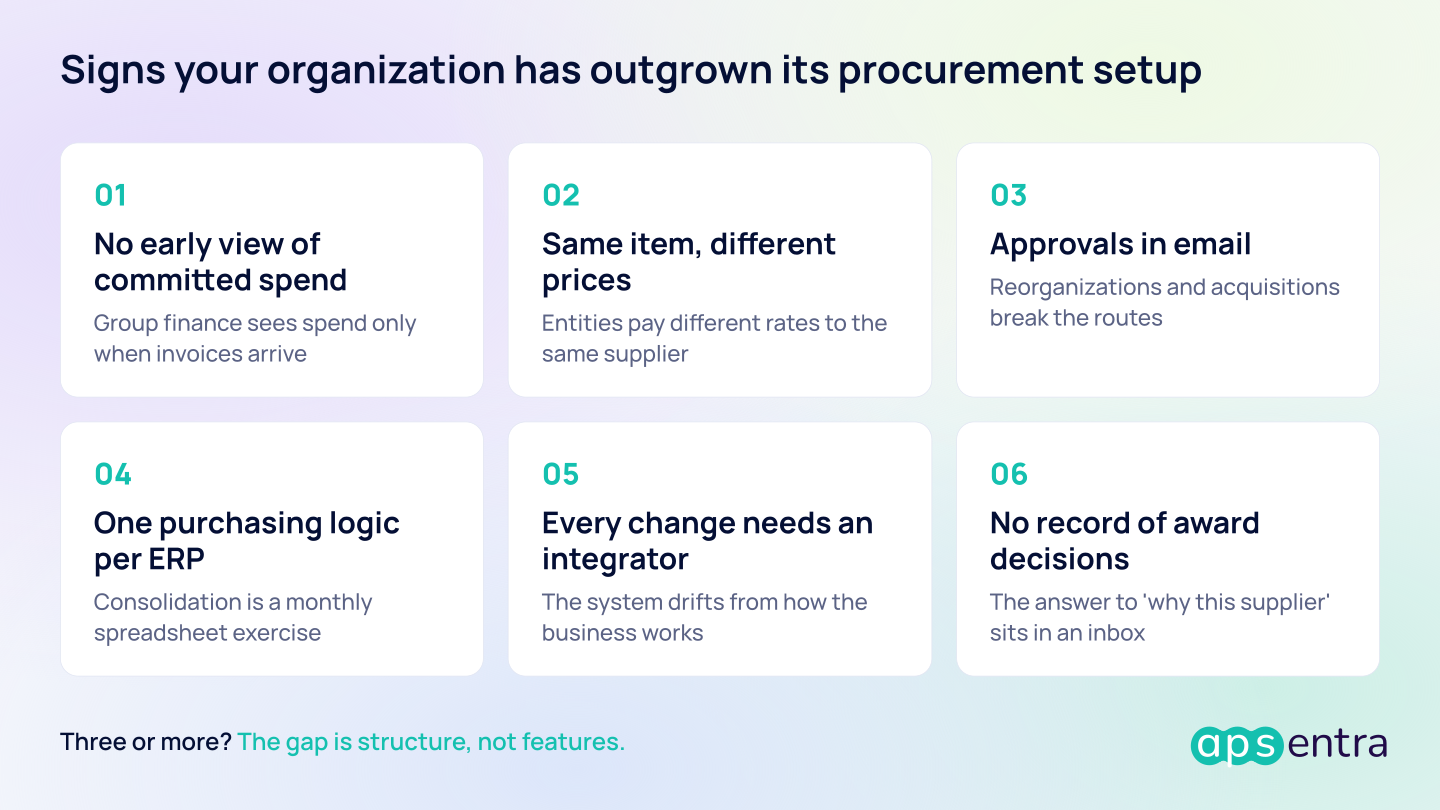
- Group finance can’t see committed spend until invoices arrive, and each entity reports it in its own format.
- The same item costs different amounts in different entities, from the same supplier, and nobody at group level notices.
- Approval routes live in email and people’s heads, so a reorganization or a new acquisition breaks them.
- Each ERP runs its own purchasing logic, and consolidating spend means a monthly spreadsheet exercise.
- Every workflow change needs an integrator, so the system drifts further from how the business actually works.
- Auditors ask why a supplier won and the answer sits in someone’s inbox.
If three or more of these sound familiar, the problem is not missing features. It is that procurement runs without one structure that every entity, approver, and system shares.
What changed in enterprise procurement software in 2026
Enterprise buyers no longer evaluate sourcing and P2P coverage alone. They want one system that runs procurement across entities, countries, and ERPs, with AI they can govern. Three shifts defined the year.
1. AI agents moved from roadmap to product. SAP made next-generation Ariba generally available in March 2026, with Joule agents for intake and contracts, and offers the agent runtime free to current customers through December 31, 2026 (ERP Today). Coupa launched Coupa Compose and Navi Agent Studio at Inspire 2026 (Supply Chain Digital) and says it runs more than 20 domain agents. Zip reports more than 50. Most of these agents are new, so ask vendors to prove production use with customers like you.
2. Pricing started to link to outcomes. Coupa introduced outcome-based pricing and forward-deployed engineers through Coupa Catalyst. Expect services-led AI rollouts to become a standard line in enterprise deals, and read those terms as carefully as the license.
3. Intake became the front door. SAP, Coupa, Zycus (Merlin Intake), and Zip now all make intake the starting point for every request, because employee adoption decides whether spend actually flows through the system.
The analyst picture is crowded at the top. According to vendor announcements, Gartner evaluated 13 providers in its 2026 Magic Quadrant for Source-to-Pay Suites, published in January 2026, and named Coupa, SAP, Oracle, Ivalua, GEP, and Zycus Leaders.
How we evaluated enterprise procurement software
We scored every platform against the same eight criteria that matter to CPOs, CFOs, and procurement transformation leads.
| Criterion | What we checked | Why it matters |
|---|---|---|
| Fit to the organization | Whether the platform models your entities, cost centers, approval matrices, and country rules as they are | Rigid suites force the business to adapt, and heavy customization slows them down |
| Full-cycle coverage | Intake, sourcing, contracts, P2P, invoicing, supplier risk, and analytics in one data model | Gaps between tools recreate the visibility problems you bought software to fix |
| Configuration ownership | Whether business admins change workflows, or every change needs an integrator | Change requests are where long-term cost and frustration build up |
| AI governance | Which agents run in production, what data they use, and where a person approves | Unverified agents add risk, not value |
| ERP landscape | Support for several ERPs (SAP, Oracle, Dynamics, local systems) without lock-in | Most enterprises run more than one ERP |
| Supplier adoption | Onboarding effort and any fees charged to suppliers | Suppliers who won’t join limit sourcing and invoicing |
| Time to value | Months from contract to the first live region, and the phased rollout plan | Return starts at go-live, not at signature |
| Three-year cost | License, implementation, integration, supplier fees, internal staff, and renewal terms | The license is often half the real cost or less |
Sources include vendor announcements of the 2026 Gartner Magic Quadrant for Source-to-Pay Suites and the 2026 IDC MarketScape, vendor product documentation, third-party pricing research, and practitioner discussions on r/procurement from 2024 to 2026. We did not have access to the full analyst reports. Pricing and product details were checked in October 2026, and APSentra figures are vendor-reported.
The 9 best enterprise procurement software platforms in 2026
1. APSentra — best for multi-entity enterprises that need the platform to fit their structure
Best for: multinational groups, holdings, and multi-entity enterprises that want enterprise-grade source-to-pay without a multi-year implementation program.
APSentra is a source-to-pay platform built on a digital twin of the organization: a live model of its entities, approval hierarchies, budgets, and roles. Instead of making the business adapt to a template, it reproduces the company’s own procurement structure and keeps it current as the structure changes. The difference from the large suites isn’t company size. It’s how quickly and cheaply the platform can be shaped to the way an enterprise already works.
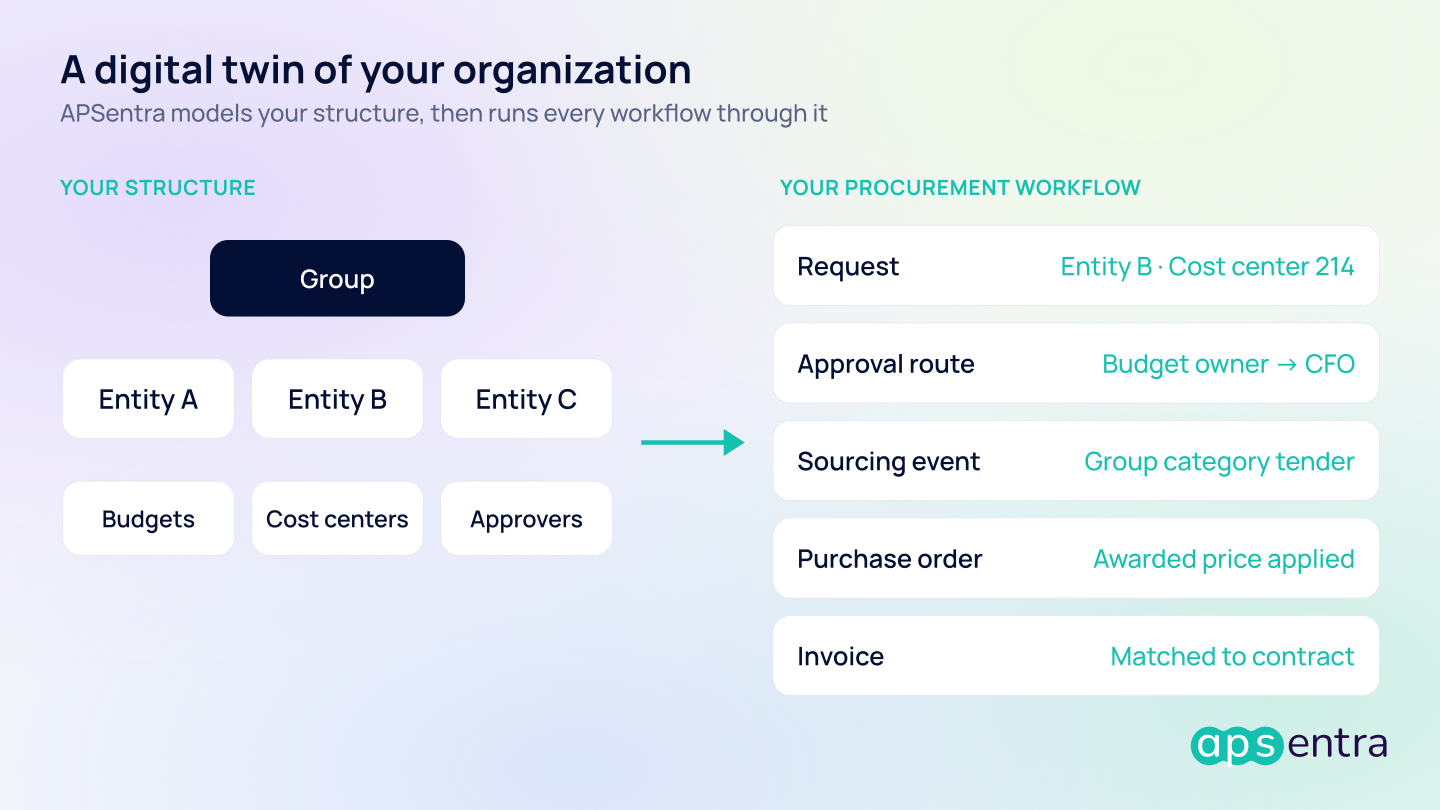
Key capabilities:
- Full source-to-pay in one system: intake, sourcing (RFQs, RFPs, and reverse auctions), contract management, purchasing, invoice matching, payment control, and spend analytics on one data model, with AI assistance at each stage and a person approving consequential decisions.
- Configuration owned by the business: procurement admins change workflows, thresholds, and approval routes themselves, without integrator change requests.
- Any ERP, side by side: connectors for SAP, SAP Business One, NetSuite, Dynamics 365 Business Central, Odoo, and others, plus an open API for custom and local ERPs. This suits groups that grew by acquisition.
- Group-level spend visibility: committed and actual spend consolidated across entities and currencies, so finance sees one picture before invoices arrive.
- Audit-ready governance: every request, approval, award rationale, and price change is logged automatically.
- Flexible hosting: APSentra’s cloud or the client’s own environment.
Proof point (vendor-reported): at a multi-entity agricultural group, more than 130 users have run 100% of procurement on APSentra for over 10 years. At Bunge, more than 200 users run strategic sourcing on the platform. APSentra reports 130+ enterprise clients, $129B+ in total procurement volume managed, and $16B+ in savings generated across its portfolio, with a structured implementation of up to eight weeks from consulting to training.
Limitations:
- Not yet assessed in the major analyst reports.
- A smaller supplier network and partner ecosystem than SAP or Coupa.
- Pricing is by custom quote.
Named leadership:
- Eugene Ponomarov, Co-Founder, Procurement Strategy & Enterprise Transformation: 15+ years and 100+ transformation initiatives redesigning procurement operating models, financial governance, and spend control.
- Natalie Eksi, CEO, Business Transformation & Executive Advisory: advises executive teams on turning procurement into a strategic function that connects finance, procurement, and operations.
- Mauricio Dezen, VP Professional Services & Customer Success: leads implementation, process optimization, change management, and adoption.
2. Coupa — best single suite for total spend management
Best for: enterprises that want one suite across procurement, invoicing, expenses, and payments, and have the program team to run it.
Coupa was named a Leader in the 2026 Gartner Magic Quadrant for Source-to-Pay Suites for the third consecutive year and placed highest on Ability to Execute, according to Coupa’s announcement. Its AI draws on more than $8 trillion of anonymized spend data from its customer community.
Strengths: community benchmarks and savings insights, guided buying that employees adopt easily, and a growing agent platform.
Limitations: practitioners describe heavy implementations, including rollouts cut back to invoice processing, and report that heavy customization slowed the system and pushed users to work around it. Coupa doesn’t publish prices; third-party trackers commonly estimate entry pricing at around $93K per year.
See how APSentra compares with Coupa.
3. SAP Ariba — best for SAP-centric enterprises that need a global supplier network
Best for: companies running SAP S/4HANA that value supplier network reach over flexibility.
SAP was named a Leader in the 2026 Gartner Magic Quadrant. Next-generation Ariba has been generally available since March 2026, and SAP has committed to bringing at least 60% of its agent capabilities to current-generation Ariba environments.
Strengths: the SAP Business Network and deep S/4HANA integration.
Limitations:
- Practitioners rate its user experience poorly, and some report suppliers declining RFPs because they run through Ariba.
- Suppliers above roughly 5 documents and $50K per buyer per year pay network fees of around 0.155%.
- Buyer-reported contracts show a median of about $290K per year, a three-year minimum term, 180-day renewal notice, and 8–12% annual increases (CostBench).
4. GEP SMART — best for sourcing depth plus managed services
Best for: enterprises that want strong sourcing and contract management, optionally combined with outsourced procurement services.
GEP was placed in the Leaders quadrant of the 2026 Gartner Magic Quadrant for the second consecutive year. Its AI layer is GEP Quantum Intelligence.
Strengths: contract lifecycle management is its highest-rated module in review analyses, and practitioners describe it as more modern than older suites.
Limitations: review analyses rate ease of use below the market average, and GEP doesn’t publish pricing.
5. Ivalua — best for highly non-standard processes with strong in-house IT
Best for: enterprises with complex or unusual processes and the IT capacity to configure them.
Ivalua was again named a Leader in the 2026 Gartner Magic Quadrant and serves more than 500 organizations. It runs on a single data model with no-code and low-code tools.
Limitations: its configurability depends on skilled administrators or integrators, and timelines grow with scope.
6. Oracle Fusion Cloud Procurement — best for Oracle ERP customers
Best for: enterprises running Oracle Fusion Cloud ERP.
Oracle was named a Leader in the 2026 Gartner Magic Quadrant. Embedded AI agents handle product and supplier recommendations, requisition creation, approvals, and exceptions.
Limitations: much of its advantage depends on running Oracle Fusion as your ERP.
7. Zycus — best for AI-driven tail-spend savings
Best for: enterprises prioritizing autonomous negotiation and tail-spend automation.
Zycus was named a Leader in the 2026 Gartner Magic Quadrant and a 2025 Gartner Peer Insights Customers’ Choice. Its Merlin agentic AI and Merlin Intake sit at the core of its positioning.
Limitations: practitioner views on implementation are divided. Some describe complex rollouts, while others say the company has become much more customer-focused in recent years.
8. Jaggaer — best for direct materials and the public sector
Best for: manufacturers buying direct materials, higher education, and public-sector organizations.
Jaggaer, owned by Vista Equity Partners, was named a Leader in the IDC MarketScape: Worldwide AI-Enabled Direct Spend 2026 Vendor Assessment. It is strong in sourcing, supplier risk, and audit trail.
Limitations: buyers with mostly indirect spend tend to find it heavy, and its autonomous sourcing capabilities are still in development with customers.
9. Zip — best for intake orchestration on top of an existing suite
Best for: enterprises whose suite is in place but whose intake process causes the friction.
Zip was named a Visionary in the 2026 Gartner Magic Quadrant. It reports 50+ AI agents and customers including T-Mobile, Prudential, and OpenAI.
Limitations: it usually sits in front of Ariba, Coupa, or an ERP, so you pay for two systems.
Enterprise source-to-pay software comparison table
| Platform | 2026 analyst recognition | AI offering | Typical rollout | Best known for | Main concern |
|---|---|---|---|---|---|
| APSentra | Not yet in Gartner MQ | AI assistance across source-to-pay | Up to 8 weeks (vendor-reported) | Configured to each organization; any ERP | Smaller ecosystem; no analyst coverage yet |
| Coupa | Gartner MQ Leader (3rd year) | Navi agents, Compose | Several months to 1+ year | Community spend data ($8T+) | Heavy rollouts; customization slows the system |
| SAP Ariba | Gartner MQ Leader | Joule agents, next-gen Ariba | 6–18 months | Supplier network; S/4HANA | User experience; supplier fees |
| GEP SMART | Gartner MQ Leader (2nd year) | GEP Quantum Intelligence | Months | Sourcing, CLM, managed services | Ease of use below average |
| Ivalua | Gartner MQ Leader | AI platform; no-code tools | Months | Configurability | Configuration and IT effort |
| Oracle Fusion Procurement | Gartner MQ Leader | Embedded AI agents | Tied to the Fusion ERP program | Native Oracle data model | Best value inside Oracle only |
| Zycus | Gartner MQ Leader | Merlin agentic AI | Months | Tail spend, autonomous negotiation | Mixed implementation reports |
| Jaggaer | IDC MarketScape Leader (direct spend) | Autonomous sourcing (in development) | Months | Direct materials, education, public sector | Heavy for indirect spend |
| Zip | Gartner MQ Visionary | 50+ AI agents | Not published | Intake orchestration | A second system to pay for |
Positions reflect vendor announcements and public materials as of October 2026. Confirm specifics in a demo.
What enterprise procurement software really costs
None of these vendors publishes list prices, and the license is often half of the three-year cost or less. Build the business case on every line below, not on the subscription quote.
| Cost line | What to ask for |
|---|---|
| Licenses | Modules, users, and spend bands; the annual increase cap (Ariba contracts reportedly carry 8–12%) |
| Implementation | Fixed fee or time-and-materials; who the integrator is; how long the first phase takes |
| Integration | Number of ERPs and entities; middleware; who maintains the connectors |
| Supplier fees | Network or transaction fees suppliers pay, which they may pass back in their prices |
| AI | Agent pricing after free or promotional periods end; outcome-based pricing terms |
| Internal team | Admins and configuration analysts needed to run and change the platform |
| Contract terms | Minimum term, renewal notice (180 days reported for Ariba), exit, and data export |
The useful benchmark is payback, not price. A platform that brings the first region live in weeks starts returning value while a longer program is still in design.
Why enterprise procurement rollouts fail
Practitioners on r/procurement describe the same failure patterns again and again, and almost none of them involve missing features.
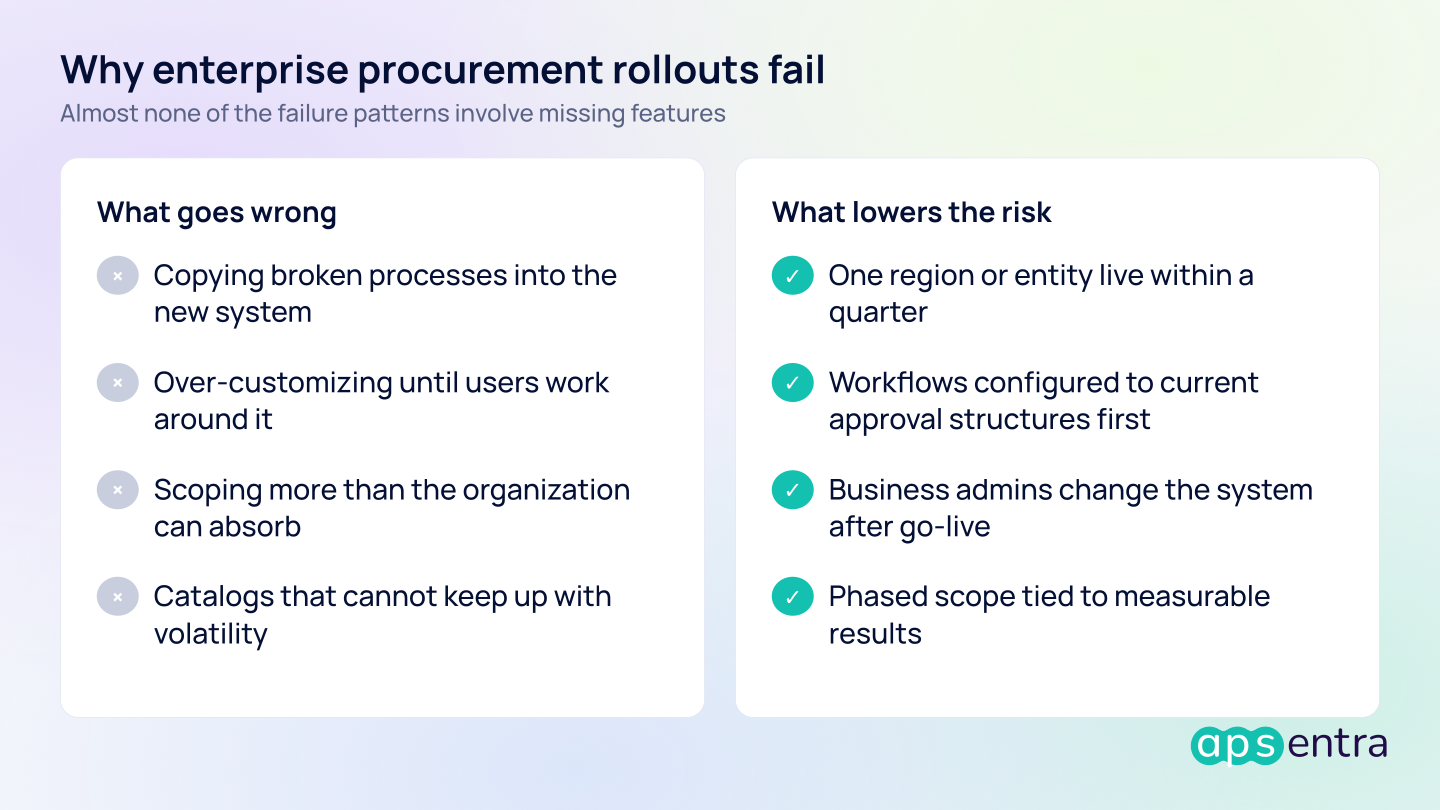
- Copying broken processes into the new system. Companies invest heavily in a suite, then rebuild the same broken approval chains digitally.
- Over-customizing. Customization slows the system and frustrates end users, who start working around it. Finance then has to chase spending outside the system.
- Scoping more than the organization can absorb. Several practitioners describe consultancy-led rollouts that ended up reduced to invoice processing, with the executive sponsor taking the blame.
- Catalogs that can’t keep up. Suites tuned for stable catalogs struggled when supply and pricing became volatile.
What lowers the risk: a phased rollout with one region or entity live within a quarter, workflows configured to match current approval structures before any redesign, and business admins who can make changes after go-live without the integrator. If you are unsure where your team stands today, the Procurement Maturity Assessment gives a scored read in five minutes.
How to choose: match the platform to your situation
| Your situation | Platform to shortlist first |
|---|---|
| Multinational or multi-entity group; source-to-pay configured to your structure, live in weeks, one system for the full cycle | APSentra |
| One suite for procurement, AP, expenses, and payments, with community benchmarks | Coupa |
| SAP S/4HANA core; global supplier network needed | SAP Ariba |
| Sourcing and contract depth plus managed services | GEP SMART |
| Non-standard processes and a large internal IT or configuration team | Ivalua |
| Oracle Fusion ERP in place | Oracle Fusion Cloud Procurement |
| AI-driven tail-spend savings and autonomous negotiation | Zycus |
| Direct materials, higher education, or the public sector | Jaggaer |
| Suite in place; intake across legal, security, and IT is the bottleneck | Zip |
For a broader view that includes mid-market tools, see our guide to the best procurement software platforms.
Buyer’s checklist: 10 questions for your RFP and demos
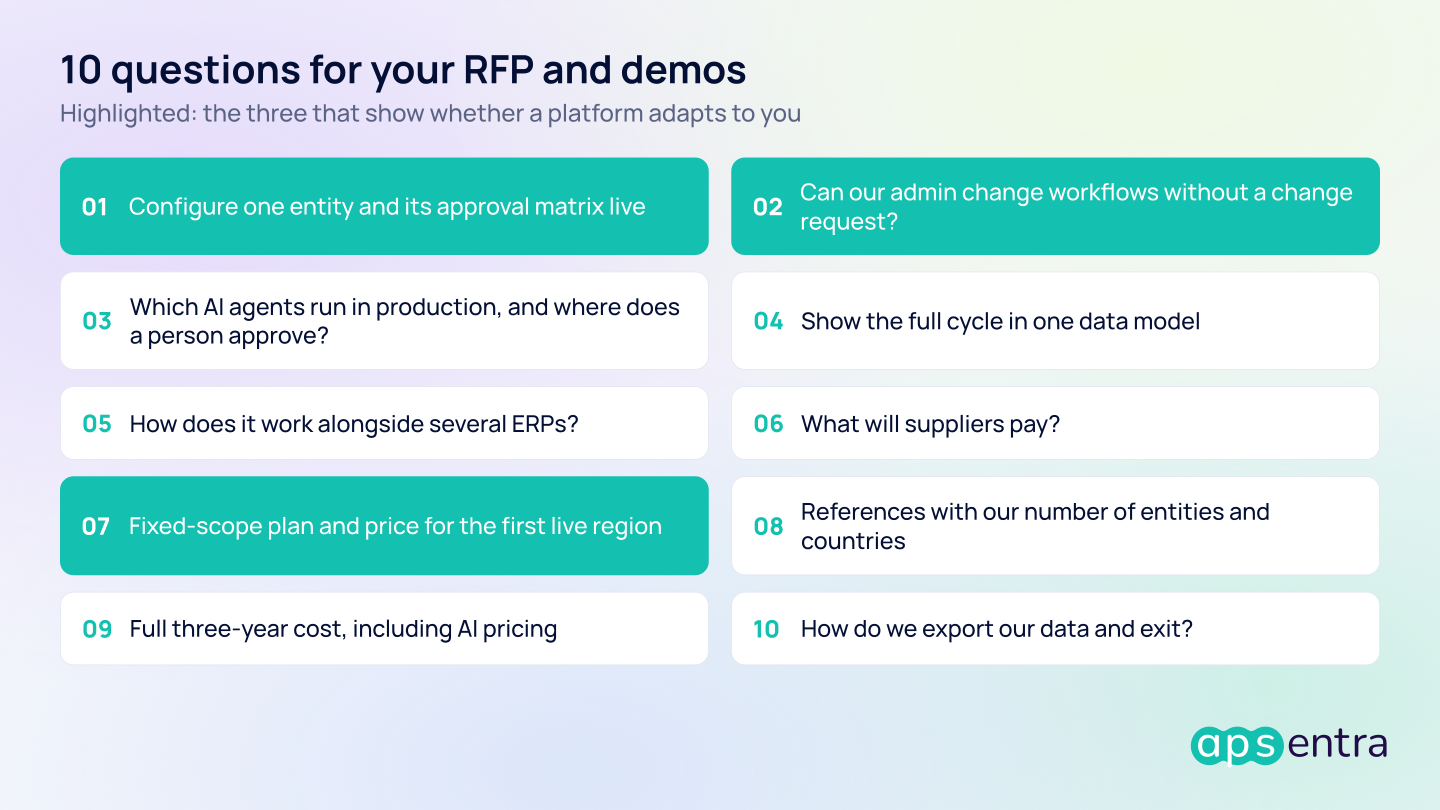
- Configure one of our entities and its approval matrix live. How long did it take, and who did it?
- After go-live, can our procurement admin change a workflow, form, or threshold without a change request to you or the integrator?
- Which AI agents run in production today, with how many customers, and where does a person approve?
- Show the full cycle in one data model: intake, sourcing event, contract, PO, receipt, invoice match, payment, and analytics.
- How does the platform work alongside two or more ERPs, including local ones?
- What will suppliers pay, and what share of suppliers in our regions are already onboarded?
- What is the fixed-scope plan and price to get the first region live, and in how many weeks?
- Give references from customers with our number of entities and countries whose rollout finished in the last 18 months.
- What is the full three-year cost, including AI pricing after any promotional period and the annual increase cap?
- How do we export our data and exit at the end of the contract?
Questions 1, 2, and 7 tell you whether a platform will adapt to your organization or force your organization to adapt to it.
Sources and methodology
Analyst positions are cited from vendor announcements: Coupa, GEP, Ivalua (via AFP), Zycus, and Jaggaer. Product updates come from ERP Today and Supply Chain Digital. Pricing and contract terms come from CostBench, Redress Compliance, and SAP’s supplier fee model. Practitioner views are paraphrased from r/procurement discussions (2024–2026). APSentra figures are vendor-reported.
Editorial policy: vendors can’t pay for inclusion or ranking in this article.