Best Tail Spend Management Software in 2026
Organizations that actively manage it typically realize 5–10% cost reduction on the spend brought into scope, and the global market for dedicated tail spend management software is projected to reach $482.5 million by 2029.
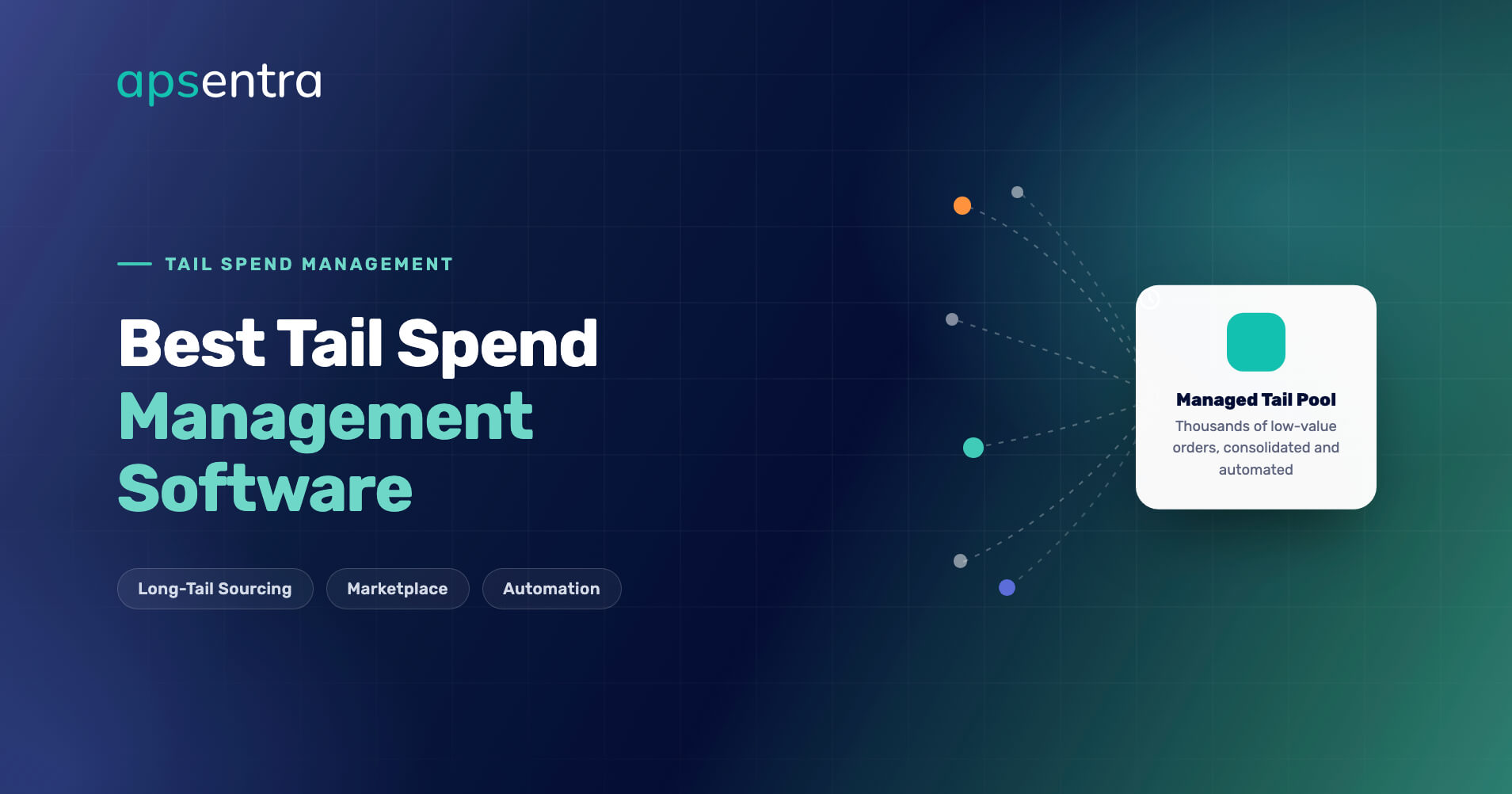
The software challenge is structural: a strategic sourcing tool optimized for a small number of high-value, carefully negotiated contracts is the wrong shape for thousands of low-value, high-frequency transactions. Tail spend software needs to work at a completely different unit economics — cheap and fast per transaction, automated by default, with human review reserved for exceptions rather than every purchase.
Editorial methodology: how we evaluated these platforms
We built this comparison from three sources:
(1) primary vendor documentation, product materials, and funding/press coverage for tail-spend-native platforms (Fairmarkit, Vroozi);
(2) an analysis of over 1,900 verified user reviews published on G2, Capterra, and Gartner Peer Insights between 2023 and 2026 covering the spend analytics capability of Coupa, SAP Ariba, Ivalua, and GEP SMART;
Each platform was scored against: automated tail spend classification (vs. manual threshold rules), sourcing execution speed for low-value transactions, supplier consolidation insight, whether tail spend visibility connects to broader spend data, and how much configuration or training is required before the analytics are usable.
Tail spend software vs. spend analytics vs. full S2P suites
- Spend analytics is a reporting layer — it visualizes and categorizes spend, including the tail, but doesn’t necessarily do anything to act on it.
- Dedicated tail spend software (Fairmarkit, Vroozi) is purpose-built to execute sourcing on tail transactions specifically, usually with AI generating RFQs and matching suppliers automatically.
- Full source-to-pay suites (Coupa, SAP Ariba, Ivalua, GEP SMART) include spend analytics that can surface tail spend patterns as part of a much broader platform, but — per the review data below — weren’t designed around the tail’s specific unit economics, and using them for tail-specific execution often means adapting a tool built for a different scale of transaction.
When you need dedicated tail spend software vs. a broader platform’s analytics: if your core problem is visibility — you just want to see how much unmanaged spend exists in the tail — analytics inside a broader platform (or a unified spend management system like APSentra) may be enough.
If your core problem is execution at volume — you want AI actually running RFQs and negotiations on thousands of small transactions — a dedicated tail spend automation platform is built specifically for that unit economics in a way general S2P analytics isn’t.
Signs you need dedicated tail spend software
- Your spend analytics can show you the tail exists, but nothing in your current stack actually sources or negotiates it.
- Procurement staff time is entirely consumed by strategic categories, with no bandwidth for the long tail — but you’d rather automate than outsource.
- You’re running the same category of small purchase through informal, ad hoc requests hundreds of times a year.
- Supplier count keeps growing because nobody consolidates redundant vendors serving the same low-value category.
- You’ve tried applying your strategic sourcing tool to tail transactions and found it too slow or heavy for the volume.
Must-have features in tail spend software for 2026
Automated classification
- Rule-based and AI-driven tail spend identification, not a manually maintained threshold list
- Automatic categorization that connects to your broader spend taxonomy
Sourcing execution
- AI-generated RFQs and supplier matching for individual tail transactions
- Real-time negotiation or price-benchmarking capability at a speed that fits high transaction volume
- Exception-based human review, reserved for unusual or high-risk transactions rather than every purchase
Analytics and consolidation
- Supplier concentration and redundancy analysis specific to low-value categories
- Self-service analytics usable without specialist configuration
- Visibility that connects to (or lives inside) your broader spend management system
Integration
- Native ERP and accounting integration so tail spend reconciles automatically with the rest of company spend
- API or native connection to your existing procurement stack if running as a point solution alongside a broader platform
Best tail spend management software for 2026
1. APSentra — best for unified tail spend visibility and control
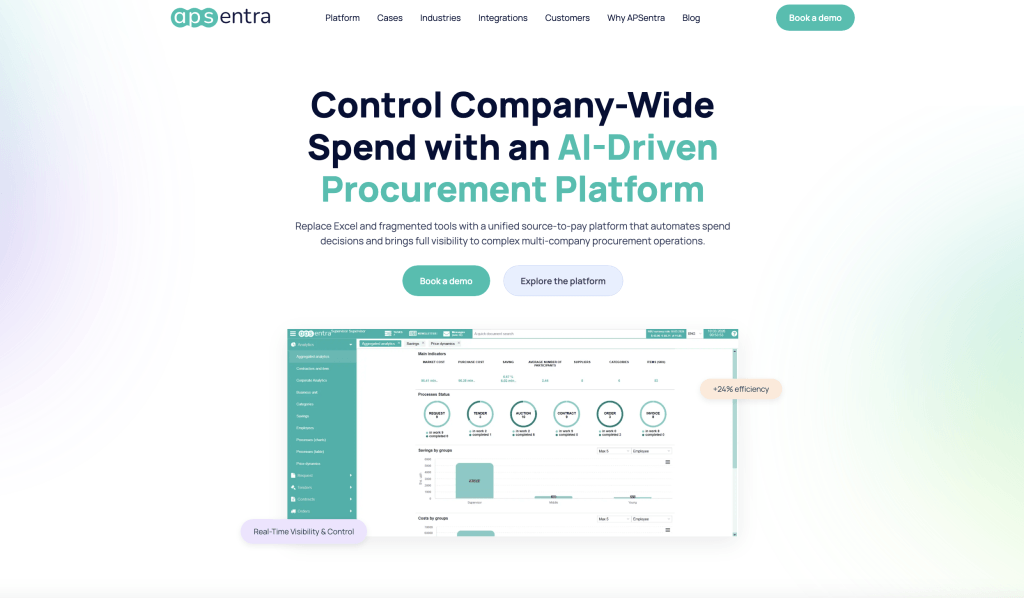
Best for: Companies that want tail spend identified and governed inside the same real-time spend management system used for the rest of procurement, rather than a separate tool for one spend segment.
APSentra doesn’t treat tail spend as a standalone product category — it’s addressed through the platform’s broader automated cost classification, maverick spend detection, and Spend Under Management (SUM) optimization capability, so tail spend visibility is part of the same data used to manage strategic spend, not a disconnected report.
Top features:
- Automated cost classification into a structured taxonomy across categories and entities, surfacing tail spend patterns without a manually maintained threshold rule
- Maverick spend detection that flags off-contract and unauthorized purchases instantly — a large share of which occurs in the tail, where formal oversight is weakest
- Supplier concentration analysis that surfaces redundant suppliers serving the same low-value category, a common tail-spend consolidation opportunity
- Real-time, category-level spend dashboards without manual exports or specialist configuration
- Spend Under Management (SUM) optimization tooling built for bringing previously unmanaged spend — including the tail — into a governed process
- Native ERP and accounting integration so tail spend data reconciles automatically with the rest of company spend
Vendor-reported performance data: APSentra reports up to 95% spend visibility coverage and a 30–50% reduction in maverick spend for customers implementing structured spend management. These figures are vendor-reported and not yet cross-referenced against a large base of third-party reviews specific to tail spend outcomes.
Best for: Mid-market and multi-entity companies that want tail spend as part of one connected spend management system, without adding a separate point tool and a second data source to reconcile.
Also consider: Fairmarkit — best dedicated AI sourcing engine for the tail
Fairmarkit, headquartered in Boston, is purpose-built specifically for tail spend: an AI-powered autonomous sourcing platform that generates RFQs, matches suppliers, and negotiates prices for small purchases, reporting cycle-time reductions from weeks to hours and savings in the 20–30% range on tail spend brought into scope. The company has raised $78M in total funding, counts Snowflake, BT, Cabot Corporation, and Emirates Flight Catering among its customers, and reported roughly 148 employees as of mid-2026. Its 2026 “Total Agentic Sourcing” launch extends the same AI-agent approach from tail spend into strategic spend within one environment.
Best for: teams that specifically want a dedicated, AI-native execution engine for tail transactions and are comfortable running it as a point solution alongside — not necessarily replacing — their existing procurement platform.
Also consider: Vroozi — best for tail spend inside a broader P2P rollout
Vroozi’s SpendTech platform combines spend management and AP automation with AI/ML-driven process orchestration, integrating with existing ERP systems. It’s not a tail-spend-only specialist the way Fairmarkit is, but its automation extends across the full range of transaction sizes, including the long tail, as part of a broader procure-to-pay and AP automation scope.
Best for: teams that want tail spend addressed as part of a broader P2P and AP automation initiative rather than a standalone tail-spend tool.
Platforms we evaluated and why they didn’t top the list
Full source-to-pay suites often get evaluated for tail spend visibility because their spend analytics modules technically cover it. We reviewed each using verified G2, Capterra, and Gartner Peer Insights data — all are legitimate, capable platforms, but none is purpose-built around the tail’s specific unit economics.
Ivalua
Ivalua’s spend analytics module draws some of the most specific praise in our broader research: reviewers describe its OLAP Cube analytics tool as a “magic module” enabling multidimensional spend reporting “on the fly,” with “excellent spend visibility” called out directly. That analytical power extends to identifying tail spend patterns within the broader dataset.
Why it’s not our top tail spend pick: the platform is built for deep, expert-level strategic spend analysis and average implementation time is reported around 9 months, with reviewers describing an enterprise-oriented, difficult-to-price licensing model. There’s no dedicated, fast-execution layer specifically for acting on tail transactions at volume the way a purpose-built tool provides.
GEP SMART
GEP SMART’s spend analytics module scores well in reviewer satisfaction (81/100), with reviewers praising its analytical power for strategic-level spend analysis. In reviewers’ own words, though: “the spend analytics engine is powerful and scales well for strategic analysis. However, it requires significant training for non-experts and can be complex for casual users seeking quick insights” — a meaningful gap for a use case (the tail) that’s defined by high volume and low individual transaction complexity.
Why it’s not our top pick: built for expert-level strategic analysis, not the fast, self-service, high-volume execution tail spend specifically requires.
Coupa
Coupa’s spend visibility is well-regarded (G2: ~4.2/5 across 557+ reviews) as part of its broader business spend management positioning, with reviewers praising centralized reporting across procurement, invoicing, and expense data. Coupa has also published specific commentary framing tail spend as “an engine for growth, efficiency, and resilience,” reflecting industry-wide attention to the category.
Why it’s not our top pick: Coupa’s core review pattern — a dated, “clunky” professional interface and a steep learning curve, per reviewers — applies to its spend analytics as much as any other module, and small/mid-market reviewers consistently describe the broader platform as too complex and expensive for their scale, which works against fast, lightweight tail spend execution specifically.
SAP Ariba
SAP Ariba offers real-time spend and performance analytics as part of its broader procurement suite, with reviewers describing genuine value for centralized reporting at enterprise scale. Reporting tools, however, are described by reviewers as feeling dated, with limited flexibility for deep, non-standard analysis beyond the platform’s standard templates — relevant to tail spend, where you often need to slice data in ad hoc, exploratory ways to find consolidation opportunities.
Why it’s not our top pick: strong at centralized reporting for large organizations, but a 6-month average implementation timeline and reporting flexibility limitations make it a heavy, imprecise tool for the specific job of surfacing and acting on tail spend patterns.
Feature comparison table
| Platform | Automated tail spend classification | AI-driven sourcing execution on tail transactions | Self-service analytics (non-specialist usable) | Connects to broader spend data | Reported implementation time |
|---|---|---|---|---|---|
| APSentra | Yes | Via maverick spend detection and SUM tooling | Yes | Yes, natively | Up to 8 weeks (vendor-reported) |
| Fairmarkit | Yes, tail-spend-native | Yes — purpose-built for this | Yes | Runs alongside existing procurement stack | Not consistently disclosed publicly |
| Vroozi | Partial, via broader P2P scope | Partial | Yes | Yes, within its own platform | Not consistently disclosed publicly |
| Ivalua | Yes, via OLAP analytics | No — analytics only | Powerful but expert-oriented (review-flagged) | Yes, within Ivalua | ~9 months (review-reported average) |
| GEP SMART | Yes, via spend analytics module | No — analytics only | Powerful but requires significant training (review-flagged) | Yes, within GEP SMART | Long; not consistently disclosed |
| Coupa | Yes, via spend analytics | No — analytics only | Limited — report customization flagged as a gap | Yes, within Coupa | Not consistently reported |
| SAP Ariba | Yes, via spend analytics | Emerging (Joule AI rollout 2025–2026) | Limited — templates described as dated/inflexible | Yes, within SAP Ariba | ~6 months (review-reported average) |
Tail spend software pricing
| Vendor | Pricing approach (as publicly reported) |
|---|---|
| APSentra | Custom quote (scoped to entity count and modules) |
| Fairmarkit | Custom quote; typically scoped to transaction volume |
| Vroozi | Custom quote |
| Ivalua | Custom quote; reviewers describe the licensing model as difficult to estimate upfront |
| GEP SMART | Custom quote; enterprise-scoped |
| Coupa | Custom quote |
| SAP Ariba | Custom quote; enterprise licensing plus transaction/network fees |
People searching “tail spend software pricing” should expect: dedicated tail-spend-native platforms (Fairmarkit, Vroozi) are typically scoped to transaction volume; full S2P suites bundle tail spend analytics into a broader, custom-quoted platform license.
Common tail spend software implementation mistakes
- Buying analytics and expecting execution
Several platforms in this comparison (Ivalua, GEP SMART, Coupa, SAP Ariba) provide strong spend analytics that can surface tail spend patterns, but none automatically executes sourcing on those transactions the way a purpose-built platform does — know which one you’re buying. - Applying a strategic sourcing tool’s workflow to tail volume
A process built for careful, multi-stakeholder review of a handful of large contracts doesn’t scale to thousands of small transactions — it just slows the tail down further. - Letting tail spend data live in a separate system from strategic spend
This recreates the exact fragmentation tail spend management is supposed to fix. - Underestimating training requirements for expert-level analytics
GEP SMART’s own review data is explicit that its spend analytics engine requires significant training for non-experts — budget for this if you choose an enterprise suite’s analytics module for tail spend work. - No plan for acting on supplier consolidation insights
Software that identifies redundant tail suppliers is only valuable if someone owns following through on consolidation.
Tail spend software trends for 2026
- AI agents are expanding from tail spend into strategic spend, not staying confined to it. Fairmarkit’s 2026 “Total Agentic Sourcing” launch — deploying AI agents across both tail and strategic spend in one environment — reflects proven tail-spend AI capability expanding upward.
- The dedicated tail spend software market keeps growing, projected to reach $482.5 million globally by 2029.
- Self-service usability is becoming a competitive differentiator
With review data showing more than one enterprise platform’s spend analytics requiring expert-level training, platforms that make tail spend visibility usable by generalist finance/procurement staff are better positioned for the fast, high-volume nature of the category. - Unified spend platforms are absorbing tail-spend-specific functionality rather than leaving it to a permanently separate point tool, following the broader consolidation trend across procurement technology.
- AI-driven anomaly and consolidation detection is moving upstream — from a periodic manual review to continuous, real-time flagging as transactions happen.
Estimating the ROI of tail spend software
This is a simplified, illustrative framework — not a case study — meant to help you build your own estimate:
Using the commonly cited benchmark that tail spend represents roughly 20% of total spend dollars, with 5–10% cost reduction achievable on actively managed tail spend, a company with $30M in total annual spend would have an estimated $6M in tail spend, with $300,000–$600,000 in potential savings from bringing it under active software-driven management.
Dedicated AI sourcing platforms like Fairmarkit report savings toward the higher end of typical ranges (20–30% specifically on sourced tail transactions) when execution — not just visibility — is automated. Run this math against your own spend data for a number specific to your organization.
Tail spend software buyer’s checklist
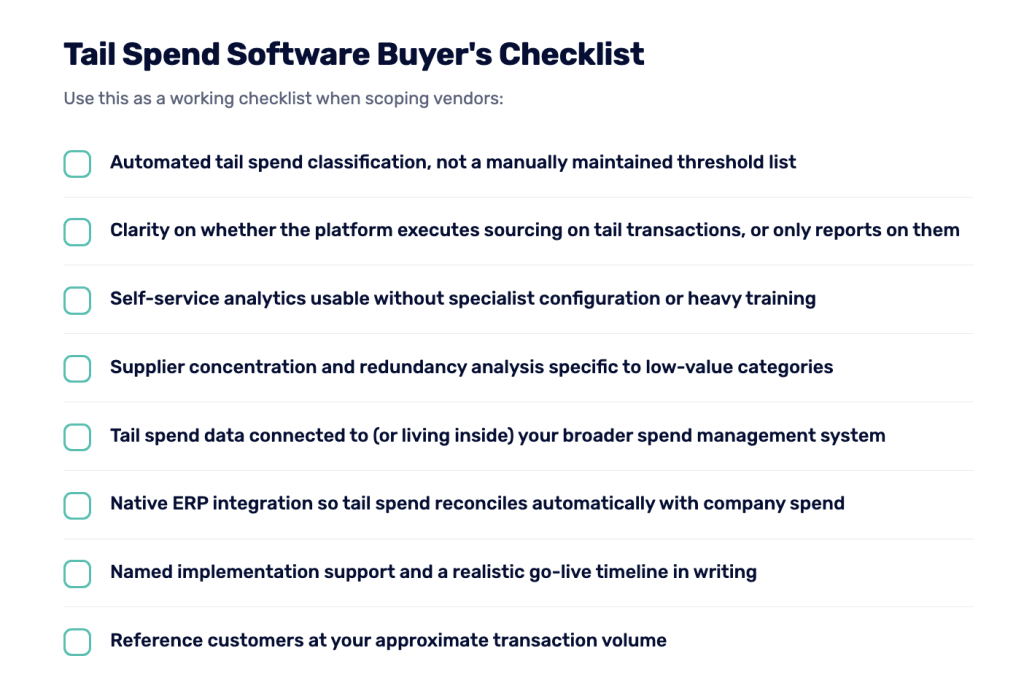
How to choose the right platform

Decide whether you need visibility or execution

Test self-service usability directly

Confirm data connects to your broader spend picture

Weigh a dedicated specialist against a unified platform based on your actual constraint
Sources and methodology transparency
Competitor data in this article is drawn from verified reviews on G2, Capterra, and Gartner Peer Insights (2023–2026), public company materials and funding/press coverage for Fairmarkit and Vroozi, and independent tail spend market research. APSentra performance figures are vendor-reported and marked as such throughout.
Editorial policy: Vendors cannot pay for inclusion or ranking in this article. Platforms are included because they meet our evaluation criteria for the tail spend management software category, and every claim about a third-party product is tied to a citable source rather than our own characterization.